Sony Pictures Releasing
Like the post-apocalyptic Britain of the "28 Days Later" franchise, Hollywood has become a wasteland, teeming with the stripped-down, lethally efficient shells of once-vital creations. Nostalgia-driven reboots swarm the multiplex, satisfying audience cravings for familiarity and studio appetites for certainty — even as they leave the surrounding creative landscape increasingly barren.
This year's "28 Years Later" could just as easily have been another of these living-dead productions. While previous installment "28 Weeks Later" (2007) — made with nominal participation from the original creative team — delivered competent scares, it hardly cried out for a follow-up.
The movie is littered with British cultural references — decontextualized and repurposed by survivors struggling to find meaning in a world they no longer understand.
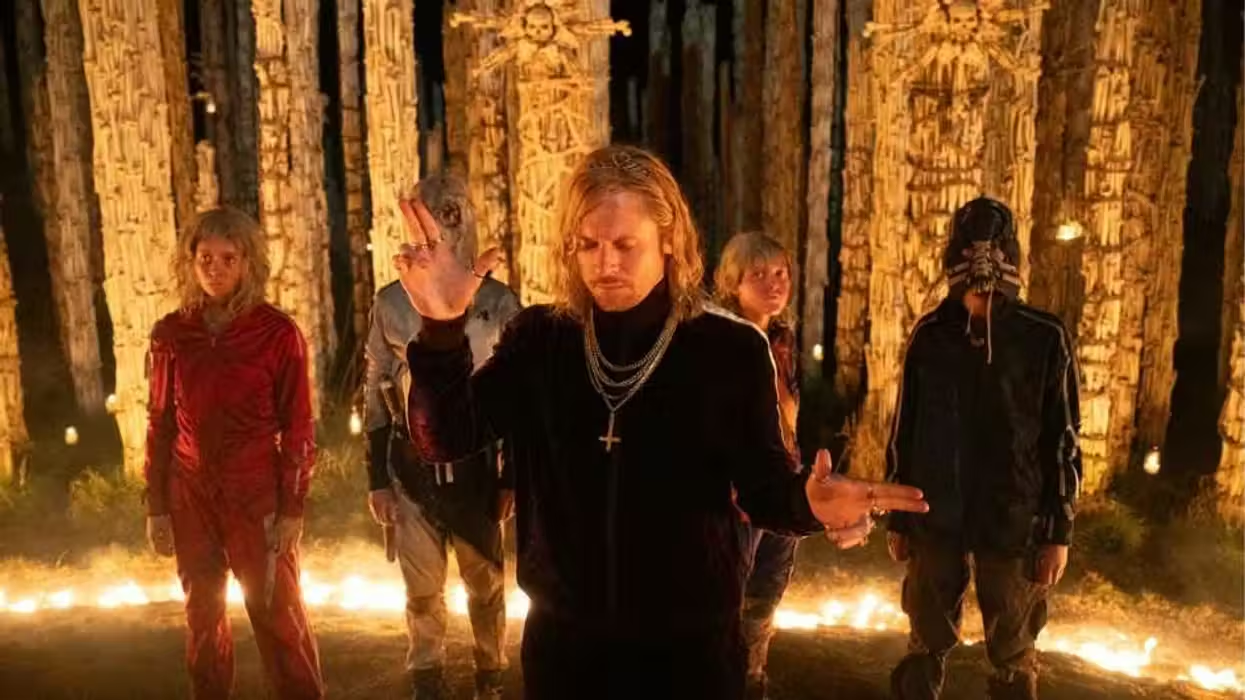
But the return of director Danny Boyle and writer Alex Garland proved worth the wait. "28 Years Later" demonstrated that this universe could still surprise, ending with a tantalizingly bizarre coda in which our hero Spike is rescued by Sir Lord Jimmy Crystal (Jack O’Connell) and his blonde-wigged, track-suited minions. Clearly the infected are not the only menace stalking the British countryside.
"28 Years Later: The Bone Temple" picks up right after this moment, confirming our suspicions that Spike's troubles have just begun. After a gruesome kind of initiation, Spike is forcibly enlisted as one the "Jimmys," who turn out to be a gang of satanic killers. Led by Jimmy Crystal, who believes himself to be the son of "Old Nick," they prowl the land inflicting gruesome ritualized violence — which they call "charity" — on those unfortunate enough to meet them.
While Garland returns as screenwriter, Boyle (who stays on as producer) cedes the director’s chair to Nia DaCosta, whose striking use of lingering close-ups and tightly framed compositions inject the film with a raw, anarchic energy. The result is a legacy sequel that both pays homage to its origins and reimagines them — one that weaves graphic violence together with incisive observations on culture, faith, and survival in a world irreversibly altered by catastrophe.
Many of those observations come straight from the kindly and philosophical Dr. Ian Kelson (Ralph Fiennes), an eccentric recluse who provided shelter for runaway Spike and his dying mother in "28 Years Later." In this grisly sequel, the iodine-covered, blowdart-wielding former physician is searching for a cure to the rage virus, using an infected “alpha” zombie — whom he names Samson — as his pet project.
He also continues work on the titular bone temple, a memorial to the outbreak’s victims, until his optimism and ingenuity is tested by the new and horrifying human adversary we met in the beginning.
While Boyle’s 2002 film focused on urban chaos, this installment widens its lens, exploring the virus’ impact across the countryside while delving into deeper philosophical terrain. Beneath the skin-flaying, stabbings, "Mortal Kombat"-style spine removals, and Iron Maiden needle drops lies a poignant meditation on a once-beautiful country sliding into social and spiritual decay.
DaCosta, an American director, deftly preserves the distinctly English identity of the original films. The movie is littered with British cultural references — decontextualized and repurposed by survivors struggling to find meaning in a world they no longer understand.
The Jimmys, with their blonde wigs, tracksuits, and gold jewelry, are intentionally modeled after Jimmy Savile, one of Britain’s most notorious sex offenders. In this universe — where society collapsed in 2002, years before Savile’s real-world crimes were exposed — the cult reveres him as a benevolent, almost mythical figure. Their so-called acts of "charity" grotesquely invert Savile’s public image of philanthropy, turning it into a rationale for cruelty and sadism.
The dynamic between Sir Jimmy and Kelson is magnetic. O’Connell and Fiennes deliver outstanding performances, moving seamlessly between surrealism and melancholy. Some of the film’s most compelling moments occur when these two simply share the screen in conversation.
Sir Jimmy and Kelson represent competing philosophies of survival. In desperate times, humanity creates belief systems — sometimes as tools of power, sometimes as mechanisms of self-preservation. Through these two figures, Garland weaves a thoughtful exploration of evil, faith, and meaning.
RELATED: '28 Years Later': Brutal, bewildering, and unabashedly British
 Tim P. Whitby/Getty Images
Religious symbolism runs throughout the film. The Jimmys repurpose Savile’s catchphrase “Howzat!” as a ritual chant — stripped of its original meaning and reconstituted as a signifier of violence. Kelson, meanwhile, assumes the role of a secular creator. His humanist liturgy centers on music and literature, which function as sacred texts connecting him to the past and preserving his sanity.
Samson’s transformation becomes an allegory for rebirth: emerging from the hell of infection into renewal. Where the biblical Adam becomes aware of his nakedness after eating from the tree of knowledge, Samson’s recovery inspires modesty as he clothes himself with memories of his return. It is the Fall in reverse — self-awareness as ascension, rebirth without grace.
"The Bone Temple" manages to inject genuine life into a franchise nearly 25 years old. I may regret saying this, but I am genuinely curious to see where the story goes next — especially with Boyle returning to direct the third and final installment. The film’s closing scene teases the return of a familiar face, and John Murphy’s fuzzed-out guitar theme suggests that hope remains, for both the survivors and the fans.


