Sydney Morning Herald/Antonio Ribiero | Getty Images
Opposing the abortions he used to perform gave him purpose; forgiveness was another matter entirely.
Bernard Nathanson died nearly 15 years ago. His story matters now more than ever. Not because he was famous, though he was. Not because he was influential, though few Americans shaped the culture more profoundly. His story matters because it proves that no one is beyond redemption — and that truth has a way of breaking through, no matter how determined we are to suppress it.
Nathanson was born in New York to Jewish parents. He became an obstetrician and gynecologist like his father. But unlike his father, he devoted his career to ending pregnancies rather than delivering babies. At one point, he directed the Center for Reproductive and Sexual Health, then the largest abortion facility in the world. He later claimed responsibility for more than 75,000 abortions. Among them was his own child.
Our age desperately needs this kind of conversion — the courage to admit complicity and the humility to seek forgiveness.
He wasn’t merely performing abortions. In many ways, he helped build the movement that made them legal. Nathanson was among the central activists whose efforts culminated in Roe v. Wade. Today, nearly 30% of American pregnancies are unintended; about 40% of those end in abortion — roughly 1,500 to 2,500 each day, between 550,000 and 910,000 annually. Those numbers cast a long shadow over Nathanson’s legacy.
By his own account, he was an atheist. He married four times. He lived without God and, for a time, without guilt.
Then came the ultrasound.
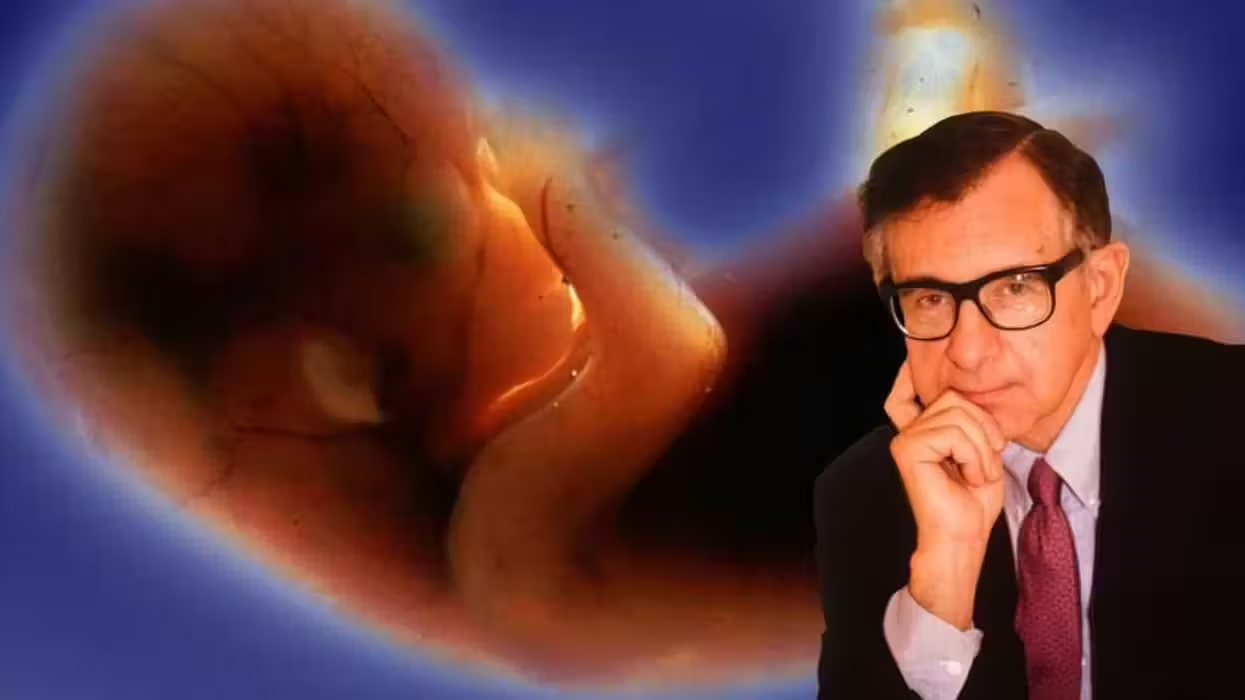
In the 1970s, advances in medical imaging made it possible to view the womb in real time. For the first time, doctors could watch a living fetus during an abortion procedure. Nathanson asked a colleague who performed 15 to 20 abortions daily to record one on ultrasound. What they saw unsettled him permanently.
“Ultrasound opened up a new world,” Nathanson later wrote. “For the first time I could really see the human fetus, measure it, observe it, watch it, and indeed bond with it and love it.”
This was his first conversion — not religious, but moral. Fetal development was no longer a medical abstraction. It was human life unfolding along a continuous path. To interrupt that life became, in his words, intolerable.
He went farther. He called abortion a crime. He did not exempt himself. He knew he had not been a bystander but a central participant. The reckoning was unavoidable.
In 1984, he directed "The Silent Scream," a film featuring ultrasound footage of an abortion in progress. It removed abstraction. What had been hidden behind euphemism became visible. The film galvanized pro-life movements worldwide because it forced viewers to see what had long been described away.
Nathanson became the abortion movement’s most formidable opponent precisely because he had once been its architect. He understood its language and its strategy. He knew how clinical terms soften moral reality. As he later admitted, statistics had been inflated and rhetoric sharpened to sway public opinion. He had helped construct the narrative.
Yet moral clarity did not bring him peace. The weight of 75,000 deaths — including his own child’s — pressed on his conscience. Ethical reversal is not the same as absolution.
Through conversations with Father John McCloskey, an Opus Dei priest, Nathanson began his second conversion. This one was spiritual. In December 1996, Cardinal John O’Connor baptized him in a private Mass at St. Patrick’s Cathedral. He received confirmation and first communion that same day.
When asked why he chose Catholicism, his answer was simple: “No religion matches the special role for forgiveness that is afforded by the Catholic Church.”
That sentence reveals what ideology never could: Guilt demands more than argument. It demands mercy.
Father Gerald Murray, who preached at Nathanson’s funeral, compared him to Whittaker Chambers, the former Soviet spy who renounced communism and testified against it at immense personal cost. The comparison was deliberate. Both men had served destructive causes with conviction. Both knew their systems from the inside. And both chose to speak because silence was no longer possible.
Neither escaped consequences. Yet each chose truth over self-preservation.
Some readers will struggle to forgive what Nathanson did. The harm was real. It cannot be undone. But what he chose once he could no longer deny the truth also matters. The screams he confronted were silent, visible only through ultrasound. Once seen, they could not be unseen.
Our age desperately needs this kind of conversion — the courage to admit complicity and the humility to seek forgiveness. Wrongdoing is softened by clinical language. Responsibility is buried beneath justification. Technology makes victims invisible.
Nathanson’s life reminds us that seeing clearly carries a cost — but refusing to see carries a greater one.
He spent half his life destroying life and the other half defending it. Many spend their entire lives destroying life and never confront it.

John Mac Ghlionn
Contributor