Fabrice Coffrini/Getty Images
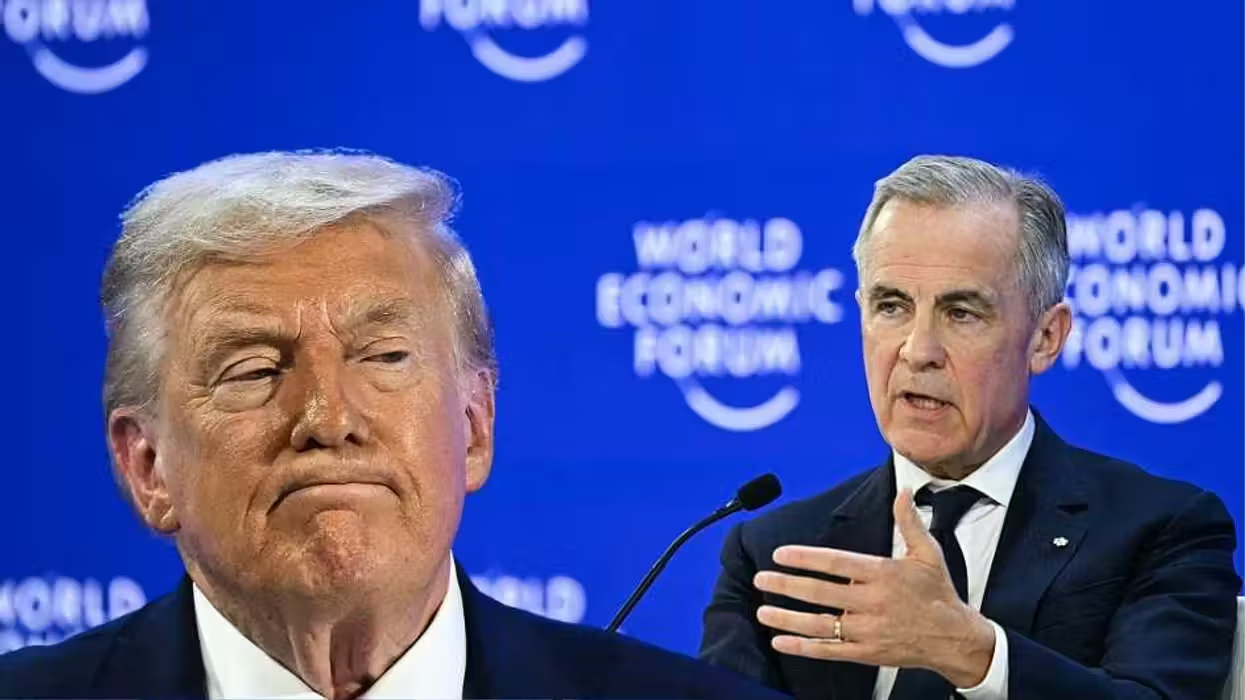
The World Economic Forum’s annual meeting in Davos offered a picture-perfect illustration of the clash between globalism and America First.
Canadian Prime Minister Mark Carney — a longtime advocate of globalist policies, whether as governor of the Bank of England or as a United Nations goodwill ambassador for climate change — delivered a speech that electrified woke forces around the world.
'Canada lives because of the United States. Remember that, Mark, the next time you make your statements.'
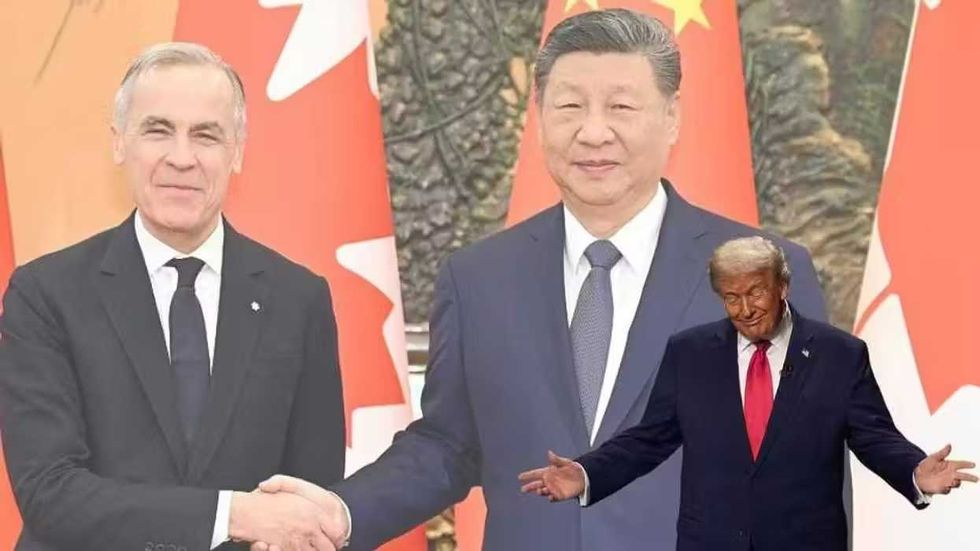
Yet while Carney proclaimed a kind of independence from U.S. economic and military hegemony, many seemed to forget that he had just signed a trade deal with China — against the backdrop of his declaration that Canada was joining Beijing’s “new world order.”
Carney’s address waved a red flag at the United States and President Donald Trump, though he lacked the courage to name either directly. Instead, he spoke of America in the past tense, obliquely warning that the “rules-based international order,” under which “countries like Canada prospered,” was finished.
“We joined its institutions. We praised its principles. We benefited from its predictability,” Carney said.
And because of that, we could pursue values-based foreign policies under its protection.
We knew the story of the international rules-based order was partially false — that the strongest would exempt themselves when convenient, that trade rules were enforced asymmetrically. And we knew that international law applied with varying rigor depending on the identity of the accused or the victim. This fiction was useful, and American hegemony in particular helped provide public goods: open sea lanes, a stable financial system, collective security, and support for frameworks for resolving disputes.
Then came the line that sent globalist acolytes into rapture.
“This bargain no longer works. Let me be direct. We are in the midst of a rupture, not a transition.”
But isn’t Carney himself the author — and perhaps the finisher — of that rupture? For years, he has worked against the natural alliance between Canada and its largest trading partner and closest military ally. As we have pointed out before, Carney has labored to replace the United States with China as the world’s economic engine.
RELATED: Trump not worried about Canada's China-centric 'new world order'
 Brad Smith/ISI Photos/Xinhua News Agency/Getty Images
Trump was listening — or at least was promptly briefed. During his own address to Davos, the president castigated both Carney and Canada for taking America for granted. Referring to the development of the Golden Dome defense system, Trump noted that it would, “by its very nature,” defend Canada as well.
“Canada gets a lot of freebies from us, by the way,” Trump said. “They should be grateful also, but they’re not. I watched your prime minister yesterday. He wasn’t so grateful.
"Canada lives because of the United States. Remember that, Mark, before you make your statements.”
By Friday morning, Trump had gone farther, withdrawing Carney's invitation to join his proposed “Board of Peace.”
Trump spent much of his Davos remarks ridiculing the globalist “Green New Scam” and questioning why the United States continues to belong to NATO when it derives so little benefit from the arrangement.
But his most biting remarks were reserved for the fantasy that green energy can power a modern economy.
China, Trump noted, makes “a fortune selling the windmills.”
“They’re shocked that people continue to buy those damn things,” he continued. “They kill the birds. They ruin your landscapes. Other than that, I think they’re fabulous, by the way. Stupid people buy them."
Trump’s rejection of globalist orthodoxy was reinforced by Commerce Secretary Howard Lutnick.
“Globalization has failed the West and the United States of America,” Lutnick said. “It’s a failed policy. It is what the WEF has stood for, which is export, offshore, far-shore, find the cheapest labor in the world. ... In reality, it has left America behind. It has left the American workers behind.”
“America First,” he continued, “is a different model — one that we encourage other countries to consider, which is that our workers come first. ... Sovereignty is your borders. You’re entitled to have borders.”
All of this carries enormous implications for any renegotiation of the U.S.-Mexico-Canada agreement.
And Carney appears to have been left with no cards to play. China has already seen his hand.