LightFieldStudios/iStock/Getty Images Plus
From Michigan to Melbourne, exorcisms are rising — an odd trend in an age when Christianity is supposedly retreating.
Odd, that is, if you accept the official story: that faith has faded, churches have emptied, and modern life has supposedly outgrown such concerns. Yet behind parish doors and rectory walls, priests report the opposite: more calls, cases, and urgency.
Evil persists not because it is misunderstood, but because it is minimized.
The demonic, it seems, didn’t get the secular memo.
I began making inquiries recently, speaking with clergy who have dealt with what most people would rather joke about, pathologize, or turn into content. One name surfaced repeatedly: Fr. Michael Shadbolt, a veteran priest who had performed numerous exorcisms and spoke of them with measured calm. I reached out to him for insight. Instead, I received word that he had recently passed away.
Thankfully, there was another source, carrying decades of experience where spiritual and psychological care meet. Fr. Stephen Rossetti, an American Catholic priest and seasoned exorcist, spoke without qualification.
“Yes, requests for exorcisms are on the rise in the U.S. and in other countries as well,” he told me. “There may be many reasons for this, but one obvious one is the decline of the practice of the faith.”
That observation runs counter to the fashionable narrative. The usual explanation for the rise in exorcisms is framed as a paradox: Christianity declines, so belief in demons increases.
But that framing flatters modern assumptions. It treats belief as an all-or-nothing package. Either accept the creed or discard the lot. But human experience has never worked that way.
One doesn’t need to believe in God to believe in evil — it’s everywhere. A loved one consumed by addiction. The husband who revels in beating his wife. The wife who revels in beating her husband. The son who turns on parents with lethal force.
RELATED: Interview with an exorcist: 'God always takes the first step'
 D-Keine/Getty Images
Evil doesn’t depend on belief to function. It advances through repetition, fixation, and the gradual loss of restraint. The language shifts with each generation, but the pattern remains. Every day, roughly 137 women and girls are killed worldwide in acts of femicide. Child sacrifice, usually relegated to ancient Peru or remote civilizations, still occurs in parts of Africa today. In the U.S., one in four girls and one in six boys will be sexually abused before the age of 18.
No vocabulary of Pinkertonian progress dissolves these facts. Calling evil “trauma” or “dysfunction” may describe the damage left behind, but it doesn’t confront the force itself. Such language manages outcomes while leaving causes untouched.
The modern world prefers to believe that evil is a misunderstanding, a system failure, or a lack of education. History suggests otherwise. Evil persists not because it is misunderstood, but because it is minimized. It thrives where it is renamed, rationalized, or treated as an embarrassing superstition.
Fr. Rossetti put it plainly, “Increasingly people are not protected by faith, and many are involved in occult practices, which are a clear opening to the demonic.”
That point is crucial. Militant atheism is seldom the starting point. The entry point is engagement with practices the Church has long warned against.
“We have a number of cases of people who drifted away from the faith and then got into the occult,” Rossetti explained. “After a few years, they found themselves afflicted by evil spirits.”
The remedy is clear. “The first thing we do is have them go to confession, start practicing the faith, and live a virtuous life,” he said. “All sin is an opening to evil in some way, and the worse the sins, the greater the opening.”
It is precisely for this reason, Rossetti continued, “that exorcisms are very effective.” However, he stressed, there’s no wand, no instant result. “Sometimes the process takes time. It is typically not one and done,” Rossetti said. After years of spell-casting, curse-making, and demon worship — often misidentified as “self-discovery” or “ancient wisdom” — it can take far longer to undo the damage.
He was explicit about the timeline. “It typically takes three to five years of exorcisms to liberate the person.” The process, he added, is one of conversion and purification.
“An exorcism is not magic,” he said.
The hierarchy is clear and always has been: Christ reigns, angels serve, demons defy — and ultimately lose.
What we are witnessing, then, is not the complete disappearance of belief but its fragmentation. Christianity retreats institutionally while belief itself goes feral. Old anchors are cut loose. New fixations rush in. The vacuum does not remain empty.
Look around. Astrology, once harmless nonsense, has become a personal operating system. It graduated from brainless fun to life-management software, complete with a $3 billion price tag. Tarot cards are sold as “self-care.” Witchcraft is rebranded as empowerment, paganism as wellness. Social media is saturated with spiritual freelancers promising protection, manifestation, and power — usually bundled with a payment link.
None of this is neutral, and none of it is consequence-free. Doors opened casually tend to stay open.
This is where the supposed paradox dissolves. Christianity isn’t retreating because belief vanished, but because belief lost its footing. Structure recedes, so superstition rises. When doctrine disappears, disorder follows. There is no neutrality — only exposure.
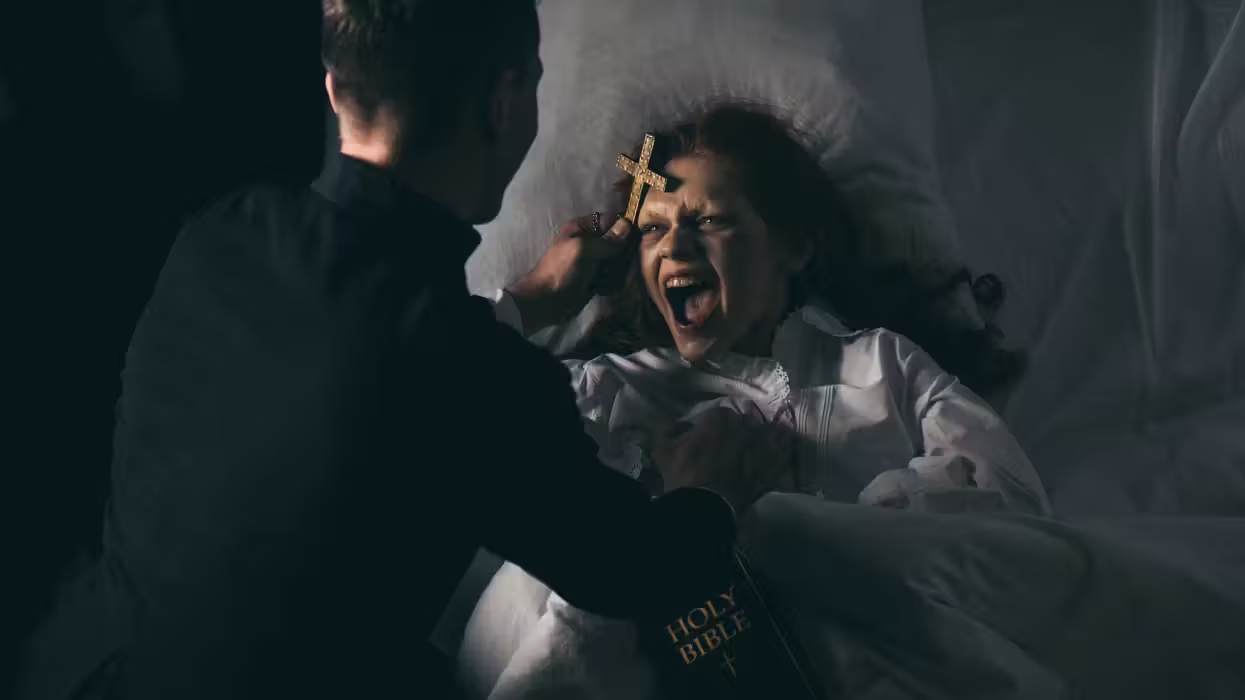
For those skeptical because of Hollywood portrayals, exorcism is not a medieval curiosity revived for effect, but a practical response to persistent realities. The Church isn’t inventing demons to stay relevant. Rather, it is reacting to what it actually sees — a culture defined by isolation, instability, and constant immersion in content that destroys self-control and sanity.
Fr. Rossetti was clear on the final point, one that many increasingly resist.
“It is critical to understand that Jesus is Lord and not Satan,” he said. “The big mistake people make today is thinking that Satan is so very powerful. He is not.”
Compared to Christ, “Satan is dust.” He has no authority unless it is surrendered.
Christian theology has never been ambiguous on this point. Satan is not a rival god, not an equal force locked in cosmic balance. He is a created being who rebelled, fell, and was expelled. His power is parasitic rather than inherent. He doesn’t rule a kingdom by right, but lurks in territory abandoned through disobedience and pride.
The hierarchy is clear and always has been: Christ reigns, angels serve, demons defy — and ultimately lose.
That, it seems, is the warning embedded in the rise of exorcisms. Not that evil has grown stronger, but that we have grown careless. We treated the spiritual realm as a curiosity, then a hobby, then a marketplace — and acted surprised when something followed us home.
Fr. Rossetti put it without hesitation: “Jesus is Lord and has smashed Satan’s kingdom.” The tragedy is that many live as though He hasn’t.