Anadolu/Getty Images
Buckle up, America — because if you’re driving anywhere in this country, you’re already under surveillance.
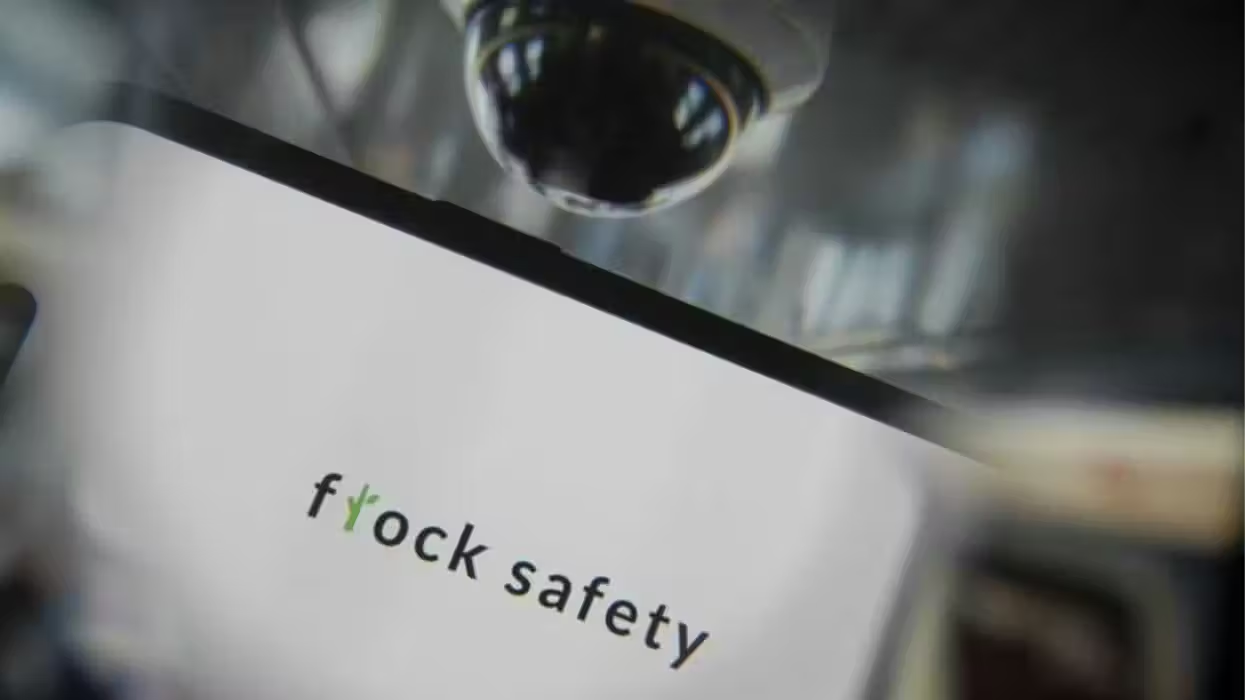
I’m not talking about speed traps or red-light cameras. I’m talking about Flock Safety cameras, those sleek, solar-powered, AI-driven spies perched on poles in your neighborhood, outside your kid’s school, at the grocery store, and along every major road.
The Institute for Justice has filed a federal lawsuit arguing that Flock effectively builds detailed, warrantless movement profiles of ordinary people.
These cameras are not just reading your license plate. They’re building a digital DNA profile of your vehicle — make, model, color, dents, bumper stickers, roof racks, even temporary tags — and logging where you’ve been, when, and with whom you’ve traveled.
And guess who has 24/7 access? Your local police, HOAs, apartment complexes, and private businesses — all without a warrant, without your consent, and often without you even knowing they exist.
I’ve been warning drivers for decades about government overreach, from cashless tolls to black-box data recorders. But Flock Safety? This is next-level.
Founded in 2017 in Atlanta, Flock has exploded into a $3.5 billion surveillance empire with over 900 employees and a single goal: blanket every city in America with cameras. As of 2024, it has already deployed 40,000 to 60,000 units across 42 states in more than 5,000 communities. That’s not a pilot program. That’s a national tracking grid.
Here’s how it works — and why it should terrify every freedom-loving American.
Flock’s Falcon and Sparrow cameras don’t enforce speed or traffic laws. They’re pure surveillance tools.
Mounted on utility poles, traffic signals, or private property, they use automated license plate recognition (ALPR) and Vehicle Fingerprint™ technology to capture high-resolution images of your vehicle’s rear, including the license plate with state, number, and expiration, plus the make, model, year, color, and unique identifiers like dents, decals, roof racks, spare tires, even paper plates. They record the time, date, and GPS location, using infrared imaging for 24/7 operation, even at 100 mph from 75 feet away.
The data is uploaded instantly via cellular networks to Flock’s cloud servers, stored for 30 days, and accessible through a web portal by any approved user. That includes police departments across state lines through Flock’s TALON investigative platform. Drive from Georgia to New York, and every Flock camera you pass logs your journey. No warrant needed in most states.
RELATED: Why states are quietly moving to restrict how much you drive
 F8 Imaging/Getty Images
The scale is staggering. Milwaukee has 219 cameras with 100 more planned. Riverside County, California, uses 309 cameras to scan 27.5 million vehicles monthly. Norfolk, Virginia, has over 170 units. Raleigh, North Carolina, has 25 and counting.
Nationwide, Flock claims it logs over one billion vehicle scans per month. These cameras cost $2,500 per year per unit, are solar-powered with no wiring required, and can be installed in hours. HOAs love them, schools want them, police can’t get enough, and new units go up daily, often without public notice or approval.
Flock CEO Garrett Langley loves to brag about Flock's crime-stopping potential. But what he doesn't mention is that you’re tracked whether you’re a criminal or not.
There’s no true opt-out for the public — every passing car is still scanned and logged — but some neighborhoods and agencies use Flock's SafeList feature to avoid nuisance alerts. SafeList doesn’t exempt anyone from being recorded. It simply tells the system not to flag certain familiar plates (residents, staff, permitted vehicles) as suspicious. The camera still captures the vehicle, stores the image, and makes it searchable; it just won’t trigger an alert for those approved plates.
Flock cameras can photograph more than a license plate — sometimes the interior of a car, passengers, or bumper stickers — but this varies by angle and lighting, and the system is not designed to gather facial images.
This is a privacy nightmare. The ACLU and Electronic Frontier Foundation call it mass surveillance. A small-town cop in Ohio can search your plate and see everywhere you’ve driven in Florida. Rogue officers have abused ALPR before, stalking exes, journalists, activists. Data breaches? Flock says its cloud is secure, but we’ve heard that before.
A 2024 Norfolk, Virginia, ruling initially held that Flock’s system amounted to a Fourth Amendment search requiring a warrant. But that decision was later reversed on appeal. Meanwhile, the Institute for Justice has filed a federal lawsuit arguing that Flock effectively builds detailed, warrantless movement profiles of ordinary people. If that case succeeds, it would be a true game-changer.
Yes, finding a kidnapped child or stolen car is good. But at what cost? This creates a chilling effect: Will you avoid a protest, a church, a gun shop, a clinic, knowing you’re being logged? This isn’t safety. This is control.
So what can you do right now? Start by finding the cameras — contact your police, city council, or HOA and ask where the Flock cameras are and who has access.
Demand transparency: Push for public hearings, warrant requirements, data deletion after 24 hours, and no sharing outside your jurisdiction. Support the fighters like the ACLU, EFF, and Institute for Justice. Spot the cameras yourself — look for black poles with tilted solar panels and a small camera box.
It's time to post your opinions on X, call your reps, show up at meetings — let's stop the surveillance.
Flock’s CEO dreams of a camera in every U.S. city. But liberty isn’t free, and it shouldn’t come with a tracking device.
Drop your thoughts below — I read every comment. Share this information with every driver you know. Because if we don’t fight now, soon there’ll be nowhere left to hide.