© 2026 Blaze Media LLC. All rights reserved.
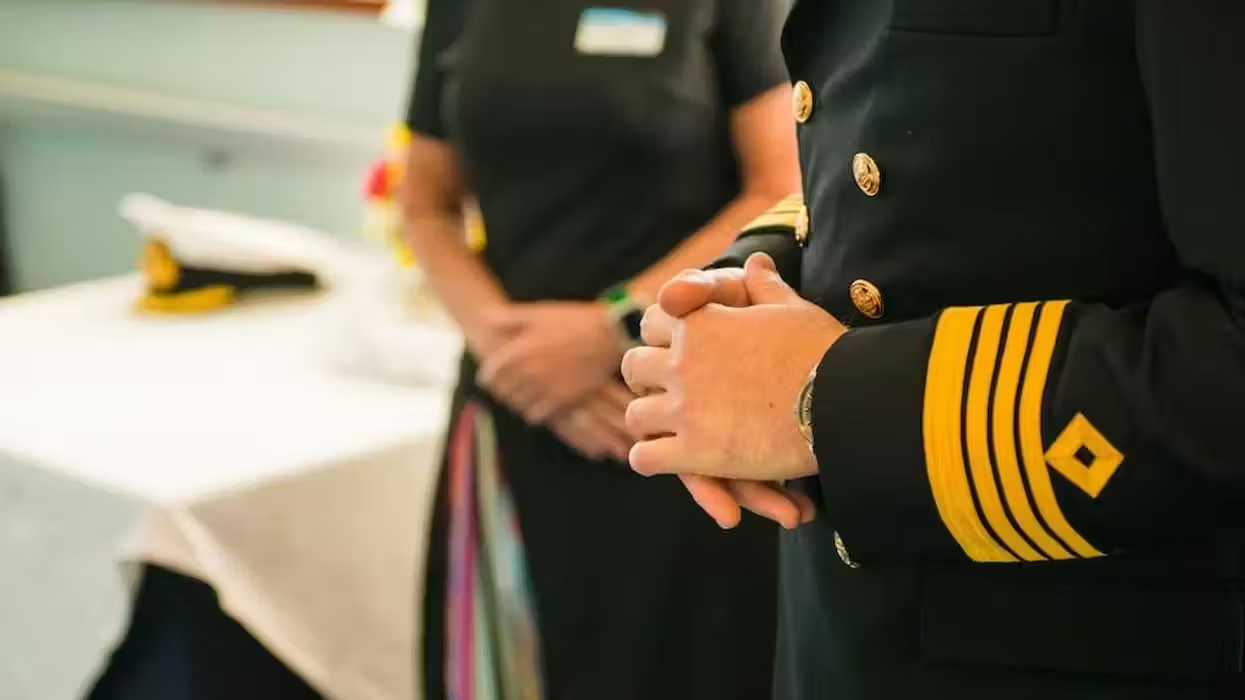
As a Navy chaplain, he carried the news no family wants to hear and taught me that some memorials live in wounds, not monuments.
As a boy in the early 1970s, I remember my father serving as a U.S. Navy Reserve chaplain in Atlanta. One of his duties was casualty notification, informing families that their loved one had been killed in military service, usually the Marines.
In winter, he wore his Navy service dress blues while accompanying other officers into some of Atlanta’s poorest neighborhoods and housing projects. There were no cell phones, GPS systems, or easy ways to locate families quickly. The notifications were time-sensitive, and strangers in uniform were often met cautiously in neighborhoods already carrying more than their share of hardship. Some families hid at first because they thought the men approaching their doors were police officers.
This Memorial Day, a nation pauses to remember the Americans who never took off the uniform.
But my father carried a different burden: the worst message a family could hear.
In addition to preaching from a pulpit, he ministered on doorsteps.
He served for many years, eventually retiring with the rank of captain. But long before that, I watched him carry one of the hardest duties a chaplain could bear.
Memorial Day means more to me because of that.
Not all memorials are granite.
Some are folded into flags handed to trembling families. Others hang quietly in framed photographs or rest beneath white crosses overlooking distant oceans. And some are so small that readers almost miss them in Scripture.
One appears in the genealogy of Jesus Christ. Under the superintendence of the Holy Spirit, Matthew records the lineage of Jesus carefully: Abraham, Isaac, Jacob, David, Solomon.
But when he arrives at Solomon, Matthew writes something unusual: “David was the father of Solomon by the wife of Uriah” (Matthew 1:6).
Bathsheba’s name is not mentioned. Her husband’s is.
Uriah the Hittite.
King David committed adultery with Bathsheba and arranged for Uriah to die in battle. Scripture does not sanitize David’s sin: “The thing that David had done displeased the Lord” (2 Samuel 11:27).
David repented. God forgave him. But the consequences remained.
Still, God preserved the name David tried to bury.
Every Memorial Day, I think about that.
Uriah has now been remembered for nearly 3,000 years, not because kings honored him properly. His own king had him killed. But God refused to let him disappear.
And Uriah was not even an Israelite by birth. He was a Hittite. Yet he served honorably even when his king acted dishonorably toward him.
Memorial Day reminds us that service is vital.
As America approaches 250 years as a nation, countless men and women have worn its uniform unto death. Some died heroically in combat. Others died through confusion, incompetence, training accidents, or the failures of leaders far from the battlefield.
War has always mixed courage with tragedy, honor with human failure. But generation after generation, Americans still stepped forward, willing to bear costs most citizens pray they never personally face.
Many of those never came home alive.
My own sons are now about the age my father was when he knocked on those doors in a Navy uniform, carrying news no family ever wants to hear.
Looking at my sons, I cannot imagine them carrying that burden repeatedly.
Yet those moments marked my father for the rest of his ministry. His faith was forged in living rooms where stunned families learned someone they loved was not coming home.
He carried both the duty of the nation and the ministry of the church into rooms shattered by grief.
His grave marker bears both his rank and his calling, a reminder that he stood beside grieving families in their darkest hours.
So this Memorial Day, a nation pauses to remember the Americans who never took off the uniform.
But in that pause, if you served beside a military chaplain, remember them as well.
Many spent their ministries carrying unbearable news to frightened families, fighting back tears while praying for those who could not, burying the dead, and offering words no one who hears them ever forgets:
“On behalf of a grateful nation ...”
History forgets names. Monuments weather. Politicians fail. But God does not forget.
In the genealogy of Christ, God preserved the name of a faithful soldier. No service and no sacrifice poured out in duty escapes the sight of God.
Not all memorials are granite. Some are written where time cannot erase them.
Want to leave a tip?
We answer to you. Help keep our content free of advertisers and big tech censorship by leaving a tip today.
<a href="https://peterrosenberger.com/">Peter Rosenberger</a> hosts the nationally syndicated radio program “Hope for the Caregiver.” He is the author of <a href="https://www.amazon.com/Minute-Caregivers-Everyday-Feels-Monday/dp/1956454306/">“A Minute for Caregivers: When Every Day Feels Like Monday”</a> and <a href="https://www.amazon.com/Caregivers-Companion-Scripture-Hard-Won-Toughest/dp/B0DTYGL2BD/">A Caregiver's Companion: Scriptures, Hymns, and Forty Years of Insights for Life's Toughest Role</a>.
hope4caregiver
Peter Rosenberger
Peter Rosenberger hosts the nationally syndicated radio program “Hope for the Caregiver.” He is the author of “A Minute for Caregivers: When Every Day Feels Like Monday” and A Caregiver's Companion: Scriptures, Hymns, and Forty Years of Insights for Life's Toughest Role.
@hope4caregiver →
more stories


Sign up for the Blaze newsletter
By signing up, you agree to our Privacy Policy and Terms of Use, and agree to receive content that may sometimes include advertisements. You may opt out at any time.
Related Content


© 2026 Blaze Media LLC. All rights reserved.
Get the stories that matter most delivered directly to your inbox.
By signing up, you agree to our Privacy Policy and Terms of Use, and agree to receive content that may sometimes include advertisements. You may opt out at any time.