A Washington Post writer recently argued that liberals should renege on freedom of speech to shut down the right wing. (Chip Somodevilla/Getty Images)
The progressive view of the First Amendment’s guarantee of free speech was explained in a column in the Washington Post on Tuesday, where a liberal said that free speech that doesn’t align with progressivism is a “political weapon."
Jennifer Delton, a professor at Skidmore College in Upstate New York, wrote the op-ed.
Delton explained in her column that "maybe liberals shouldn't be free-speech absolutists after all."
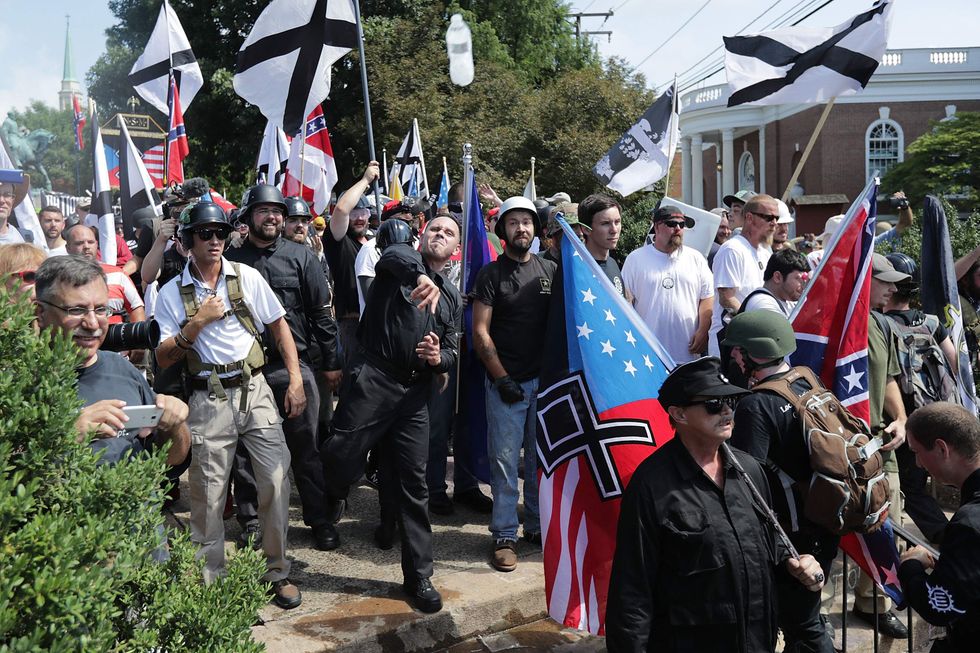
The crux of the column centered on the violent clashes free-speech advocates and far-left activists have had on college campuses nationwide over the last several years. Delton wrote that "the alt-right and conservatives are using 'free speech' to attack and destroy colleges and universities."
That forces "college presidents try to figure out whether the First Amendment protects conservatives’ right to create political spectacle and instigate violence," she alleged.
To combat the "political foe" — conservatives who advocate for free speech — Delton called on her readers to remember "the 1940s, when New Deal liberals purged U.S. communists from American political life." The communists of that time hid behind the guise of the First Amendment right of free speech to try and undermine Western democracy, which is why the Democrats at that time had to waiver on the First Amendment, she explained.
Given the threat conservatives allegedly pose when advocating for free speech, Delton went on to suggest that the philosophy from the 1940s and 1950s on when to waiver on all free speech needs to be revisited.
She listed several reasons why:
She went on to bring her column full circle: "[I]t is clear that western liberalism, as well as left-liberalism in the United States, is under attack from people who see the First Amendment as a political weapon and not a sacred principle."
Given the "attack" that liberalism is under, Delton wrote: "[I]t may be worth remembering that our constitutional rights are not unchanging abstract principles, but, as Hook and Schlesinger argued, always evaluated in terms of their consequences for society at any given historical moment."
Good God. Constitutional rights "are not unchanging abstract principles," but can be infringed based on the "consequences for society." pic.twitter.com/EQLTCX1Bm6
— Alex Griswold (@HashtagGriswold) August 22, 2017
The author literally says that we need to ban and suppress conservatives, but be careful not to suppress liberals who say the same things
— PoliMath (@politicalmath) August 22, 2017
Delton agued a position that we already knew liberals — especially progressives of today — held dear: free speech applies only to them. All one must do to see this is look toward Antifa, a far-left activist group that has gained an immense amount of notoriety since Trump became president.
The group is open about its willingness to use violence to shut down anyone it disagrees with. Yet the group fails to realize its right to exist as a group, which holds (hopefully) fringe views, can be 100 percent attributed to the First Amendment.
Truth is, the First Amendment's guarantee of free speech works only if it is provided to all — everyone or no one, but certainly not: me but not you. A Nazi has as much of a right to speak in the public square as an anarcho-communist. The only way to rid society of fringe views is to rise above them with better ideas. Suppressing a group's right to speak freely hurts all Americans — including the suppressors.