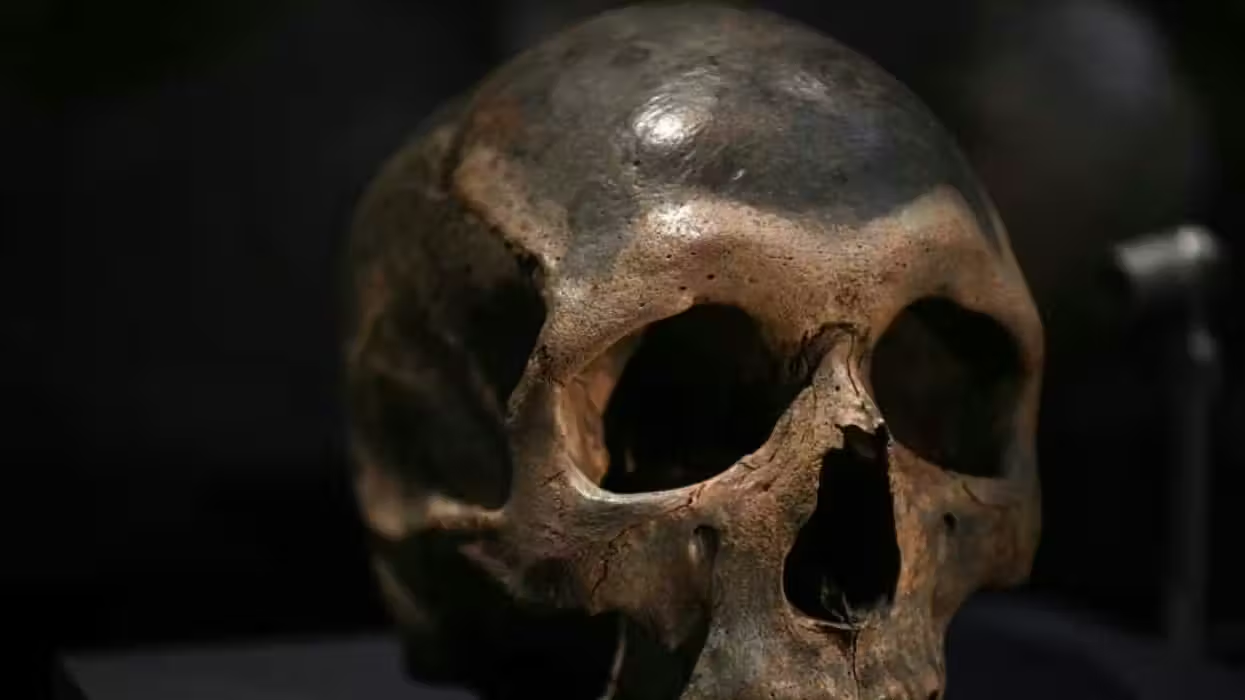
Skull on display at British Museum. Photo by DANIEL LEAL/AFP via Getty Images.
Liberals in the United Kingdom have worked desperately to paint white Britons uniquely as history's villains, erase them from British history, and/or programmatically undermine their unique claims to indigeneity in the isles.
The trouble for the institutional proponents of this vilification and revisionism campaign is that facts keep getting in the way.
Case in point: Recent DNA analysis confirms that the second-century skeleton gleefully identified by the BBC as the "first black Briton" was not a sub-Saharan African but rather a white woman.
'Her story has shifted over time and has sparked important debates about diversity.'
A skeleton was discovered in the 1950s in Beachy Head, England, which belonged to a young woman who lived in the second or third century. Her remains sat in storage for decades until 2012, when Jonathan Seaman, the heritage officer at the Eastbourne Borough council, and his team "came across two boxes, which said ‘Beachy Head, something to do with 1956 or 1959,’ and that was about it."
As there were virtually no records available about the remains, Seaman and his team worked to identify the Roman-era skeleton, sending it off for facial reconstruction, which was undertaken by Caroline Wilkinson, an academic then at Dundee University.
Seaman recalled, "Straight away on seeing this girl, [Wilkinson] said, 'Oh my, you realize you’ve got a sub-Saharan African here?’"
Seaman noted further:
Caroline subsequently had it looked at by two more experts who agreed, without being prompted, that this individual showed many traits of being a sub-Saharan African person. They were 100% sure that this was the origin of this lady. There are certain features of the skull that you can tell are Caucasian or African. We didn’t know her carbon date at that stage or anything about her, so again it just deepened the mystery. They reconstructed her, and as they did so, her African origins came out in the features of her face.
While the media made a big deal out of this supposed discovery, the BBC went further than most, hyping it both in its news coverage and in its 2016 "Black and British: A Forgotten History" documentary.
In the documentary, British-Nigerian host David Olusoga — overcome with delight at the sight of a facial reconstruction of the Beachy Head Woman with dark skin, dark eyes, and dark hair — tells Seaman, "So she's a black Briton? ... So she's the same as me — she's somebody who is both [British and African] but who spent their life in this country."
RELATED: No more stiff upper lip: My fellow Brits are fed up with 'diversity'
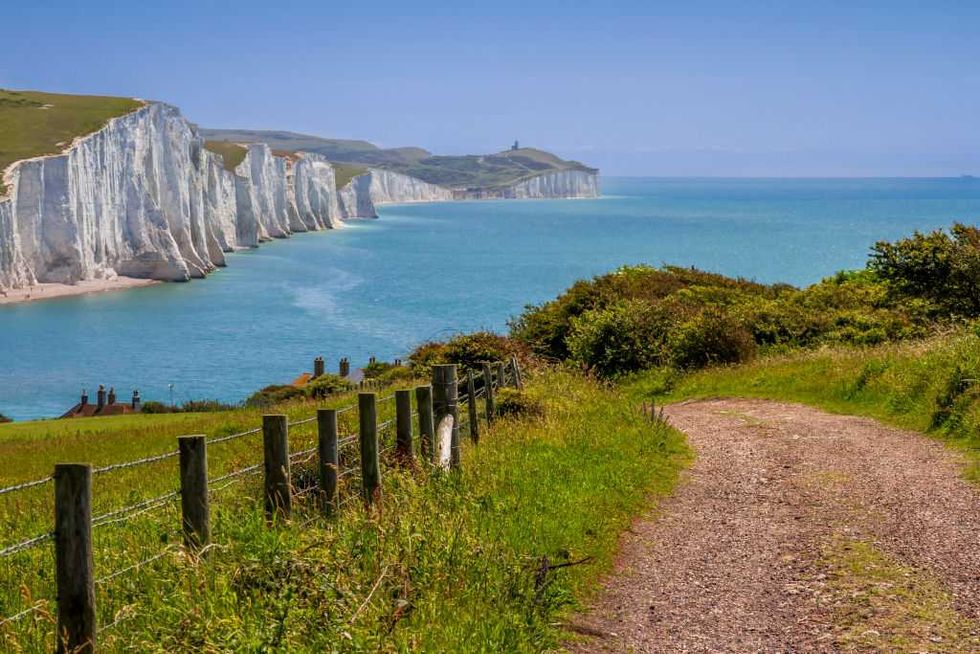 Coastline near Beachy Head. Photo by: Bill Allsopp/Loop Images/Universal Images Group via Getty Images
As part of the documentary series, the BBC installed a plaque where the remains of the Beachy Head Woman were found, stating, "The remains of the 'BEACHY HEAD WOMAN' were found near this site. Of African origin, she lived in East Sussex 2nd-3rd century AD."
The plaque was removed in 2023 after DNA testing by the Crick Institute determined that the Beachy Head Woman's origin was not Africa but possibly Cyprus.
More recently, a research team led by Drs. Selina Brace and William Marsh of London's Natural History Museum and Andy Walton of University College London re-examined the skeleton using state-of-the-art DNA analysis techniques. They determined that the Beachy Head Woman was neither an African nor a Cypriot but a white local from the south coast of England.
According to the researchers' findings, which were published in the Journal of Archaeological Science, "she shows a close affinity to individuals from modern-day England and contemporary Roman-era Iron Age individuals in England and Northern continental Europe."
DNA results indicate that the Beachy Head Woman had blond hair, blue eyes, and "intermediate skin," with paleness weighted as more likely.
The researchers noted that "the decade-long investigation into Beachy Head Woman's origins has centered around how her story has shifted over time and has sparked important debates about diversity and how we portray individuals from our past. The results presented here will no doubt add to this."
Like Blaze News? Bypass the censors, sign up for our newsletters, and get stories like this direct to your inbox. Sign up here!