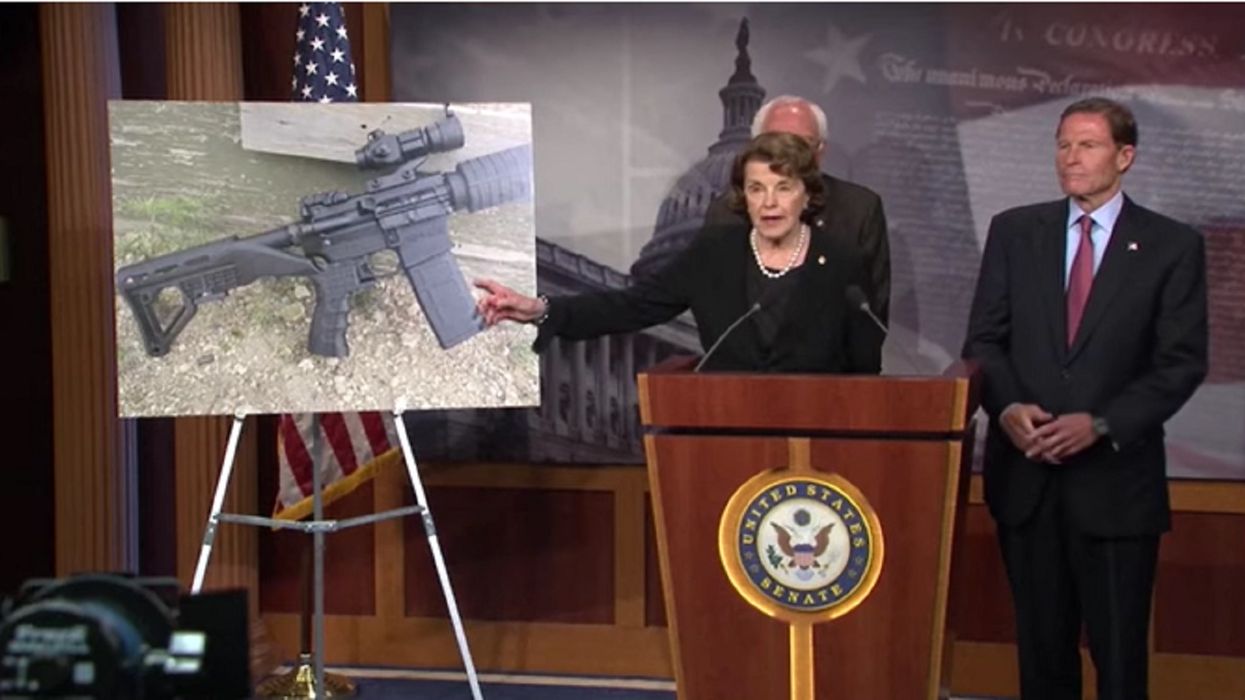
Dozens of senators lined up behind new gun bills this week, and partisan division on the issue couldn't have been more evident.
The Assault Weapons Ban of 2019, introduced by Sens. Dianne Feinstein (D-Calif.), Chris Murphy (D-Conn.) and Richard Blumenthal (D-Conn.) was co-sponsored by another 26 Democrats; while Texas Sens. Ted Cruz and John Cornyn were joined by 29 of their Republican colleagues in rolling out the Constitutional Concealed Carry Reciprocity Act.
What's this about a ban?
While full text of the bill has not yet been revealed, Sen. Feinstein has outlined the key provisions of the "assault weapons" ban on her senatorial website, which explains that the legislation:
- Bans the sale, manufacture, transfer and importation of 205 military-style assault weapons by name.
- Bans any assault weapon that accepts a detachable ammunition magazine and has one or more military characteristics including a pistol grip, a forward grip, a barrel shroud, a threaded barrel or a folding or telescoping stock.
- Bans magazines and other ammunition feeding devices that hold more than 10 rounds of ammunition.
- Bans stocks that are "otherwise foldable or adjustable in a manner that operates to reduce the length, size, or any other dimension, or otherwise enhances the concealability of a firearm."
- Bans assault pistols that weigh 50 or more ounces when loaded.
- Bans assault pistol stabilizing braces that transform assault pistols into assault rifles by allowing the shooter to shoulder the weapon and fire more accurately.
- Bans Thordsen-type grips and stocks that are designed to evade a ban on assault weapons. (Link added by writer.)
The proposed legislation would allow owners of the abovementioned firearms and accessories to keep their existing property if the bill were to become law, but weapons would need to be "stored using a secure gun storage or safety device like a trigger lock."
How about the reciprocity bill?
The purpose of Sens. Cruz and Cornyn's legislation is to allow gun owners with concealed carry privileges in their home states to enjoy the same rights when traveling to other states that allow concealed carry.
KCBD-TV reported on the bill's aim as "protecting fundamental constitutional rights," as it:
- Allows law-abiding citizens to exercise their fundamental right to self-defense while they are traveling or temporarily living away from home.
- Allows individuals with concealed carry privileges in their home state to conceal carry in any other states that also allow concealed carry.
- Treats state-issued concealed carry permits like drivers' licenses where an individual can use their home-state license to drive in another state, but must abide by that other state's speed limit or road laws.
Sponsors and co-sponsors of the concealed carry reciprocity proposal point out that state sovereignty is still protected if the bill becomes law, as the legislation does not establish national standards for concealed carry, nor does it provide for a national concealed carry permit.
States that do not allow concealed carry would still be able to prohibit the practice within their own borders, and restrictions on locations where weapons can be carried and types of firearms allowed would still need to be followed in accordance with each state's respective laws already on the books.