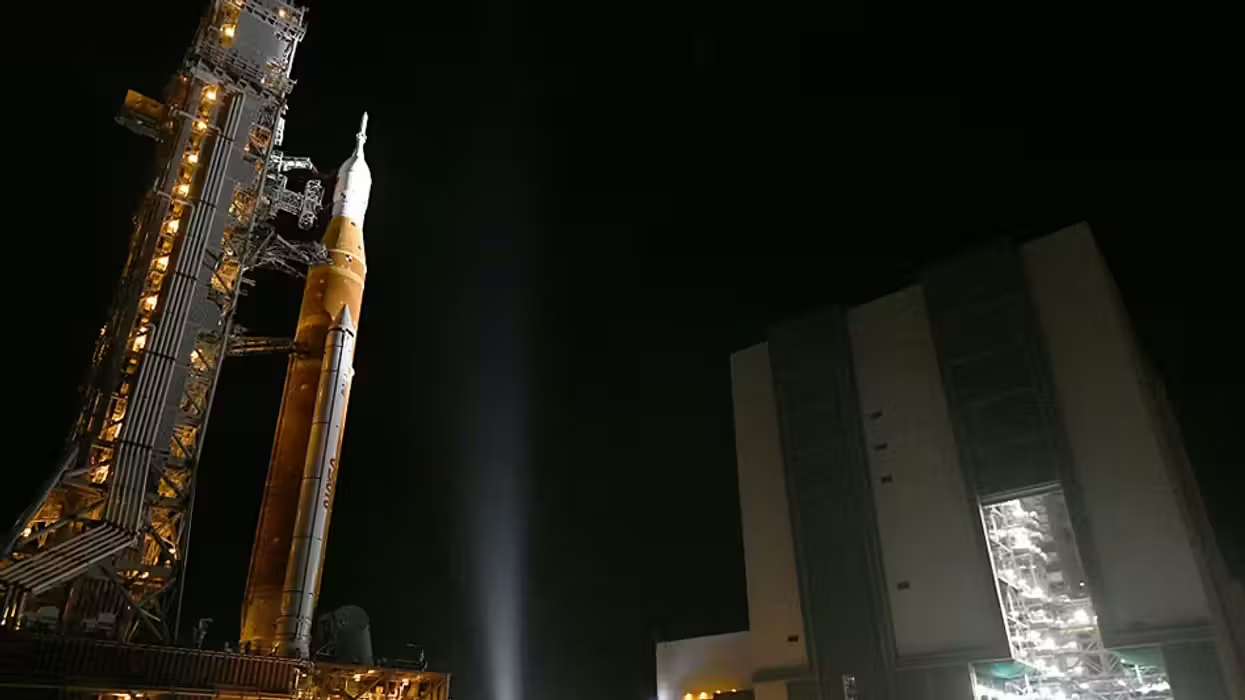
Paul Hennesy/Anadolu/Getty Images
The agency said its current plan is miniscule compared to what's ahead.
NASA announced it is shifting priorities to make sure it meets President Donald Trump's goals before the end of his term.
The announcement, part of NASA's "Ignition" event, declared that the space agency is "committed to achieving the near‑impossible once again."
'Returning to the moon and building a base will seem pale in comparison.'
NASA Administrator Jared Isaacman revealed the agency's new directive at the event, telling audience members that the new "National Space Policy" includes accelerating preparations for America's return to the moon.
First, this involves fulfilling missions that will establish an American base on the lunar surface.
"Return to the moon before the end of President Trump's term, build a moon base, establish an enduring presence, and do the other things needed to ensure American leadership in space," Isaacman said.
The administrator added, "If we concentrate NASA's extraordinary resources on the objectives of the National Space Policy, clear away needless obstacles that impede progress, and unleash the workforce and industrial might of our nation and partners, then returning to the moon and building a base will seem pale in comparison to what we will be capable of accomplishing in the years ahead."
That's not all, though. NASA's plan also includes nuclear-powered space exploration that will see new space helicopters used on Mars.
RELATED: Is real-life 'Star Wars' America's manifest destiny?
NASA said it will launch Space Reactor-1 Freedom, a "nuclear powered interplanetary spacecraft," on a mission to Mars before 2028. Once the craft reaches Mars, it will deploy another craft called Skyfall, which will then drop a group of new space helicopters, called the Ingenuity-class helicopters.
These tissue-box-size helicopters will then explore the surface of the Red Planet.
At the same time, NASA plans to launch a "nuclear-powered octocopter" in 2028, set for arrival at Saturn's moon Titan in 2034. This will be launched by Dragonfly, which, according to Gadgets 360, is another fully autonomous nuclear-powered craft.
These highly ambitious projects face an already strict timeline, as several of NASA's current lunar missions are years behind.
RELATED: America's historic return to the moon suffers ANOTHER setback
NASA's Artemis II mission, a crewed lunar orbit meant to test landing systems, has already missed its late 2024 window. However, NASA still says it will launch by April 1.
This mission delay has pushed Artemis III to mid-2027. That mission was originally meant to include a lunar landing; it no longer does. That job is left to Artemis IV, which has a launch date of early 2028. Artemis V is meant to be another lunar landing by the end of 2028, which NASA previously said is when it expects to "begin building its moon base."
The latest plan is set for three phases, with phase one sending "rovers, instruments, and technology demonstrations" to the moon for testing.
Phase two is meant to establish early infrastructure on the surface, with help from Japan's pressurized rover.
Phase three would reportedly get help from Canada's Lunar Utility Vehicle and Italy's "Multi-purpose Habitats" in order to establish a permanent lunar base.
Like Blaze News? Bypass the censors, sign up for our newsletters, and get stories like this direct to your inbox. Sign up here!

Andrew Chapados