Martin Bureau/Bettman/Tom Williams/Alex Wong/Sia Kombou/Getty Images
The fact is, the global ruling class likes pedophilia.
Pedophilia is the aftershock of an earthquake that no one wants to name. That earthquake is the sexual revolution.
The purveyors of the sexual revolution use the best of modern scientific advertising and marketing knowledge to package their ideology.
Why can’t we seem to get to the bottom of the pedophilia problem?
I’m going to give you three factors that prevent us from stopping the pedophilia crisis.
Then I’m going to give you four very specific action steps you can take — steps that will help protect children from being harmed and help heal the children who have already been harmed.
Let’s look at these three contributing factors to the ongoing childhood sexual abuse crisis.
You’ve heard the term grooming, haven’t you?
Grooming is the preparation stage of sexual abuse. You could call it the pre-touch phase. Without ever committing a criminal act — without ever touching a victim — the grooming process prepares the child’s mind for submitting to a predator.
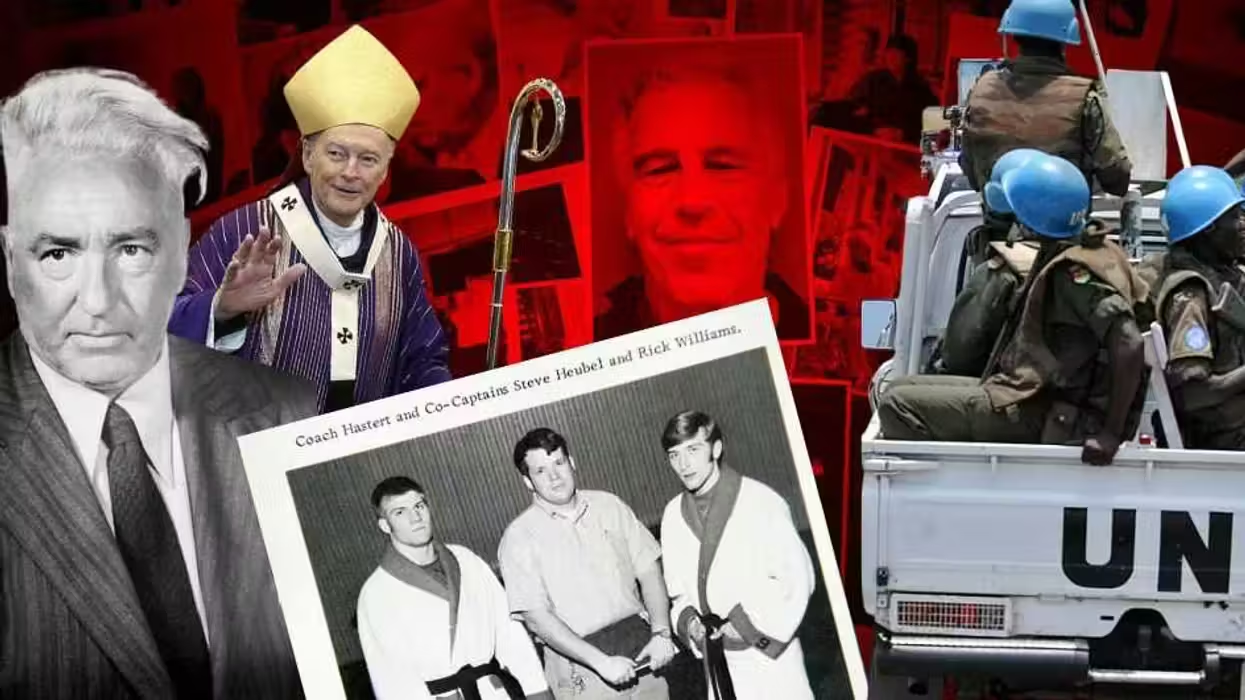
Children are not just being abused by billionaires on tropical islands. Epstein Island is just the tip of the pedophilia iceberg. Churches, public schools, and even the United Nations have been implicated in sex crimes against children. What I’m about to explain applies to all of these situations.
Let’s start with public schools.
According to educational researcher Carol Shakeshaft’s 2024 book, “Organizational Betrayal: How Schools Enable Sexual Misconduct and How to Stop It,” a staggering 17% of children in public schools suffer sexual misconduct by teachers, school administrators, and other personnel.
That’s a lot of kids being traumatized.
Now consider the United Nations. Not only do UN agencies promote “sexual rights” for minors, there have been repeated reports of peacekeeping troops sexually exploiting children in refugee camps. As author Jennifer Ells writes:
To cite only a few of many heinous incidents, a series of “food-for-sex” scandals erupted in the early 2000s when UN peacekeepers in Liberia were accused of selling food for sex to girls as young as 8. In Haiti, at least 134 UN peacekeepers from Sri Lanka were accused of sexually abusing children in a sex ring from 2004 to 2007. One boy reported having sex with more than 100 peacekeepers, averaging about four a day over the course of three years beginning when the boy was 15.
Ideas that groom are part of the problem in each of these cases.
One of the intellectual roots of this problem is Wilhelm Reich, the Austrian psychiatrist who wrote “The Sexual Revolution.” He promoted the idea that children are sexual beings from birth and need sexual expression for proper development.
Here is how that argument was framed in the section called “Sexual Abstinence During Puberty,” on page 106. “Abstinence is dangerous and absolutely deleterious to health. To recommend abstinence to youth means to set the stage for neurosis.”
Reich also held that teenagers needed to have their own private spaces where they could have sex without parental knowledge or interference. Check out the section called “Sexual Intercourse Among Adolescents,” starting on page 116.
You might think that was a long time ago, and it has nothing to do with us today. But you would be mistaken.
These ideas persist, often under different language. For example, within the United Nations, the concept of “reproductive health” has been defined as a right to a “satisfying and safe sex life,” along with the freedom to decide when and how often to engage in it.
That raises an obvious question: If a satisfying sex life is a right, who exactly is responsible for providing it?
At the same time, many schools in the United States teach children that sexual activity is natural for them, that they are entitled to it, and that their parents need not know about it.
Parents are beginning to push back.
These curricula present too much information too soon — information that normalizes sexual activity, even for very young kids: books that normalize sexual activity; information that may very well scramble the child’s normal developmental process.
We can also name many other examples of the sexualization of children in advertising, marketing, and entertainment media. The purveyors of the sexual revolution use the best of modern scientific advertising and marketing knowledge to package their ideology. It’s glamorous. It’s cool. It’s sexy. You’ll be popular. You’ll be one of the gang.
All of this contributes to the grooming atmosphere.
And what I mean by the grooming atmosphere is that you’re setting kids up for the creep who comes along — who doesn’t sound or look creepy, but who flatters them, who’s kind to them, who tells them how special they are.
So this is my first key takeaway: Ideas that groom children for sex are a major contributing factor to their vulnerability to predation.
The second contributing factor to the pedophilia crisis is something that makes it harder for justice to prevail. I call this tribes before truth.
Sexual misconduct generally takes place in secret. Sexual assault is generally underreported. Sexual crimes against children are even more likely to go unreported.
Kids can’t easily make police reports — especially against somebody they know, perhaps love, or depend upon. Victims can be crippled by shame. Little kids sometimes blame themselves in their own minds.
This is why reporting lag is a very real problem.
In our Ruth Institute study in 2018, we studied Catholic clergy sexual abuse. We found that, on average, victims first reported the crime 28 and a half years after it was committed.
So when somebody does come forward, the public doesn’t have complete information. We hear the complaint on one hand and the denials on the other. Understanding what really happened can be very difficult.
Law enforcement and the judicial system have the resources — and the responsibility — to discover the whole truth. But ordinary people like you and me almost always have an incomplete picture.
And in the face of incomplete information, here’s the pattern I’ve noticed.
If the alleged perpetrator is a member of what I consider to be my tribe, I believe he is innocent. I say: Don’t rush to judgment. Let the legal process take its course.
If that fails, people shift their attention to the victim:
By contrast, if the alleged perpetrator is a member of what I consider to be the enemy tribe, I believe absolutely every word the victim says.
“Surely they wouldn’t make up something like that. I knew all along this guy was a creep.”
We tend to judge not on the facts, but on our relationship to the alleged perpetrator and victim.
My tribe is always innocent — therefore I harass and hound the victim.
The enemy is always guilty — therefore I support the victim.
Do you see the problem?
Actual victims need real support. Being called a liar is one of the most traumatizing aspects of being victimized and then finally coming forward.
Think about it from the victim’s perspective. A person pulls himself or herself together enough to make a complaint — and then has to run the gauntlet of public shaming and embarrassment.
Does that make it more likely people will come forward in a timely manner — or less likely?
I think you can figure that out.
So my second key takeaway is this: Our natural tendency to favor tribes over truth is a real problem.
We all have a natural instinct to favor our friends over our opponents. You can see this in general. But as soon as a real situation arises, we let our emotions run away with us.
At the very moment we most need to be objective, we are least likely to be.
This brings me to the third contributing factor.
Pedophilia is icky.
The sexual abuse of children is too nasty for any normal person to face. We would all prefer to be doing anything else rather than admit that this is going on in our society.
Rather than admit that someone you love and respect could be the perpetrator.
“I can’t believe it” often means “I don’t want to believe it.”
I trusted this person. I admired him. I supported him. I feel betrayed. I feel foolish.
Stop thinking about him. Stop thinking about yourself and your feelings. Start thinking about the child.
As John Manly, an attorney who has filed numerous lawsuits against public school teachers in California, puts it:
When this happens to a child, it’s emotional murder. They’re never the same.
Every person should have the right to pick and choose their first sexual experience. And when that’s stolen from them — whether in third grade or in high school — it has a profoundly damaging effect.
So here is my third and final takeaway: Our revulsion about even thinking about pedophilia hampers our ability to address it — to prosecute it and to prevent it.
RELATED: Wikipedia co-founder: Epstein, elite rings, and occult portals — what they don’t want you to know
 Blaze Media
If you’ve read this far, thank you. You’re the kind of person who wants to get something done.
I’ve given you three contributing factors. Now here are your marching orders — in reverse order.
Being disgusted by pedophilia is a wholesome and natural instinct. But that doesn’t mean you should avert your eyes. Look at that feeling objectively now, so you’ll have the courage to face it when someone you love needs you to.
Identify your own tendency to excuse some while rushing to judge others. Don’t let yourself off the hook. Most of us won’t have to make legal judgments — but your ability to face the truth will matter in what comes next.
Here’s John Manly again:
“No one was mandated by law to go to Epstein Island. But you are required to send your children to school. Parents in many cases have no choice. And if you get the wrong teacher, that’s just too bad.”
Get your kids out of public schools. Make a stink at your local school board. Write letters to advertisers. Complain at your local library.
Once you start looking, you will see endless opportunities. The propaganda of the sexual revolution is everywhere. That means there are unlimited opportunities for you to do something constructive about this grooming atmosphere.
Anyone can do this.
If you know someone who has been sexually victimized, reach out. Ask how you can help. If you dismissed or shunned someone in the past, reach out and apologize.
It’s a matter of justice. It’s a matter of kindness. And it’s simple common sense.
Because honestly — do you really expect the most powerful people on earth to come clean if you and I won’t do our part?
Note: This article was adapted from the Ruth Institute's video “The Real Causes of Pedophilia.” For more information on the Ruth Institute and its work, click here.