Patrick Smith/Brett Carlsen/Heather Diehl/Getty Images
Where do we go after Donald Trump?
The question has divided the right. When it comes to charting the correct course, a book published during the president's first administration is timelier than ever: R.R. Reno’s "The Return of the Strong Gods."
'The perverse gods of blood, soil, and identity cannot be overcome with the open-society therapies of weakening,' writes Reno.
One faction of the right appears keen to continue delivering on the promise of Trump’s “Golden Age” by leaning further into a muscular and nationalistic conservatism.
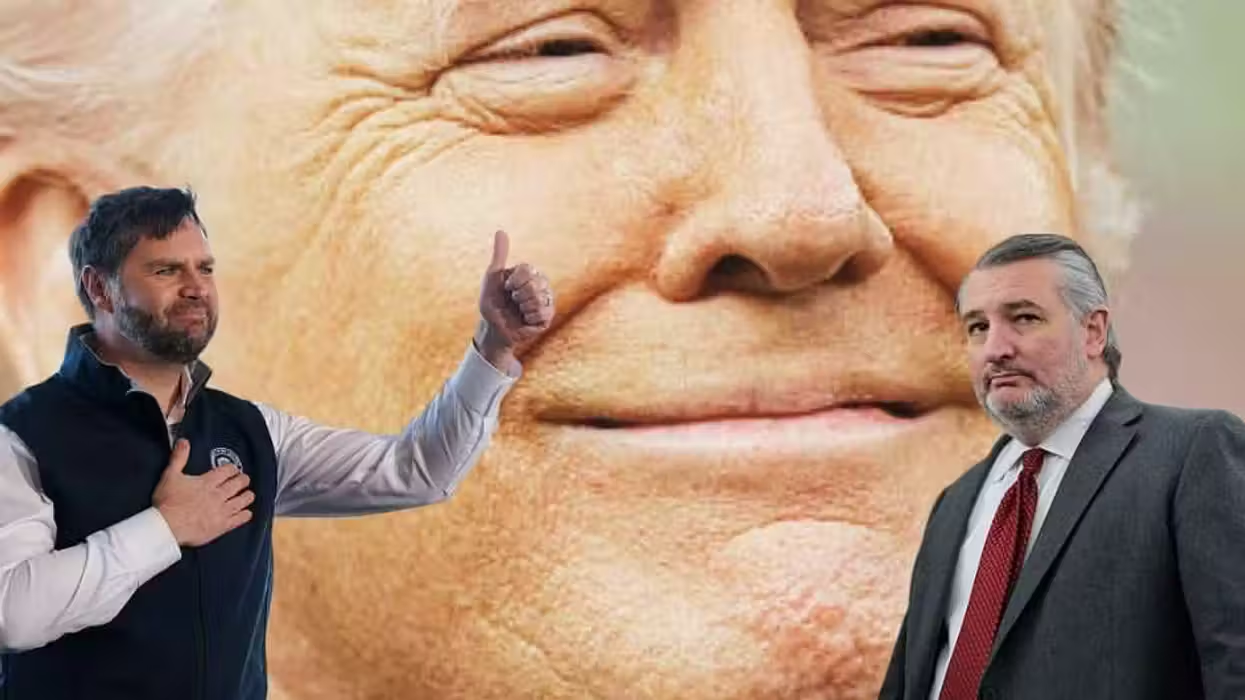
Liberal interlopers and other ideological refugees with forward operating bases situated right-of-center have been working ardently to politically neutralize this camp ahead of the 2028 election, smearing, for instance, some of those in Vice President JD Vance’s orbit as “woke right.”
Such liberal saboteurs are right to be fearful of this camp, as its dominance — affirmed by a Vance win — would signal the MAGA movement wasn’t a sprint but a marathon.
The second camp, whose potential champion in the 2028 primary field appears to be Sen. Ted Cruz (R-Texas), is keen both to act as though the populist upheaval of the 2010s hadn’t irreversibly changed the game and to slink back onto the rhetorically conservative, libertarian-minded side of the liberal coin.
This is the politics that has purchased cultural and economic deregulation, a ruinous series of foreign entanglements, a demographic crisis, and a low-trust society marked by an anemic sense of “we.”
The old guard in both parties — those who’ve long railed against and/or sought to undermine the MAGA agenda — would doubtless regard the success and empowerment of this camp as a godsend.
Early polling data provide strong indications, however, that there is little appetite among likely Republican primary voters for a return to a George W. Bush-era style of Republican leadership. The reason is perhaps best explained in a book first published six years ago.
In “Return of the Strong Gods: Nationalism, Populism, and the Future of the West,” R.R. Reno, a political philosopher and editor of First Things magazine, discusses both what was behind and what is ahead of the recent nationalist and populist uprisings in the West.
The book, which Reno has touted as an “essay in the politics of imagination,” is an engrossing elaboration on an article he penned years earlier detailing the full-spectrum campaign spearheaded by classical and progressive liberals after the Second World War to "disenchant and desacralize public life” and to produce an “open society” wherein the “strong gods” — the “objects of men’s love and devotion, the sources of the passions and loyalties that unite societies” — could inevitably be neutralized and/or replaced by “weak loves” such as relativism, diversity, and tolerance.
Reno suggests that the reasoning behind this project of societal opening and weakening was that earlier in the 20th century, strong gods had supposedly rendered the masses easily manipulable by demagogues and set the stage for those totalitarian regimes that warred against humanity.
The general theory of society underpinning the postwar consensus became, according to Reno, “characterized by a fundamental judgment: whatever is strong — strong loves and strong truths — leads to oppression, while liberty and prosperity require the reign of weak loves and weak truths.”
RELATED: Conservatives face a choice in ’26: realignment or extinction
 MediaProduction via iStock/Getty Images
This, Reno insists, was a catastrophic overreaction.
In their campaign to water down dark loves, the war-traumatized liberal elites of yesteryear also watered down the powerful loves and intense loyalties that hold Western civilization together and supply a sense of belonging, purpose, and solidarity — such as family, nation, religion, and transcendent truth.
Reno notes that this campaign not only produced a dysfunctional society but incubated some of the very dark loves it was meant to destroy.
“The perverse gods of blood, soil, and identity cannot be overcome with the open-society therapies of weakening,” writes Reno. “On the contrary, they are encouraged by multiculturalism and the reductive techniques of critique. In its present decadent form, the postwar consensus makes white nationalism an entirely cogent position.”
“We cannot forestall the return of the debasing gods by reapplying the open-society imperatives. False loves can be remedied only be true ones,” adds Reno.
While the postwar liberal regime enjoyed great success in producing monsters and in disenchanting, disorienting, deracinating, and rendering homeless those guns-or-religion deplorables for whom America’s detached elites still brazenly express contempt, its success karmically set the stage for a popular yearning for anchorage, belonging, and a sense of “we,” which in turn prompted a rejection of the postwar consensus.
That rejection has manifested in various ways but most clearly in the rejection of the open society and its possessing forces of weakening that occurred on Nov. 8, 2016.
During his first term and again over the past several months, Trump has pursued reconsolidation and protection as opposed to deregulation and openness and delivered significant results along the way.
Those who’d seek to steer the right back toward the open society and sell voters on a rebrand of the postwar consensus stand a better chance of sweeping waves back into the sea.
While well-positioned to lead, those in the first camp may nevertheless want to heed Reno’s caution about the open society: “This project cannot be opposed solely on political grounds, as if nationalism alone can overcome the ‘destiny of weakening.’ We need strengthening motifs across the board.”
“Our task, therefore, is to restore public life in the West by developing a language of love and a vision of the ‘we’ that befits our dignity and appeals to our reason as well as our hearts,” wrote Reno.
“We must attend to the strong gods who come from above and animate the best of our traditions. Only that kind of leadership will forestall the return of the dark gods who rise up from below.”