Chris Graythen/Getty Images
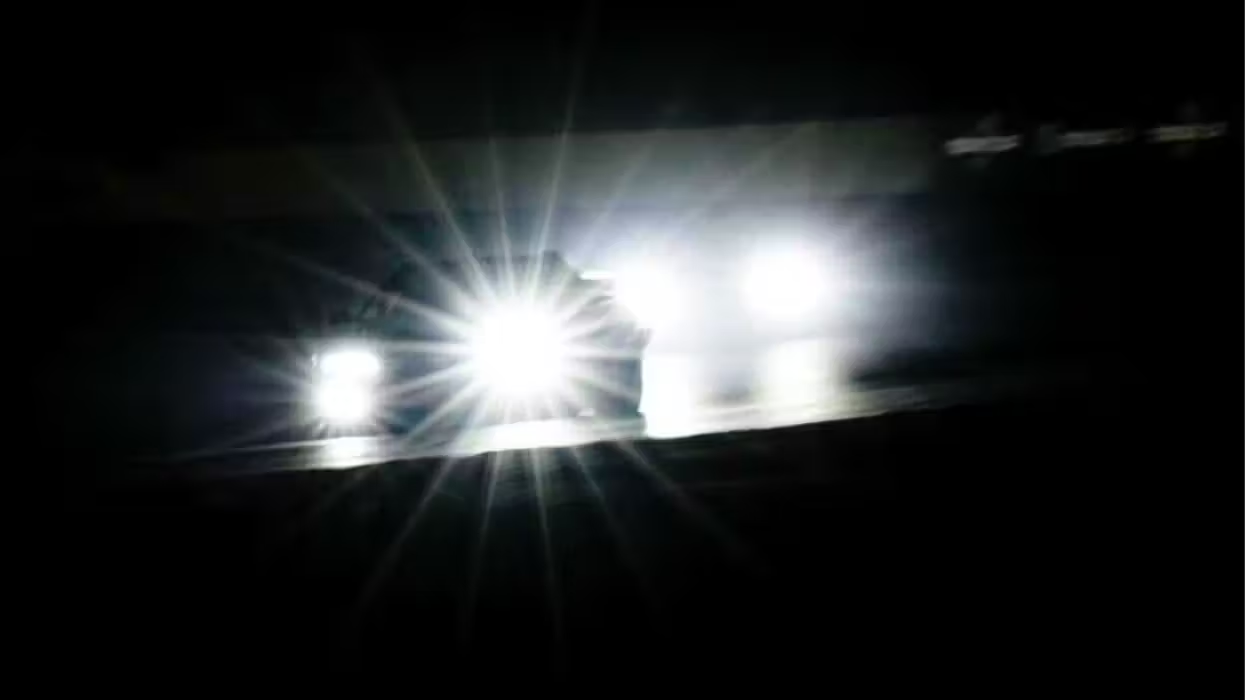
Bright headlights have become a genuine safety issue for American drivers. Complaints about being blinded by oncoming vehicles are now commonplace, cutting across age groups, vehicle types, and driving environments.
For most of automotive history, safety innovations followed a clear principle: improve visibility without creating new risks. Today’s headlight crisis shows how far that balance has drifted. What began as a push for better nighttime illumination has turned into a widespread hazard — one driven not by reckless drivers or faulty equipment, but by outdated regulations and incentives that reward brightness without restraint.
A headlight that improves visibility for one vehicle can simultaneously degrade safety for everyone else.
Modern LED headlights are far brighter than anything federal regulators envisioned when lighting standards were written decades ago. As frustration grows, an uncomfortable truth is becoming clear: This problem is not a technological failure. It is the predictable result of rules that no longer reflect how vehicles are designed, tested, or driven.
Data backs up what drivers have experienced firsthand. The Insurance Institute for Highway Safety reports that average headlight brightness has roughly doubled over the past decade. Complaints submitted to the National Highway Traffic Safety Administration increasingly describe glare so intense that it causes eye strain, headaches, and momentary loss of visual clarity. These reports come from drivers of all ages, in both older vehicles and brand-new ones, on city streets and rural highways alike.
The increase is not subtle. Traditional halogen headlights typically produced around 1,000 lumens. Many factory-installed LED systems now produce 3,000 to 4,000 lumens, while some aftermarket lights exceed 10,000 lumens — levels that would have been unthinkable when federal headlamp standards were last meaningfully updated.
At the center of the issue is Federal Motor Vehicle Safety Standard No. 108, which governs automotive lighting. Much of this regulation dates to the 1980s, when lighting technology was limited by the physical constraints of halogen bulbs. Brightness was naturally capped, so strict numerical limits were unnecessary. That assumption no longer holds.
LED technology fundamentally changed how light is generated and controlled. LEDs can produce intense illumination using little power, and their output can be shaped and focused with remarkable precision. Yet instead of setting modern limits on overall brightness, federal standards still rely on beam-pattern measurements designed for older technology. As long as light output stays below certain thresholds in specific test zones, overall brightness can rise dramatically elsewhere.
Automakers have learned to design within these boundaries. By carefully shaping beams and managing shaded areas during compliance testing, manufacturers can produce headlights that are technically legal while delivering far more light on the road. This is not a violation of the law — it is the predictable exploitation of a regulatory framework that no longer matches reality.
Safety ratings have unintentionally made the problem worse. Headlight performance plays a significant role in evaluations by organizations such as the IIHS. Brighter headlights often score higher in controlled tests that measure forward visibility distance, giving automakers strong incentives to push brightness ever higher for better ratings and stronger marketing claims.
What these tests often fail to capture is glare’s impact on other drivers. A headlight that improves visibility for one vehicle can simultaneously degrade safety for everyone else. Current regulations and rating systems rarely account for this trade-off, allowing brightness gains to be celebrated without serious scrutiny of their broader consequences.
Vehicle design trends amplify the issue further. Modern trucks and SUVs sit higher than previous generations, placing headlights closer to eye level for drivers in sedans and smaller cars. Even properly aimed headlights can become overwhelming when mounted higher off the ground, particularly on uneven pavement or during braking and acceleration. Federal standards offer limited guidance on how brightness and mounting height interact in real-world conditions.
RELATED: Quick Fix: What's the safest used car for my teenager?
 CBS/Getty Images
Adaptive driving beam technology is often cited as the solution — and it does hold promise. These systems can dynamically adjust light patterns to reduce glare for oncoming traffic while preserving illumination elsewhere. But adaptive headlights were only approved in the United States in 2022, long after they became common in Europe and Asia. Adoption remains limited, mostly confined to higher-end vehicles, and performance varies widely depending on sensors, software, and calibration.
Even with adaptive systems, the absence of a clear federal cap on brightness remains a fundamental flaw. Technology can mitigate glare, but it cannot replace modern standards that reflect real-world driving conditions.
The safety implications are serious. Night driving already carries higher risk due to reduced visibility and fatigue. Excessive glare increases reaction times, reduces contrast sensitivity, and impairs depth perception. For older drivers and those with vision conditions such as astigmatism, the effects are magnified. These are not minor inconveniences — they are factors that directly influence crash risk.
Despite growing evidence and public concern, regulatory response has been minimal. The last major federal investigation into headlamp glare occurred in 2003, before LEDs became dominant. Since then, vehicle lighting has changed dramatically, but the rules governing it have not.
This is not an argument against innovation. LEDs offer real benefits, including efficiency, durability, and the potential for smarter lighting systems. The problem is not brightness itself, but the lack of modern oversight to ensure that brightness improves safety without creating new hazards.
Updating standards would not require rolling back technology or limiting consumer choice. It would mean establishing meaningful brightness limits, accounting for vehicle height and beam placement, and ensuring that adaptive systems meet consistent performance benchmarks. Most importantly, it would recognize that safety on public roads is shared — not something that can be optimized for one driver at the expense of others.
Until that happens, drivers will keep adapting on their own. Some will avoid driving at night. Others will install even brighter aftermarket lights, escalating a cycle that benefits no one. Many will simply accept discomfort as the cost of modern driving, unaware that it is neither inevitable nor necessary.
The technology to fix this problem already exists. What’s missing is regulatory urgency. As headlights continue to grow brighter, the gap between legal compliance and real-world safety widens. Closing that gap is essential if we want innovation to serve safety — rather than undermine it.