Jorge Fernández/Getty Images
Every Friday evening, our house goes offline. My wife and I close our laptops, silence our phones, and step away from the world for about 24 hours.
We don’t watch any movies, don’t listen to any music, don’t drive anywhere in the car, and don’t buy anything at the store. Our kids may not be as plugged in as my wife or I am, but they too retreat from the world outside our family.
I remember what actually matters. I feel less angry, less anxious, and less consumed by things beyond my control.
We do this every week because we observe the Jewish Sabbath, which begins just before sundown on Friday night and ends just after sunset on Saturday.
The truth is not many people observe the Sabbath like we do. Of course, all traditionally inclined Jews observe in our same way, but there aren’t that many traditionally observant Jews in the world. In terms of world population, the number of people who take a 24-hour break from the internet every single week on the Sabbath is rather small.
That number should be larger. I say that not because I think more people should be religious in the same way we are; in my view, everyone has their own faith, and it’s not my place to tell people what to believe. But I do think people should observe some sort of Sabbath because it’s good for you.
I'm not the first to suggest that both gentiles and Jews could benefit from this ancient tradition. The late Charlie Kirk observed the Sabbath much like we do. At the time of his assassination, he was preparing to launch a book on the personal benefits of stepping away from the world every Friday evening.
I can personally vouch for all the benefits the Sabbath brings. Getting away from the internet for a solid 24 hours every single week keeps me sane. Really, I’m not exaggerating. I would lose my mind without it. I don’t know how I would handle being plugged in 24/7 — 24/6 I can do, but no more than that.
To be honest, I feel myself starting to get sick of X, Instagram, news, and everything else searchable by Friday afternoon. I feel myself starting to get physically ill and more angry than I ought to be as the hours wind down before the weekend.
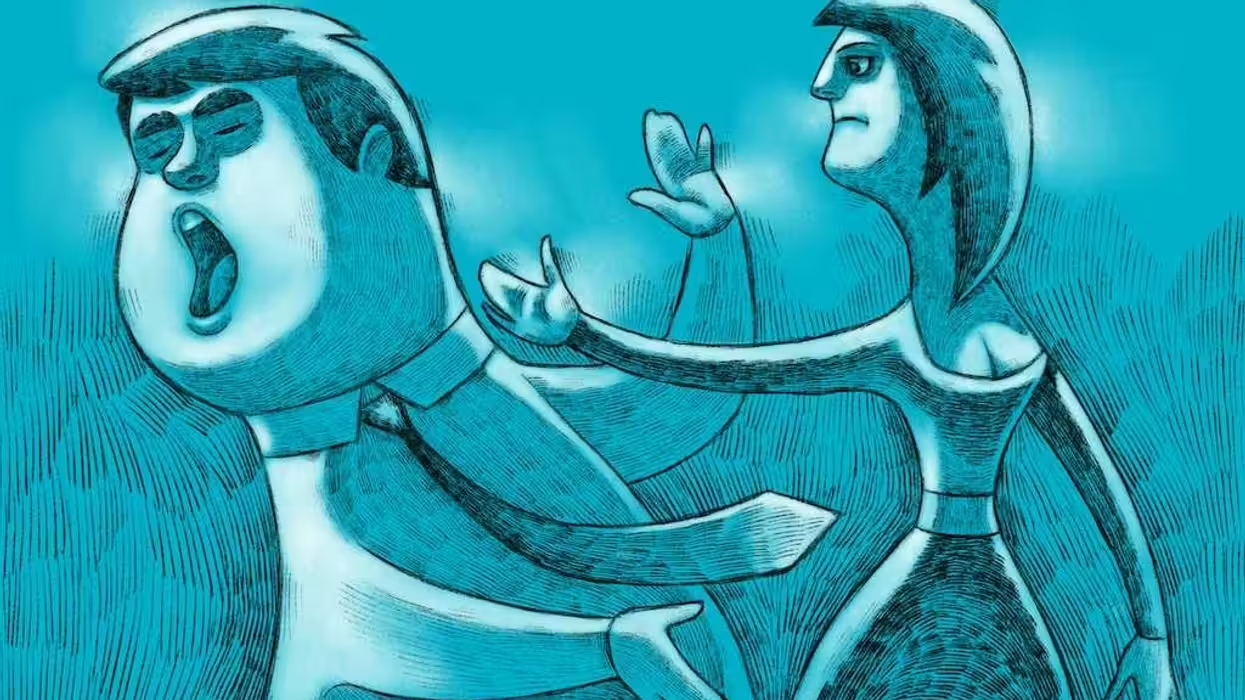
After six days of online living, I start to feel like a rubber band about to snap. Too many competing signals crowd my brain, making it impossible to think clearly. By the time the sun begins to set, I hate the internet so much that I just want to unplug from everything.
So that’s what I do.
And why not? Even God — the original Sabbath-keeper — needed a break after creating the world:
And on the seventh day God ended His work which He had done, and He rested on the seventh day from all His work which He had done. Then God blessed the seventh day and sanctified it, because in it He rested from all His work which God had created and made (Genesis 2:2-3, NKJV).
And He didn't have social media.
Never before in history have human beings had such constant access to the wider world. We can read news from every corner of the globe, peer into places our ancestors never knew existed, and absorb information about people we don’t know and never will. We can even enjoy the strange, modern pleasure of being insulted by random strangers online who, for reasons known only to them, have decided they hate us.
These are all recent developments — and they come with modern, often negative consequences.
Our ancestors never lived in a world like this. And it is, frankly, a wild one. It has a way of convincing us that trivial things matter more than they do, of distracting us from what truly matters. It pulls our attention away from our families and from God and pushes it instead toward a constant stream of strangers, gossip, and noise. It wears on you. It drives you a little crazy.
I think we’re seeing the effects of that now. A world permanently plugged into the internet is a world slowly losing its bearings. People become meaner, more confused, more absorbed in distant controversies and less attentive to the people right in front of them. They become less themselves and more like the mob — less human, in a subtle but troubling way. The always-online state has made us coarser, and we are worse for it.
RELATED: Erika Kirk joins Glenn Beck to discuss Charlie’s legacy and his book on honoring the Sabbath
 Glenn Beck, Erika Kirk. Image source: Blaze Media
Every week when I unplug, I arrive at the same realizations. They usually come sometime around Saturday afternoon. I remember what actually matters. I feel less angry, less anxious, and less consumed by things beyond my control. I feel more like myself. My mind is clearer. My heart is gentler. I am, quite simply, more at peace.
I wish I could remember all of this without the Sabbath. But I can’t. I’m not perfect — far from it. And maybe, just maybe, God knew something about the people He created when He gave us a day of rest.
I step away from the internet and the world of work every Friday night. I don’t think you have to do it exactly the way I do — or even on the same day — for it to matter. Maybe for you it’s Saturday night to Sunday night. Maybe it’s all day Sunday until Monday morning. Whatever works for you is fine.
I only know what works for me: turning off my phone every Friday evening, watching my wife and daughter light the Shabbat candles, sharing a meal together, not checking the news, and spending 24 hours in a small, quiet cocoon — safe, for a time, from a chaotic world.