Photos by Ken Beck
Westland, Michigan, is the only city in America named after its shopping mall.
Located about two miles west of the Detroit city limits—residents voted to incorporate themselves as a city in 1966. In a nod to progress, they chose the name for their new mall, Westland Shopping Center. The following year, Detroit exploded in an orgy of flames and racial animus.
Detroit emptied out. Westland filled up. And, if any proof was needed of the good American life, all one had to do was visit the mall. Dodge, Ford, and Chevy in the parking lot. JCPenney, Macy’s, and Sears & Roebuck under a single roof.
I grew up near the mall, and my mother still lives there. And if any proof is needed that the city has been knocked back on its heels, the mall sits half empty. Even Sears went bust half a dozen years ago.
There’s a culture in Westland, Michigan. At an early age, we are taught not to taunt a man with a badge and gun. Don’t block the road. Don’t disobey orders.
Except for some dope addicts camping in the nearby woods, people have been leaving Westland for decades as their good paying factory jobs got shipped south.
“I used to go there a lot as a kid,” said Kevin Raycraft, acting field office director of ICE’s Detroit Enforcement and Removal Operations, as he drove by the mall on a recent early morning. “It’s not looking too good. I’m surprised it’s even still there.”
I was on a ride-along with Raycraft and his apprehension team. Since nature abhors a vacuum and vacuum cleaners don’t operate themselves, Westland began filling up again with cheap, unvetted laborers who’d illegally crossed into the United States through Biden’s porous border.
Some of them—quite naturally—are not your Elk’s Club community booster types. Some of them are felons. Some are punks. Many have already been deported multiple times, only to be waved back through under the previous administration.
 Ken Beck
The ICE agents this morning were looking for 12 illegal aliens. Among them was a convicted drug dealer who had served jail time and had been deported on three previous occasions. Another had been arrested while driving around in a stolen car, only to be released by the local cops. This list of offenses is extensive . . .
How did the group of illegals get on Raycraft’s radar? One of them got busted for drinking and driving. Suffice it to say, once a known illegal alien’s photograph and fingerprints are uploaded into law enforcement databases, ICE receives a hit. Then the work begins.
Agents had eyes on the group for days. They knew what time the lights went out. What time they went on. The targets were living in a modest Cape Cod, not two miles from where my mother lives. I knew the area well. I played Little League baseball a few blocks away. The karaoke dive bar was still up the street.
In my career, I’ve crossed the desert with a group of migrants, guided by a member of the Sinaloa cartel. I learned Spanish in Alaska, working in a cannery. I’ve seen how people live back in their home countries. If I were hungry, I’d try to get to America, too. If Canada were paying $200 an hour to shovel horseshit with your bare hands, I’d be there. And I’d behave. The people Raycraft was targeting, on the other hand, were not my mother’s “neighbors.” They were wanted criminals who sold dope, stole cars, and drove around drunk. They made problems, and my mother wanted them out.
Over several days, ICE agents had clocked the crews’ habits and movements. Every workday morning, a Dodge truck would pull up to the house at precisely 7:15 a.m. The illegals would load up and carpool to some tiny subdivision to rake some rich man’s leaves, or mow his lawn, or vacuum his carpets.
The ERO apprehension agents are ICE’s elites. They receive specialized tactical training and must have a college degree or some significant specialized experience, generally military time. The nine men assembled this morning have dozens of years of experience among them. Their sector stretches from Cincinnati, Ohio, to the shores of Lake Superior.
 Ken Beck
Play-acting politicians like Jacob Frey, the mayor of Minneapolis, claim ICE agents “don’t belong in our cities.” But of course they belong in our cities. By virtue of federal law dating back to the 19th century, agents can make arrests, conduct operations, serve warrants, and have the authority to carry firearms. Their jurisdiction stretches from ocean to ocean and to every city in between.
They belong in our cities because the supremacy clause of the Constitution is explicit: when in conflict, federal law trumps local law. Period.
Still, the violent images and political venom spewing from Minnesota, Oregon, and California have a debilitating effect on the agents. No one likes being called a Nazi. But an oath is an oath.
“Maybe it’s human nature to focus on the negative as opposed to those who support us,” Raycraft said. “It’s very clear that assaults are up, people are fleeing at a far greater rate, and there’s injuries to officers. Regardless of those who may disagree with what we do, the people who do this job understand the impact that they make from a public safety perspective.”
Few people know the extent of power given to immigration officers under federal law. They are allowed to conduct warrantless traffic stops and searches and inquire about immigration status within a “reasonable distance” from an international border. That reasonable distance as defined by law is 100 air miles.
By virtue of its unique geography, Michigan is the only state in the union which falls entirely within this 100-mile zone. (The Great Lakes are considered an international boundary.)
That’s better treatment than inmates get at the Wayne County Jail. Believe me.
Even U.S. citizens can be subjected to random stops and questioning about their nationality when there is reasonable suspicion that immigration law may have been violated. Checkpoints are a routine feature on the southern border. If a person refuses to answer an agent’s question, that person can be detained until his legal status is determined.
If an agent is concerned about his safety, he may legally order a woman to get out of his way. If she refuses or uses her vehicle to impede an agent’s work, she is subject to arrest.
I’ve looked at the video a dozen times. Perhaps the ICE agent in Minneapolis could have side-stepped Renee Good’s oncoming vehicle. Maybe he should never have stood in front of it in the first place. But he did. And when she put the car in drive and struck him, the agent had legal justification to fire his gun.
There’s a culture in Westland, Michigan. At an early age, we are taught not to taunt a man with a badge and gun. Don’t block the road. Don’t disobey orders. Don’t try to flee. Don’t weaponize your vehicle.
Why? Because you could end up dead.
Renee Good learned the hard way.
But even here in Michigan, we’ve had our close calls. A recent video hit social media showing a Border Patrol agent attempting to heave an unconscious and handcuffed woman he had just tasered into the back of his truck. The woman lay limply on the service drive.
The outrage machine quickly cranked into overdrive. The protestors began mustering online. Pyrotechnics were planned. And then it petered away as the facts came out.
As it happened, the woman and her boyfriend—both illegals from Ecuador and both with outstanding deportation orders—were pulled over by local cops for doing 20 mph over the speed limit through a neighborhood. When the cops eventually found their passports, the computer dinged the two as fugitives. So the cops called Border Patrol.
A single CBP agent arrived. He cuffed the man’s hands behind his back and cuffed the woman with her hands in front. The agent would pay for this small act of chivalry.
I smiled and waved at him: “Enjoy CECOT, motherfucker.”
As he drove the couple to the detention facility, the agent heard the man whispering into a cellphone. The incredulous officer pulled over, got out of the truck, and opened the back door, where the male suspect was seated.
As he did, the suspect violently kicked the door open with his feet, knocking the agent to the ground. The male suspect hauled off into the neighborhood, with his hands still cuffed behind his back. That’s when the woman jumped out of the vehicle and onto the back of the agent, riding him like a rodeo steer, strangling him with the chain of the handcuffs.
The agent tasered the woman. A motorist filmed the scene. And the video made its way to X.
A white woman was quoted in the local paper saying she didn’t feel safe with ICE in her upscale community and wanted them out. Meanwhile, the felon from Ecuador, with his hands cuffed behind his back, was still on the loose until ICE agents hunted him down.
Hopefully, none of that would happen this morning. But if every apprehension of an illegal immigrant erupted in a fuselage of stones and shattered glass, nothing would get done, and almost nobody would be arrested.
Raycraft's men were planning to let the crew of illegals pile into the truck, follow them through the narrow streets of the subdivision, and pull them over when they turned onto the main street, Wayne Road, just south of the shopping mall.
 Ken Beck
If all went according to plan today, this would be an uncomplicated roundup of felonious jardineros.
With Raycraft at the wheel, the miasma of the early suburban morning rolled out in an unspectacular, dispiriting collage: Liquor Store. Auto Parts. McDonald’s. Wendy’s. Red Lobster.
Ping. Ping. Ping.
The seatbelt alarm interrupted the monotony.
“I hate to ask you again,” said Raycraft, gently busting my balls about the undone seatbelt. “But this is a government vehicle.”
A real law and order guy.
“Sorry,” I said, doing up the belt. “I grew up in the 80s.”
The son of a cop, Raycraft also grew up in the 80s, and grew up around here about seven miles from the mall.
“We’re a very unique office,” he said. “The majority of people who work here are from here. They grew up in these communities. They care about and understand the communities. I think it’s incredibly important to note that many of the people who work at ICE . . . that enforce immigration laws are first- and second-generation Americans, and they care about public safety.”
Raycraft parked his black truck with the darkened windows in a crumbling lot, monitoring the radio, waiting for the “go” sign from his agents who were staged close to the house.
RADIO: Alright, one mile, two miles in the back. No movement on target vehicle.
Across the street was a residential rehab facility, the windows filthy with neglect, the blinds in tatters. The shop next to that was abandoned.
“Why are we living here?” I asked sarcastically.
“I don’t think you can beat the people of the Detroit area,” he said. “It’s gotta be that.”
A morning school bus stopped to pick up children.
 Ken Beck
“They don’t even know you’re out here keeping them safe,” I said. “Nobody does.”
“That’s how we like it,” said Raycraft. “We’re nearing school time, and these are all considerations that we take into play. We do our research to avoid scenarios. We use every resource we have to identify them, and understand their routines. It’s not random. It’s not haphazard. We know who we’re looking for, and we’re good at finding them. We just don’t want them catching on to us.”
RADIO: Alright, I’m set up on first pass . . . at the trailer out front. Registered to one of the tangos.
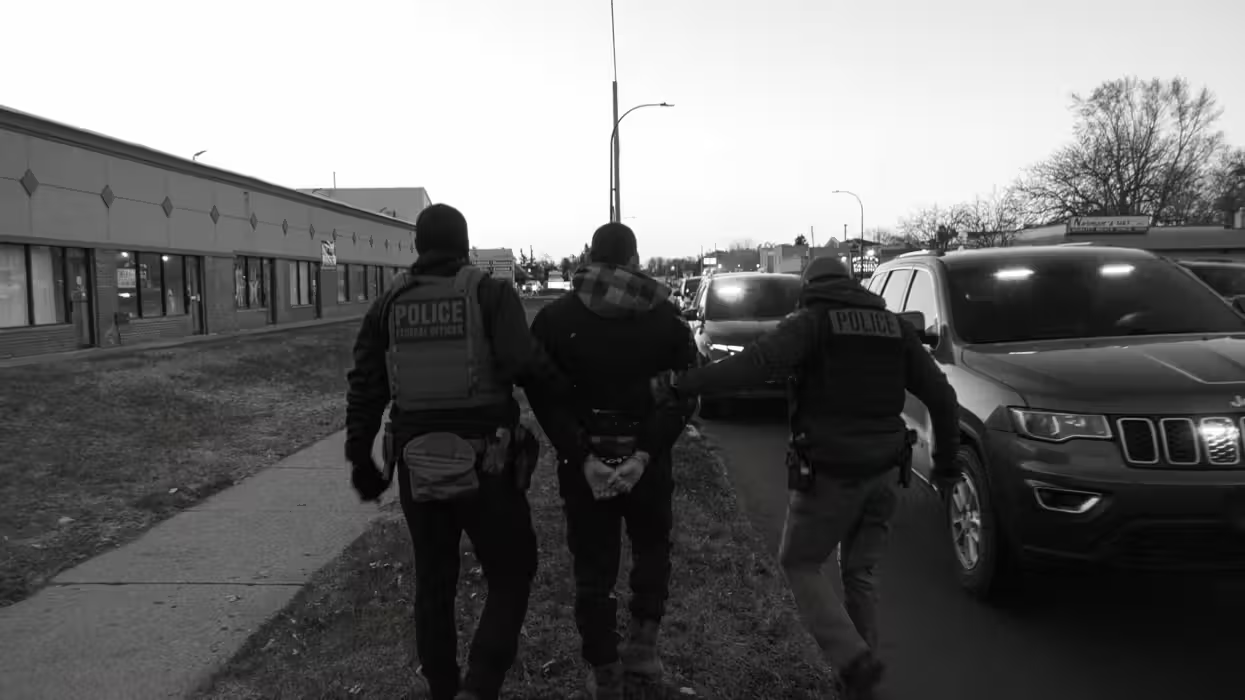
While assaults on ICE agents have skyrocketed, only one man in Raycraft’s crew was wearing a mask this morning. Unlike the clips cooked up for social media and cable news, this is how the apprehensions are effectuated. Quiet. Calm. Precise.
No citizens are being “disappeared” into the night. In fact, Raycraft’s crew carry arrest warrants this morning for their targets, when “probable cause” is all they would technically need by law.
And, to be sure the targets are the people they are in fact looking for, agents have brought along a portable fingerprint reader.
Entering the United States illegally is a federal crime. Under U.S. Code Title 8 Section 1325, the first offense is a misdemeanor punishable by up to six months in jail. The second offense is a felony carrying a two-year prison term. It is a 10-year felony for the third offense, and up to 20 years if you’ve been previously convicted for an aggravated felony and reenter. In short, the dope-dealing, booze-swilling third-time offender the feds were stalking this morning was facing hard time.
RADIO: Fourth person popped out in front of the house . . . looks like all four of them are going . . . yeah, doors closed . . .
RAYCRAFT into radio: Charlie says, “I’m gonna step out and have a cigarette.”
RADIO: [laughter] What’s that?
RAYCRAFT: Charlie goes, “I need a cigarette. I’m gonna have [to] step out real quick.”
RADIO: [more laughter]
RAYCRAFT: No pee breaks, no cigarettes.
And just like that, it’s a go.
RADIO: Tangos on the move.
At the morning muster the agent leading the briefing informed the crew that the illegals routinely leave the house at 7:15-ish. I looked down at the clock on Raycraft’s dash. It read 7:16.
Raycraft steered cautiously through the neighborhood and, once on the main road, the ICE vehicles converged on the truck in a splendid display of coordination.
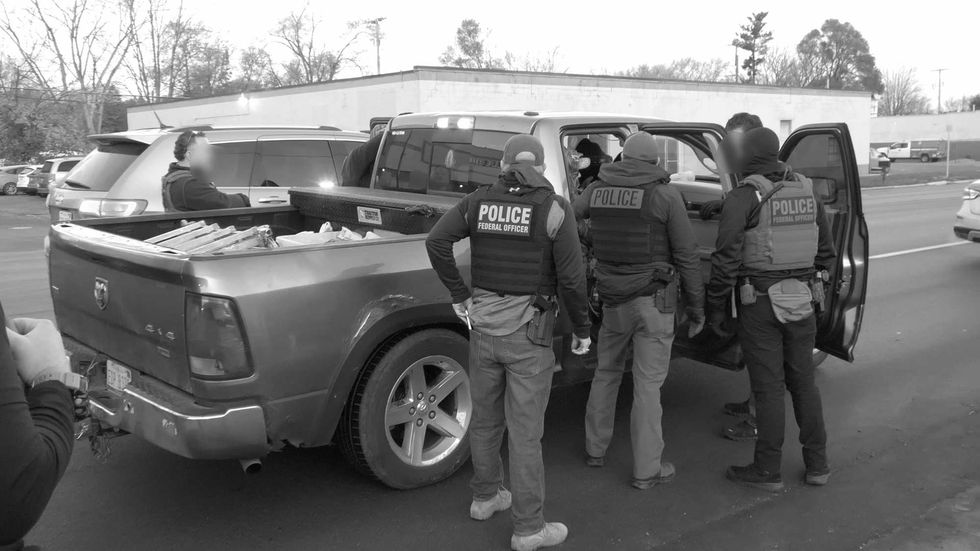
They pull the truck over to the shoulder near a hookah bar. In Spanish, an agent asks to see hands, then paperwork. From their research and surveillance, they already know the woman seated in the front passenger seat is a U.S. citizen.
 Ken Beck
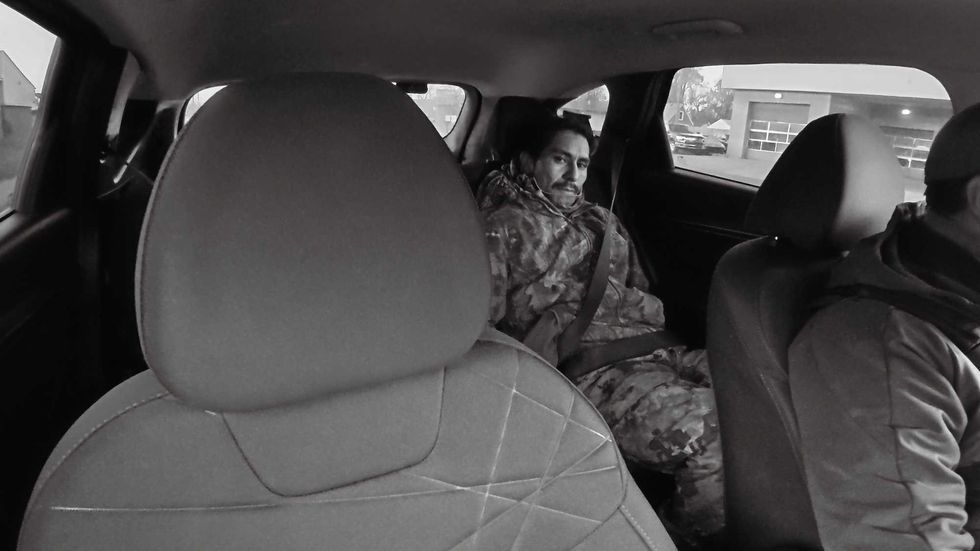
Five people were cuffed, searched, and put into the back of the agents' vehicles. Just like that. No tear gas. No white women with purple hair screaming at them.
They’d be taken to the federal lock-up, where they’d receive a physical and dental exam, unlimited international phone calls, and the choice of a free lawyer.
That’s better treatment than inmates get at the Wayne County Jail. Believe me.
As he was being driven away, the dope-dealing, booze-swilling three striker smiled at me through the window as if to say: ‘Ay cabron, I’ll be back for Christmas.’
I smiled and waved at him: “Enjoy CECOT, motherfucker.”
A good old boy driving a Ford 4x4 veered toward our scene, rolled down his window and screamed: “Get ‘em all out! Let’s go Trump!”
And with that, he goosed the accelerator and headed north toward the dying Westland Mall.