Peter Gietl
"I hate this time of year," the bellhop growled, shoving my luggage cart in through the door. Only after his audible grumbles faded back down the hall did I realize—along with his jarring attitude having cost him his tip—that his complaint had not been the cold but the slower business. Well, I thought. Welcome to the new new Vegas.
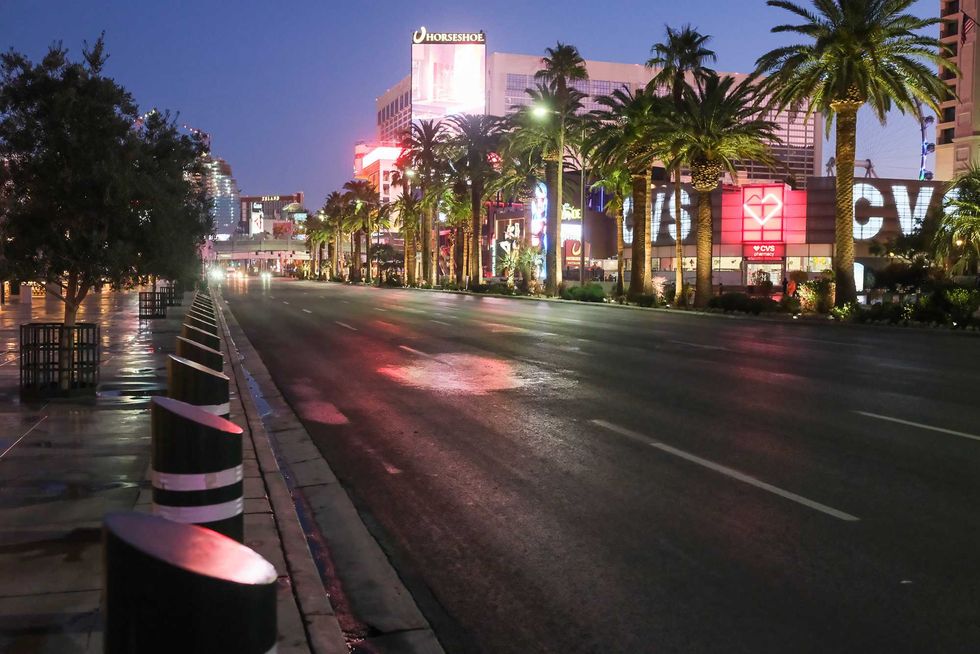
As indeed is the case for more and more tourists these days, domestic and international, it had been a while since I’d been to America’s creaking playground. An hour earlier, as I cruised from Frank Sinatra Drive across to Las Vegas Boulevard and the last swell of sunset withdrew from the Strip and down into the mountains, I saw for the first time that the Mirage had been shut down. In fact, the demolition was well underway. A bulbous, indeterminate shape, naked steel and glass fused into a large, inhuman figure, had already begun to rise in its place, as if the exhausted relic beside it were a body desiccated by an abrupt, accelerating transfer of life force—and, soon, stature—from host to parasite. Like a 21st-century Sphinx, the looming spectacle silently announced its irresistible riddle. Could America’s great desert funhouse survive the annihilation of its old mystique by a new, unrecognizable mystery?
Unsurprisingly, perhaps, the joke was on me, a sojourner very late in the game of following in the footsteps of pop culture’s anthropologically dynamic duos seeking the truth about America in the light and shadow of Vegas. Later, I would learn that the uncanny Shape—the Sphere’s seeming successor, or clone—was the bottom section of a towering new guitar-shaped resort, stringlike beams of light soon to be rising from where its neck would begin into the dark of the sky like a cross between the Luxor’s alien-beacon capstone and the funereal searchlights of the 9/11 memorial. Rather than an intergalactic visitation from the future, it was the unfinished Hard Rock Hotel. And, rather than the relief that I had only had a moment to expect from the revelation, this detail brought on another uncertain sensation, in some ways even deeper than the first.
Vegas’s ailment in the Current Year was a bad case of dissipating mystique.
As the former frontman of various electric “axe”-wielding bands in the 2000s and 2010s, I must say that nothing in this moment feels less futuristic, forward-looking, or rich with life force than rock ‘n’ roll, “hard” or otherwise. Wandering the casino floor of the Mandalay Bay, head swimming with heavy memories where the destiny of that particular hotel once horribly intertwined with that of the Route 91 Harvest country music festival, I reflected that both country music and the Mandalay had, like Vegas itself, suffered not at all in stature from the poorly explained mass shooting,
which at the time had seemed to strike a potential death blow against Sin City’s mystique while, over the same time span, rock music had fallen—and today even hip-hop is now falling—into a veritable open grave of irretrievable irrelevance. It was no more than a husk within which a pulsing, prickling being had once lived, whatever the defenders of the scant few throwback novelty acts to muster a blip on the collective timeline might halfheartedly insist, and the invisible but nonetheless real tumbleweeds that rolled with languid freedom through Mandalay’s House of Blues restaurant.
 Peter Gietl
A few warm nights before Halloween, in the ancient year of 2003 A.D., my manager had gotten me into the House of Blues on Sunset Boulevard—sold so fast a decade later its designer had to raid the shuttered place in a high-value tchotchke salvage operation—for the big Napster re-launch party . . . It, the Big It, was all gone, a dust of dreams assuming facts no longer in evidence, and with them whole industries, whole scenes, entire personalities. What had become of the quintessentially American attitude, the recklessly resilient, confidently squandering way of life that I was here to sniff out in Vegas? The conspicuous absence of its rare and heady odor was already beginning to leave my nose cold. Eight years before the sun went down for the last time on the Sunset House of Blues, The Hard Rock sold to the Florida Seminoles (the tribe, not the team) for just shy of a billion dollars. What, I asked the unattended craps tables, could be more natively American than that?
But the particular high-modern American magic that flowered at its fullest through the acts that made Vegas Vegas— Elvis, Britney, Michael (yes, an all-new music and acrobatics show is up and running), Adele, who I heard the casinos pipe in more than any other star, or even The Killers, now more appropriately called The Lifers—was always infinitely more about mystique than mystery. And after only a few minutes soaking in the Mandalay’s one hot tub not closed for winter, gazing out at the teen girls and old men lounging and bobbing in the half-shadow of an ersatz Burmese temple—families far outstripped twenty-somethings, the Strip’s ostensible lifeblood—it swiftly sunk in that Vegas’s ailment in the Current Year was a bad case of dissipating mystique.
 Peter Gietl
It’s been a bad year—a bad decade, honestly a bad millennium so far—for mystique, the dizzyingly superficial, falsely effortless, hypnotically engrossing reality distortion field sometimes known, but never entirely understandable, as glamor, charisma, magnetism. In a phrase, star power—that exclusive or exclusive-feeling sensation explicit to America since at least the great Gatsby's great Clintonite smile. “It faced—or seemed to face—the whole external world for an instant, and then concentrated on you with an irresistible prejudice in your favor. It understood you just as far as you wanted to be understood, believed in you as you would like to believe in yourself, and assured you that it had precisely the impression of you that, at your best, you hoped to convey.” Of course, Fitzgerald continued, “precisely at that point it vanished—and I was looking at an elegant young roughneck.” The spell shatters as quickly as it was cast.
It may not be particularly worthwhile or successful to crack open the dictionary in an effort to master the difference between mystery and mystique, experiences which live or die at the frontier of the indescribable. But there, in the Mandalay’s age-gap hot tub, I felt more certain than ever that mystique was truly the illusion of mystery. Charismatics from Napoleon Bonaparte to Wicked’s Wizard of Oz, adoring audience in tow, have portrayed the truth as a lie agreed upon. In fact, that’s mystique, the offspring of an unspoken pact between those who need each other to lure themselves into behaving as if they believed—to borrow MJ’s line about David Copperfield’s act—that the magic is real. Mystique is the mask without which such seduction becomes impossible; Jean Baudrillard, the postmodern genius whose prophetic prediction of our simulating age inspired The Matrix, warned that our sacrifice of seduction in an orgy of total overexposure would lead to the desertification of the real, and so, it seemed, that rough beast had at last come round to claw Vegas back into the sands and outcroppings of the high, unforgiving wilderness.
It’s not just the King of Pop who has eroded into an Ozymandian cultural menhir. Copperfield, whose kitsch-core ads with the T-Rex and the UFO still emblazon cabs and kiosks, is now tarnished by his Epstein associations. Penn and Teller are actually physically smaller; Piff the Magic Dragon’s beloved Chihuahua assistant, Mr. Piffles, died two years ago and has been “replaced by a clone,” Piffles the Second; “The” Eagles, checked out yet unable to leave their forever farewell tour, appear entombed in what might as well be holographic form within the Sphere’s gargantuan dimensions.
There is now a Museum of Punk Rock— my drummer of the previous two decades is in rotation as a docent there. Meanwhile, the more youthful of the city’s glitzy fixtures seemed gone without a trace, or at least AWOL: Bruno Mars, notoriously in superstar-sized debt to the MGM corporation, had just been administered a lived-in rebrand from his 24-karat mystique to, as his latest release dubs him, “The Romantic.” While the tourists fed their bottomless appetites for yet another Gordon Ramsay establishment, Bruno was breaking performance records where the real audience was: inside Roblox’s viral “Steal the Brainrot” game.
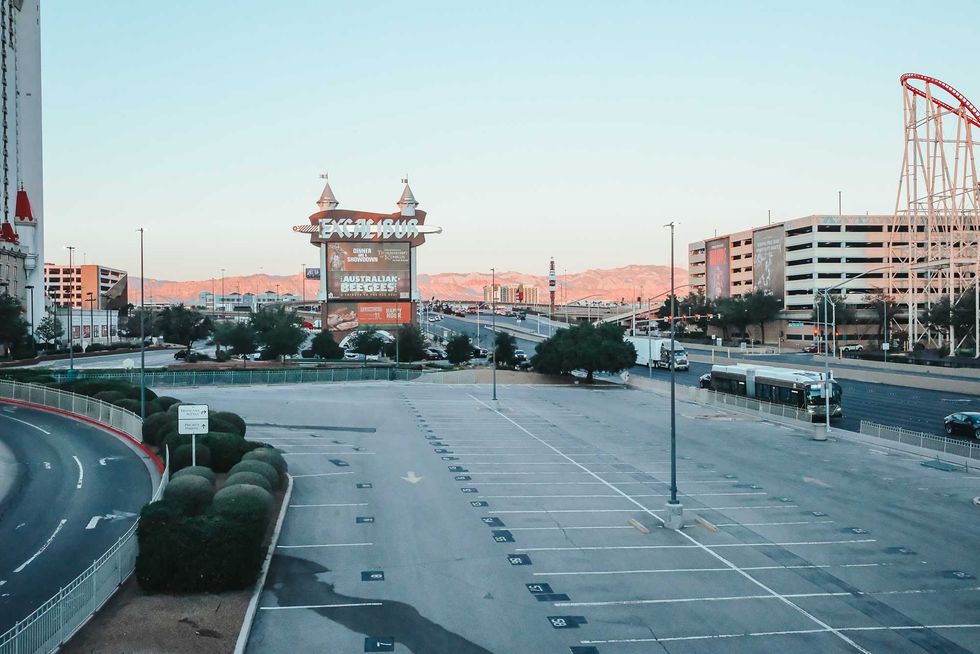
What the ordinary person thinks of as the hard-to-shake foundations of modern life are, in short, palpably slipping away. But could we ever stumble back toward a previous era—a simulation of a premodern safe space? Here, if anywhere, in this city of replicas, one might find a sign . . . Blipping through New York, New York, its roller coaster an all-too-unselfconscious symbol of the rickety rise and fall of the once unchallengeable industrial age, I swiftly reached Excalibur. One stride across the drawbridge’s drained moat below, and I was buffeted by the dankest stereotype of the Dark Ages: the scent. I strolled forward like a jaunty knight-errant, trying not to breathe, or at least smell. The carpets and decor themselves had come out of a time uncomfortably more ancient than even the real Luxor (or the embalmed career of its two big draws, King Tut and Carrot Top). Yes, I mused, judging by the atmosphere, the name of this place ought to be Excabdriver . . .
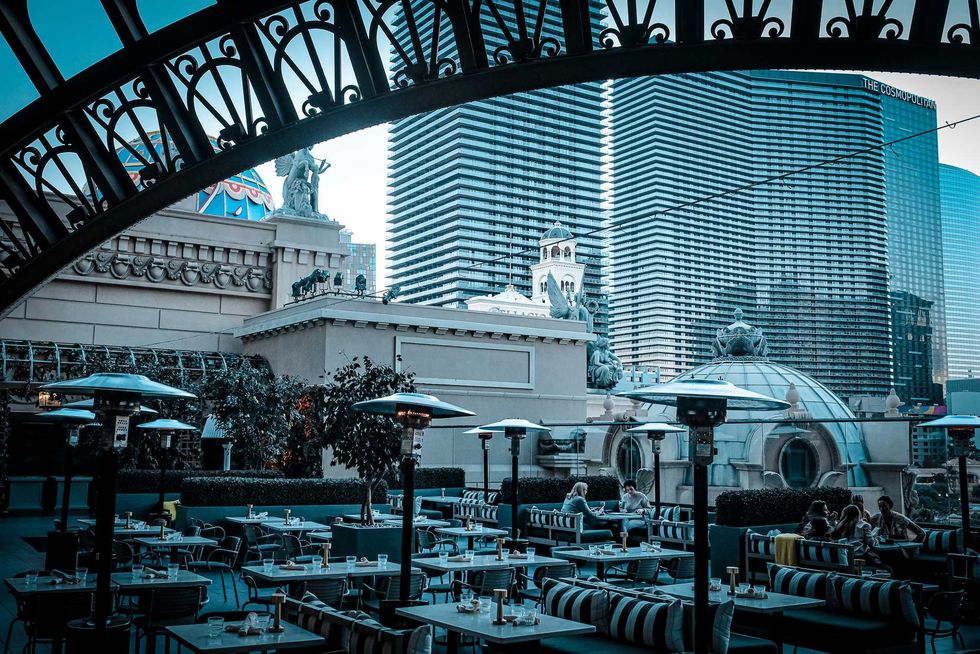 The few diners seemed to disappear into their vacant surroundings. Peter Gietl
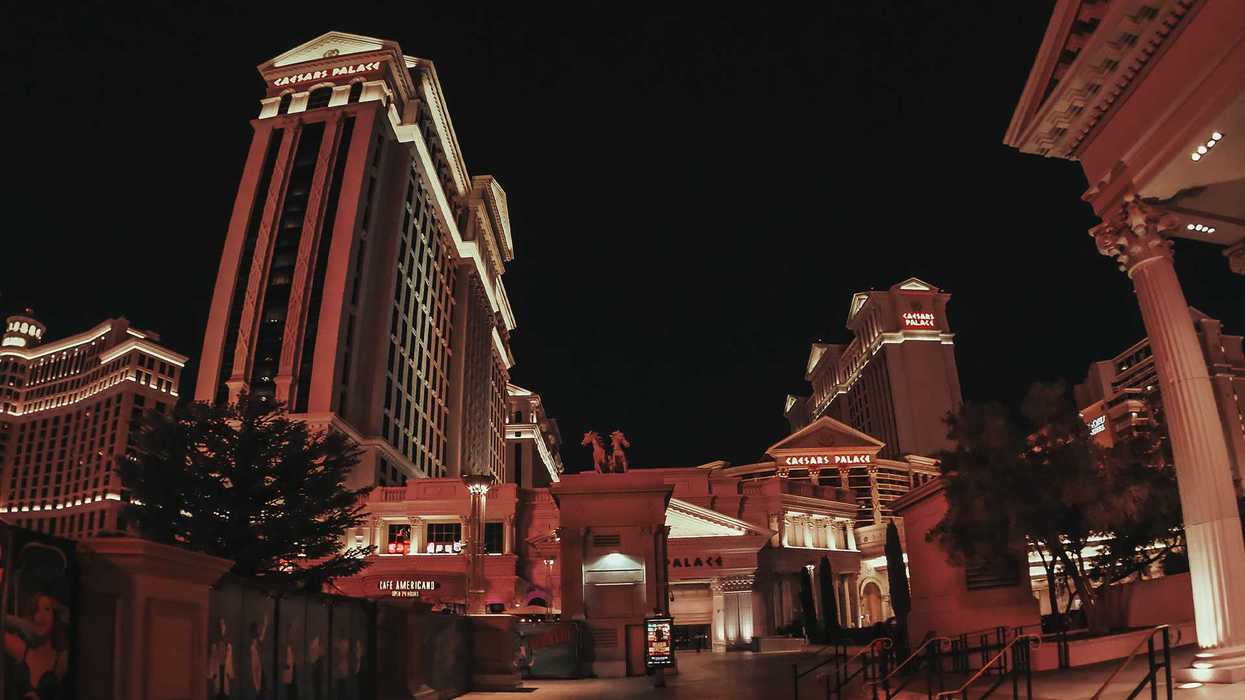
But after clocking the general vibe of a strong and steady collective pulse at Caesar’s, the Cosmopolitan, and the Palms, I realized that the city’s veritable ghost of Vegas Future was unevenly distributed. There were still patrons, amusements, and excitement, still a sense of carefree enjoyment and affable prosociality. More or less balanced people more or less keeping their balance—neither spiraling toward the mummified future, prefigured by the plastinated action-figure corpses of the unending Bodies exhibit, nor the musty, mutton-leg plastic castle through whose halls, also owned by MGM, I had dizzily prowled.
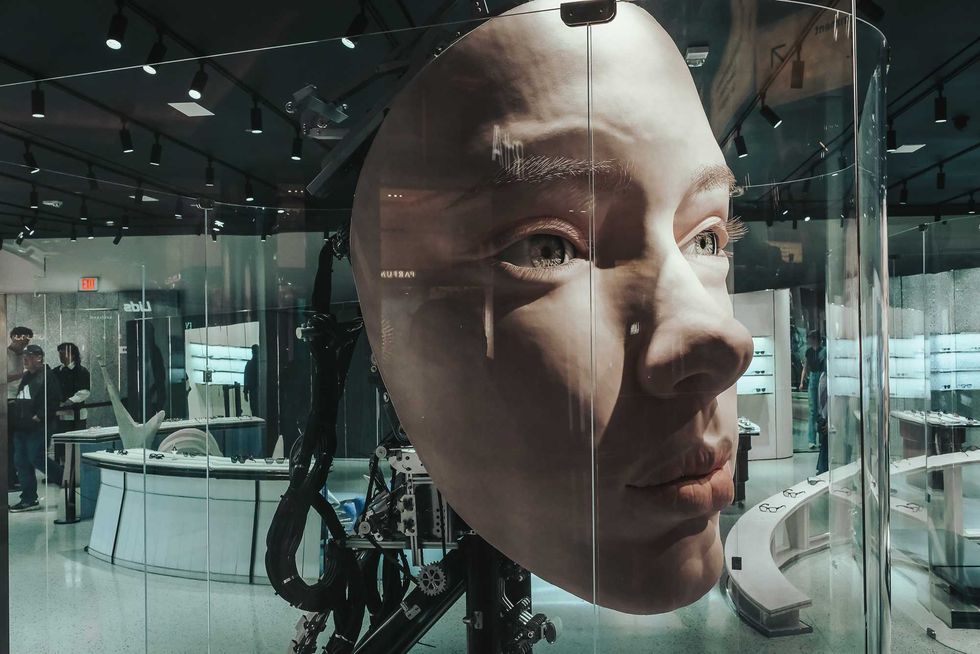
Sure, technology had muscled in on the clammy, sweaty, fleshy terrain of the bargain seeker and the lounge lizard. Yes, the storied shops at Caesar’s were dominated by three gigantic fembot heads, installed in the vast front display space at Gentle Monster, the South Korean luxury sunglasses shop. But for now, at least, the heaviest meatspace presence of proper clankers was a battery of goofy janitor bots, milling around still more aimlessly than the human patrons—enough to cause more than one near-collision (myself included). There was still time for the human race to take its bearings once again, not only to repent but also to rebalance, reinvent, and rebound. Caught up in it all, I felt my cynical critique of the Strip’s medieval casino morph enchantingly into a crash-course brand identity salvage job plan—Shrekscalibur . . .
Who was to say which scraps of the present would fall into loamy soil, decaying into the nutrients nourishing a freshly natal bloom? No, Shrek whispered to me fatly, the death of mystique—is it ever really dead, or just sleeping? Can’t you see its bosom softly rise and fall?—need not occasion a catastrophic erasure of all Mirages, all derelict towers and trivial fond records . . . or at least not only those things. The clearing of debris can open a doorway, a view to a genuine mystery, one that paradoxically offers a genuine promise of new life called forth from the very unknowability of the future, the future identity of this city or any city, perhaps America itself, even, perhaps, you and me. Predicting the future of Vegas, I sensed below the enormous glare of an accident attorney’s mall-mounted digital billboard, its sales pitch beneath his gritty visage reading only “WE WIN”, was no less difficult than predicting the future of America, notwithstanding, at the very least, the uncanny new mystique of machine-powered soothsaying at scale.
Indeed, the more under-the-radar casinos off the Strip are seeing more traffic; the convention scene—from January’s annual Consumer Electronics Show spectacular to the soccer tournament that had the ponytail-and-shinguards girls out in force up and down the Strip—thrums on unabated. The chorus line ladies shilling for pics are fewer on the streets, but so are the homeless, and the pushy orange-robed monk quotient appears to be up. For every show that didn’t make it through the COVID filter, like Spiegelworld’s rollicking, intimate Opium, another, like the group’s bigger Absinthe number, lives on. Prices are high, but so is value—the coffee and the boozy bevvies will knock you back in your seat on both counts. At the Mandalay, the Shining vibe of the untrafficked hotel corridors was countered by the flux of families queuing for grub and streaming toward whatever plans they had for the day, a mystery within each one, each parent and child, however tightly their calendars were scripted. If mystique is something you know that doesn’t really exist, mystery is the opposite, something that does exist no matter how incapable you are of knowing its identity. Know that, and you can begin to trust. Begin to trust, and, whatever the evidence, you can begin to hope.
Buoyed up by the divine thrill of indeterminacy, I threw on a suit—remember those?—for the inalienable satisfaction of a classic Vegas steakhouse dinner: the incomparable (as my associate Peter assured me) Bavette: a Chicago-born exemplar of the form where the hometown location spawned lines around the block and months-ahead reservations. Here in Vegas, our same-day booking only had to wait for the first phase of late night, at 9:30 p.m. The rich, cavernous digs, carved deep into what once was the Monte Carlo and had now been assimilated into the MGM Borg as “Park MGM”, enveloped us suavely, and our waiter—every bit a showman, flamboyant in a way that implicated yet ultimately transcended gender expression—duly catered to our every, albeit modest-for-Vegas, whim. The steak was flawless, the wine list empyrean. Not that we had the sovereign wealth to drink deep and descend into the five-figure end of the cellar. I wondered briefly whether enough ladies who brunch or bachelorista parties could keep such advertised luxuries from gathering too much dust. But having learned long ago, to take one Vegased-up example, that Chrome Hearts shops often make up for a year of inactivity on a single day, when East Asian drop-watchers descend on the new season’s racks and pick them clean by morning, I knew it wasn’t our place to reason why. Ours was but to do and dine.
 Peter Gietl
At another time, in another place, it could have been Peter and me in Hunter S. Thompson’s great red convertible, racing halfawares toward Fear and Loathing. Yokel hitchhiker in the back, somewhere around Barstow, at the edge of the desert, Dr. Gonzo riding shotgun, headed to the Fourth Reich (Circus Circus) with a suitcase of ornately illegal drugs, seeking, and never quite finding, the dark heart of the American Dream. Just an orangutan, riding a carousel, under the big top . . .
It could have been us a bit further back, at the height of the Manson madness, as the ick draped down on the Sinatraverse, a pall spreading out from Tarantino’s Cielo Drive, out across Sinatra’s own Rancho Mirage, clear out to the Vegas of Thomas Pynchon’s mostly-fictional Kismet Hotel—an Inherent Vice plot device inspiring Benicio del Toro’s un-Gonzo attorney Sauncho Smilax to warn that the powers that be intended to oust the Outfit with white Anglo owners on the Strip. Owners like Howard Hughes, whose spirit of de-mobification (technically, mere de-Costa Nostra-fication) could usefully have availed itself—as James Ellroy would depict in tabloid detail—of a couple of enterprising wordsmiths like us . . .
It would’ve felt like only a moment—an insane, irrepeatable phase shift marked out not in calendar pages but in chalk tracings, bodies stacked, strewn, slumped, dissolved, caved in with shovels presently tamping down loose earth hurried into shallow graves somewhere outside city limits: the voiceover Vegas of Scorsese’s Casino—before the bumped-off mobster’s narrator gave way to the inner monologue of the aging bookie lifer, impeccably dressed in the upscale prison uniform at the unhappy medium between the chesty, hairy Mediterraneos and the buttoned-up white boys of the federal persuasion, bearing badge and uniform or, under the ever-expanding purview of agency contractors known and unknown, not. In would march the hordes of families and retirees, into the safe and shiny new resorts power-washed cleaner than any crewcut yokel, guys like us now stewing in a booth at the Dresden on LA’s eastside, now commencing a martini-fueled midnight ride to the swingin’ reenactment Vegas of the young—ah, so young—Vince Vaughn and Jon Favreau . . .
From there, it was only The Hangover to look forward to, sequel after sequel offering little more than lower highs and deeper lows, a copy of a copy, everything Baudrillard had warned about in his poetic French reenactment of Tocqueville’s troubled, hopeful reverie on the enormity that was America. Ours is a space almost inconceivable in its emptiness to the ever-cramped Europeans, its yawning graphlike flatlands visibly interrupted only by nodes of habitation clustered around great edifices: statehouses, in the aristocrat’s time; in high modernity, steakhouses. And in the refactored aftermath, where today’s hungover Vegas now finds itself, colossal replicas, spheres, mirages.
Las Vegas is forever dying, interminably unsustainable, and perpetually preposterous, whether in its Rat Pack incarnation or any other. It is a place impossible to remember—or to imagine—America without. Irresolvable, inexplicable, trapped somewhere in the high, fine twilight between the shameful and the shameless, wack, workaday, whimsical, it poses the more aspirational version of Baudrillard’s rhetorical question to our whole wild country of what are we doing after the orgy. This is still the entertainment capital of America, after all, the crown jewel in that precarious industry, too schlocky for art and too pure for exploitation. Too weird to live, too rare to die . . . how weird can you take it, Thompson loved to inquire, before your love will crack? The decisive question, now, is familiar to every good entertainer, and more than a few bad ones; it is, in a sense, the question now facing us all: What will we do for an encore?
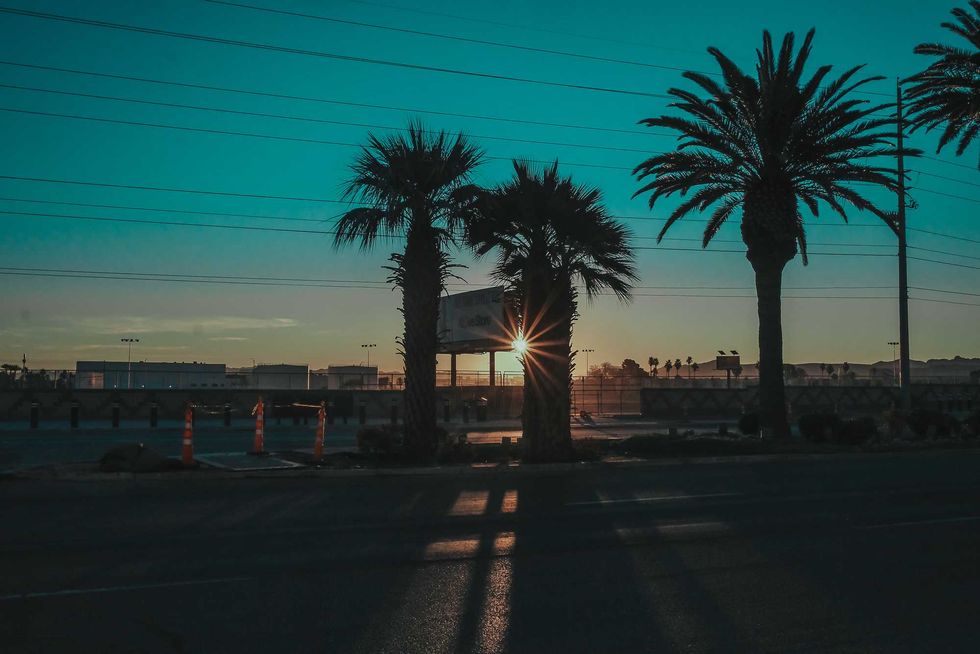 High or low, broke or flush, Vegas forever awaits, and receives, a new dawn.Peter Gietl