© 2026 Blaze Media LLC. All rights reserved.
I. A Drink
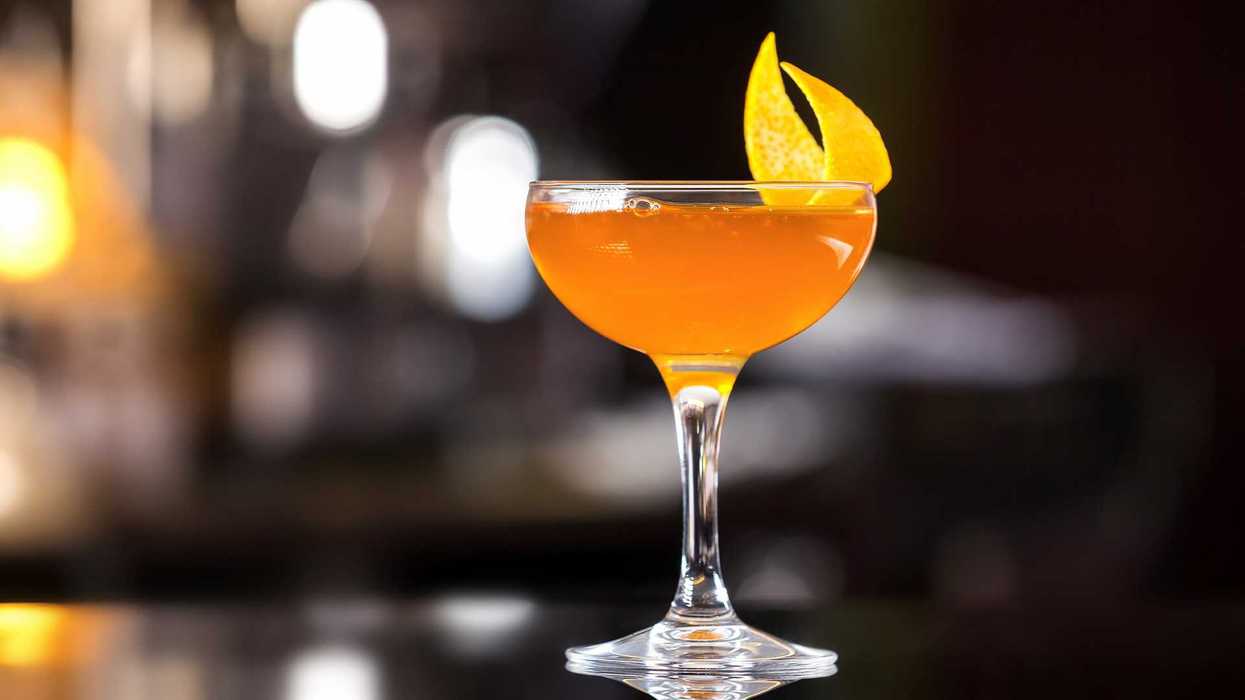
Bleak mid-winter has a grim palette: leaden, cloudy gray, wet asphalt-black, dirty snow-white, bare branch-brown. Even the streetlights don’t glow so much as they moan. The Sidecar shows up as a liquid rebuttal to the gloom, all warm tones—burnished amber, cognac-gold, honeyed copper—that end, if you do it right, in sunlit caramel.
Every drink has its season. The Sidecar belongs to the months when the sky looks personally offended, and the calendar insists you keep showing up anyway.
The name comes from a specific time and place. A sidecar is an attachment to a motorcycle, not so common now. The legend—and it’s always a legend—is that the drink was named after a U.S. Army captain who frequented a bar in Paris, arriving via sidecar.
Is it true? Who cares?
The U.K.-based Difford’s Guide says the Sidecar is “having a moment,” which is funny to say about a drink that first appeared in print in 1922. David Wondrich and Noah Rothbaum, in The Oxford Companion to Spirits and Cocktails, call it “a symbol of sophisticated drinking for a century.” True enough. The Sidecar carries a whiff of tailored clothes and good manners.
It also works in sweatpants while the driveway disappears under snow. Trust me.
The combination stays almost insultingly simple: brandy, curaçao (triple sec), lemon juice. That simplicity invites endless arguing. How tart? How sweet? How much cognac? Sugar rim, or no? A Sidecar can feel sharp and exacting or soft and forgiving. Same drink, different temperament.
Here’s the version I keep coming back to:
• 2 oz. brandy (I favor Lecarré VS French Brandy)
• 1 oz triple sec (Cointreau works beautifully)
• 3/4 oz fresh lemon juice
• Shake hard with ice
• Strain into a chilled coupe
• Optional: sugar rim (half-rim if you want manners; full-rim if you want comfort)
• Garnish with a thin citrus peel (I prefer lemon)
No foam. No smoke. No preposterous garnish. The Sidecar doesn’t need staging. It requires a cold glass, fresh fruit, and a brandy you respect.
In winter, this cocktail offers 10 minutes of warmth and brightness while the world outside keeps its bleak palette. It won’t shovel the driveway. It won’t restock the lemons. It won’t resupply the ham. It will, however, make the room look slightly more habitable.
A drink like that deserves a literary companion.
II. A Book
The Ombibulous Mr. Mencken, by Roy “Bud” Johns, is a long out-of-print “drinking biography” of the Sage of Baltimore, published in 1968. Johns didn’t write Mencken’s life story so much as Mencken’s drinking story, with the rest tacked on as supporting evidence.
He opens with a line that snaps like a fresh towel behind the bar: “I’m ombibulous. I drink every known alcoholic drink and enjoy them all.”
It sounds exactly like Mencken—and also a little too perfect, the kind of quotation that might have been sanded down for maximum repeatability. Suspicions like that are healthy. They keep a man from becoming the sort of person who posts “quotes” on the internet over photos of Abraham Lincoln or Franklin D. Roosevelt—HLM’s mortal enemies.
Writers repeat themselves. Columnists repeat themselves most of all. Deadlines show no mercy, and a long career means you revisit your best convictions and your best lines. Mencken did. Some sentences earn the privilege of reappearing.
In The Smart Set in 1920, he wrote:
As for me, I am prepared to admit some merit in every alcoholic beverage ever devised by the incomparable brain of man, and drink them all when the occasions are suitable—wine with meat, the hard liquors when the soul languishes, beer on jolly evenings. In other words, I am omnibibulous, or, more simply, ombibulous.
Ombibulous beats omnibibulous, even if omnibibulous carries the cleaner etymology—omnis (all) plus bibere (to drink). The accurate word trips over its own shoes. Ombibulous walks in like it owns the place. Mencken knew when to choose music over pedantry.
He also knew how to speak plainly about appetite. “I drink exactly as much as I want, and one drink more,” he told one correspondent—a small confession with the dignity of arithmetic.
He wasn’t a prude about other people’s habits either. In his late-life notebooks, published as Minority Report in 1956, he mocked the drinker with violent likes and dislikes—the man who insists Scotch heals the kidneys while rye corrodes the liver. Mencken shrugged at the moral bookkeeping and returned to the same broad principle: he could “admit some merit” in every alcoholic beverage ever devised.
Whoops! The line returns!
Which means Johns didn’t need to improve anything. In Mencken’s final recorded interview in 1948 with Donald Kirkley for the Library of Congress, he circles back again, this time in ordinary speech:
HLM: I’m actually ombibulous. I drink every known alcohol drink.
Kirkley: What was that word?
HLM: Ombibulous.
Kirkley: That’s a very fine word.
HLM: I drink every known alcoholic drink and enjoy ’em all.
So there you have it. Johns didn’t invent the voice. He bottled it.
I found Johns’s book 35 years ago in a now-defunct used bookstore in Venice, California. The copy I found came with special provenance. The author didn’t sign it. Its previous owner signed it: Stan Getz.
A Mencken drinking biography that once belonged to a cool-jazz saxophone immortal? You don’t ignore a coincidence like that. You follow it.
III. A Song
Stan Getz gets flattened into a single cultural artifact: “The Girl from Ipanema,” the bossa nova postcard that never stops arriving. Great song. He earned the fame and the money. He didn’t deserve the confinement.
Focus (1962) sits outside the postcard rack. Eddie Sauter wrote it as a seven-part suite, a set of “fairy tales” for strings with space carved out for Getz to enter and improvise. That’s the premise: composition builds the room; the saxophone tells the truth.
The album opens with “I’m Late, I’m Late,” and the title comes straight from the White Rabbit’s song in Disney’s Alice in Wonderland, not the book. Lateness isn’t a metaphor. It’s a declared theme.
 Wim van Rossem
The track carries urgency from the first bars. Strings tighten the air. The tempo pushes. It’s rushed. Listen to it on your commute. Getz arrives with that tone—clean, steady, cool—and it lands like a man speaking clearly while other people start talking faster.
One detail sharpens the pressure: “I’m Late, I’m Late” is the only movement on Focus with another jazz musician. Roy Haynes plays brushes, the lone additional solo presence in the suite. Those brushes don’t show off. They keep time in the periphery. The clock stays audible without becoming obnoxious.
Then comes the best fact of all. Getz recorded two complete takes of “I’m Late, I’m Late.” Both came out fresh. Both came out different. Nobody could choose—so the story goes—so they spliced the takes together and kept them both.
Which brings me to my own confession: this piece arrived about three weeks after the deadline. The joke wrote itself the moment I saw Stan Getz’s name on my Mencken book and remembered this track existed. White Rabbit energy. Late, late, late.
Fine. Guilty. Sorry, fellas.
But “I’m Late, I’m Late” offers a better defense than an apology. It suggests a rule worth keeping: Show up with something alive, even if you’re tardy.
CAPTIONS:
The very nearly perfect Sidecar (sugar rim not pictured).
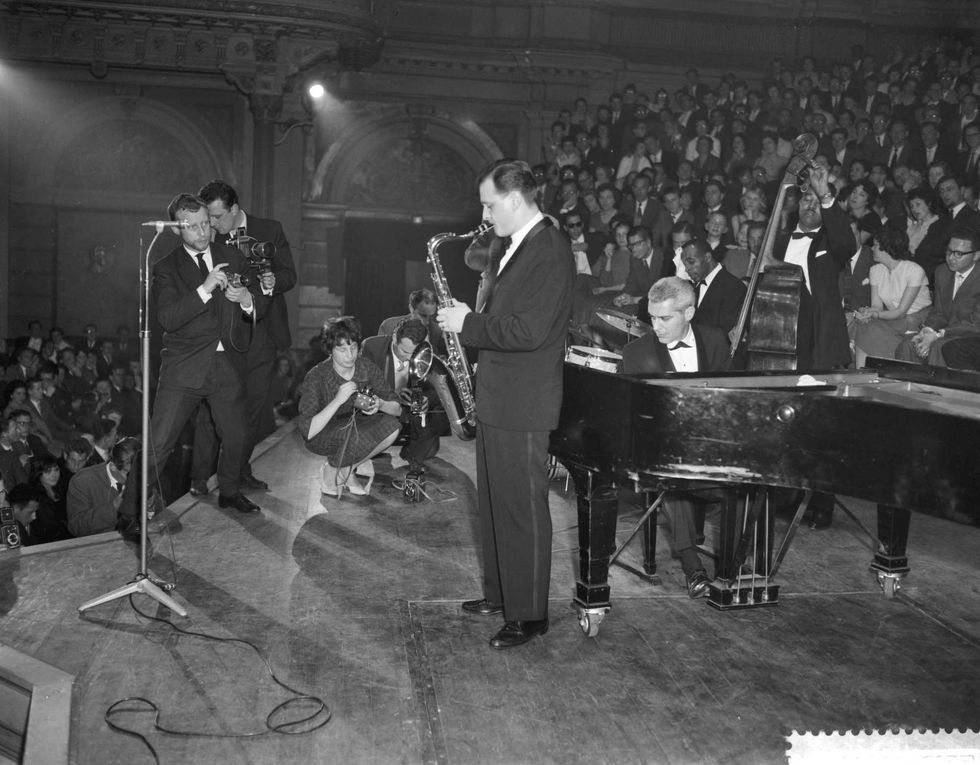
The crowd gets the Getz treatment.
Want to leave a tip?
We answer to you. Help keep our content free of advertisers and big tech censorship by leaving a tip today.