Mike Mercury
If I wanted to meet members of the Camorra—the fractious criminal network in Naples—an Italian friend from Tuscany suggested that I first look for a priest. “The priest always knows the criminals in his neighborhood,” he told me. And while riding my motorbike in Scampia, the suburb known for Camorra’s dominance, I took my friend’s advice and found a sacred place.
The church was not what I was expecting. It was architecturally neither Baroque nor Gothic nor Renaissance nor Romanesque, all the styles that continue to awe me despite being so commonplace in Italy. Instead, this church was built from concrete: stark, cold, imposing. Unmistakably, it bore the mark of Brutalism.
In my eyes, Brutalism seemed out of place in this Mediterranean climate and at odds with the local sensibility. It was too rational, too passionless, too cynical, too severe, and therefore antithetical to the Italian mentality.
The church resembled a military bunker. The windows looked like embrasures. The entrance staircase descended underground, finding shelter. And the building was surrounded by a green, wrought iron gate. This barrier, I soon found out, was to prevent Scampia’s neighborhood children from riding their motorcycles onto the roof of the church.
I parked my own motorcycle beside the church. Some laborers were loitering near the entrance. I asked them to call for the priest. He soon arrived. The priest, at first glance, was unlike other men of the cloth. This was true in a quite literal sense: his all black windbreaker, jeans, and sneakers were more urban than pastoral. The only contrast was the clerical collar, which provided a white accent and was casually unfastened around his neck, like a bowtie that has been loosened at a wedding after the dancing starts.
Father E— was in the middle of some construction. A pipe had recently burst and flooded his church. Now, unrelenting jackhammers shattered the concrete floors, revealing the unfaithful plumbing, which made conversation impossible and the air taste like chalk. I followed the priest around like an obedient dog, trying to get his attention and telling him a little about myself, as he directed his laborers with a foreman’s authority. He didn’t seem to harbor any suspicion because, within five minutes of meeting him, I watched him hand over an envelope of cash to a local official. I gathered that his parish needed access to the municipal water line. With a knowing smile, as though anticipating a surprised foreigner—one who has observed a holy man paying bribes in broad daylight—he told me, “It’s how anything gets done here.”
It didn’t take long for me to realize that this priest was something special. He was suave, deliberate, and carried himself with an undeniable sprezzatura. His was not the performed indifference of a man who self-consciously seeks approval and therefore betrays his whole affectation. No, Father E—’s carefree grace was solid, central. It seemed almost to say something about his religious faith; a cool indifference towards worldly affairs, as though our planet was merely a layover. And I didn’t have to explain to Father E— why I wanted to meet the Camorra. “You want to meet them?” he responded. “Follow me then.” Just like that, I had my introduction.
Antonio was a real gangster, not a sensitive young man. Or so I thought.
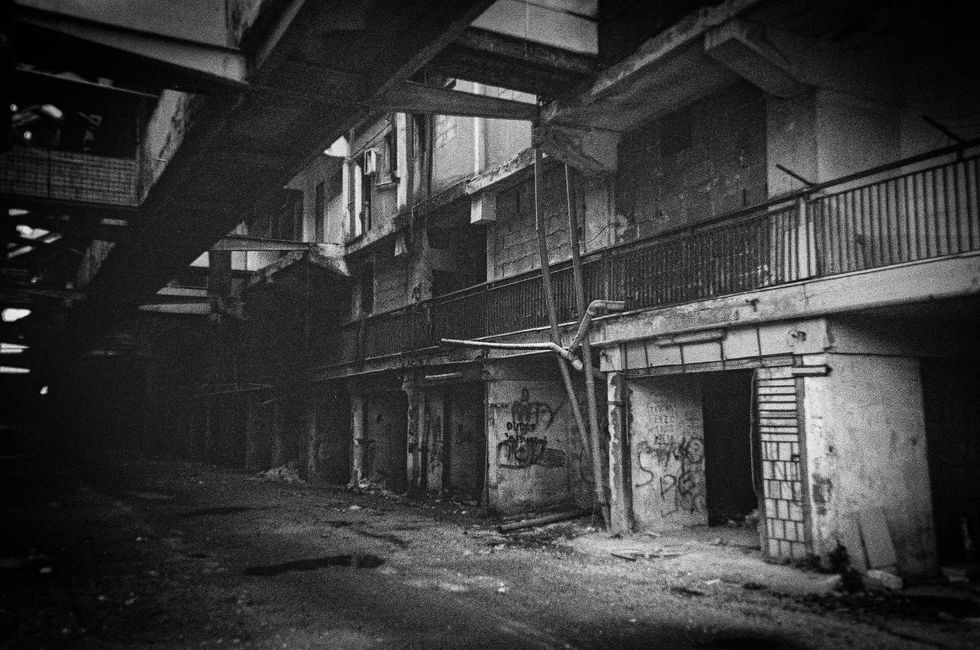
The priest shared lore about the neighborhood as we crossed the church’s parking lot toward the courtyard of an apartment building. The building was once controlled by the legendary clan leader Paulo Di Lauro, whose drug trafficking alone generated more than €500,000 per day at its peak. I had heard about this golden era a week before from a group of former gangsters. They nostalgically recounted ostentatious sights such as when Ferraris circled the neighborhood. That was well before the notorious Scampia feud, a protracted gang war that brought the Camorra to its knees. Now, a far more common sight of transportation is the horse and buggy.
“Here, first we’ll meet some local drug dealers,” Father E— said. The second floor of the apartment building had a continuous wraparound balcony facing the open quadrangle, all connected and undivided, accessible via several outdoor staircases. We walked up a flight of stairs and found a transexual cradling an infant while on sentinel duty. Drug dealing was a community effort here. Even the little nonna who was perched on her windowsill was scanning the streets, not only from boredom, but also to survey the environment for furtive police and encroaching rivals. She had to protect her grandchildren as well as her family’s livelihood. Someone has to bring home the pancetta.
The transexual eyed me with distrust as we approached. “That’s not your baby,” the priest jested, without malice. To my surprise, his joke provoked a deferential smile on the transexual’s face that contradicted any masculine posture. Father E— then caressed the sleeping newborn, cooing and murmuring. In the meantime, I became distracted by three happy kittens playing under a plastic chair. I crouched down and gave them some affection. Looking around, I then caught the stare of two unflinching eyes.
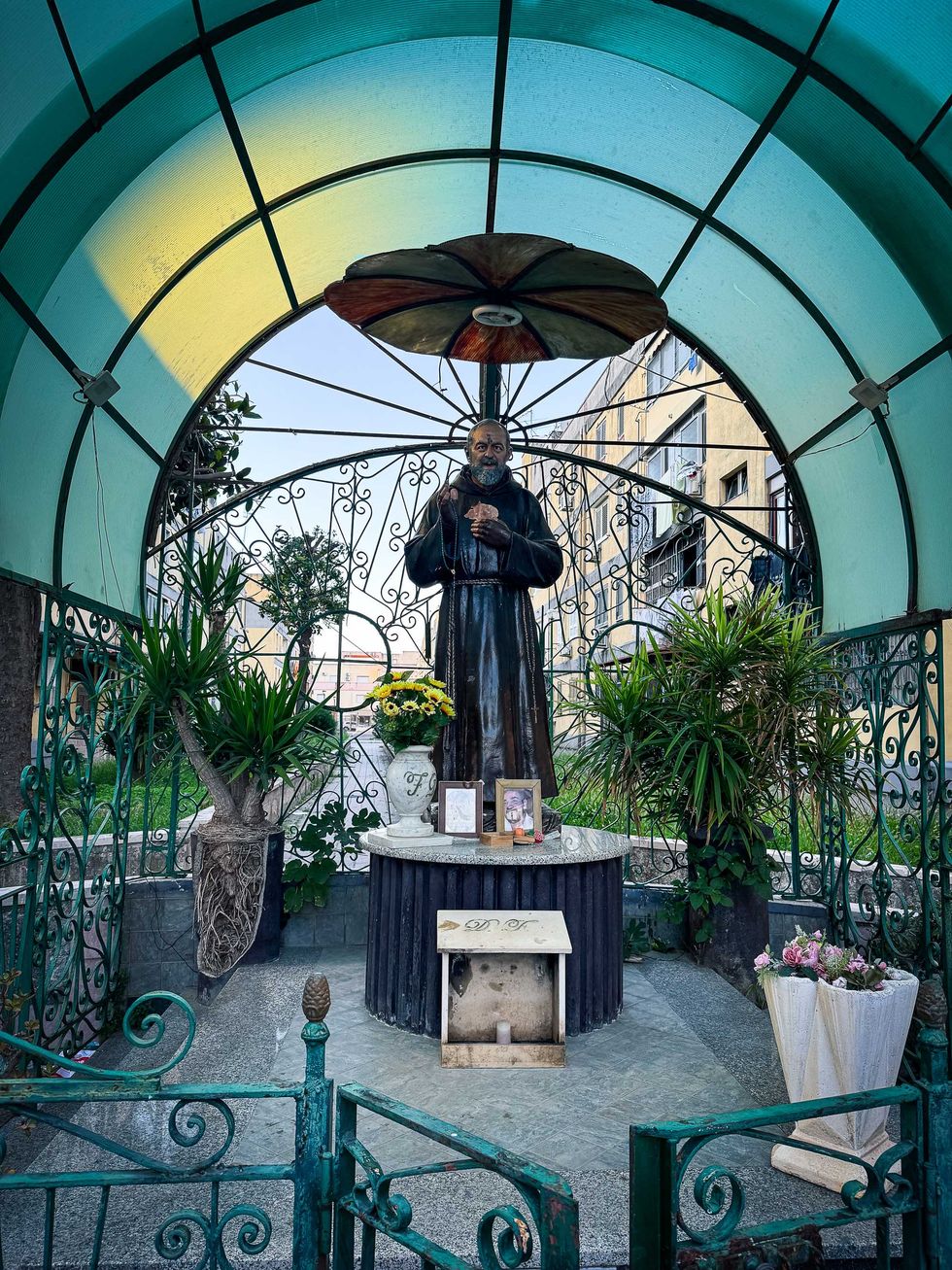
It was the Virgin Mary. Her statue, placed against the wall with other religious paraphernalia, was looking down on us. Her position meant that she was perpetually, piously gazing in this direction, toward a seat that normally hosted a drug dealer. The Mother of God was placed there a long time ago, when Scampia’s residences were built for working-class commuters. But she was now stuck overseeing countless unholy transactions. I smirked to myself at this ironic situation. Weeks later, I would reconsider this sight and arrive at a more hopeful interpretation. With the chair’s back towards the statue, along with the peddler who usually sat there, only addicts faced the Virgin Mary and received her benevolent gesture. Maybe, through her painted eyes, these poor and pathetic creatures saw the possibility of redemption, that it was never too late to reconcile with God. Perhaps the Blessed Mother would still intercede, even as she watched these wretched addicts, day after day, trade their souls for artificial paradise.
The priest called out to me. No one here was worth my time. So we continued our walk.
Antonio was sitting outside a grocery store in the open quadrangle of the complex. Unlike the swarthy men typical of Southern Italy, Antonio was blond with blue eyes. He was young, only twenty years old. Father E— asked him several questions. The speed and unusually low volume of the conversation made it very difficult to understand. But whatever the priest said, it worked, because Antonio asked me to return later. We exchanged phone numbers. And my luck was still better. Antonio spoke fluent English, which was even rare among the most educated Neapolitans. Several hours later I received a text from Antonio asking for my location. I sent him a picture and a few minutes later, he responded: “I’m behind you in the black Fiat Panda. We’ll go someplace else. I don’t want anyone to see us.”
 Mike Mercury
Logic has little use here. The sharp and penetrating reason that gives mankind its advantage over other animals and over nature, so incisive elsewhere, somehow becomes dull and flaccid in Naples. Here, the blade of rationality doesn’t bite; it slips, and if forced to perform, it cuts the hand that wields it.
Instead, one understands this city better through more sensitive instruments, inborn feminine ones, rather than through the tools discovered or invented by men. In my limited experience (having only visited three times), I’ve found that Naples only reveals her inner secrets when approached through speculation and feeling, through intuition and attentive perception, and never through skepticism or scrutiny. Whenever those impartial perspectives are searchingly applied, Naples recoils, as though sensing the disenchanting effects of vulgar objectivity.
It’s why Naples is often called controsenso—commonly translated as “nonsense,” though the literal translation, “against sense,” better conveys the more active negation at play. It’s not merely that Naples cannot be understood, it’s that she resists being understood. Yes, she. Because Naples is a woman; a seductive and flirtatious woman; a dangerous enchantress. Just like Parthenope, the Siren after whom this curvaceous bay was named when the Greeks first arrived. Parthenope, who, having hurled herself into the sea in jilted anguish after failing to entice Odysseus, washed up on these shores . . . dead.
Why the Cumaeans chose to name their new settlement after a suicidal Siren, who knows? It would seem like a bad omen, especially for the superstitious pioneers of Magna Graecia. But one can assume they had their reasons. Maybe the name wasn’t aspirational but descriptive. Maybe, upon arrival, the land itself emanated feminine pain, chthonic seduction, intoxicating beauty, and anguished love. Whatever the original inspiration, history has consistently confirmed Parthenope’s haunting presence. Almost as though her vengeful spirit never found respite, in death or afterwards, and instead inhabited every woman born to these shores—explaining how Parthenope’s daughters inherited the instinct of luring men and bringing them to ruin.
For nearly 3,000 years, countless valiant men of great European civilizations have come to the Bay of Naples. All were spellbound by her beauty, and each new kingdom vanquished the last in pursuit of sovereignty. But no one prevailed. As Parthenope would have wanted, every powerful race eventually fell, departed, or was subsumed by the nebulous, Neapolitan, mongrel mass. And despite her incorrigible infidelity toward mankind, she fostered their orphans and raised them as her own—much like the she-wolf who nursed Romulus and Remus. There’s clearly a reason why Italian men worship their mothers, and nowhere outside of Naples is this faith more strongly demonstrated. Mama Vita Mia (“Mother My Life”) is apparently a common tattoo among Neapolitan prisoners.
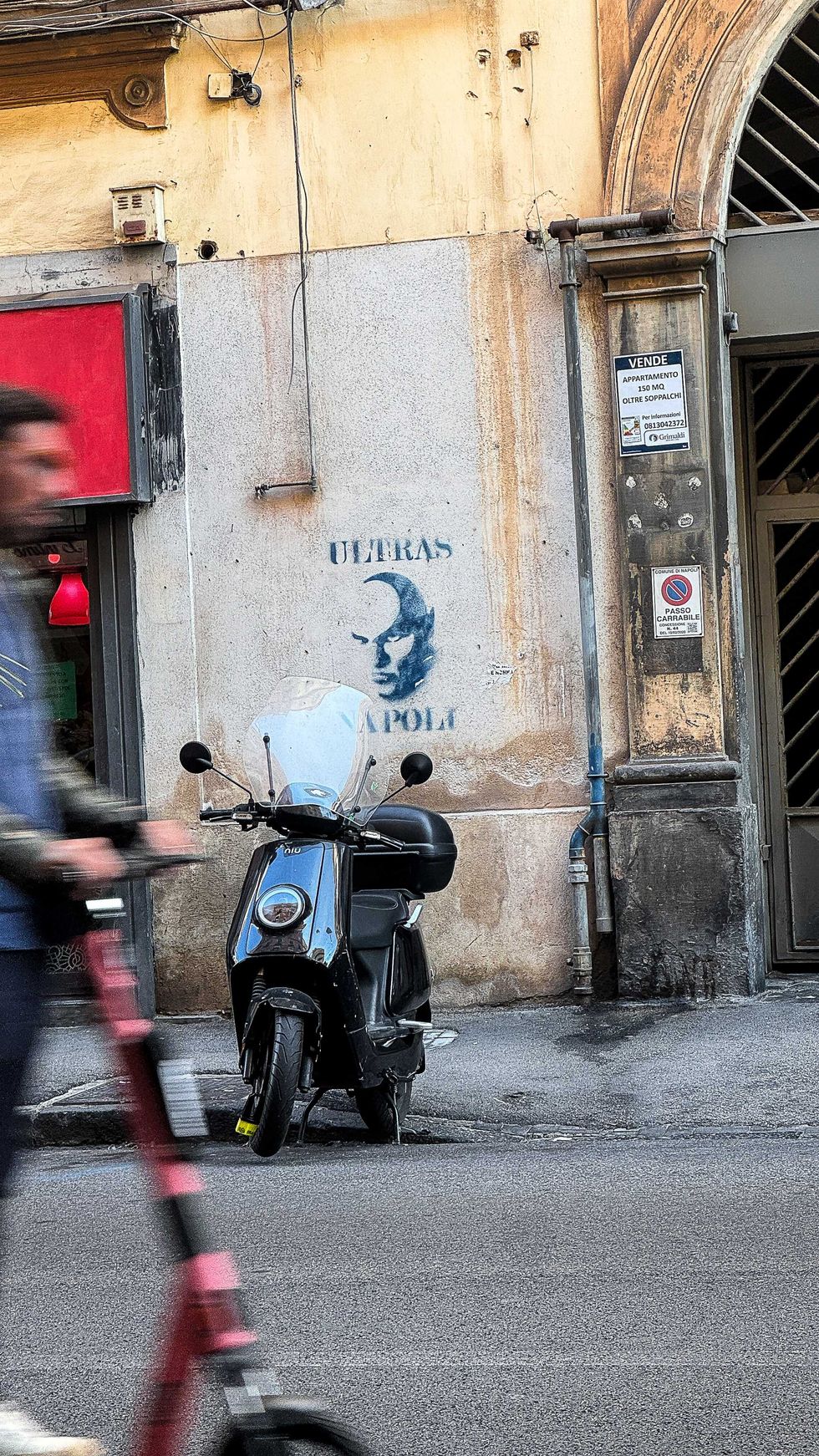
The city’s tenant history is indeed dizzying: Greek, Roman, Byzantine, Norman, German, French, Spanish, French again, and Spanish again. No one lasted. Then it was unified into Italy. However, Neapolitans today still squirm when they are held and they remain insubordinate. Everywhere there are signs and graffiti which read: Napoli non è Italia (“Naples is not Italy”).
Even the Neapolitan language reveals the feminine, chaotic spirit of Naples. According to linguists, it’s so distinct that it’s considered a different language altogether rather than merely a dialect of Italian. I don’t know either language well enough to make any technical claims, but some differences are obvious to my ear and reveal the mother behind the tongue.
Italian has a musical rhythm from stressing each vowel between tight-lipped consonants, which gives its phonetics a predictable contour and smooth roundness, climbing and falling, suspended and always floating, and, when spoken softly, breathes like heaping clouds drifting over undulating grasslands. It’s a gentle and idyllic image because Italian nurtures sound. It cradles and rocks words as they form in the mouth, as though tumbling phonemes into perfect spheres, which then leave the lips with an elongated inflection, like little sparrows taking flight from their mother’s nest. It’s no surprise, then, that Italian is a language of celebrated courts, political philosophy, and religious poetry.
Here, the blade of rationality doesn't bite; it slips, and if forced to perform, it cuts the hand that wields it.
But no, not Neapolitan, which is Italian corrupted with absurd syncopation, exaggerated double consonants, and a staunch refusal to elide final vowels. Compared to highfalutin Italian, which seems high and noble, Neapolitan seems much closer to the ground, like a drunk farmer’s calloused tongue that’s used to issuing slurred commands to the soil, to stubborn livestock—to animals that will never understand semantics but will learn to associate certain tones with a lashing.
Evidently, Naples cannot be fully conquered, only temporarily occupied. Sure, Naples has indulged the occasional dalliance, but rarely for long and certainly not forever. She is unlike that faithful wife, who, even long after her husband’s death, continues to honor his memory, wearing black to demonstrate her commitment to widowhood. Naples is more like an impulsive mistress—her affections first burn intensely in a raging blaze of passion. But this fire quickly dwindles, before eventually going cold, after which she leaves for a new admirer who she thinks will reignite her flame. Naples moves on very quickly. That’s how, after enduring so much suffering, she continues without complaint. On the Bay of Naples, tomorrow always promises another sunrise.
From the architectural diversity alone, one could rightly accuse Naples of promiscuity; however, no one can admonish her for any hypocrisy. Naples does not repress her memory or bury her sins. All across the city are beautiful buildings and ruins from past eras. Each monument reveals a previous ruler—a ruler who thought himself to be Naples’ permanent master, and each monarch who built monuments under the same delusion. And for this fact, she shows no shame. She instead continues to wear the gifts and bear the scars, equally, from the hands of brutal lovers, who, all gone now, have left her an old woman with too many secrets.
Of course, her past indiscretions show on her body. Naples is an old mistress. Her face is wrinkled and flaked. In every neighborhood, including the wealthiest ones, the paint peels from buildings and the plaster sloughs off like dead skin. And she is not only surface damaged. Her bones are fractured, too. Her joints are arthritic. Huge cracks split the roads and sidewalks. But she has aged well, and her adulterous past has given her an experienced charm.
The most beautiful examples are in Posillipo, where stunning palaces were built along the water’s edge, on foundations laid half a millennium ago. The sea has undermined these glorious residences, and their façades have crumbled in the ocean breeze. But those flaws have not diminished any of her beauty. They have instead given Naples her enchanting character, like a handsome fisherman with a weather-beaten face, who is actually enhanced by his deep furrows and rough skin. Naples and the fishermen are not merely fastened by the simile alone, either.
By observing their uninterrupted work and private contentment, it’s not unreasonable to suppose that it’s only fishermen for whom Naples seems to have lasting respect. Civilizations cycle, flags rise and fall, men have struggled to tame and temper Naples.
So why does she not haunt and ruin the lowly pescatore of all men? Maybe because they never take too much from the waves that lap her shoreline. Or perhaps because they’ve learned, from observing the countless ships that have arrived at this bay full of optimism, that controlling Naples is a fool's errand. Whatever the reason, the fishermen are tired anyway.
They must contend with the temperament of the sea, another fickle and dangerous mistress. That’s enough hardship in one life. And so for them, Naples is a place of repose, not conquest.
Perhaps it’s the fisherman’s oblations to her memory, which are performed unconsciously, every day. His ritual of retrieving corpses from the sea, at dawn, becomes the symbolic reenactment of Parthenope’s arrival and this city’s founding. Because just as the gods are pleased when men imitate their heroic actions, the muses are flattered when their stories are retold. And perhaps Naples adores a fisherman because he silently recounts her myth in the crepuscular morning, faithfully and without an audience, before her daughters awake and while the sun softly rises.
 Mike Mercury
Bruno runs an after school program in Caivano, right at the entrance of the Parco Verde neighborhood and between many social housing complexes. Caivano has a bad reputation. Not too long ago, Italian prime minister Giorgia Meloni singled out this little neighborhood of 6,000 residents after two little girls were allegedly raped by 15 other elementary school children of a similar age. Meloni addressed Parco Verde as the place where she would “make citizens feel the state’s presence” and dispatched thousands of armed authorities to raid Camorra homes and make arrests. Bruno doesn’t think anything has improved. There are too many problems. Besides the widespread poverty, which means most people lack cars while living in a suburb, Parco Verde is plagued by an astonishingly high rate of cancer, an endemic malignancy caused by the dumping and burning of toxic waste. Any neighborhood where the murals convey hope and peace through vivid primary colors—such as the painted cartoon on Bruno’s afterschool wall, where happy children of every race are depicted holding hands and standing upon the circumference of the Earth—it’s a sure sign that things are pretty bad.
Bruno used to be a boss, or capo, in the Camorra. That was before languishing for 12 years in prison. He served his full sentence because he never collaborated with any police or prosecutors. His silence—or omertà, as it’s called here—received the magnanimity of the Camorra, who let him walk away without any recidivating obligations.
And with his new freedom, he began redressing his sullied past. He created a program to dissuade other children from entering the malavita—compounding of “bad” and “life”—and a common term used by both the Camorra and its opponents, which specifically describes the grim existence of operating in the underworld.
With this initiative, Bruno started working against the Camorra, if only by depriving them of future membership. A perilous attempt at redemption indeed. Bruno showed me a school bus that he recently bought for the children. Really, the bus was only a metal skeleton. The Camorra had drenched the vehicle in gasoline and then set it on fire, leaving Bruno a scorched warning. In retaliation, he filled the blackened bus with colorful flowers. It was the kind of defiant symbol that government committees and endowed charities love to support. Bruno was clever.
He has the kind of indefatigable enthusiasm that’s unique to short men. It was as though Bruno’s blood pulsed too forcefully, for how little distance it had to travel, leaving him a surplus of energy, which he then discharged through exaggerated gestures and restless conversation.
Walking through Parco Verde, Bruno recounted his biography. He began his life’s story with the regret of never receiving an education, which was without doubt a disadvantage. However, as he lamented his penurious childhood, in which the malavita offered the best opportunities, I thought that Bruno might be overestimating the value of classroom instruction. It’s a mistake that uneducated people seem to make again and again. What’s more, he also underestimated his own education under the Camorra.
It’s doubtful that his strengths, such as his commanding aura and his ability to juggle competing priorities under stress, could have ever developed under the auspices of a schoolmarm.
I would, in fact, wager that his unwritten curriculum vitae—managing violent criminals, providing them with directions, and resolving their disputes—made all subsequent forms of leadership, cooperation, and diplomacy rather easy. He was clearly competent at managing discontent. At least all the residents of Parco Verde thought as much, since they approached him with all their problems. Even though Bruno no longer held the title of capo, he never lost his status as a tribal chief.
As we passed apartment after apartment, Bruno was beckoned from both doorways and windows. First, someone had wrongfully occupied a parking space. Bruno would have to be the parking authority. Soon enough, another issue demanded his attention. A man explained that his neighbor was dumping garbage on his doorstep. Bruno would have to enforce proper sanitation. Near the end of our neighborhood tour, an old woman hissed at us. She was upset that I was being shown around. Bruno would have to reassure her later.
His phone also rang constantly. One of the buildings had been raided recently. Large quantities of drugs and several guns were found. However, the police were unable to apprehend every suspect, and because several Camorra members continued to live inside, the power was cut for the entire complex. As collective punishment, the apartment’s civilian population had been without heat or light for almost a week. Unsurprisingly, these measures don’t exactly buy goodwill. Most locals with whom I spoke—in Scampia as well as in Caivano— distrusted the government more than they despised the Camorra.
Bruno felt this way too. He gave me more context to the scandal that received national attention and the prime minister’s intervention. The story was more lurid than publicly recorded, in which the rapist children were culprits, sure, but also scapegoated and sacrificed for a coverup. It was the school janitor who first began raping the girls— his own granddaughters—several years before. But the janitor was never charged or brought to trial because of his ties with the principal. And this was only the beginning of the corruption. Though maybe less obscene than two girls ravaged by their classmates, there was something more systemic and pernicious taking place, which halted any progress in Caivano.
The very same principal, along with the entire school board, preferred truancy over educating pupils, since every absent student guaranteed funding from the European Union. It was a system that encouraged dysfunction. The incentive structure made sure of it: bad outcomes for students, more money for administrators, more children entering the Camorra.
However important, my mind was fixed on the horrific incident.
“Why hasn’t the Camorra done anything to achieve justice?” I asked in disbelief. “Do they know about the incestuous pedophile?”
Yes, they know. No, they haven’t lifted a finger. The Camorra, Bruno told me, only cared about their balance sheet, and any extrajudicial killing, however noble, would have invited police attention and compromised their profits.
“But what about honor,” I insisted, “that sacred and inviolable code that raises Italian criminals above petty thieves and peddlers?”
“That’s a romantic idea, which died a long time ago,” responded Bruno.
“When?” I pressed, not expecting Bruno to provide an exact date: November 21, 2004.
On that day, in the midst of the notorious Scampia feud, a young woman named Gelsomina Verde was abducted and tortured, then shot and set aflame. Her crime, unmeriting such brutal treatment, was having had a romantic relationship with a low-level secessionist, a man who betrayed the established Camorra and joined the rival faction that opposed Di Lauro’s authority. But she had not collaborated with the enemy, and her abductors knew it. Only her heart had been perfidious. But something had changed in the air. Previously, women and children were off limits. Not anymore. Gelsomina’s corpse was found as charred as Bruno’s school bus. Soon after, Maria Licciardi, a woman and Camorra boss, allegedly (apocryphally?) delivered a simple verdict that continues to echo in the Neapolitan hinterlands, and which Bruno repeated to me: the code is over.
 Mike Mercury
Naples is a place where one must constantly impose one’s force of personality upon others; Neapolitans value charisma above all other qualities. Men are loud and gregarious and generous. Women are severe and flirtatious and warm. Both are constantly playing with each other, and not in the coy Northern European way, which is subtle and intellectual and elegantly posed, but in the mezzogiorno way, which is bold and corporeal and self-abandoned.
One can even understand the value placed on personality by driving around on a motorbike. For me, it has always been the most intimate way of feeling Naples. It’s dangerous, obviously. Many of the steep, serpentine roads are made of volcanic rock, which has been dimpled by hammer and chisel to provide more traction. But when the cobblestones are wet, it’s easy to slip and fall. The third time I ever drove a motorbike was in Naples. I pulled the front brakes too abruptly during a torrential downpour while entering a roundabout in Vomero after a long afternoon driving around the Amalfi Coast. On the back seat was my then-girlfriend (now-fiancée). The bike slipped out from under us, and my girlfriend’s little wrist fractured against the hard, wet stone. A group of men immediately rushed over. They helped my girlfriend to her feet.
One even brought over a cone of gelato to assuage her shock. In the meantime, two beautiful women magically appeared to wipe down our scrapes and sanitize our road burn. They were pharmacists who had witnessed the crash from their storefront. They affectionately reprimanded me, in incomprehensible Neapolitan, while patting me down. Do things get more cliché? However, this accident was hardly unusual. Just a few years later, I recommended the activity to two friends. They both crashed their bikes almost immediately.
And it’s not only the infrastructure that puts one in danger. It’s also how people drive, which, compared to Northern Italy, is much looser and more disobedient: red lights are optional, stop signs are ignored, lanes are imaginary, and no one yields to prioritized traffic when entering a roundabout. All the rules that are meant to make driving a little safer have been disregarded by the entire population. Even the Carabinieri, the national gendarmerie of Italian law, allow in Naples what elsewhere is criminal.
The real problem now, they complained (perhaps displacing their own guilt onto others), was the Baby Gangs.
But it all works. So well, in fact, that few people honk or erupt with road rage. The lack of rules gives rise to an organizing principle in which structure emerges rather than being imposed, and in which physical possibilities supersede codified laws. To any outsider, this interactive behavior is brilliant and mysterious, like two lines of intersecting ants that move in perfect coordination. It’s even more amazing because one witnesses the natural order— something innate and intuitively appreciable—all while inside an Italian city. Like with flocking birds or schooling fish, order forms from chaos.
In this common instance of reckless maneuvering that endangers everyone, without enforced rules or the means of arbitration, the question naturally arises: how do people negotiate or contest space? The answer only further proves the Neapolitan admiration of might, assertion, and boldness! Neapolitans have an instinct that understands force of will—they quite literally have a sense for who is going for it and who deserves it—conceding their right of way to someone with steadfast convictions. Because driving here, like everywhere else in the world, is not just the mechanics of navigation and travel, it’s a social interaction that reveals a distinct social culture.
Here, men must always be present, vivacious, theatrical, and whatever qualities are opposite to Germanic people, and their descendants in Western Europe, among whom silence and introversion are not only prized but expected. When one visits a cafe early in the morning, before work, loud talking and even yelling are not obnoxious or rude behaviors, but signs of life. I first mistook this extroverted aspect of both men and women as exclusively the result of their absurd diets.
Everything consumed here is an attempt to address an earlier mistake, since the morning begins with several coffees and a breakfast that is either a donut coated in granulated sugar, a croissant filled with jam, chocolate, or custard, or some other cloying pastry. That surge in cortisol, overwhelmed by other Italian delights and largely overlooked by mesmerized tourists, results in a kind of enduring physiological anxiety that becomes the baseline of Neapolitan existence.
Not to worry! Any cellular friction can be treated with the moderating effects of cigarettes. But this is actually more of a curse than a blessing: nicotine first serves to relax his master, then betrays him, and feeds his internal restlessness. But there is still time to overcorrect, and for any problem, a solution; a soporific in this case. Work being over, Italians can fix whatever accumulated stress with an afternoon drink—the invariable aperitivo. And if one cocktail becomes many, well, a recourse to caffeine and cigarettes can rescue you from sedation and restart the cycle.
The day finally ends how it started (and never stopped), by eating way too many starches. In general, pasta is eaten every day for lunch, with pizza on the weekend for dinner—and only someone insensitive to his own body could believe that Filippo Marianetti was exaggerating or being needlessly provocative when he blamed Italian gastronomy for crippling the Italian race. But while Marianetti blamed pasta for causing lethargy and pessimism among Italians, I found exuberance among the Neapolitans. One of us was necessarily wrong, and after two weeks, I realized it was me. My mistake came from observing the fuel and not the engine. So then, correcting my initial, causal theory, I developed a more mature idea: while dietary agitation confounds and exaggerates Neapolitan charisma, it does not explain it. Far more likely, restless energy only underlies the regional character.
And that left me with an unanswered question: why are the Neapolitans so charismatic? Maybe it was Vesuvius. There is generally something to people who live under a volcano’s constant threat. And nowhere is this something more obvious and acute than in and around Naples.
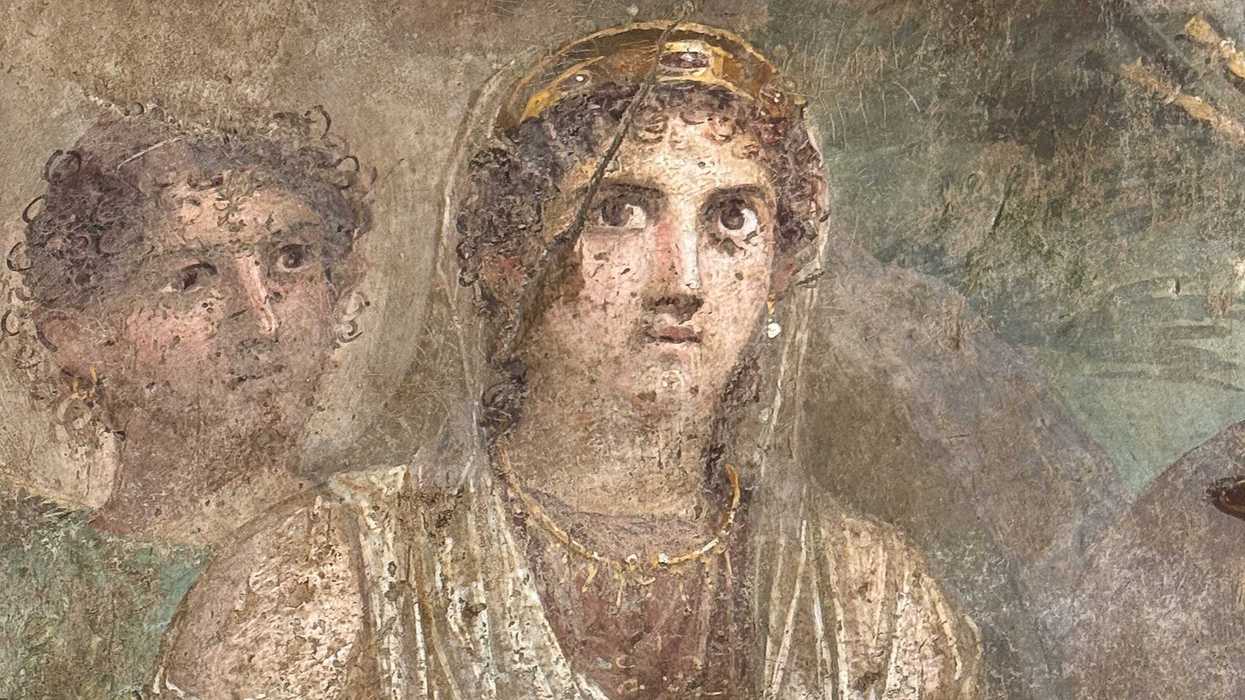
Just look at the artifacts retrieved from under the pumice and ash that buried and immortalized Pompeii, such as the few paintings found in the House of the Tragic Poet. Observe the piercing, numinous stares in three separate panels that belong to Achilles after taking two war brides, or to Helen as she is being taken to Troy, or to Hera during her marriage to Zeus. All these characters, with divine or mythological status, have a similar expression: a furious and focused countenance, their eyes shining as though searing the objects of their gaze, with white hot anger, making the association of an intensity in gaze with an intensity of being.
These incandescent glares were doubtlessly stylistic choices by celebrated Pompeiian artists meant to convey a profound meaning, not some random brushstroke accidents—an even more obvious intention because the secondary characters in the paintings all have dimmer aspects. Art historical speculations aside, one might wonder what all of this has to do with Vesuvius.
Well, in the more likely case that these divine subjects were actually made in the image of men, local Pompeiians were probably depicting Greek heroes and gods with the daimonic qualities that were visible among themselves. Pompeii remains more than a museum of death and a vacant city with encased bodies as inhabitants, more than an archeological amusement, or morbid fascination; it’s a reflection as well as a magnification of human greatness.
Not everything about Pompeii is history. There are still signs of its continuation. Those rare eyes, which flickered with divine fire and which symbolized noble sentiment and grandeur—those very same eyes—can be seen today on the streets of modern Naples. It’s as though the heroic gaze transmitted across millennia, like surviving starlight passing through the abyss of black space from a constellation that long ago became extinguished. Pompeii is gone, but Vesuvian eyes remain, and we are witnesses to its sourceless luminescence.
The respect for charisma contained the same mystery. And it seemed everything was connected. Neapolitans do not stifle ambition or eccentricity, which are intuitively admired and encouraged, because those are requirements for greatness.
This is why I couldn’t simply dismiss the Camorra members as merely stupid animals. Though the clans fight over concrete and squalor in their suburban slums, they have maintained the archaic desire of forming kingdoms. And it was in their glowing stares that I saw primitive impulses, inchoate plans, of dominance, of fraternity, of drama, which are the precursors of genuine aristocracy.
I rephrased this observation in theological language and posed it as a question to the priest. I asked him: “Isn’t it better to have vicious criminals, who commit sin everyday, but still have vigor and potential and drama, than to have a population who, acquiescent and resigned and conformist, commit few sins and break few laws, but might as well not be alive or human, and act more like well-behaved automatons?” It was a rhetorically loaded question, admittedly, one that even begged the question, but the priest was under no pressure to see any merit to my point of view.
Father E— told me that before moving to Scampia, he would have disagreed with me. Now it was plainly obvious that humanity was more present here, however troubled, than in Milan (where he was born) and in California (where he had previously worked). Of course, most “serious thinkers” would have found my query politically obscene and dangerously romantic, something closer to myth than reality. As a problem, they frame the Camorra’s existence as a symptom of political failure, stemming from state neglect and poverty, which could be diminished through socio-economic reform and thoughtful, progressive policy.
Of course, they overlook the omnipresent volcano. They ignore Neapolitan stock—a stew made from violently mixed warrior blood. Worst of all, they peer into Vesuvian eyes that rage with ancient divine f ire (somehow persisting despite modernity’s chilling breath) without recognizing what’s in sight. They think they can solve Naples, just like all empires thought they could conquer her.
 Mike Mercury
For one weekend during my stay in Naples, two Canadian friends who live in Europe came for a short visit. Instead of touring any museums, lining up for popular restaurants, or skipping straight to the Amalfi coast, we drove our motorbikes towards Scampia to see the notorious apartments known as Le Vele (“The Sails”). By 1975, seven sails were built, attempting to create an urban utopia that even Milan would envy—no one thought to consult the land of Naples and her mercurial nature.
And so, in the fall of 1980, when earthquakes shook Southern Italy, all those beautiful fantasies came crashing down. Villages and towns were flattened. Naples and Salerno were damaged. A quarter million of Campania’s poor were displaced from their little homes, and most were resettled elsewhere rather than rebuilding. Tens of thousands chose to occupy Scampia and declared Le Vele their new home. According to one former resident, after the earthquake, there were more squatters in these buildings than official tenants.
If any metaphor survived the tremors, it’s the image of the sailboat, mutinied and turned into a pirate ship. Because soon after the earthquake, Le Vele became Europe's largest open air drug market. “Man plans and God laughs,” according to the Jews; in the case of Naples, one might say, “architects design and Earth shakes.” We now stood outside these dilapidated buildings, or what remained of the original seven, since their demolition started five years ago. Some locals were happy about their removal. The apartments were old, neglected. Only last year, two remaining residential stragglers were killed when a suspended walkway collapsed on top of them. We were told that one of the buildings was undergoing conversion into offices. I wondered about the motivations in this new batch of designers and administrators. How much of the renovations were planned for the benefit of Scampia? After all, Le Vele had become monuments to Italy’s failure. The state had lost its sovereignty to a criminal enterprise. Destroying the buildings seemed symbolic, driven more by resentment than by assistance, like when petty insurgents detonate the statues of rival gods. Repurposing the last sails into an office seemed like unfortunate spolia. From my memory, only two sails remain.
A few days later, I would jump the fence to get a closer look. Not without local permission, obviously! A pre-teenage boy granted my admission and recommended entering through a gap in the fence, with the helpful advice of not letting anyone see me. Which was easier said than done. More than one surveilling nonna caught me trespassing. They didn’t seem to mind, though. And there wasn’t much to see anyway. As with most things concerning the Camorra, I was about twenty years too late. Not to mention that urban decay looks more or less the same everywhere. If someone from post-industrial America was placed in Le Vele without any context, he might mistake Scampia for his home.
My friends and I eventually became bored and crossed a revitalized green park (all concrete) right next to Le Vele. Inside the park, which felt more like a stadium, some men were spray painting "Ciro" with angel wings attached to the shoulders of the name. These graffitists were surprisingly old (late 30s, early 40s) and were commemorating Ciro Esposito, a football fan murdered by a Roma supporter. This happened more than 10 years ago. They gave us uninviting looks, and so we continued walking.
On the other end of the park and across a desolate boulevard, a group of ex-bosses and gangsters were slowly gathering at the cafe to watch a football match between Naples and Turin. We joined them. They were helping themselves to the largest brick of fragrant hash I had ever seen, easily over 400 grams, and comparable to a chunk of cheddar. It didn’t take very long for us to make new friends.
The retired gangsters were soon sharing with us their stories of Scampia, along with bottles of Prosecco and food from their wives, all while rolling joint after joint and smoking them without showing any apparent effects. In contrast, one of my friends, who is rather experienced in this matter, went completely mute. I felt somewhat reluctant to bring up the Camorra, since I thought it might seem rude or invasive. I had irritated other Neapolitans, who felt as though the criminal aspect had reduced their city to a single note: Camorra, Camorra, Camorra. “It’s enough,” they complained with indignation, “there is so much more to this place!”—but then they pointed to unremarkable Roman slabs or another decent pizzeria.
Just when I thought I should avoid the issue entirely, a former mobster, who spoke French from having lived in Paris, received a text, which lit up his phone with the words “Mafia City” as the wallpaper. To my excitement, these men were only too eager to speak about the Camorra and treated the subject ambivalently.
On the one hand, the Camorra had turned their community into a drug-addicted wasteland; on the other hand, the criminals had also made Scampia famous and turned the locals into something like celebrities or ambassadors. The real problem now, they complained (perhaps displacing their own guilt onto others), was the Baby Gangs. I had heard about these little troublemakers earlier that week.
Ten days before I arrived in Caivano, a group of boys performed a ritual called la stesa near where I was standing. They drove their scooters through the neighborhood and shot their pistols into the ground. The purpose was to intimidate rivals and declare their territorial control. According to many locals, such dramatic self-inaugurations had become increasingly common.
The Baby Gangs elude strict definitions. They have no official status and few loyalties. Generally, they are understood as groups of children who precociously enter la malavita and are subcontracted by the Camorra for low-level street crime. It would seem quite unethical to hire children for drug-trafficking and violence; however, like any offshore textile manufacturer should admit, child labor has its many advantages. In the particular case of helping the Camorra, Neapolitan children are prosecuted as minors and receive far lesser penalties, such as one-year sentences for crimes that would usually condemn an adult for decades. Using children means that the Camorra avoids risking their more senior members. It’s about business, after all, and any serious organization must have efficient human resources.
The remuneration for their work is considerable. The children sometimes receive more money than their parents do with their combined salaries. To no one’s surprise, there are tradeoffs. With easy access to guns, supplied by the Camorra as professional tools for intimidation and protection, the power often slips beyond the Camorra’s control, and the weapons become recreational toys for personal mandates, like self-enrichment (robbery) and conflict-resolution (murder). The Baby Gangs have become such a problem that even veteran Camorra members complain about them. As one older gangster told me, the kids are a little too quick to draw their weapons.
But it’s hard to be overly critical of children—they’re still learning! And the fact that Neapolitan kids with lethal power are not yet old enough to drive cars or motorbikes means that they terrorize their neighborhoods on upright, electric scooters. One of my friends captured the absurdity of the whole phenomenon when, after passing two boys we suspected to be Baby Gangsters, he remarked, “How fucking embarrassing would it be to get robbed by a chubby pre-teen on an e-scooter with frosted tips?”
 Mike Mercury
What’s astonishing about old Naples is how Neapolitans have retained their youth. This is true in the literal sense, since kids are everywhere, dominating the streets, and in terms of regional character, since Neapolitans are emotional and impulsive as well as wondrous and trusting. Even older men make friends with strangers, like little boys at recess.
Most incredible are the courtship rituals among adolescents. I’ve sometimes thought that only in Naples can real love still exist. It’s in plain sight. On staircases, teenage couples embrace with such intensity that lovers elsewhere would shudder with embarrassment.
I have no idea whence this abandoned Neapolitan love derives. But I sense it’s connected to their lack of irony, which we in the West use to create protective buffers between ourselves and our curated images of ourselves. We seem to prefer subverting reality and obfuscating our intentions to avoid potential derision. But for some reason, Neapolitans are utterly sincere. I have no idea how this happened. Maybe, like Carlo Levi’s concept that Christianity never reached Southern Italy—leaving its people pagan and outside History—postmodernism never entered Naples. Here, the earth is too strong to be disturbed with ideas. Or maybe Vesuvius is a constant memento mori, keeping everyone honest and loving.
Perhaps that’s why in Naples it’s nearly impossible to turn a corner without seeing girls and boys with entangled limbs, so in love that they almost seem to be despairing, as though until this very moment they were unaware of their own mortality. In every kiss, a silent eulogy; in every farewell, the premature mourning of their lover. It’s so serious that sometimes it’s hard not to laugh. They give their departures, which only keep them estranged for the night, the sentimental weight of tragedy.
I have tried to make sense of all this love. On a warm weekend evening, the neighborhoods were colonized by children. They choked the sidewalks with joy. They blockaded the roads with happiness. A visitor walking towards them had to dodge their fun. It was so overwhelming that my cynicism had no chance here. It was ridiculed, mocked, and chased out of town. Goethe’s reflection, which before was only romantic literature, is now a grounded reality with which one can identify: “Naples is a paradise: in it everyone lives in a sort of intoxicated self-forgetfulness. It is even so with me: I scarcely know myself; I seem to myself quite an altered man. Yesterday I said to myself, ‘Either you have always been mad, or you are so now.’”
I watched the boys walk the streets, swaggering around without conceit or arrogance, but with the excitement about what might await them around the corner. Around the corner were girls, glowing with the pride that came from burgeoning beauty and having recently discovered their power to cast spells. Neapolitan girls are striking and unfathomable in a way that seems to have come from the Orient. These are not the ethereal or light women from the North, who seem to float in the sky and have angelic qualities. Neapolitan women are chthonic temptresses, mysterious, as though from under the ground. They exaggerate this very aspect. They apply black eyeliner to give depth to their already dark, almond eyes. They grow out their lustrous, rich hair so their tresses run down their tanned backs, like heavy black waterfalls, which magically shimmer under moonlight and street lamps. Their naturally swollen, red lips intoxicate young boys like a full-bodied wine. And it’s not only in their passive features. Their cavernous eyes do not shy away in demure restraint; on the streets, they meet a man’s eyes on equal terms.
Yet there is nothing lewd or vulgar or overly explicit to their displays. Their courtship signals provoke the passion of the heart more than the lust of the loins. And more than the legendary physical beauty of Neapolitan women, which so many mesmerized men documented during their Grand Tour, it’s their confidence and audacity that catch you by surprise. The girls tease the boys with jeers that have a spicy bite, like the earthy heat of black pepper, cinnamon, cocoa, nutmeg, and cardamom.
How could they not be this way? These women have a whole of history behind their eyes, an inherited vision, which has seen empires and kingdoms rise and fall. Their ancient grandmothers drank wine from these hills long before Christ performed his miracle at the wedding in Galilee. The girls seem to know that even when mankind reaches his zenith, Vesuvius—Mother Nature, Parthenope, Gaia—can erupt and consume civilization’s latest attempt at becoming immortal. And still, somehow, mercifully, they don’t hold this against the boys. They still let them be boys. Here, despite the complete freedom to do anything, the gender roles remain intact, and with it, the natural order of life.
One night in the Spanish Quarters, the streets echoed with footsteps of dancing feet against cobblestone, while voices sang in ecstasy to the newest popular music. My friends and I stayed till 3 a.m. But the joy of youth grew louder and louder as it got later, not diminishing in the face of morning.
What does all that happiness do to a city, to physical space? It causes the architecture to surrender itself to the youth. The city itself becomes an extension of their happiness. Yes, hard to believe from the secular perspective that sees Naples as merely a collection of physical material, but for those who can see the spirit that resides in matter, well, even the infrastructure of Naples feels alive. Nothing is static; everything is moving. As though Naples is flesh rather than stone and wood and metal and glass.
 Mike Mercury
The Camorrista Antonio picked me up in his black Fiat Panda near the Brutalist church. At the same moment, dozens of little girls were being unloaded by their parents for an evening dance lesson. Antonio had changed into something more professional for our meeting. He had replaced his gray, non-descript sweatsuit with a Manchester United tracksuit. Driving away from Scampia, I asked him about his day.
When I first met him through Father E— outside the apartment grocery store near the church, I had thought he was selling fruits and vegetables. I surmised that his criminality was only a nighttime affair, like the Baby Gangs who attend school by morning and rob their teachers by night.
It turned out that he was trying to cultivate the impression of being a green grocer. He had only ever sat before bags of onions, never actually lifting any. His true profession was selling something far less nutritious— specifically, cocaine, heroin, crack, and a drug called kobret (which, he explained, was a residue from the heroin-making process that was supposedly much stronger). The bounties of fruits and vegetables were only a disguising background.
He reportedly made around €400 to €500 per day, in addition to his monthly salary of €3,500, and whatever weekly bonuses from robberies and thefts. He mostly stole watches and jewelry along the highway connecting Naples to Arzano, where wealthier Neapolitans lived. He showed me videos of his heists, recorded by witnesses and uploaded online.
These were hardly sophisticated burglaries. More like violent snatch and grabs. One of his friends drove a scooter in rush hour traffic and filtered between cars. This first driver, operating as a scout, looked into every window, checking for passengers on the left and drivers on the right. He then reported what might be worth the crime to Antonio, who was waiting farther behind in traffic.
If the reconnoiter saw something apparently valuable, like the sparkling crystal face of a Rolex or a fat gold chain necklace, the car was identified by make and model. On a separate scooter, with an accomplice in the bitch seat carrying a gun, Antonio then pulled up beside the targeted vehicle. His passenger on the motorcycle then smashed the car window and pointed a gun menacingly inside at whomever was wearing the coveted object. After receiving their booty, they quickly escaped. Because they deftly maneuvered between cars, it was easy to evade any police.
However, last month an officer did manage to shoot at Antonio while he was fleeing. A bullet struck his friend in the back. Antonio had to resolve the classic criminal dilemma, and in the end decided to dump his friend at the hospital to save his life. Of course, once his friend had convalesced enough to be discharged from the hospital, he was admitted to prison.
I asked him if he ever feels reservations or guilt during these holdups, especially when children are present. “I have no mercy,” he told me, “I take from children, old people, pregnant women.” “No mercy,” he repeated. Even if this seemed rather harsh, these weren’t exactly his most terrible deeds anyway. He had previously stabbed another man for giving him a dirty look, and Antonio thought he’d soon be called upon to murder a rival. For many Camorristi that’s how one earns a promotion. Would he do it? “Yes,” Antonio responded, “I think so.” Antonio was a real gangster, not a sensitive young man. Or so I thought.
Despite his apparently casual indifference, he soon began volunteering self-absolving justifications—twisting his mind to relieve his heart—in ways that ultimately betrayed a guilty conscience. He first justified stealing because, if he didn’t, others would. Similarly, he told me that if he didn’t sell drugs, addicts would buy from other dealers. I was not looking for a good man, but he was adamant on appearing like a victim.
On staircases, teenage couples embrace with such intensity that lovers elsewhere would shudder with embarrassment.
He blamed his crime on the outside world. He was poor, he claimed. He was hungry. He hadn’t chosen this life. His father had left his mother when he was just a baby. If his father had stuck around, he would have never entered the malavita. It was his father’s fault. Of course, these were confessions masquerading as explanations. Satisfied with exonerating himself, Antonio then took the next step, contorting his vice into virtue. He was only stealing from the rich. It was wealth redistribution. His victims could always replace their jewelry and watches anyway. And they had good jobs, whereas he was poor and hungry. Antonio needed to provide for his family. Maybe this was true, but it contradicted his obsession with luxury and status. After all, he wasn’t selling his own jewelry for bread.
During the highway robberies, Antonio claimed that he sometimes makes €30K in less than two minutes. He showed me pictures of his own watch collection, particularly a gold Rolex. I noticed that his wrist was bare. Antonio said he only wore his Rolex at home, and only once a year, on his birthday, does he risk wearing it outside his house. Why? Because he was afraid other thieves would steal it from him. Apparently, no one was safe from the Camorra—not even the Camorra. Antonio told me he’s even stolen from bosses. Only once was he identified through his helmet and face mask. The next day, several armed men showed up to his house. He returned the stolen car without argument. He knew the rules.
He has been a criminal for a long time, since he was about 12. He sold drugs in Le Vele and began extorting businesses along the main stretch in Secondigliano (where earlier in the week I had the best sfogliatella riccia). If the owners refused to pay the protection racket, he would firebomb their storefront. He continues this extortion today. How much does the Camorra take from those businesses? “Only €100 per week,” Antonio told me. What if they call the police? “They never do.” Why? “Because this is Naples.”
His older cousin had introduced him to the underworld, though his career was shorter-lived. According to Antonio, his relative was a little “too good at the malavita.” He was making too much money, moving up too quickly, and provoking too much envy in his colleagues. And so, not long after his cousin turned 18, some jealous Camorristi opened up his face with a handgun. Like a desiccated pomegranate, which has split in the late summer heat, the gruesome contents of his cousin’s head were spilled onto the streets of Scampia. And though his cousin’s early success inspired Antonio to enter the malavita, his premature termination did nothing to alter Antonio’s course.
Antonio now works for the Vanella Grassi clan.
We drove to a bar called Blue Moon in Casandrino. The Secondigliano Alliance, a strategic network of Camorra clans, reportedly owned the place. The place was so bright and white, with only neon blue fluorescents giving a little color, that it felt like its architect drew inspiration from both tacky Greek nightclubs and North American pharmacies. It was almost like a spaceship. Everything was so clean and neat and unnatural, it was sickening. The spotless floors were glistening, like the glossy lips of a desperate single mother, the walls so sterile and monochromatic, like a waiting room, without art or texture, and the place so immense with atrium-height ceilings, that the few wrinkled, tanned, tattooed patrons, who were big senior Camorra bosses, looked very small and childish. Altogether, this Lavazza-branded cafe felt more like a custom-built purgatory that God poorly designed to please Neapolitan criminals and torture anyone with aesthetic sensibilities.
“This place is very nice,” Antonio said.
It’s no secret that Camorristi have garish tastes, like gypsies, like cafone (“peasants”). When I asked Antonio about his dream home, since all young criminals have big dreams, he recounted visiting a clan boss’s home, not far from where he scooped me. Despite being in a dilapidated building where most other occupants were poor, the boss’s apartment was all marble, gilded, and stuffed with baroque ornamental chairs and giant lion statues. “It was perfect,” Antonio told me.
Antonio ordered a peach iced tea for himself. He told me he likes to keep a lucid mind, so he doesn’t drink or do drugs. Instead, I watched him nervously smoke many Marlboro Golds. He was a little on edge because two days ago, he was arrested. The police let him go, but Antonio was still waiting to be charged. The last time he was arrested, he was imprisoned for one year, and his girlfriend spent twelve months crying. His passport was confiscated too this time, so he couldn’t flee anywhere.
It was getting late, and Antonio had to go home to have dinner with his mother. Driving back toward the church, we entered the same traffic from which he usually plundered. But Antonio never bothered waiting. He drove onto the sidewalk and created his own lane. Tonight he was buying a pizza for his mother. He didn’t want her to be stressed with cooking. Does she ever cook? On Sundays, which is also the only day Antonio takes off from crime, because “Sundays are for rest and family.”
We said goodbye.
What’s funny is that, despite Antonio’s own testimony that admits a selfish mindset, I am rather friendly with him. He video calls me now on occasion to show off his English fluency to his girlfriend, or to show me what movie he’s watching. The last time we chatted, he was watching Goodfellas, and I recited the film’s iconic first line: “As far back as I can remember, I always wanted to be a gangster.” The phrase was apparently relatable; it was going to be his next tattoo. I invited him to visit me. But his passport still remains with the authorities. “I wish brother, that’s my dream,” he tells me. He has started telling me that he wants to leave the malavita and the Camorra, but then within hours, he sends me a picture of some vials or of himself brandishing a firearm.
 Mike Mercury
Outside Bruno’s afterschool in Caivano, I lingered outside the torched bus and contemplated the area. Bruno had just finished smoking a hash joint. We were experiencing some silence for the first time today, after more than eight hours together. A group of little girls, in candy pink tracksuits, with little ponytails, walked past us. Bruno looked at me in a strange way. It was like he was encountering something profound. These were heavy eyes, weighed down with sadness, pity, and truth. Eyes that simultaneously looked at me, but were looking through me, past me, as though searching for God to answer him back. When he finally spoke, he seemed as though the thoughts were not his own but were coming to him.
“These little girls,” he told me, “they go to school. Some can’t even speak yet. They are too young. They don’t have language yet. Maybe ‘mama,’ that’s it.” I stayed silent. “But their eyes have seen guns at school, because the police guard the school entrance. And they see guns on the streets because boys have pistols and shoot each other on the street. And they see guns because the military is here, with their guns, to protect the little girls from little boys.” I looked at Bruno and, for the only time that day, I felt his pain and understood his dedication. “When they go home, their parents are watching the news. The girls see the television, they see the wars in the Middle East and Eastern Europe.” Then he trailed off and just repeated, “People are dying . . . people are dying . . . people are dying.” He continued making the same point, “They don’t have words in their mouths yet, but their eyes have seen violence, death, and guns. What does that do to the mind of little girls? That’s why I paint colors.” I looked at the horrible saccharine paintings that I had judged so harshly. “It’s so they can see something beautiful.”
At the cafe near Le Vele in Scampia, the retired gangsters told me about how women are always protected in Naples, how women are sometimes bosses, and how terrified gangsters are of their wives. One of them told me that when he used to be a Camorrista, he would puff out his chest when walking down the street. To demonstrate, he stood up and held his arms out like he was carrying two heavy grocery bags. But when the Camorristi got home, he explained, they became very small and timid. He then gestured like he was crawling under barbed wire. “We’re scared of the women in Naples.”
And yet, their contemporaneous Camorristi set Gelsomina Verde on fire, ending all codes of conduct and honor. But how interesting that the savage murder of a woman at the hands of the Camorra brought Scampia to ruin? It’s as though the Camorra forgot they were Neapolitan.
Leaving the bar in Casandrino, Antonio told me his most successful heists are on Christmas Eve, when he robs multiple fishermen on what should be their best day of the year. For dinner on December 24, Italians typically feast on fish, which they buy fresh in the morning. They spend more money on this meal, bringing home cod, eel, and lots of shellfish for spaghetti alla vongole, than they will for Christmas dinner the next day. After a long morning hauling nets from the sea and selling to happy families, the fishermen will eagerly clean their stalls. They will be coming home to their own families with more cash than on any other day of the year. But my friend Antonio will put a gun to their face, in the same way the Camorra did with his cousin, and then Antonio will steal all the fruits of their labor. He hurts the only man that Parthenope has shown lasting affection. When I asked Antonio how his mother felt about these heists, he said she looks away. “Here, the men are in charge,” he told me. That’s not what the older Camorristi had said, though, and then I realized the poor state of my criminal acquaintance.
Antonio thought he was in control of Naples. He thought that with his weapon, like every soldier and pirate before him, Naples was under his authority. But he couldn’t have been any more mistaken. Not even his actions were his own. He was like a marionette with invisible strings. Maybe when someone is within Naples, it’s harder to understand her. Even Antonio’s resentments and euphoria didn’t belong to him; they belonged to Parthenope. They were the manifestations of her erratic mood swings. Just like whenever a young boy pulled the trigger on his Beretta, eliminating a staunch rival, spilling their blood onto the street, Naples was merely shedding flesh and discarding blood, ridding herself of excess men, as though Parthenope was menstruating . . . only to restart the cycle. My new friend will likely die soon. Antonio doesn’t listen to Naples. He never hears her song. And for that, Parthenope will have her revenge.