Donald Mayerson
Cormac McCarthy’s Westerns map a hard truth the present refuses to acknowledge: order is carved from chaos by men willing to venture into the unknown—men familiar with violence.
Civilization is not spontaneous. It does not arise from nothing. It is a fortress, a place where men can rest, where luxuries like philosophy, science, and art can flourish. These luxuries exist only because others have cleared the way, freeing men to think beyond survival and sustenance.
But a fortress must be built, and it must be defended. That burden falls to men, those willing to shoulder rifles, ride into danger, and face the frontier head-on— men who will do the necessary things that more civilized people later pretend were never required.
McCarthy understood this. In the middle of his career, he turned his gaze to the American frontier. He wrote the West as birth, elegy, and return: Blood Meridian at the beginning, The Border Trilogy as its fall, and No Country for Old Men as the grim resurrection of frontier violence within the walls of civilization.
Blood Meridian opens with sanctioned violence. The state of Chihuahua pays for Apache scalps. American authorities look away as their enemies are removed. The Glanton Gang begins as a sanctioned force, hired to eliminate Apaches, but rapidly descends into savagery. In McCarthy’s telling, the Glanton Gang paradoxically becomes the vanguard of civilization—not by legal authority, but by naked force, clearing space for what will later be called law and order.
McCarthy refuses to flatter us with clean hands; there are no white hats to be found in his telling. The West is midwifed by men who will never be invited to its coronation. They are the necessary instrument—expended, then discarded.
Judge Holden, the incarnation of evil and the novel’s great antagonist, refuses sentimental lies. He is monstrous, but he speaks truths we do not want to hear. He insists that war is ontological. Young men love it because it proves them; old men admire it in the young as a reminder of what they’ve lost.
You can reject his words, but the landscape backs his claim: the frontier is violent and unforgiving; men who cannot back their words with force will own nothing. In that world, discipline backed by violence is the only currency. It may be tragic, but it is no less true.
Severity without discipline becomes cruelty. Discipline without severity becomes theater.
This is not to say that the savagery of the Glanton Gang is good; rather, they have lost their humanity. Glanton and his men spend too long on the edge, becoming more ferocious than those they were paid to fight, turning against the order they claimed to serve.
Though peripheral to McCarthy’s narrative, the Texas Rangers offer a counterpoint: men fully sanctioned to confront violence with violence, adopting the tactics of their enemies, remaining—however tenuously—tethered to the state, yet still seduced by violence.
From the 1820s to the 1850s, ranging companies patrolled lawless lands, tracking signs through mesquite and desert, confronting Comanche raiders and Mexican bandits. Their methods were brutal, but they helped clear space for the civilization they would never fully join.
The frontier demands such men—deputized, often reluctantly, to fight the savage on his terms, in his ways, to make ready the path for order.
The frontier is first founded in irregular violence—then slowly rationalized statutes and ordinances. Some men survive that transformation. Glanton’s Gang does not. They are a warning of the danger of staring too long into the abyss; they pass from law-bringers to marauders. Though we never see them before their descent into savagery, we know that each man was once an agent of order, and that somewhere along the way, they forgot who they were. It is only natural that once civilization catches up, the very society that made them possible must eliminate them.
As Blood Meridian progresses, the world begins to change. The Kid, Glanton’s last surviving comrade, ages into a half-domesticated creature. He lingers near the firelight of towns, neither fully civilized nor fully wild. The wilderness remains—but it is no longer endless. Civilization creeps forward: board by board, ordinance by ordinance, man by man.
The men who cleared the way become intolerable, a reminder of what once was. The town can now live without them. So it pushes them to the margins—and if they refuse to go, it buries them.
There is a historical skeleton beneath the novel’s violence. McCarthy draws on real episodes: scalp-hunters, border wars, and the shadowy figure of a “Judge Holden,” briefly mentioned in Samuel Chamberlain’s My Confession—but mythologized beyond recognition. Yet McCarthy’s point is not historical. It is revelatory.
The border is where ideals die. We like to imagine law as self-sustaining, as independent of the men who enforce it. That is a fantasy. Laws mean nothing without men to enforce them.
The Border Trilogy is McCarthy’s requiem for the West. The violence has receded. Civilization has grown.
In All the Pretty Horses, John Grady Cole rides south searching for a life that has already died. In The Crossing, Billy Parham wanders under skies still vast and beautiful, but no longer his. In Cities of the Plain, both men flee a world that no longer wants them.
The frontier is closed—not just as land, but as a horizon of meaning. Bureaucracy arrives. Fences cut the land into parcels. The cowboy becomes a relic—admirable, noble, but maladapted. A beautiful idea with no place to call home.
McCarthy never lectures us about modernity. He shows it: a ranch bought and sold by men who do not ride; a love story broken by invisible rules; a friendship undone by bureaucratic convenience.
These novels are tender, whereas Blood Meridian is cruel, but the theme continues. Order has a cost. The men who paid it slowly wither away, and we discard them at our peril.
In No Country for Old Men, the struggle between chaos and order shifts to 1980s Texas, where Apache country is replaced by concrete and city lights. But the movement is not geographic—it is metaphysical. The frontier once lingering on the horizon is now internal.
Though structured more as a crime novel than a Western, No Country for Old Men resurrects the existential anxieties of the frontier and plants them inside shopping plazas and rest stops. The agents of chaos no longer wear feathers or ride horses. They drive rental cars and walk motel corridors—outwardly indistinguishable from civilized men.
Sheriff Ed Tom Bell finds himself unprepared for such adversaries. He recognizes that he is not equipped to deal with the ruthless cartel violence. He feels helpless when he confesses his dissolution. His uncle, a retired lawman, tells him, “You can’t stop what’s coming. It ain’t all waitin’ on you—that’s vanity.” This is not despair—it is realism.
Ed Tom Bell is every man who grew up in relative peace. Like Sheriff Bell, civilization can no longer pretend that violence belongs to the past. The frontier has returned through the gate left unattended.
The antagonist of No Country for Old Men, Anton Chigurh, is not merely a man; he is a principle. He represents violence without reason, cruelty without honor. He is a metaphysical punishment for a civilization that no longer remembers how or why it was built.
In this world, Sheriff Bell’s decency is admirable—but insufficient. Piety without force cannot keep the wolves at bay.
If order is to survive, someone must be willing to do violence for it. That violence must be bound by law and custom—but it must be real. The law must fight chaos on its own terms.
This is not a call for vigilantism. It is a call to remember what built civilization—and what sustains it.
Order is not self-renewing. It must be created—brutally at first, by men on the edge, and then later by men in uniform, under discipline.
A mature society distinguishes between cruelty and severity. Cruelty is violence for its own sake. Severity is violence in service of the law—measured, principled, bounded. We used to know the difference. We used to honor the men who did hard things so others could sleep easy. Our problem is that we’ve grown soft and sanctimonious. We enjoy the fruits of past severities while denouncing the very means by which they were won.
Worse, the frontier has reappeared in its hardest-to-govern forms—on every street, at every border, and inside institutions that have traded responsibility for paperwork. We’ve tied the hands of those who would act, then hired consultants to study “root causes.”
In the old West, “necessary” meant men with rifles riding to meet the enemy head on. Today, it means interdicting narco-traffic at sea and along rivers. It means prompt, law-bound capital punishment for the worst offenders—enforced without apology or delay. It means mass removal of those who enter unlawfully and prey upon the commons.
The euphemisms of the managerial class—“complex challenges,” “community-based alternatives”—are not solutions. They are rhetorical furniture meant to obscure a simple fact: someone must carry a gun and be willing to use it. Civilization is not maintained by those who despise the concept of a border. It is not defended by people who believe punishment is archaic. If you want order, you must will it.
Yes, such measures risk excess. So did the early patrols who rode fence lines, and the marshals who wore tin stars. That is why the question is not violence or no violence, but whose violence, to what end, under what discipline? Severity without discipline becomes cruelty. Discipline without severity becomes theater. The challenge is to keep both in harness: force constrained by law, and law backed by force. The alternative is performative reality.
Nietzsche warned: “He who fights with monsters should see that he does not become one.” There is wisdom in that line— and also a trap. The trap is to confuse “doing frightening things” with “becoming a monster.” A hangman is not a murderer. A soldier is not a bandit. A nation that deports those who break its laws is not committing cruelty; it is affirming that its statutes are non-negotiable.
To avoid monstrosity, we need limits, clean procedures, and public accountability. We also need men who can live under authority and a citizenry that honors them, not treats them as props when convenient and liabilities when not. If Judge Holden is wrong, it is not in his diagnosis of man’s fallen nature—but in his claim to supremacy. War is not God. But in a fallen world, the preparedness to do necessary violence must be ready at hand.
A moral system that refuses this truth is not humane. It is childish. It wants the fruits of civilization without the burdens that sustain it. That fantasy does not end in peace. It ends in a vacuum—and into that vacuum something worse will emerge.
Taken together, McCarthy’s three great westerns tell a timeless truth. The frontier is not a place—it is a permanent feature of human life. You do not abolish it with slogans. You police it with men who accept the burden. This is the truth our age refuses: comfort is dependent on courage, and courage is costly. A serious nation recruits for fortitude, trains for severity, and rewards competence. It does not confuse weakness with mercy. It does not pretend that paper will turn wolves into dogs. It puts steel at the border and puts resolve into the courtroom. It honors the man who does ugly work so that children can sleep and ordinary people can plan ten years out without fear.
“War is god,” says the Judge—meaning, perhaps, that the struggle between order and chaos is a constant. He is wrong about the divinity. He is right about the condition. We don’t have to love the instruments of order. But we do have to keep them sharp, clean, and ready. If we lack the stomach for that, we lack the stomach for civilization itself.
CAPTIONS:
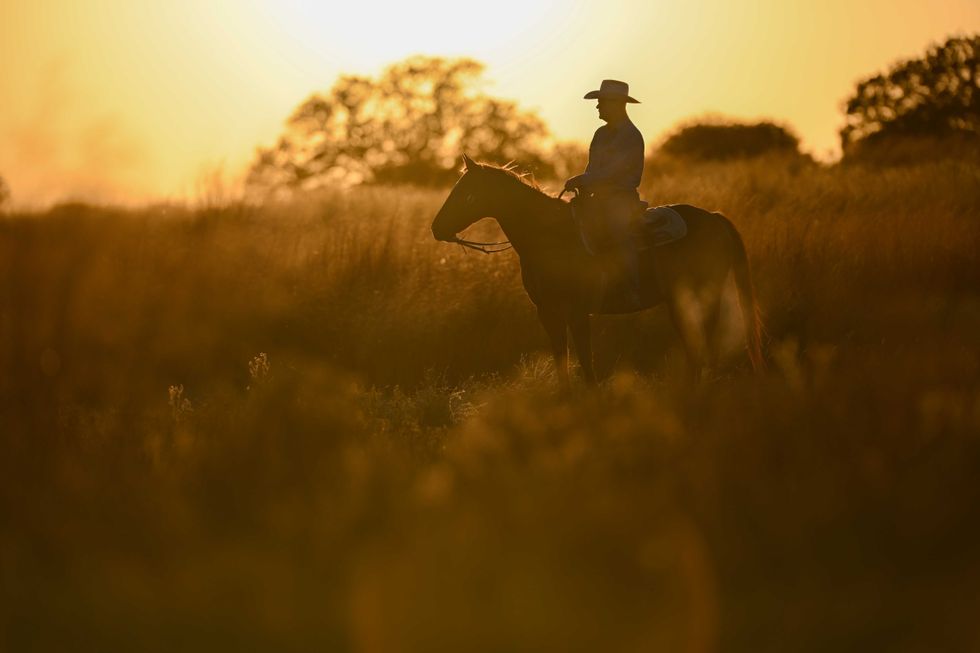
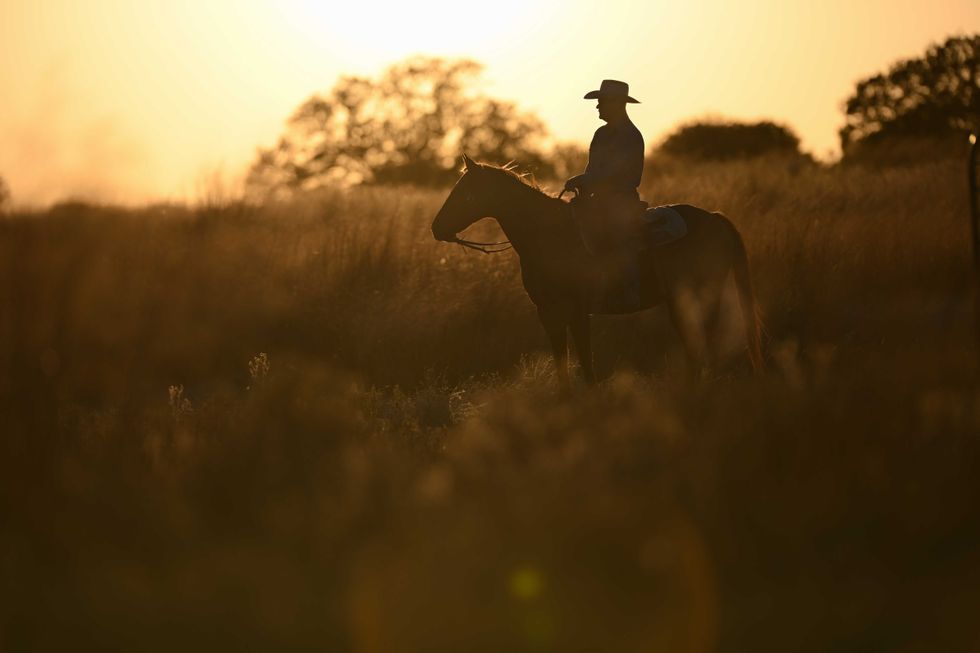
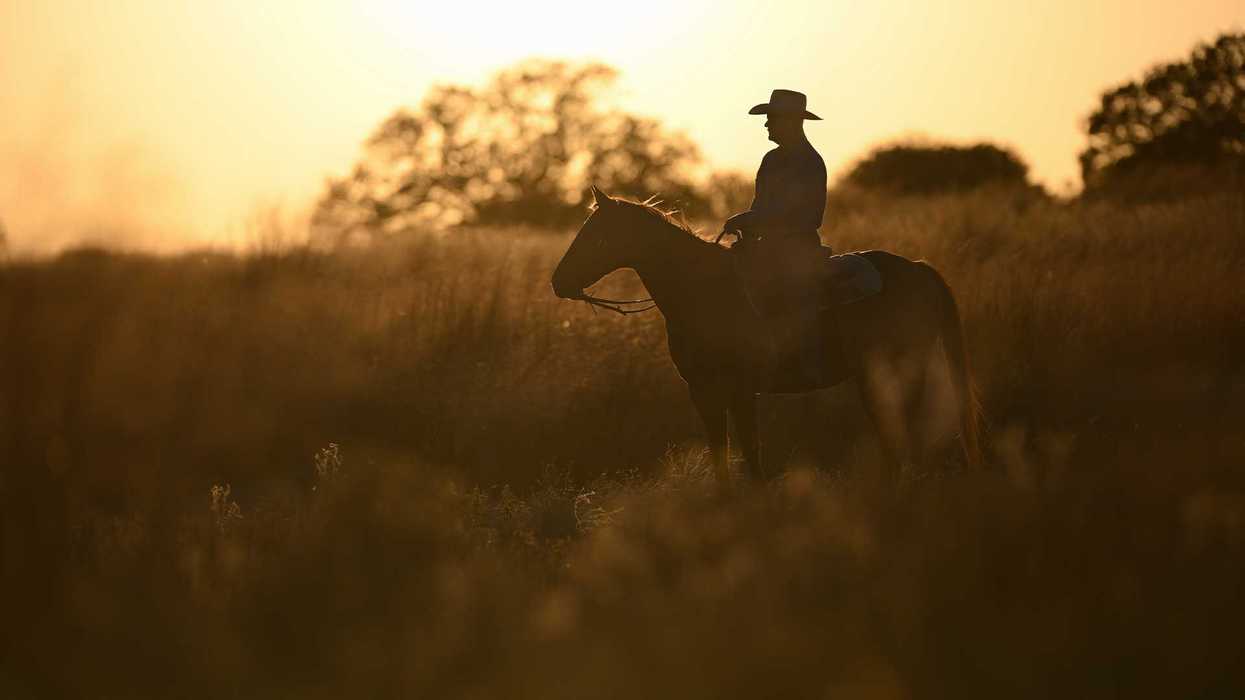
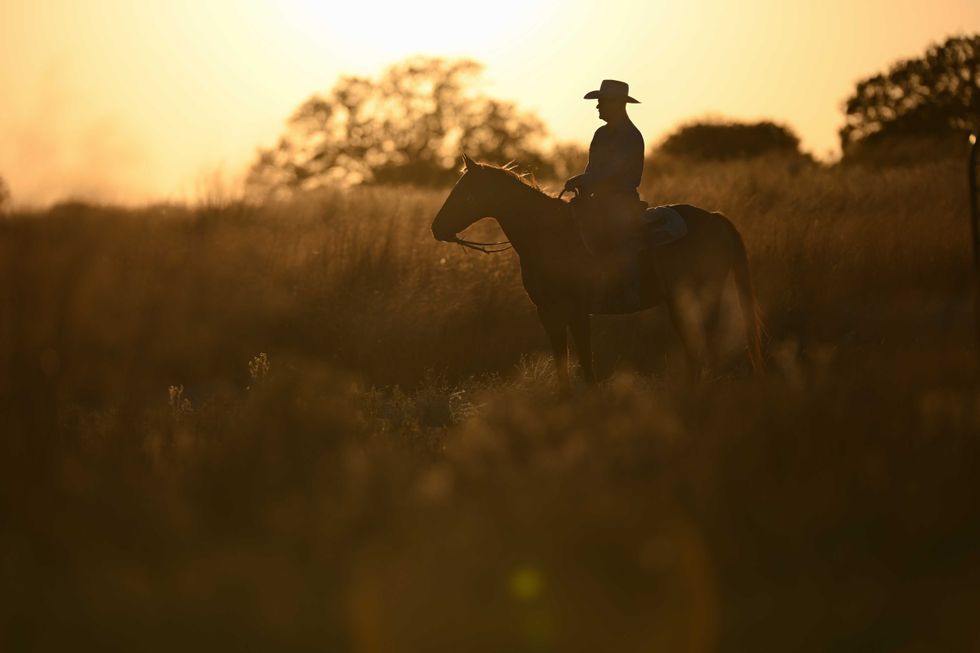
Between the civil and the wile, man and beast stand watch.
These empty spaces teem with destiny.