gremlin/Getty Images
Carl von Clausewitz framed war as a “continuation of politics by other means.” Weaponry, in this view, is an extension of state judgment, a tool pulled from the kit when the talking stops. Looking at the landscape of directed-energy weapons and autonomous subsea networks, one suspects the tools have begun to write their own script. The question is no longer just what we do with the tools, but what kind of world becomes thinkable and governable once they exist.
The new frontier is the management of latency, visibility, and energy at the very edges of the habitable world. It is a reorganization of politics around the capacity to see and the speed at which one can destroy.
The border is becoming a software-defined stack of sensing and response.
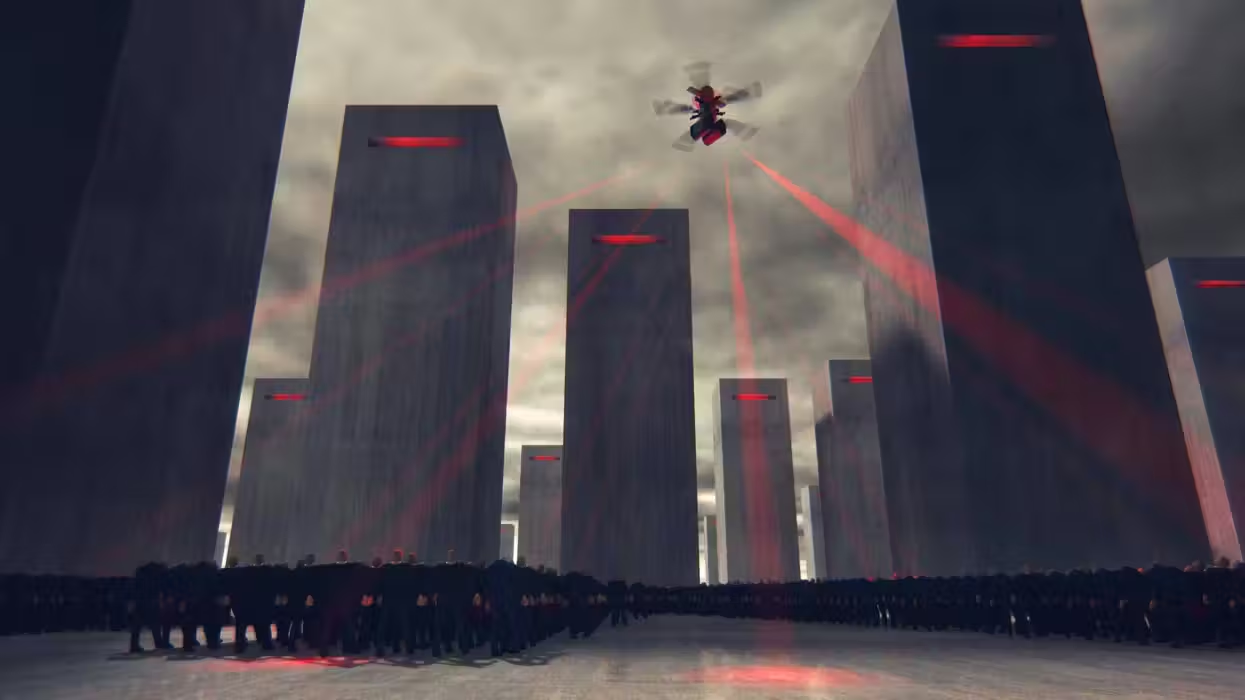
The visual theatricality of directed-energy weapons appeals to our desire for a clean defense. We hear of the Iron Beam, a 100kW-class laser system integrated into multitier defense arrays. The descriptions are intoxicating: an unlimited magazine, almost zero cost per interception, and the promise of reduced collateral damage. These defense systems promise to restore cost symmetry in the face of cheap, numerous drones that can saturate expensive missile defenses.
The technical reality is more mundane and perhaps more telling. These weapons of light remain stubbornly bound to the earth. A laser is a system of ordering: power generation, cooling, and software integration. It is also a prisoner of the weather. For all their speed-of-light elegance, lasers are degraded by the most common of things: rain, fog, and storms. Even when the technical feasibility is proven, the operational reality is constrained by the atmosphere itself.
If the sky is becoming a theater of light, the ocean is becoming a laboratory for a different kind of visibility. Historically, the undersea domain was the last holdout against panoptic ambitions: It was difficult to see, difficult to communicate through, and difficult to police. The Cold War depended on this opacity, on stealth and the difficulty of detection by sonar.
Now, the sea is being made a platform. Subsea drones, from small autonomous vehicles to the U.S. Navy’s Orca extra-large uncrewed undersea vehicle, are designed to make the underwater domain legible. The goal is a distributed fleet architecture, storing eggs in many baskets to ensure that no single loss is catastrophic.
RELATED: Yes, there's an AI hive mind, and it's making us dumber
 Yuuji/Getty Images
Yet the physics of water remains punishing. While we take high-speed wireless for granted on land, the underwater acoustic channel offers only a few kilobits per second over a 10 km link. This scarcity of bandwidth forces a shift toward decision-making at the edge. A drone under the ice cannot call home for instructions but instead must interpret its own sensors and manage its own contingencies through a complex stack of perception, state estimation, and mission policy.
Reliability here is engineering for trust. In the extreme cold of under-ice operations, in which temperatures can sustain -35°C, there is no fail-safe of surfacing. The ice layer removes the luxury of escape.
The Arctic was once the site of exceptionalism, a region governed by cooperation, science, and the explicit exclusion of military security from the mandate of the Arctic Council. That story is ending. As the sea ice declines, this environment is being revealed as a corridor for commerce and surveillance.
The IPCC suggests the Arctic may be practically free of sea ice in September at least once before 2050. The U.S. Department of Defense is more aggressive, suggesting an ice-free summer could arrive by 2030. This melting makes minerals, fisheries, and choke points like the Bering Strait newly available for military and commercial ordering.
The map is being redrawn by infrastructure as much as by diplomacy. Finland and Sweden have joined NATO, shifting the alliance geography of the North. The U.S. Air Force maintains a North Warning System of 49 radars, a logistical feat that requires sustaining sensors and fuel in an austere environment. In this theater, sovereignty requires infrastructure: keeping the sensors on, the parts moving, and the communications flowing.
The cost of latency here is strategic. Because geostationary satellites do not sufficiently support high-latitude operations, there is a frantic move toward low-Earth-orbit constellations to provide the connectivity required for modern command and control.
We are witnessing a shift in the nature of the border. It is becoming a software-defined stack of sensing and response. NATO now treats the ocean floor, the hidden architecture of cables and pipelines, as a critical space that must be monitored by AI and sea drones. It is the defense of the material substrate of digital life. Technologically mediated violence produces a new kind of border politics, in which the decisive terrain is invisible, found in electromagnetic spectra, sonar inference, and satellite coverage gaps.
In this world, we are always operating under imperfect information. We return to Clausewitzian friction, though today we call it packet loss, acoustic noise, or navigation drift. We find ourselves at the edge of the habitable world, watching the ice melt and the sensors blink, waiting for the speed of light to solve a problem that remains stubbornly human.