peepo/Getty Images
Elon Musk has virtually mastered the space race. SpaceX regularly sends up Falcon 9 rockets, autonomously lands boosters, and embarked on the most ambitious space exploration program ever dreamed up by mankind with Starship. Now Musk wants to launch a whole new kind of object into orbit — a data center meant to power xAI’s growing portfolio of products and services.
And it all starts with a momentous new lunar mission.
In early February, two of Elon Musk’s most ambitious companies — space pioneering venture SpaceX and generative AI startup xAI — merged into one organization. With a unified brand, Musk claims that the move will “improve speed of execution” of the monumental new off-world undertaking.
We’ll finally be rid of the resource-hogging data centers that hamper our infrastructure here on Earth.
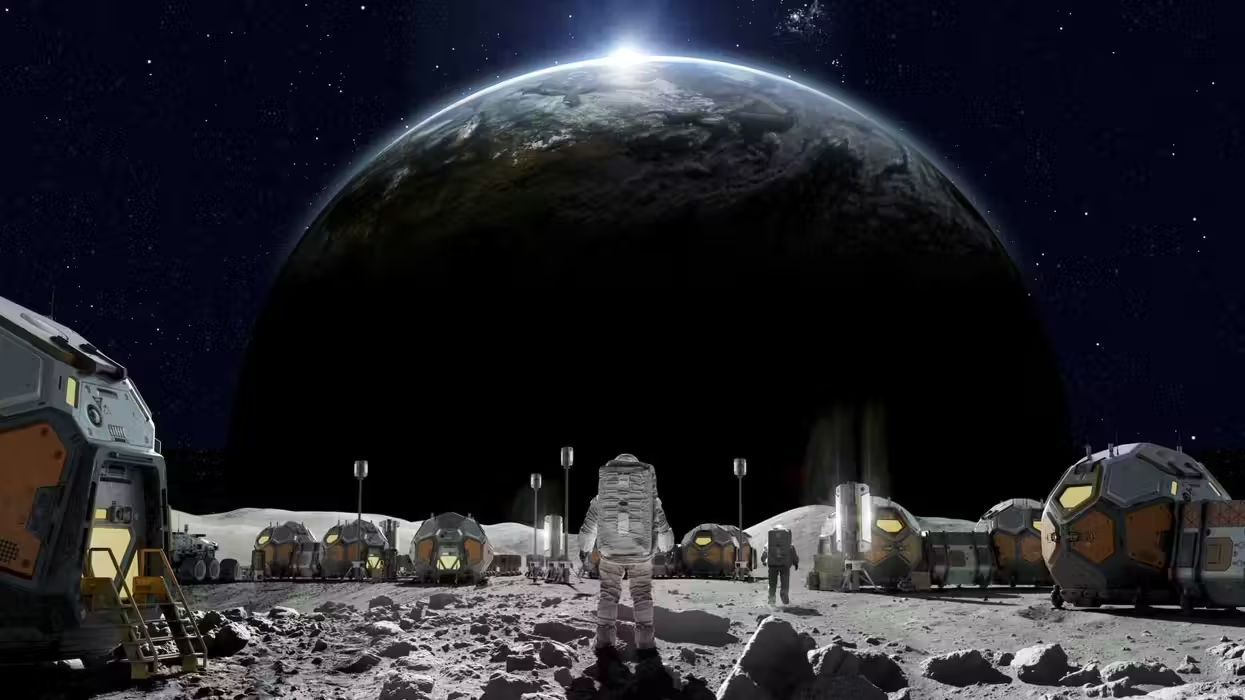
The goal? Establish Moonbase Alpha, a permanent lunar city planted on the surface of the moon. The base will serve as a manufacturing hub and a launch site for spacefaring data centers that will power Musk’s growing AI endeavors, including xAI, Grok, Imagine, Optimus robots, and more.
It sounds like something out of a science-fiction novel, but if Musk has his way, Moonbase Alpha will be up and running by approximately 2030.
While this project would mark the first time any human has set up residence on the moon, this isn’t the first time SpaceX has launched permanent objects into orbit. The company currently manages a fleet of 9,600 Starlink satellites that circle the earth daily, beaming wireless internet to regions all around the globe. Presumably, the new space data centers would fall in line along the same or similar paths.
A data center, however, is a little more complicated than a wireless internet router in space. Data centers consist of thousands of GPUs, TPUs, cooling systems, and other networking components. They must have the bandwidth to process, store, and utilize large stores of data. For LLMs in particular, data centers also have to be able to train and maintain new models as AI evolves.
Clearly, there are some pros and cons to running an AI data center in space. Let’s get into them.
RELATED: NASA astronaut gives very American response to DEI questioning
 Manuel Mazzanti/NurPhoto/Getty Images
Despite weighing the risks against the benefits, Elon Musk believes that space is an essential piece of AI development: “Current advances in AI are dependent on large terrestrial data centers, which require immense amounts of power and cooling," he explained in a recent post at the SpaceX website announcing the merger. "Global electricity demand for AI simply cannot be met with terrestrial solutions, even in the near term, without imposing hardship on communities and the environment. In the long term, space-based AI is obviously the only way to scale. To harness even a millionth of our Sun’s energy would require over a million times more energy than our civilization currently uses!”
He’s right. The only way to sustain AI in modern society is to move it to a place where it can’t siphon away our vital resources, namely power, water, and land. It needs to operate in its own sustainable vacuum. What could be better than space?
Musk isn’t alone, either. Google is also putting data centers into orbit. According to Google CEO Sundar Pichai, "We are taking our first step in '27. We'll send tiny, tiny racks of machines, and have them in satellites, test them out, and then start scaling from there."
And just like that, the AI age of the space race has begun. As for who will win, mankind is the biggest benefactor — not because renewable AI will magically make everything better, but because we’ll finally be rid of the resource-hogging data centers that hamper our infrastructure here on Earth while Big Tech sets its sights on moon-shot missions in the stars.