Visual Capitalist/Elijah Nouvelage/Getty Images
Because today’s auto industry feels thoroughly international — Americans can buy nearly any car made anywhere, and American vehicles are common sights overseas — it’s easy to forget how deeply regional car markets still are.
That’s the topic of the latest episode of “The Drive,” a podcast I host with executive analyst at iSeeCars.com and Forbes Autos contributor Karl Brauer. This week, our guest is longtime Detroit News auto columnist and syndicated cartoonist Henry Payne.
Japan’s streets — especially in dense cities like Tokyo — are filled with vehicles most Americans rarely see: kei cars, a government-defined class of tiny, boxy, ultra-efficient runabouts.
In a conversation that jumps from Japan’s Mobility Show to the battle over unionization at Volkswagen’s U.S. plant in Chattanooga, we keep returning to the same theme: Cars are global, but markets are local—and policy is increasingly the hidden hand behind what gets built, where, and for how much.
Payne joins us fresh from the 2025 Japan Mobility Show, an experience he says he found “surreal.”
“My grandfather fought on Okinawa in WWII, and here I am two generations later, and I am going to Japan as a guest of Honda,” he says.
Despite all that’s changed since then, Payne says the show was a reminder of how regional cars still are.
Japan’s streets — especially in dense cities like Tokyo — are filled with vehicles most Americans rarely see: kei cars, a government-defined class of tiny, boxy, ultra-efficient runabouts. They’re built around small displacement engines, tight dimensions, and the reality that Japan imports most of its energy. They make sense there.
In the U.S. they generally wouldn’t — despite recent rumblings from Trump to the contrary.
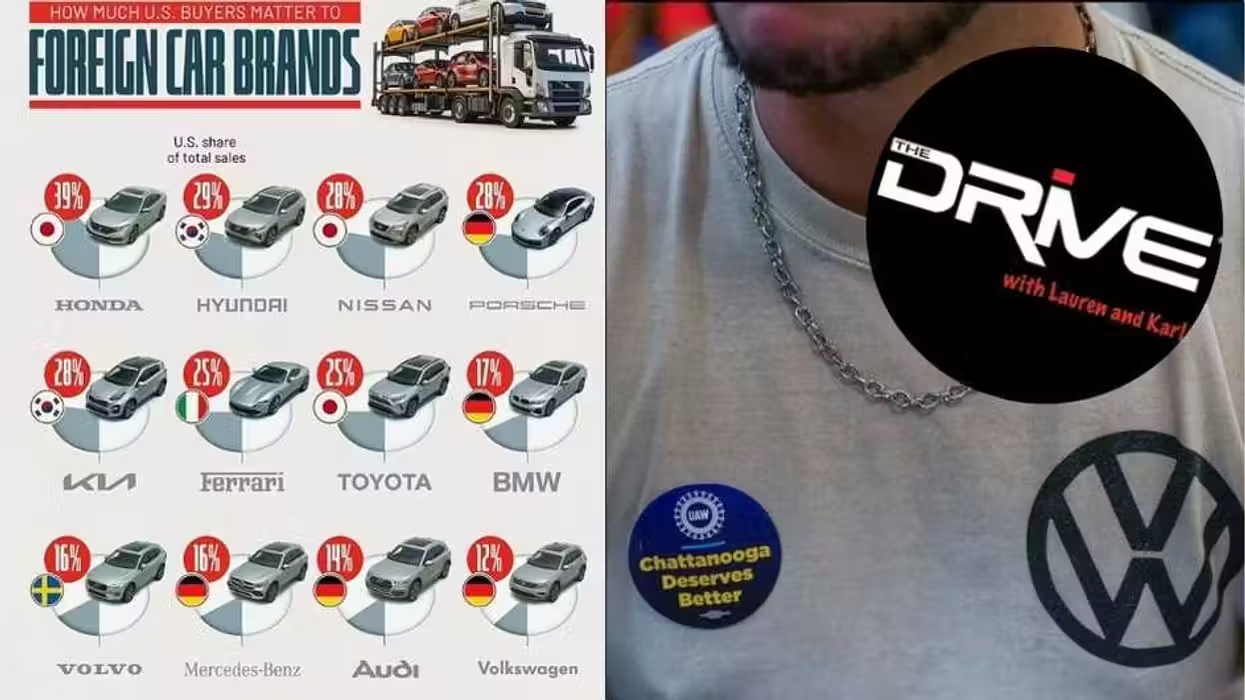
That contrast matters because it underlines a second point: The United States is not just a big market — it’s a market that props up entire global product plans. Payne notes that Honda sells far more of its output in the United States than it does in Japan, and other Japanese brands lean even harder on American buyers. The U.S. consumer is simply a different customer: higher buying power, more space, more appetite for variety, and more willingness (or necessity) to buy larger vehicles.
In other words, when automakers build out multiple trims and performance variants off the same platform — base model, sport model, track model, special edition — that’s usually because of U.S. demand.
Auto industry math still comes down to very specific local realities: what people can afford, where they live, what infrastructure exists, and what regulators demand.
If Japan shows how regional car markets still are, Chattanooga shows what happens when the most powerful market of all — the United States — starts limiting its own flexibility.
Payne’s argument is that transplant automakers (foreign brands building cars in the U.S.) have long enjoyed a competitive advantage: non-union shops.
It’s important to note that the advantage is not in labor prices — “You’ll find that the pay scales of the non-union automakers in these right-to-work states are pretty competitive with UAW,” Payne says — but in the ability to adapt to changing markets.
Unions add a layer of management that makes it more difficult to shift production, change processes, and retool lines.
Nonetheless, Volkswagen’s Chattanooga plant last year became the first foreign-owned factory to unionize. This was the UAW’s third attempt to unionize the plant — and the first time that VW didn’t put up a fight. Why not?
In a word, Payne says, the EV mandate. Because it so much harder to make a profit on EVs, VW relies on various subsidies and tax breaks — incentives turned out to be politically sensitive.
Volkswagen wasn’t legally required to accept unionization — but the politics had shifted. With the UAW closely aligned with Democrats and billions in EV incentives flowing from Washington, Payne notes that VW received a letter from 33 Democratic senators urging it to stay neutral, citing “a lot of money on the line.” The leverage wasn’t statutory; it was political.
Thanks to President Trump, the EV tax credits ended in September, removing much of VW’s incentive to unionize. Of course, by then it was too late.
RELATED: 'A uniquely American industry': SEMA CEO urges EPA to scrap emissions regs
 SEMA CEO Mike Spagnola. Bill Clark/Getty Images
The conversation ends with a more personal detour: Payne’s long-running fascination with Tesla — which he sees less as an “EV brand” and more as a rare disruptor in a mature, brutally difficult industry.
In fact, Payne calls Elon Musk “the Henry Ford of his time” and the Tesla Model 3 (he’s on his third) “the most fascinating car I’ve ever owned.”
“It’s good to have a disruptor,” Payne continues, likening Musk to Donald Trump and the latter’s effect on Washington, D.C. “It’s good to have Elon Musk come into the automotive industry ... and say, ‘Why are we selling cars through dealers instead of through stores like Apple sells iPhones? Why aren’t we updating cars constantly like phones and making them better on the road?’”
And if you’re wondering why your next car costs what it costs — or why automakers seem to change direction every six months — this episode offers a blunt answer: The industry is being pulled by forces that don’t always align, and the tug-of-war is happening everywhere at once.
Listen to the full episode of “The Drive with Lauren and Karl” (featuring Henry Payne) below.