Selcuk Acar/Anadolu/Getty Images
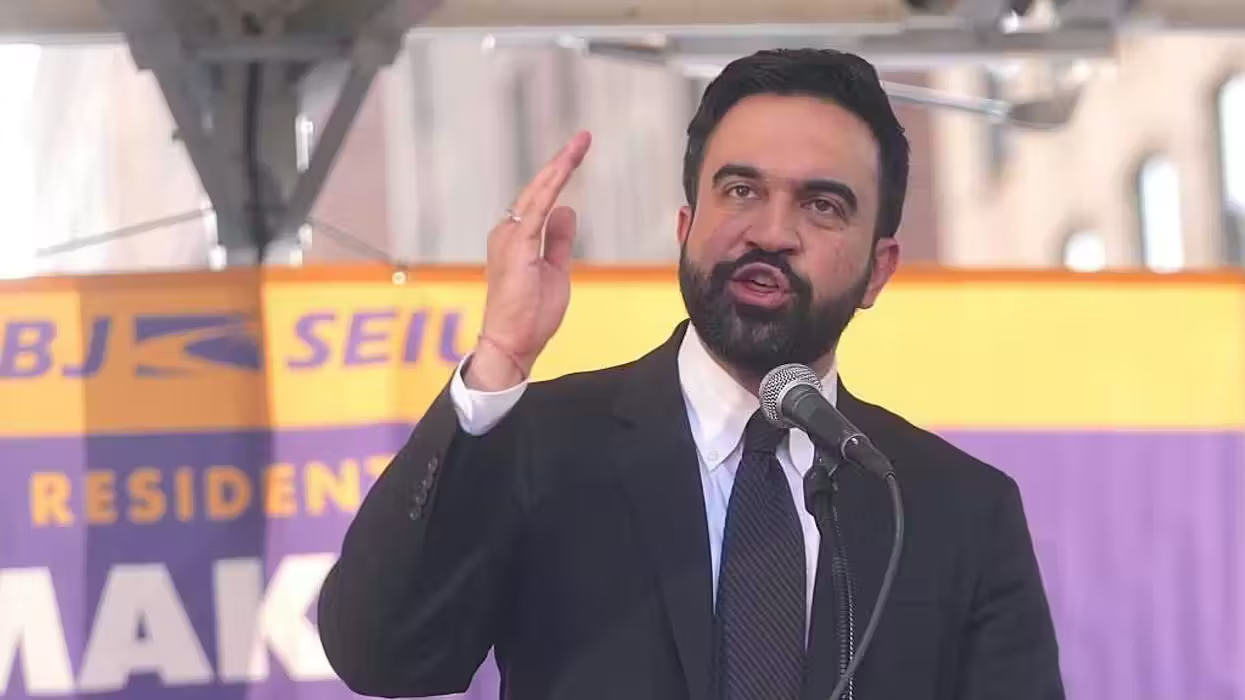
Less than 100 days into his administration, New York City Mayor Zohran Mamdani has been forced to slam the brakes on his signature campaign pledge. Instead of the citywide no-cost transit he promised, New Yorkers are being offered a scaled-back pilot covering three bus lines per borough. That is, if the state legislature can pass a budget, which is already a week past its deadline.
Here's the part that really stings: Mamdani sabotaged his own policy. He and state Sen. Michael Gianaris (D) successfully launched a Queens free-bus pilot in 2023. It worked. But when Mamdani picked a fight with Assembly Speaker Carl Heastie (D) over a housing dispute, Heastie yanked the expansion from the budget.
What does a socialist mayor do when his promises collapse? He makes bigger ones.
Mamdani killed his own program, then ran for mayor promising to bring it back citywide. He campaigned on cleaning up a mess he made.
Now he's calling a three-line pilot "a first step." Metropolitan Transportation Authority CEO Janno Lieber has been critical of the plan. Gov. Kathy Hochul (D), who has committed an additional $1.5 billion to bail out the city, is making it clear that buses rank below housing and auto insurance on her list.
The reception in the state legislature has been, generously speaking, chilly.
So what does a socialist mayor do when his promises collapse? He makes bigger ones.
This week, Mamdani announced that La Marqueta in East Harlem will become New York City's first government-owned grocery store. The plan outlines one in each borough, where prices are "fair" and New Yorkers can "actually afford to shop."
The man who couldn't deliver free buses now wants to compete with Costco. He even challenged the private sector directly: "I look forward to the competition."
What he doesn’t seem to understand is that the competition has already won. Decades ago. And the proof is everywhere.
It will cost $30 million just to open the East Harlem location, with a $70 million budget for all expected stores. That's $70 million in taxpayer money going into a business where even the best-run private grocery stores average margins under 2%.
Every major retailer in America has spent decades perfecting supply chains and slashing spoilage, and yet they're still barely breaking even. Mamdani, fresh off failing to stop charging $2.90 for a bus ride, thinks he can do better.
The real-world track record is telling. Baldwin, Florida, opened a city-run grocery in 2019, struggled to break even, and shut down in 2024. Erie, Kansas, ran its only grocery store at a loss for years before handing it to a private operator. Those towns had zero private competition, and they still couldn’t make it work.
In New York City, the sequence is even more dangerous. The government store moves in, undercuts private competitors with taxpayer subsidies, and drives out the corner bodegas and family grocers who actually pay rent and taxes.
RELATED: The liberal guide to committing national suicide
 Blaze Media Illustration
Then, as history guarantees, the government store collapses too. The Soviet Union, Venezuela, and Cuba all tried it. Every time: empty shelves, shortages, black markets. You don't end up with affordable groceries. You end up with a food desert and no private stores left to fill the gap.
The reason is simple: Politicians are not personally responsible for the losses their policies create, so they have no incentive to operate efficiently. The losses get folded into next year's budget and repackaged as progress.
Three out of four young voters put this man in office. Voters who had lived in New York City less than five years backed him 85% to 14%. They voted for the TikTok version of governance: big promises, great optics, someone else's problem. Free buses sounded great in a Trevor Noah interview.
City-owned grocery stores sound great at a rally in East Harlem. Governing eight million people with real money and real consequences? That's where the fantasy ends.
New York City doesn't have a bus problem or a grocery problem. It has a mayor with a socialism problem. And unlike his buses, the bill is running right on schedule.