L-R: Shadi J.H. Alassar/Anadolu/Getty Images; Roberto Schmidt/Getty Images
The U.S. and Iran reached a fragile ceasefire agreement on Tuesday before President Donald Trump's threat of civilizational annihilation could be put to the test.
Trump subsequently noted that the U.S. "will be helping with the traffic buildup in the Strait of Hormuz. There will be lots of positive action! Big money will be made," adding that "this could be the Golden Age of the Middle East!"
'It is madness.'
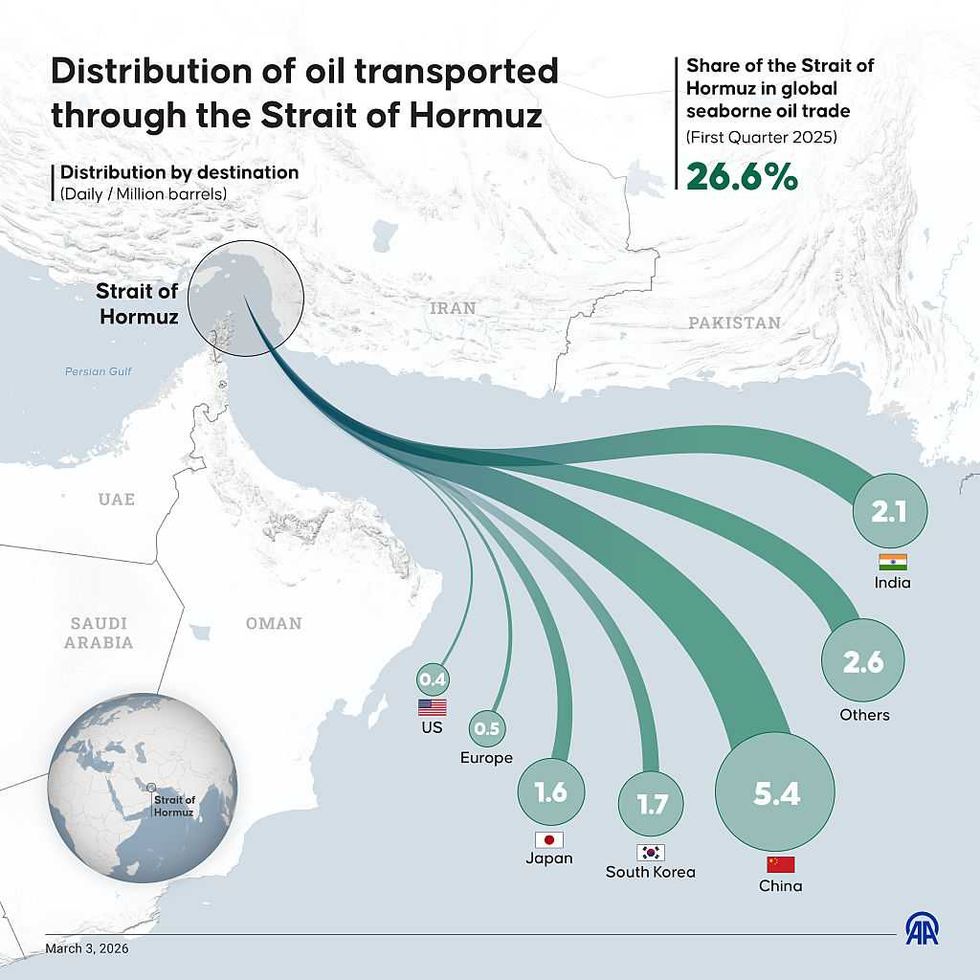
When asked on Wednesday whether he was amenable to the Iranians charging a toll for all ships that transit the Strait of Hormuz — the body of water between Iran and Oman linking the Persian Gulf with the Gulf of Oman, across which one-fifth of the world's oil customarily travels — Trump told ABC News' Jonathan Karl, "We’re thinking of doing it as a joint venture. It’s a way of securing it — also securing it from lots of other people."
"It's a beautiful thing," Trump said, hours before Iran reportedly halted oil tankers attempting to pass through the strait, claiming Israel had violated the ceasefire by firing on Lebanon.
While now apparently open to such a partnership with Iran, Trump suggested to reporters on Monday that the U.S. could unilaterally impose tolls on vessels attempting to pass through the strait, reported The Hill.
RELATED: Israel ramps up attacks on Middle East target despite US-Iran ceasefire
 Elif Acar/Anadolu/Getty Images
"What about us charging tolls?" said Trump. "Why shouldn’t we? We’re the winner."
He also said during the press briefing, "We want free traffic of oil and everything else."
Such tolls on vessels transiting a natural strait would seem to run afoul of the United Nations Convention on the Law of the Sea — ratified by the U.S., 170 other nations, and the European Union — which guarantees vessels the "right of transit passage" through straits used for international navigation; bars states bordering straits from hampering transit passage; and states that "no charge may be levied upon foreign ships by reason only of their passage through the territorial sea."
Tolls can be levied only at man-made canals, according to the U.N. agreement.
Of course, the agreement's authority and enforceability could be tested.
"All international law, unfortunately, is fragile," Saleem Ali, chair of the University of Delaware's geography department, told the New York Times. Ali noted that international laws depend on mutual respect between nations.
Blaze News has reached out to the White House for comment.
The idea clearly doesn't resonate with everyone.
Karen Young, a senior research scholar at the Columbia University School of International and Public Affairs, told Blaze News, "It is madness to think we are jointly collecting fees to help secure profits to the [Islamic Revolutionary Guard Corps]."
Former Israeli government spokesman Eylon Levy expressed a similar objection, writing, "If President Trump lets the Iranians charge a toll for ships in the Strait of Hormuz, then every time you fill up your car at the pump, you will put money straight in the pockets of the Islamic Revolutionary Guard Corps. This would be a humiliating disaster for the US."
Joint venture or no, it appears that Iran aspires to keep sweating passersby in the Strait of Hormuz, now for crypto tributes.
Hamid Hosseini, a spokesman for Iran's government-linked Oil, Gas and Petrochemical Products Exporters’ Union, told the Financial Times that his nation intends to force ships passing through the strait to pay the cryptocurrency equivalent of $1 per barrel of oil and notify Iranian officials of their cargo during the two-week ceasefire.
"Once the email arrives and Iran completes its assessment, vessels are given a few seconds to pay in Bitcoin, ensuring they can’t be traced or confiscated due to sanctions," said Hosseini. "Everything can pass through, but the procedure will take time for each vessel, and Iran is not in a rush."
Reuters estimated last week that if Iran charged each vessel $2 million to transit the Strait of Hormuz, as it had already in one instance, and traffic were restored to prewar volume — 150 ships down the strait — Tehran could bring in around $110 billion annually.
According to the European think tank Bruegel, the $2 million per vessel, which "translates to roughly $1 per barrel," would prompt the world oil price to rise "by only $0.05-$0.40 per barrel, relative to the pre-war level," with Gulf exporters absorbing the bulk of the toll.
Of course, for Iran to impose tolls, it must first keep the strait open.
Like Blaze News? Bypass the censors, sign up for our newsletters, and get stories like this direct to your inbox. Sign up here!