Pavel_Korr/Getty Images
In April 2026, Ukraine’s Ministry of Defense announced that ground robots had completed more than 9,000 frontline missions in the previous month. The number was offered without fanfare, embedded in a press release alongside procurement timelines and delivery metrics, as though the figure were perfectly ordinary, which by then it was. Nearly 24,500 missions in the first quarter of the year; 167 units using uncrewed ground vehicles, up from 67 the previous November. The ministry did not dwell on what this meant.
Ukrainian soldiers who complete verified missions using robots earn e-points through a digital platform that tracks, authenticates, and tallies their work. Those points can then be exchanged, through an online marketplace, for additional equipment. Orders reach frontline units in roughly 10 days. The whole apparatus, in its architecture and its assumptions about human motivation, looks less like a combat system and more like a loyalty program.
The state understands its soldiers as participants in a platform, and it is engineering their behavior accordingly.
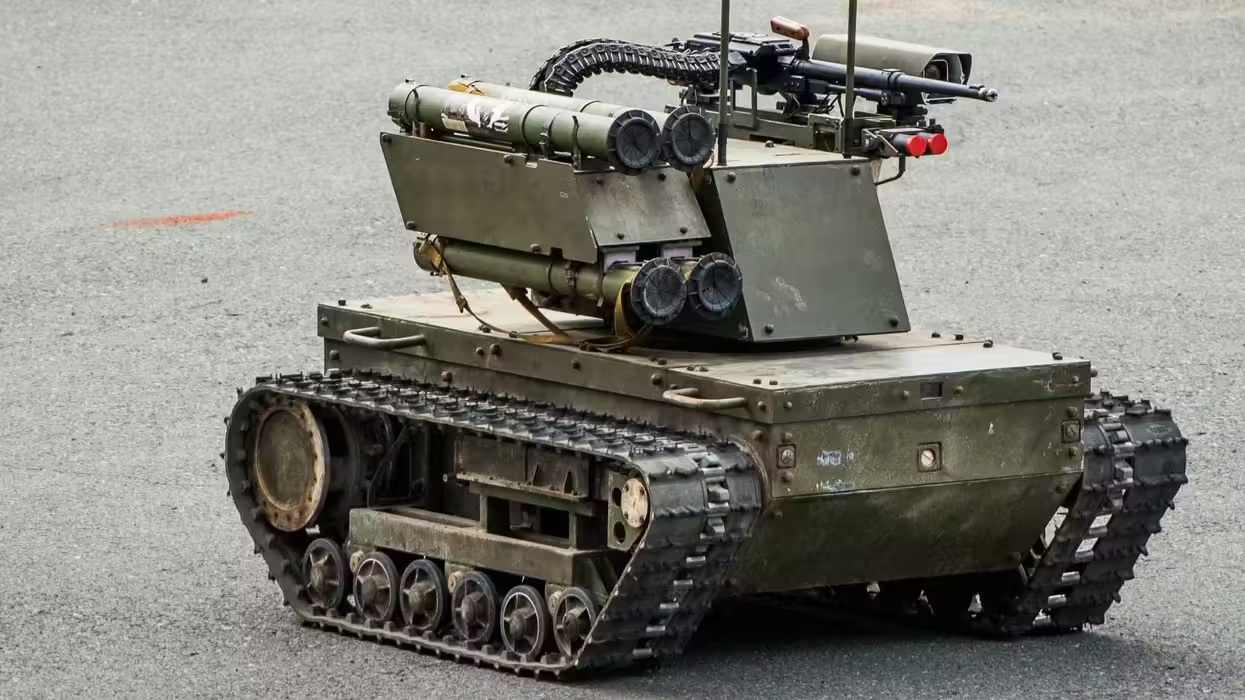
The UGV itself is not a new idea. The Germans fielded the Goliath tracked mine in World War II, a remotely controlled demolition device that failed, in the end, because its control cable could be cut. The Soviets experimented with teletanks in the 1930s, aiming to spare soldiers from exposure that was otherwise certain to kill them. The problem of controlling a machine at distance through contested terrain, under fire, with limited bandwidth and imperfect video, is not a problem the 21st century invented. What the 21st century has done is make it cheap.
Ukraine’s UGVs are designed, above all, to be expendable. The country operates under mass artillery and persistent drone surveillance, which creates a specific engineering pressure that earlier Western robotics programs never faced. American explosive ordnance disposal robots in Iraq were conserved, repaired, and mourned in a way that revealed something about how their operators understood them. Ukraine’s systems are produced in the thousands, iterated rapidly, accepted as losses, and replaced like ammunition.
The substitution principle drives everything. The state’s explicit purpose, reiterated in every official channel, is to move the most dangerous tasks (ammunition resupply, casualty evacuation, mining and demining, certain forms of direct contact) away from human bodies and onto machines. The missions are logged. The ministry’s argument is that somewhere in those 9,000 March missions is a corresponding number of soldiers who did not die. The robot went; the human did not.
RELATED: The US military needs to adapt to modern warfare
 The US military needs to adapt to modern warfareUSAF/Getty Images
What makes Ukraine’s system interesting, and practically consequential, is the way it distributes agency. A UGV mission is not performed by a soldier or a robot, but by a network: the operator watching a video feed, the encoder compressing that feed under bandwidth constraints that determine whether the latency is tolerable or fatal, the repair crew, the procurement pipeline, the verification interface that converts the mission into a data object, the points system that converts the data object into future capability.
The human is present throughout this chain and is, in some sense, responsible for it. However, responsibility, in this architecture, is not the same as when a soldier carries ammunition through a kill zone but is cast as clicking, uploading, or watching a screen.
This practice is not unique to Ukraine. Mediated violence is familiar from drone programs and earlier remote weapons systems. What Ukraine has done is extend the logic farther into the supply chain, the metrics, and the incentive design, making explicit what other militaries have left tacit. The gamification is structural. The state is acknowledging, through the design of the e-points system, that it understands its soldiers as participants in a platform, and it is engineering their behavior accordingly.
The Ukrainian government is aware of the genuine tension in this design. Goodhart’s law holds that when a measure becomes a target, it ceases to be a good measure. If points are awarded for confirmed hits, soldiers will pursue confirmed hits. Ukraine’s system tries to counteract this by assigning points also for evacuation missions, for the lifesaving work that does not produce the bright flash of verification. Whether this framework works, whether the incentive categories actually reshape behavior or merely sit alongside it, is an empirical question.
By early 2026, seven UGV models from six Ukrainian manufacturers were available for direct order through the DOT-Chain Defence marketplace. Foreign platforms have entered the ecosystem too: Estonian-built THeMIS vehicles, first delivered in 2022, were absorbed into Ukraine’s logistics environment alongside the domestically produced systems. NATO was also watching. Its UNITE initiative, announced in late 2025, proposed to scale prototyped battlefield innovations among alliance members, with unmanned ground systems explicitly named as a future focus.
Ukraine’s particular answer to a particular problem — how to fight at scale under conditions of acute manpower constraint — is becoming a transmissible model. The rapid iteration, the platform-mediated procurement, the tight loop between battlefield data and design revision are not incidental features of Ukraine’s approach. Other militaries, in more comfortable circumstances, studying this from a distance, may conclude that they want something like it.
What they would be acquiring is a way of knowing, a way of governing through metrics and incentives and interfaces, that treats war as a system to be optimized. The appeal is obvious. Systems can be improved. Metrics can be refined. Platforms can be updated. The facts that cannot be put into the system — the exhaustion, the fog — remain outside the data. They do not affect the point calculations. They do not appear in the quarterly mission totals, which continue to rise.
In March 2026, the machines completed 9,000 missions. The ministry reported this statistic as progress. It was surely also something else, something that does not yet have a name.