CookiesForDevo/Getty Images
Tim Ferriss did something that almost no author with a brand to protect would ever do. He posted his real sales numbers, and they weren’t pretty. He called his own catalog the “cadaver on the table.”
It's worth looking at the body.
Ferriss has five books, all of them number-one best-sellers, the kind of backlist that is supposed to pay out like an annuity. "The 4-Hour Workweek" was still one of the most highlighted titles on all of Amazon a full decade after it came out. Then the floor gave way. His sales were down 46% in 2025 and are on pace for another 57% drop this year. If the run rate holds, his catalog will sell roughly 80% fewer print copies in 2026 than it did in 2022.
What changed in 2022? ChatGPT launched that November. The slide tracks the chatbot almost line for line, and it isn't just that. In the first quarter of this year, total print sales fell 3.1%, and self-help took the worst beating of any category, with units down 26.3% from a year earlier. Only two of adult nonfiction's 16 subcategories grew at all. One of them was religion. Hold that thought for later.
A free country runs on citizens who can read a contract before they sign it.
Ferriss' read is clean and probably correct: A how-to book was always a lookup table. "The 4-Hour Body" is a menu. How do I lose the fat, fix my sleep, and add 10 pounds of muscle? In 2019, the best interface to those answers was 600 pages. In 2026, it's a free chatbot that already ate the book and will hand you a personalized version in 15 seconds, adjusted for your weight, your bad knee, and your hatred of cottage cheese.
He's right about the books. I think he buried the lede, though. And the lede is us.
Here's the thing nobody in this conversation wants to say out loud. Most people who bought how-to books weren't readers. Not really. With no offense intended to Ferriss, who has been remarkably successful, his bibliography could easily be dismissed as “airport books,” something you thumb through on a long layover.
The guy who would never crack a novel would still buy the diet book. The money book. The manual for fixing his own transmission. He read because he wanted the thing on the other side of the reading, and the reading was the toll you paid to get it. That toll is what kept a whole class of marginal readers in the habit at all. Self-help was the gateway drug to literacy for grown men and women who had set reading down the day they walked out of high school.
Ferriss is documenting the exact moment we stop charging the toll, and we're doing it at the worst possible time in about a century.
In December 2024, the National Center for Education Statistics dropped the latest international assessment of adult skills, and the results were ugly. Average U.S. adult literacy fell 12 points between 2017 and 2023. The bottom rung swelled from 19% of the population to 28%. That's the group that struggles to compare two pieces of information, paraphrase a short passage, or make a basic inference.
That’s more than one in four working-age Americans and is the first statistically real drop since they started keeping score in 2008.
Sit with the timing on that. The test was given in 2022 and 2023, before the chatbots had fully soaked into daily life. We were already forgetting how to read on our own.
RELATED: Livid judge cancels trial and busts lawyers for faking briefs with AI — on both sides
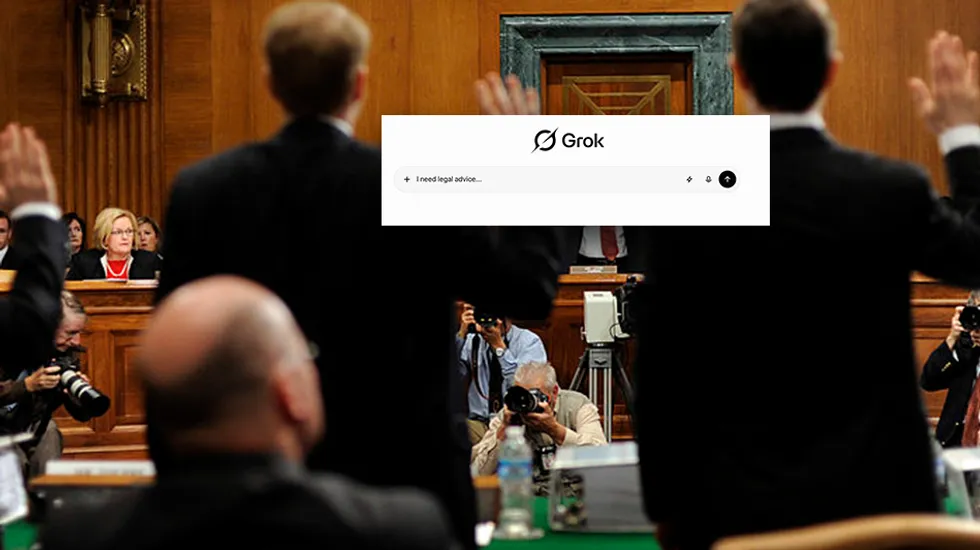 Background: Melina Mara/Washington Post/Getty Images; foreground: Grok/xAI
The habit data says the same thing from a different angle. By 2021, Gallup had Americans reading fewer books than at any point since it started asking in 1990. Reading as a favorite way to spend an evening got cut in half in four years, from 12% down to 6%. And a CBS/YouGov poll out last week found a third of Americans now read fewer books than they did a decade ago, with more than a third admitting their own attention spans have gotten worse. They can feel it going. That's almost the saddest part.
The kids are the leading edge of this, not the exception. Reporting in the Atlantic last year had professors at places like Columbia trimming their syllabi because incoming students couldn't get through a whole book any more. And these were bright kids, the ones who tested in. The professors said it’s a problem of stamina and commitment. “Students can still read books, they argue — they’re just choosing not to,” said Rose Horowitch of the Atlantic.
But the adults are the real story here, because they already have the skill and are choosing not to exercise it.
Every generation gets handed a reading villain. Radio was going to rot our brains. Then television. Then the smartphone. And many of the concerns about those technologies were valid. Despite that, we remained a nation of readers until the smartphone era. “Teenagers are constantly tempted by their devices, which inhibits their preparation for the rigors of college coursework,” Horowitch said.
But even in the worst case, all of those things merely competed with reading for your attention. The chatbot is the first one that poses an existential threat to publishing, its very reason to exist. It doesn't just pull you off the page. It offers to stand between you and every page you'll ever encounter, from now on, and hand you the gist so you never have to do the work yourself.
The work was the whole point of reading: comprehension, judgment, and the slow, unglamorous business of building a mind that can tell when it's being handled. The early research on what they call cognitive off-loading indicates that the more people hand their thinking to the machine, the less they draw on their own. One MIT team even wired up people's brains and found weaker neural connectivity and poorer recall when subjects leaned on a chatbot to write instead of doing it themselves. That study was about writing, and it's preliminary, so I won't oversell it. But you don't get the bicep by watching somebody else lift the weight.
A free country runs on citizens who can read a contract before they sign it. Read the ballot initiative. Read the lease, the diagnosis, the verse, the founding document, and catch it when somebody's tidy little summary is shading the truth.
Ferriss tosses off a Pew number almost in passing: 83% of Americans haven't paid for news in any form in the past year, and when they slam into a paywall, exactly 1% reach for a credit card. Now, the other 99% shrug, give up, or ask the AI for the gist. A whole population is increasingly taking the machine's word for what the document said, without looking at the document itself.
That's not just a reading crisis, but a sovereignty crisis. A man who can't read for himself, and won't, has no choice but to trust whoever's doing the reading for him. There's an old word for that arrangement: subject.
This is what inspired my wife and me to launch Chapter House. We make hardcover children's books, the kind meant to be read aloud and handed down to the next generation. We didn't build it out of nostalgia, and we sure didn't build it because print is the fastest way to get information into a mind.
We built it because speed was never what reading was for. Reading forms the person doing it. A child raised on hard, beautiful books grows into the one adult in the room the machine can't fool, precisely because he has already done the work the machine keeps offering to skip.
Ferriss circles this the whole way through his post without ever landing on it. He says what survives the AI flood is voice, taste, the sequenced journey, the experience of sitting with one mind at real length. He's describing a thing. The thing has a name, and it's a lot older than his bibliography. It's education. The genuine article.
He ends by lashing himself to the mast of long-form writing and half-joking that maybe he's just delusional.
He's not delusional. He's optimistic about the wrong number. The thousand true fans are going to be fine. They were always going to be fine. It's the quiet quarter-billion I'd lose sleep over, the ones for whom the machine just removed the last practical reason they had to ever read anything again. They don't get the tidy ending. And they vote, and raise children, and sign their names to things they didn't read.
The off-ramp is open. It's well lit, it's free, and the machine is happy to take the wheel.
Whether we hand it over or not was never up to the machine.
The one lever still entirely in our hands is whether the next generation can do the thing the machine keeps volunteering to do for them. So read to your kids tonight. It's a smaller act of defiance than it sounds like. It might also be a bigger one.