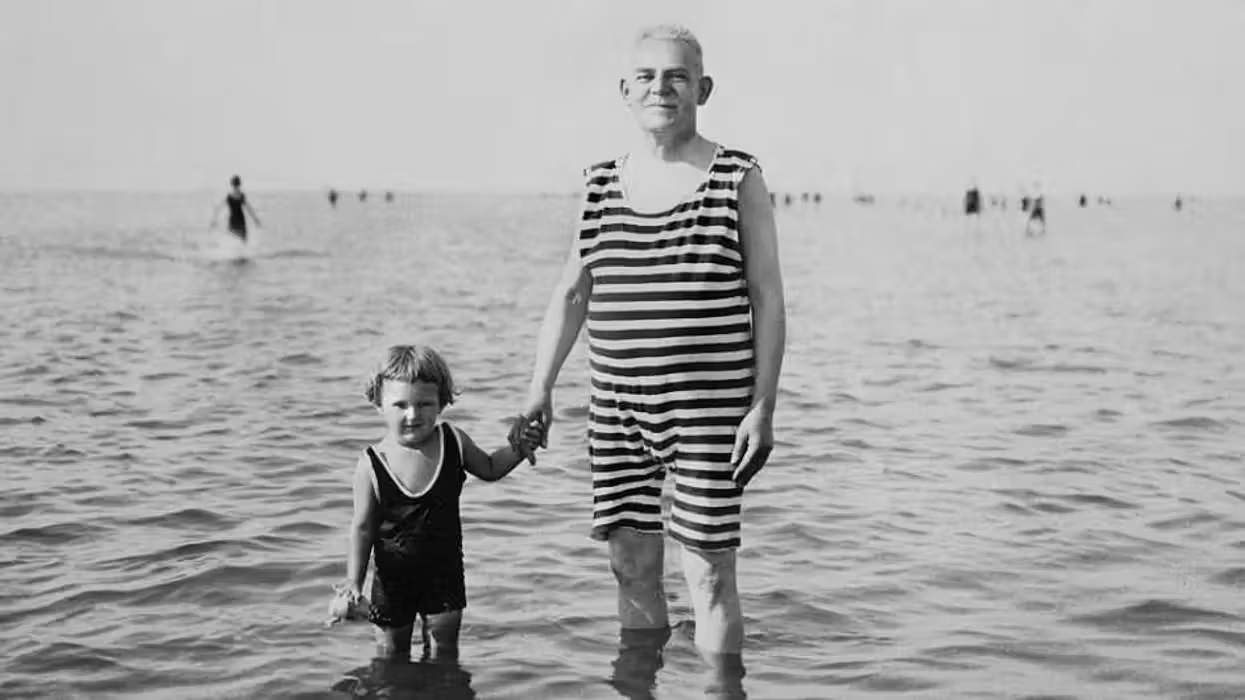
Kirn Vintage Stock/Getty Images
Ten years have passed since I last spoke to my grandfather as himself. Not a day goes by that I don't miss him.
The man who forgot me isn’t the one I carry. I carry the other one. The one who took me for long walks, who collected acorns the way other men pocket loose change. He taught me never to speak ill of others, advice I have absorbed deeply and applied far less than he would have liked.
He never had a bad word to say about anyone. Not once. As an Irishman, this made him practically a medical curiosity.
We fed livestock together in the early mornings, breath visible, ground hard underfoot. He had a tenderness with cattle and sheep that I have never seen replicated . A slow hand to the forehead, a particular stillness, and the animal would simply decide to trust him. Even the wild ones. Especially the wild ones.
In the garden, he taught me to plant vegetables with something approaching ceremony. Potatoes pressed into drills with two hands, like an offering. Scallions in lines so deliberate they made the rest of existence feel approximate. Soil under the fingernail. The unshakable faith that what you plant will, in its own time, pay you back.
He taught me how to play piano and the Irish flute — hours of patient instruction that I traded, around age 13, for sports and the dubious pleasures of warm cider in a field. I stopped. He said nothing. I am still grateful and still guilty in roughly equal measure. He was the kindest man I have ever known.
He never had a bad word to say about anyone. Not once. As an Irishman, this made him practically a medical curiosity. We are, by temperament and long tradition, a people who can elevate mild inconvenience into competitive suffering. He never caught that particular bug.
Then Alzheimer's arrived. Before it takes the body, it takes the person, which makes the grief savage in its specificity. You mourn someone still breathing in front of you, still drinking tea, still occasionally smiling, while the version you knew withdraws without a forwarding address.
The first time he didn't recognize me, I expected hesitation. What I received was blankness. Placid, absolute blankness. A face I had known my whole life, looking at me like I was a stranger who had wandered into the wrong room. For him, likely a passing cloud. For me, a clean line dividing before from after.
My grandmother outlived him by months. The official cause was a heart attack. The accurate cause was a broken heart, and I mean that with clinical precision rather than poetic license. She simply had no further use for mornings without him. Fifty years of reaching for the same hand, and when the hand was gone, she simply lost the argument for continuing. There is a particular brutality in watching love become a countdown.
RELATED: 'Farmer' George Clooney wouldn't last a minute with my family's sheep
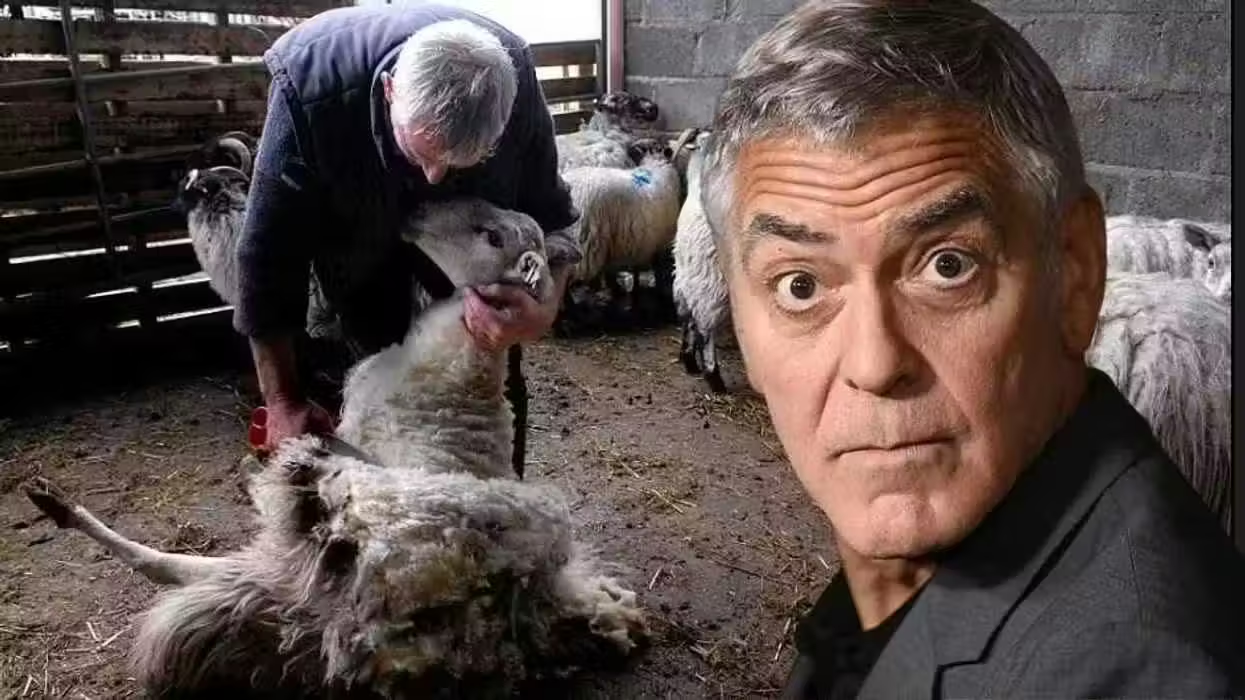 Axelle/Bauer-Griffin/Andia/Getty Images
For decades, the dominant scientific theory treated Alzheimer's as a single-villain story: amyloid plaques accumulating in the brain. One cause; one target. It was neat and tidy.
It was also completely wrong. Researchers now describe a far more complicated picture. Tangled Tau proteins. Genetic vulnerabilities. Metabolic failures. Disruptions originating in the gut, of all places.
The brain fails as part of a longer story. The first forgotten name is never the beginning, but only the moment the beginning becomes impossible to ignore. Medicine, in other words, spent decades treating the final chapter as the only one worth reading.
Newer treatments show modest results. They slow the decline, but they don’t reverse it. They don’t put a man back at his kitchen table, telling a story his family has heard so many times they could recite it backward, about meeting his wife at a dance, and making it feel, on the 43rd telling, like something worth leaning in for.
The current scientific ambition, at least, has grown more honest: attack the disease across every front simultaneously. Target the proteins, the aging cells, the metabolic dysfunction, and the genetic predispositions. Treat the system, not the symptom.
My grandfather would have grasped this without a single journal article. He understood, bone-deep, that everything connects. Soil quality shapes the crop. Weather shapes the soil. The animals depend on both. You can’t fix a failing field by fixating on one plant.
There is something resembling hope in this shift. It arrives too late for him and for her. But the possibility exists that fewer families will sit across from someone they love and watch recognition drain from a familiar face. Over 7 million Americans currently live with Alzheimer's. The people who love them number considerably more, and their suffering doesn’t appear in the statistics.
My grandfather carried me when I was too tired to walk and when I was too sick to stand. In return, I carry him. The man who never gave anyone a reason to be forgotten. It is the least I can do and nowhere near enough. And I will do it anyway, gladly, until I no longer can.