Toa55 via iStock/Getty Images
The holidays have a way of forcing conversations many families would rather postpone.
Every year, as adult children come home and aging parents gather around the table, familiar signs emerge. Someone struggles with stairs. Someone tires more easily. Someone forgets what was once routine. And with those observations come discussions caregivers know well.
The promise.
“I’ll never put Mom or Dad in a nursing home.”
It is often spoken years earlier, in healthier days, and always with sincerity. At the time, it feels like a declaration of love and loyalty. Assisted living seems distant, unnecessary, and meant for other families, not ours.
The problem is not the promise. The problem is that life keeps changing.
Circumstances change. Strength ebbs. What once worked may no longer work safely or wisely.
Over time, what began as devotion can quietly become more than one person can manage alone. Needs grow. Safety becomes a concern. Medical issues multiply. Caregivers often find themselves trying to do, by themselves, what normally requires trained professionals, proper equipment, and constant oversight.
At that point, the issue is no longer love or loyalty. It’s capacity.
That reality came into focus during a recent conversation with a friend. He had offered a small cottage on his property to help a friend relocate aging parents closer to family. The mother now uses a walker. The father has been her caregiver for years, but serious heart problems have begun to limit what he can safely do.
Still the conversation kept circling back to the same refrain: Neither would ever go into assisted living or a nursing home.
Their adult son is caught in the middle, trying desperately to make everyone happy. That is a fool’s task. In my work with fellow caregivers, I call this the caregiver FOG — fear, obligation, and guilt — because it blurs perspective, narrows options, and makes even familiar paths hard to see. No one wins.
It is like driving into actual fog. Visibility drops. Muscles tense. Judgment narrows. We try to peer miles ahead when we can barely see the hood of the car.
Every highway safety officer gives the same advice: Slow down, turn on the low beams, and stop trying to see five miles down the road.
Caregiving requires the same discipline.
My friend asked what I thought.
I suggested we lower the emotional temperature and start with one concrete issue.
Not the promise. Not the arguments. Not the guilt.
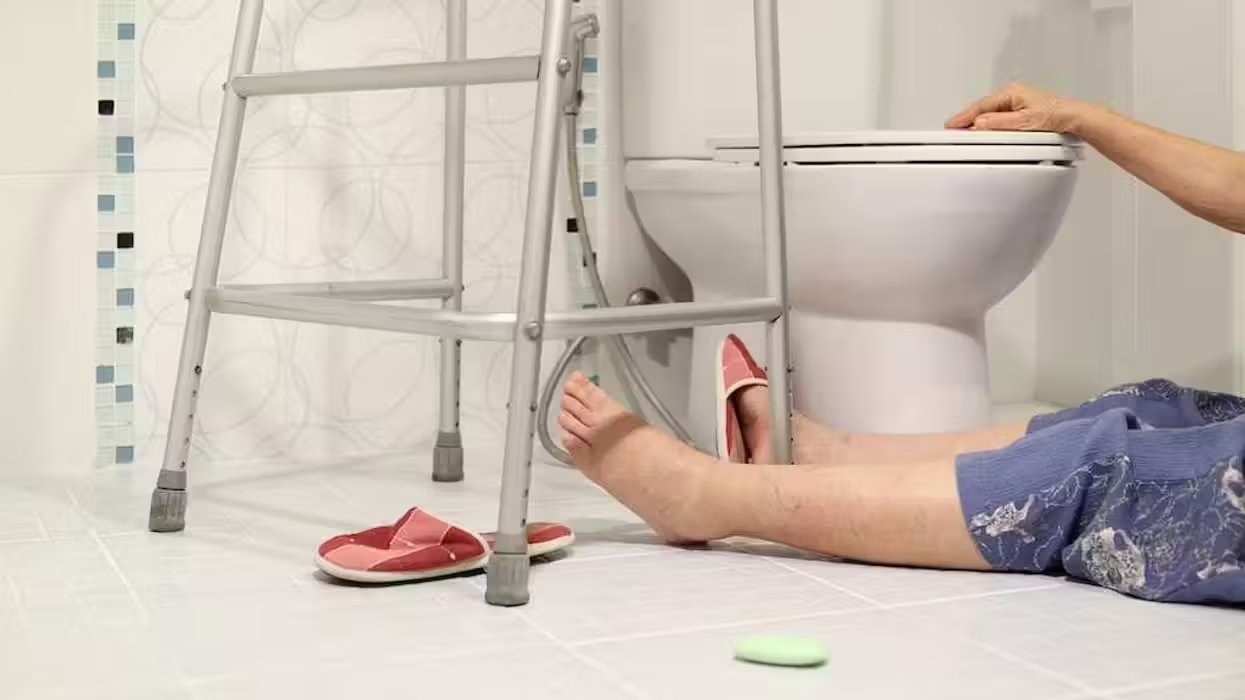
Start with the toilet.
Laugh if you like. It sounds abrupt. But it has a way of clarifying reality quickly.
RELATED: When the soul flatlines, call a ‘Code Grace’
 PeopleImages via iStock/Getty Images
The bathroom is often ground zero for caregiving challenges. If the toilet is not safe and accessible, the demands on the caregiver escalate immediately. Transfers become harder. Fatigue compounds. Falls become more likely.
Once the toilet is addressed, you move outward.
The shower. The bedroom. Doorways, lighting, entrances.
Sometimes modest changes are enough — grab bars, a raised toilet seat, a walk-in shower. None of these are exotic ideas. But determining needs honestly requires facing the limits of strength, balance, and endurance as they exist today, not as we wish they were.
While politicians and toilets often deal with similar subject matter, toilets remain refreshingly honest. They simply reveal what actually works.
When families do this, reality follows. Cost. Time. Budgets weighed against needs. Timelines measured against declining strength. What once felt like a moral standoff becomes a practical evaluation.
Fear, obligation, and guilt begin to loosen their grip. In their place come planning, stewardship, and direction.
This matters because emotional decisions often rush families into choices that create larger — and sometimes far more expensive — problems later. We see this dynamic everywhere, including politics. While politicians and toilets often deal with similar subject matter, toilets remain refreshingly honest. They do not respond to intentions, promises, or speeches. They simply reveal what actually works.
Families do not choose assisted living or nursing homes in the abstract. Toilets always have a seat at the decision table.
RELATED: Christian, what do you believe when faith stops being theoretical?
 fotojog via iStock/Getty Images
Surveys consistently show that most older Americans want to remain in their own homes as they age. That desire is sincere and understandable. But staying home without meaningful accommodations transfers an enormous burden onto the caregiver. The home may remain familiar, but the cost — physical, emotional, and relational — often rises exponentially.
Most promises are made sincerely. They are also made without a full understanding of how disease progresses, how bodies change, or how deeply caregiving reshapes everyone involved. Honoring a promise does not mean freezing it in time. It means continually asking how we can care well, given today’s realities.
Assisted living is not a surrender of care. In many cases, it is an extension of it. It allows families to return to being sons, daughters, and spouses, rather than exhausted amateur medical staff running on guilt and fumes.
We are not obligated to preserve every arrangement exactly as it once was. We are called to steward what has been entrusted to us — finances, time, energy, relationships, and the caregiver as well.
Circumstances change. Strength ebbs. What once worked may no longer work safely or wisely.
Important decisions are best made with clear heads, honest assessments, and wise counsel — not under the duress and resentment that so often accompany them. The days after the holidays are not a verdict. They are an invitation to slow down, think clearly, seek experienced guidance, and choose what is best not just for one individual but for the whole family.
The path forward is rarely determined by emotion, decades-old promises, or guilt.
More often, it is clarified by something far more unassuming — and far more truthful.
The appliance in the nearest bathroom.