Leontura / Getty Images
Some still remember when Google defined itself by a simple motto: “Don’t be evil.” When Google reorganized under Alphabet in 2015, the new parent company adopted the somehow less confidence-inspiring, “Do the right thing.” Another phrase with a lower bar also made the rounds — “to organize the world’s information” — but rest assured, that was never the motto. It was simply ... uh ... the mission statement.
Anyway ...
The AI doomers’ strange brand of apocalypticism is: Let’s create an evil god so we can save the world from it.
It took until this week for some of the most powerful voices in tech policy to circle back explicitly to a prime directive: Avoid hellacious acts. For that, thank the AI doomers, whose strange brand of apocalypticism — let’s create an evil god so we can save the world from it — finally breached technology insider-dom and splashed across the political timeline.
The high-stakes soap opera has, as usual, deeper currents than the news feed can convey. But the key development is that the White House and its allies moved at warp speed to establish a few basic touchstones that take us back to the good old days of not being evil.
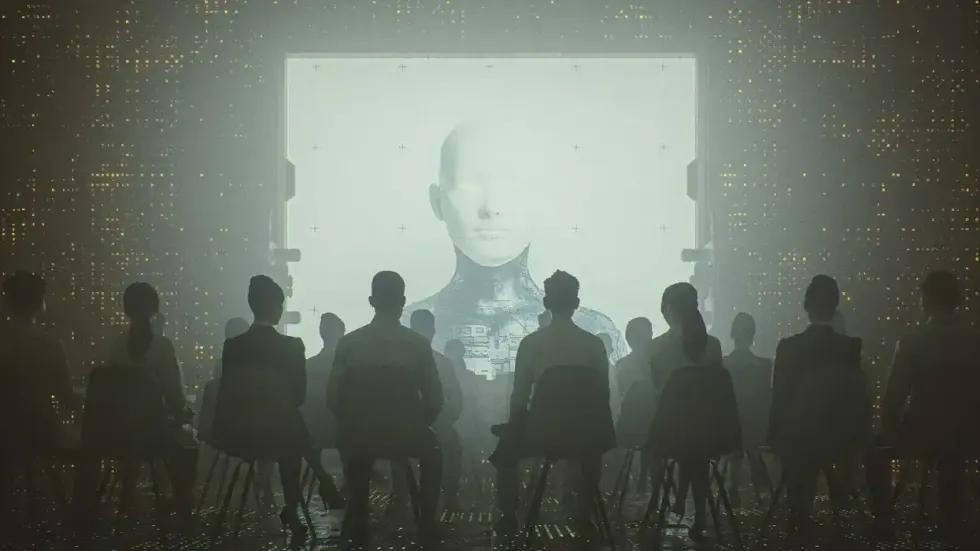
Trump has received most of the attention for memeing his stern-looking self above the caption “Americanism, Not Effective Altruism!” But his vice president captured the matter in a single line that’s tough to beat. “If you’re building Frankenstein,” he said, “stop!"
Note the emphasis. Trying to build an evil god — for instance, one with a statistically nonzero chance of wiping out the human race — is fortunately still considered axiomatically evil. But JD Vance’s reference underscores that trying to build a "new man," even with the best of intentions, is also evil.
According to the doomers, the best way to save the world from evils they might create is for the rest of us to give them some form of planetary governing control. Vance endorsed a more commonsense approach: The best way to spare the world from evils you’re responsible for is to ... not do them in the first place.
RELATED: Silicon Valley is building a god in its own image
 Gremlin/Getty Images
The vice president may, like every one of his predecessors in living memory, carry a pronounced partisan identity. But his folksy-clever line echoes in anti-doomer rhetoric now blaring from the industry’s rooftops. Microsoft, of all places, recently published its own rulebook for what not to build. On X, Microsoft AI CEO Mustafa Suleyman promoted the new “Humanist AI Code of Conduct,” which insists AI “is not conscious and should not be designed to imitate consciousness. It should,” Microsoft avows, “be engineered to avoid representing as though it has feelings, subjective preferences, or intrinsic motivation.”
Microsoft also flatly states: “We reject the pursuit of legal personhood, or the idea that models might deserve welfare, or be entitled to rights.” No Frankensteins here!
Or rather, no Frankenstein’s monsters — which means no Dr. Frankensteins running amok in the lab.
At Palantir, outspoken CTO Shyam Sankar made a similar point in a 2025 interview. “I think the secularists in Silicon Valley are filling the God-shaped hole in their heart with AGI,” Sankar said.
“The people who have religion are the most skeptical” of the doomers’ build-a-god-and-save-the-world-from-it thesis — which, yes, does itself resemble an inverted religion. For “the people who are kind of transhumanists,” Sankar concluded, “it becomes what they wish were true.”
Even Nvidia’s Jensen Huang, not known for Bible-thumping, recently struck an economic note with more than a whiff of spirituality.
“If we’re not confident about the safety of the products, like all companies ... if you build a product or a service and you’re not confident in its functionality, capability, or safety, then don’t release it,” he said. "And so that’s a very obvious thing to do. You pace yourself until you are confident you’re releasing something that the market would appreciate. The market forces are already there. We don’t need any new laws. We don’t need new regulations.”
RELATED: Poll: Most think AI could do this to humanity — but don't agree on what to do about it
 da-kuk/Getty Images
Translation: Hear a little voice in your head, or more likely, your heart? Whispering, “No, this product is bad”? Don’t take it to market.
Turns out, you can just not do things!
Of course, Huang’s logic is a bit deceptive. We would like to believe the market will punish bad people for taking bad things to market, but that is not always how it works. As we speak, present-day Dr. Frankensteins are transplanting human brain organoids into mice engineered to lack most of their cerebral cortex, allowing the human tissue to occupy much of the vacant space and wire into the animals’ nervous systems.
No, doctors! Bad! Evil! Don’t!
Except they are. In the end, it matters that people examine their own hearts for evil before looking elsewhere and pointing fingers. But spiritual insistence alone will not keep society on the rails. It is not enough to scowl at our mad doctors, however good their intentions, as their creations erode the boundaries around our sacred human bodies and being — supercomputers or no.