David Paul Morris/Bloomberg via Getty Images
Nearly half of Americans now refuse to identify as either Democrat or Republican. According to a recent Gallup poll, independents make up a record 45% of the electorate, yet our political system continues to operate as though this plurality doesn’t exist — until now.
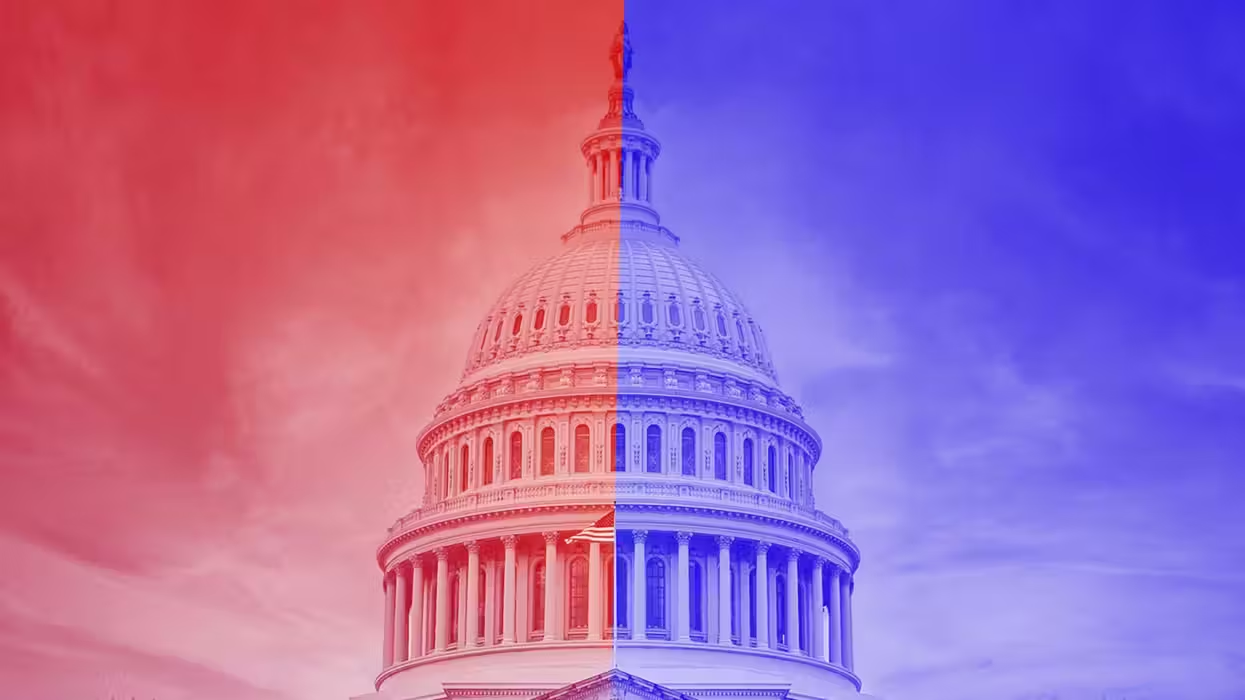
Both major political parties are facing widespread public dissatisfaction, with 58% of Americans viewing the Republican Party unfavorably and 61% expressing unfavorable views of the Democratic Party. As confidence in the parties erodes, 2026 is shaping up to be the year that we see a handful of independents elected to Congress, disrupting the balance of power in Washington.
Independents need only three to five seats to fundamentally transform American politics.
For politically homeless voters, this moment calls for supporting credible independent candidates where they can actually win, especially in congressional districts where neither party is delivering for its constituents.
While the Gallup poll shows the increase in independent self-identification metrics, which have been sitting at around 40% since 2011, there is a convergence of two major trends that make this moment in politics ripe for independents.
The first major trend is the rise of Millennials and Gen Z as a central voting bloc. 2026 will be an election in which younger Americans make up a sizeable portion of the electorate, with projections currently holding that Millennials and Gen Z will account for over half of voters by 2028.
Millennials are now well into their 30s, many serving in executive and senior leadership roles in politics and business, including prominent voices such as Vice President JD Vance and New York City Mayor Zohran Mamdani (D). Together, Millennials and Gen Z are becoming one of the most influential forces in the electorate.
Unlike their predecessors, these two generations are far more likely to identify as independent. Many have never belonged to a political party in the first place. Younger independents are focused on issues like affordability, which both parties are failing to address. They gravitate toward candidates from either party who appear to be invested in their issues.
The second trend is the broader integration of AI systems into everyday life — including politics. AI is the great leveler, much like the printing press fundamentally altered information systems and power structures centuries ago. It will be a game-changer in a similar way, and it’s a major reason why an independent movement in 2026 can make more progress than past efforts.
RELATED: Republicans and Democrats are in revolt — for very different reasons
 Douglas Rissing/Getty Images
The two-party system, like the taxi industry before Uber disrupted it, represents an entrenched but flawed model that has resisted reform. AI provides the tools to completely bypass the old system, rather than slowly reforming it from the inside. Technology now democratizes campaign infrastructure, voter outreach, and message distribution pathways for alternatives that were previously impossible without massive institutional backing.
Americans are hungry for more options at the ballot box. We can customize what we watch, what we drive, even which type of peanut butter sits on our shelves. Yet when it comes to politics, those options narrow dramatically. As the two major parties continue to struggle to meet the moment, voters’ appetite for credible alternatives is only growing stronger.
In the private sector, we would call it a clear product-market fit. If there were two brands that people clearly rejected, competition would naturally emerge in the market. The same logic applies to politics. Recent polling from the Independent Center Voice discovered that 76% of voters would likely vote for “strong, well-funded independent candidate.”
For far too long, the conversation among independents has fixated on electing a third-party candidate to the White House. They’ll find more luck channeling their dissatisfaction, frustration, and growing disillusionment toward Congress, where institutional change is more enduring. It’s in congressional races — not presidential ones — that the independent movement will be felt first.
Independents need only three to five seats to fundamentally transform American politics. With growing concentrations of independent and “no party preference” voters across key districts, the foundation for change is already in place.
The real question is no longer whether the independent movement will arrive, but whether the political system is prepared to respond.
Editor’s note: This article was originally published by RealClearPolitics and made available via RealClearWire.