Kristian Tuxen Ladegaard Berg/SOPA Images/LightRocket/Getty Images
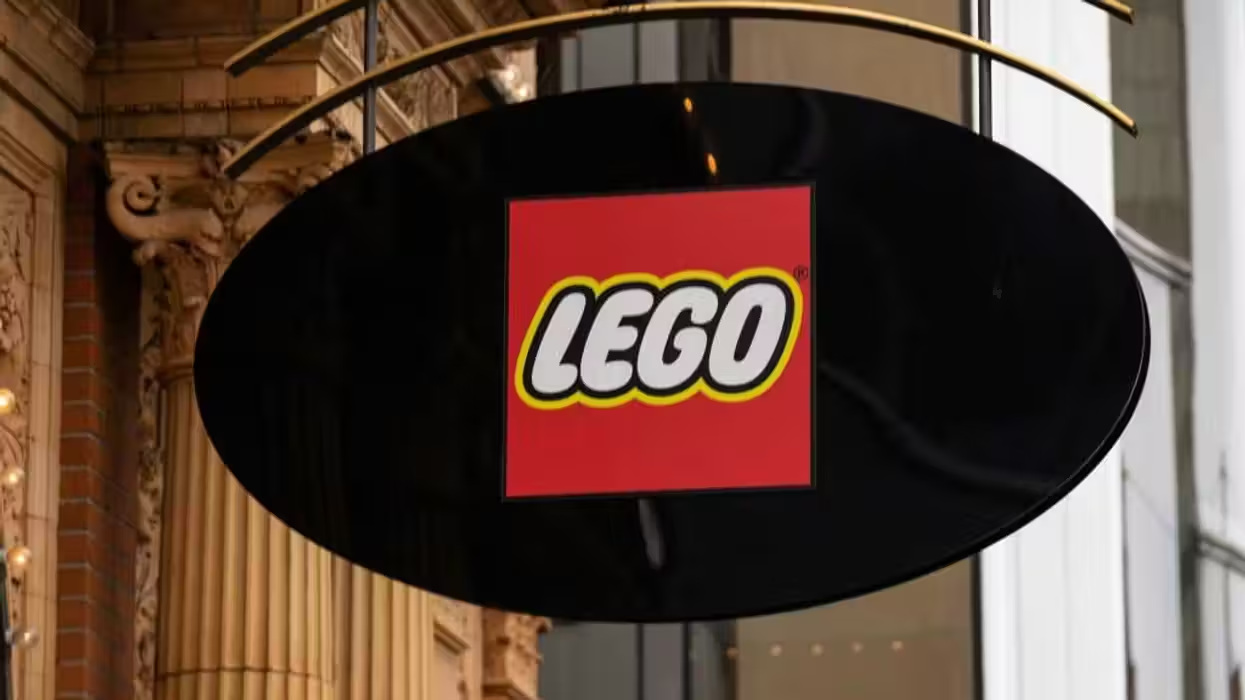
I grew up playing with Legos, and so did my kids. But when I told them the story of Bryan Mansell, Star Wars Legos, and Bricks & Minifigs, it sounded too strange to be true. It sounds like something written by a committee of internet pranksters, small-town cops, corporate lawyers, Lego collectors, and Kafka.
I did not expect this story at the start of the summer.
Where are the Legos? Who owes the Mansell family? And why did it take an internet firestorm to get anyone to listen?
At the center of it is not a culture-war symbol, a presidential scandal, classified documents, or some new university ideology. It is a Star Wars Lego collection.
And somehow, around this collection of plastic bricks, we now have lawsuits, arrests, temporary restraining orders, allegations of corporate misconduct, allegations of harassment, a YouTuber reportedly fleeing to Mexico, a police department under national scrutiny, and a family still asking the question that started the whole mess: Where are the Legos?
Act 1 begins in Keizer, Oregon.
Bryan Mansell says he took his 83-year-old father’s prized Star Wars Lego collection to a Bricks & Minifigs retail location in late 2023. His father was battling cancer, and the family wanted to sell the collection to help with medical expenses.
This was not a box of random toys found in an attic. By Mansell’s account, it was a massive collection assembled over many years, with hundreds of sets and more than a thousand minifigures. Some estimates put the value between $150,000 and $200,000. Some collectors described it as one of the most impressive private Star Wars Lego collections in the region.
The arrangement, according to reporting that reviewed the documents, was a written consignment agreement. The store would sell the collection, take its percentage, and pay the Mansell family. The important point is simple: Under the agreement, the collection remained Mansell’s property until sold.
Then the store changed hands. Records became contested. Corporate Bricks & Minifigs says the consignment arrangement was unauthorized, poorly disclosed, and mishandled before corporate officials or later owners had enough information to sort it out. Former franchise owners dispute parts of that account. Mansell says much of the collection was not returned and he was not properly paid.
That should have been a civil dispute. It might have been messy, but it should have been boring: contracts, inventory, accounting, receipts, lawyers, and maybe a settlement.
Instead, Act 2 arrived in the person of Benjamin “Reckless Ben” Schneider.
Schneider is a YouTuber, which meant the story would not stay in the file cabinets. He began making videos about the dispute and tried to help Mansell recover what he claimed was owed. Millions watched. A local disagreement about consignment inventory became an internet crusade.
Then the saga became even stranger.
Schneider went to Utah, where Bricks & Minifigs is based, and tried to confront or serve people connected to the company. American Fork police got involved. Schneider was arrested twice and later charged with stalking and targeted residential picketing. Bricks & Minifigs and its owners also filed a civil lawsuit accusing Schneider, Mansell, and others of defamation, disparagement, conspiracy, stalking, trespass, and intentional infliction of emotional distress.
RELATED: ‘Backrooms’ is horror for a self-justifying age
 A24
A24
Then came the temporary restraining order. On May 28, a Utah judge ordered that videos related to the underlying dispute and allegedly defamatory or unlawful content be taken down. The order also restricted contact with Bricks & Minifigs employees and prohibited conduct such as threats, doxxing, trespass, and interference with the business.
That raises an obvious constitutional problem. Courts can punish defamation after proper process. They can restrain threats and harassment. They can enforce trespass laws. But when a court orders videos removed before a final judgment, and when the surrounding legal process appears unclear to the public watching online, ordinary Americans have reason to ask whether the case has drifted into something darker.
We are not talking about a terrorist cell. We are talking about a YouTuber and a Lego dispute. Yet suddenly there are allegations of prior restraint, questions about due process, and a police response many viewers found hard to square with ordinary law enforcement neutrality.
Schneider reportedly fled to Mexico, while the online world tried to piece together what was happening. It is the kind of plot turn that would get rejected by a screenwriter for being too ridiculous. “The YouTuber investigating the missing Star Wars Lego collection fled the country after Utah police arrested him.”
That sentence should not exist. Yet here we are.
Act 3 is the attempted corporate cleanup.
Bricks & Minifigs has now closed the Salem-area store and parted ways with the most recent franchise owners. CEO Ammon McNeff has said he wants to sit down with Mansell, review the spreadsheets, consignment agreement, and point-of-sale data, return any remaining Star Wars Lego items in the store, and compensate Mansell for anything shown to be unaccounted for.
That sounds like progress. It also raises the central question again: Where are the Star Wars Legos?
If they were mostly sold, where is the full accounting? If some remain, why has it taken this long to identify and return them? If the consignment agreement was unauthorized, why should that eliminate the duty to account for property that belonged to someone else? If multiple versions of inventory records exist, who created them, and why do they differ? If corporate now says it wants to make Mansell whole, why did that require months of public pressure, lawsuits, arrests, and internet outrage?
Here is the larger question: Why did a Lego dispute produce behavior that looks to many observers like constitutional overreach? What was really at stake in this collection that allowed a consignment dispute to spiral into lawsuits, arrests, and First Amendment questions?
America is supposed to have guardrails. Police are not supposed to look like private security for the well connected. Courts are not supposed to silence speech merely because it embarrasses a company. Citizens are supposed to know the charges against them. Journalists, creators, and ordinary people are supposed to be able to ask uncomfortable questions without being treated like criminals.
Of course, there are limits. No one has a right to threaten, stalk, trespass, or defame. If Schneider or anyone else crossed those lines, the law can address it. But the same standard must apply in the other direction. If police abused their authority, if a court order went too far, or if a company used litigation to silence criticism rather than answer legitimate questions, that also demands accountability.
RELATED: Rainbow Batman from LEGO sparks outrage: ‘We don’t need gay Batman!’
 Mark Kerrison/In Pictures/Getty Images
The Bricks & Minifigs saga is not over. It may still end with a full accounting, a settlement, and the Mansell family receiving what it is owed.
But the damage has already been done.
A family tried to sell a beloved collection to help an elderly father with medical bills. A YouTuber turned the dispute into a national spectacle. A company tried to contain the fallout. Police and courts entered the story. Now everyone is asking what should have been answered at the beginning.
Where are the Legos?
Who owes the Mansell family?
And why did it take an internet firestorm to get anyone to listen?