Franco Origlia/Getty Images
The pope offered a polished appeal to peace inside a mosque but skipped the hard truths about theology, history, and reciprocity.
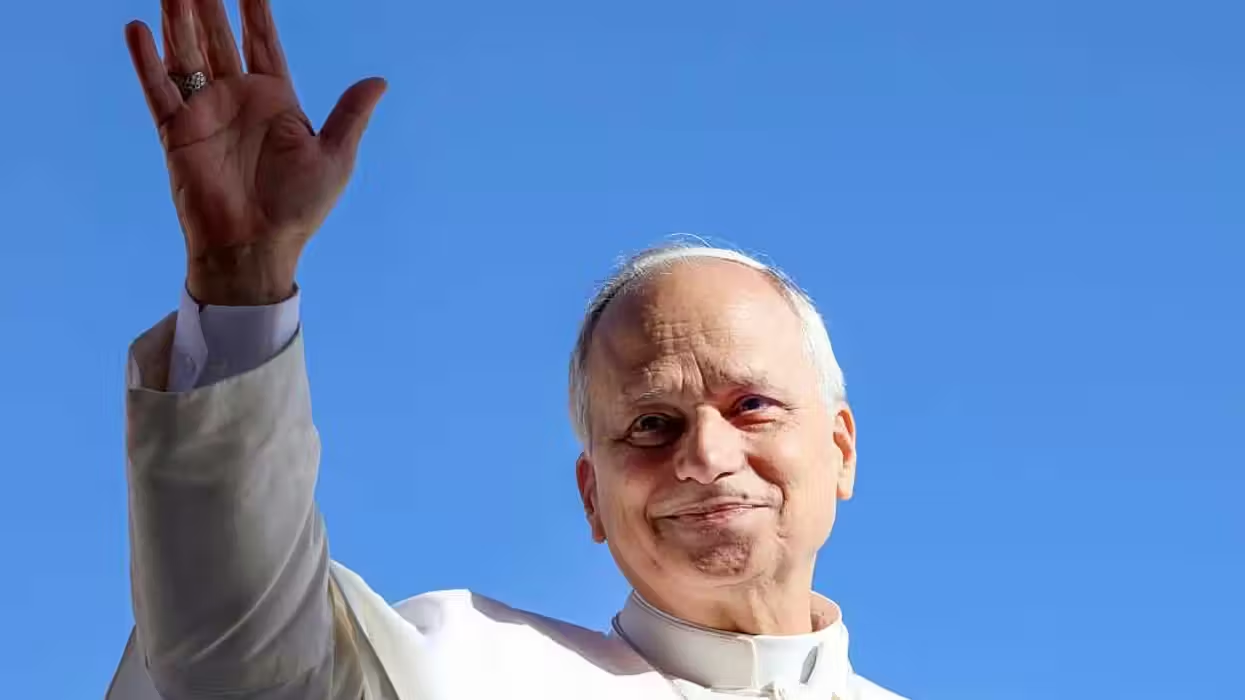
Pope Leo XIV wants Christians and Muslims to focus on what unites them.
That was the clear message of his remarks last week inside a mosque in Algeria. But by highlighting common ground, the pope may be downplaying something just as important: the big and enduring differences — not to mention a long, uneasy history — that continue to shape relations between the two faiths.
Speaking at the Grand Mosque of Algiers on April 13, the pope emphasized mercy, solidarity, and what he called “concrete fraternity.” He urged believers to reject violence, warning that religion without compassion loses sight of human dignity. It was a gracious, carefully calibrated message, one that reflects decades of Catholic outreach to the Muslim world.
Real dialogue, if it is to be more than symbolic, requires more than shared language about peace and dignity. It requires clarity.
But it's only part of the story.
Relations between the papacy and Islam stretch back more than 1,300 years to the era of Pope Donus in the 7th century, when the rapid expansion of Islam transformed the Christian world. What followed was not primarily dialogue, but conflict. Muslim armies swept through formerly Christian lands in North Africa and the Middle East. Europe responded with the Crusades. Constantinople fell. Naval battles like Lepanto became defining moments of civilizational struggle. For much of history, Christianity and Islam encountered each other not in shared spaces of worship, but on opposing sides of war.
That history does not dictate the future, but ignoring it doesn’t lend clarity to the present.
The Catholic Church’s modern approach to Islam largely dates to the Second Vatican Council in the 1960s. Its declaration, Nostra Aetate, marked a turning point, stating that the Church “has a high regard for the Muslims,” who worship the one, merciful God. It called for both sides to move beyond past hostilities and work together for justice and peace.
The Catechism of the Catholic Church builds on that framework. It teaches that Muslims, “together with us, adore the one, merciful God” and are included in God’s plan of salvation. That’s pretty remarkable language, especially when viewed against centuries of conflict. They reflect the Vatican’s deliberate effort to emphasize common ground and reduce religious hostility.
But they do not erase fundamental differences.
Islam rejects the Christian understanding of God as Trinity, denies the divinity of Jesus, and does not accept the central claim of salvation through the cross and resurrection. These are not minor disagreements. They go to the heart of what each religion believes about God and humanity’s relationship to Him. Any serious discussion of Christian-Muslim relations must grapple with that reality.
Previous popes have approached this tension in different ways.
Pope St. John Paul II became the first pope in history to enter a mosque when he visited the Great Mosque of Damascus on May 6, 2001 — a groundbreaking moment in interfaith relations just months before 9/11. That same year, he sparked controversy by kissing the Koran. Supporters saw it as a sign of deep respect. Critics saw it as a confusing gesture that seemed to honor a text at odds with core Christian beliefs. Either way, it highlighted the risks that come with symbolic outreach.
Pope Benedict XVI took a more cautious approach. While committed to dialogue, he stressed that it must be grounded in truth and reason, not just goodwill. He argued that peace requires honesty about differences, including disagreements over religious freedom, an issue that remains unresolved in parts of the Muslim world where Christians face legal or social restrictions.
Pope Leo’s remarks in Algeria clearly point to the Vatican’s emphasis on unity. There is nothing inherently wrong with that. In a fractured world, a call for peace and mutual respect is not only understandable, but it’s also necessary.
There is, however, a difference between emphasizing shared values and presenting an incomplete picture.
Leo spoke movingly about fraternity but said little about the theological differences that define Christianity and Islam. He called for peace but did not address the question of reciprocity — whether Christians are afforded the same freedoms in Muslim-majority countries that Muslims enjoy in the West. He highlighted what unites while leaving largely unspoken what divides.
That move may be diplomatically prudent. It may even be pastorally appropriate in a mosque setting.
But for a global audience, it risks creating the impression that the differences are smaller, or less significant, than they really are.
Real dialogue, if it is to be more than symbolic, requires more than shared language about peace and dignity. It requires clarity. It requires acknowledging that agreement on some moral principles does not erase profound disagreements about truth. And it requires confronting difficult realities, including the uneven state of religious freedom worldwide.
The Catholic Church’s own teaching reflects this balance. It calls for respect toward Muslims, rejects hatred and violence, and encourages cooperation where possible. But it also insists on the uniqueness of Christ and the truth of the gospel. Those elements are not in conflict.
The challenge is maintaining that balance in practice.
Pope Leo XIV’s visit to an Algerian mosque was a powerful symbol of goodwill. It showed a church willing to engage, to listen, and to seek peace across religious boundaries. But symbols, however compelling, are not the whole story.
If interfaith dialogue is to have real substance, it must be rooted not only in what is shared, but also in what is true — and in a clear-eyed understanding of history, theology, and the world as it is.
That is the harder message. It is also a far more necessary one.

Patrick Novecosky