RaÅid Necati Aslım/Anadolu via Getty Images
Ayatollah Ali Khamenei, the late supreme leader of the Islamic Republic of Iran, did not die of old age. The United States killed him, and that fact matters.
Iran’s regime has advertised its project for decades: repression at home, terror abroad, and “Death to America” as a rallying cry. It has crushed dissidents, jailed and killed its own people, and waged proxy war across the region — all while murdering Americans and targeting U.S. interests. Western “countermeasures” rarely stopped the bleeding. At best they slowed Tehran down. At worst, they bought the regime time, money, and legitimacy.
Much of Europe is already governed by technocratic managers, and the spirited element of the people is being shoved to the margins. That arrangement can’t last.
The predictable scolding began almost immediately. As soon as the joint operation was launched, leaders of some of America’s most important European allies — the United Kingdom, France, and Germany — urged restraint and appealed to “international law.” Even figures associated with Alternative for Germany, an anti-immigration party on the right, echoed that posture. European Commission President Ursula von der Leyen called for “de-escalation” and an emergency U.N. Security Council meeting, and she convened commissioners for internal deliberations.
Iran may sit far from Europe’s coastlines, but its damage doesn’t. For decades, Tehran’s destabilization has pushed drugs, terrorism, and illegal migration across borders and into Europe. The regime has executed protesters, imprisoned dissidents, funded terror proxies, and even helped fuel a war on Europe’s own continent.
Western Europe’s governing class answers that threat with a familiar reflex: convene international bodies, issue statements, and restart negotiations that have already failed. That approach has produced little more than delay. European leaders and institutions have not mounted a serious response to Iran’s campaign. In many cases, they have not mounted much of any response at all.
This procedural faith sounds alien to MAGA ears. What’s easy to forget is that it’s also alien to Europe’s own history.
Operation Epic Fury has exposed something deeper than policy disagreement. It has exposed Europe’s postwar loss of thymos.
Plato used thymos to describe “spiritedness” — the part of the soul that burns with courage, indignation, and honor. In modern terms, it’s courage disciplined by moral judgment. It isn’t frenzy or bloodlust. Properly ordered, it’s the moral force that refuses humiliation, resists the inversion of good and evil, and defends what is sacred.
Europe’s warriors of old endured lives marked by hardship: hunger, plague, invasion, civil war, and exile. Their spirits pressed deep into theology, philosophy, science, exploration, and statecraft, expanding the frontier of human knowledge. The European peoples, formed in principalities, kingdoms, and states, took control of their destiny, much as President Trump has implored the Iranian people to do.
RELATED: Do they hate Trump — or do they just hate America?
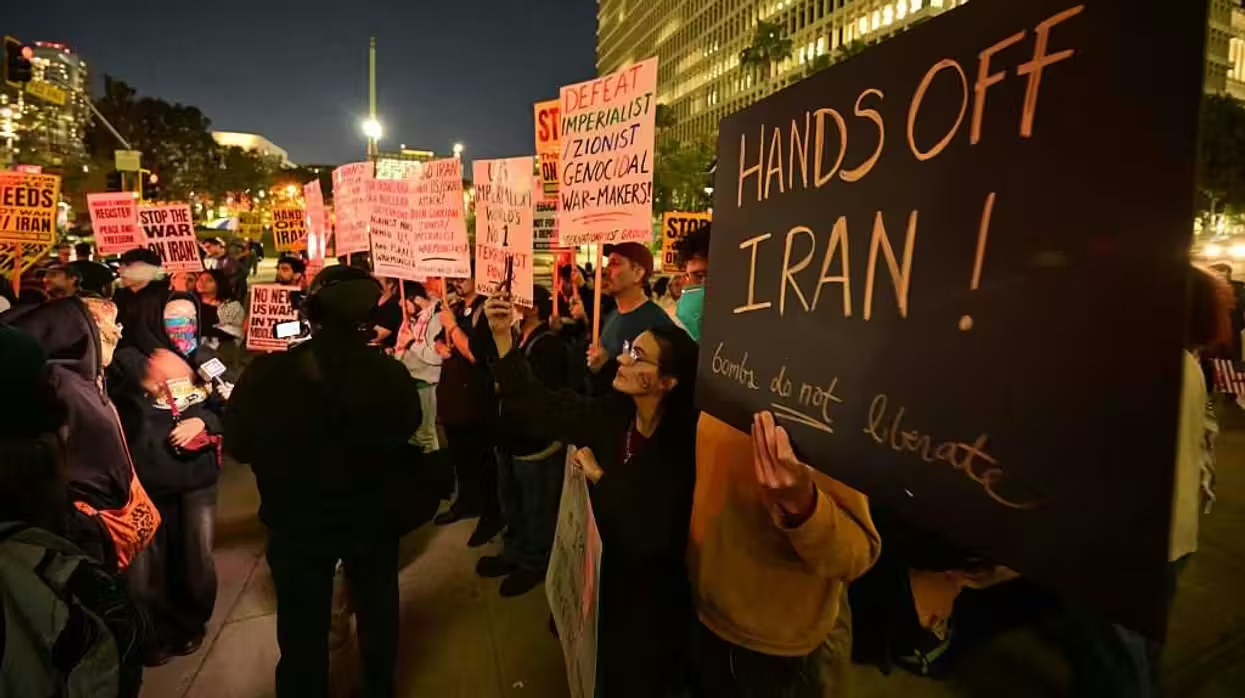 Photo by Frederic J. Brown/AFP via Getty Images
European warriors made plenty of strategic blunders throughout their history, but they realized that building up forces was the key to fighting the powerful and obtaining power. At one time, nearly all of Europe underestimated Napoleon, but they did not assume that conferences alone would restrain him. Coalitions eventually formed because countering a powerful threat required a decisive response, and the Congress of Vienna only mattered because armies first checked imperial ambition.
Europe learned through blood that force underwrites order. Today, however, its leaders often speak as if procedural appeals alone can substitute for resolve.
The European Union has become an institution that manages, regulates, and adjudicates — not one that protects nations or Western civilization as a whole. The peace in postwar Europe depends on American security guarantees and nuclear deterrence rather than on institutions like the EU and the United Nations Human Rights Council.
This project’s main “success” is the coordinated dissemination of the belief that technocratic governance is a sufficient framework to sustain civilization. The decline of civil society across Europe, however, and the responses of some of its leaders to U.S. military action in Iran indicate the spurious nature of that belief.
Europe’s thymos has been effectively sedated by procedure and managed decline, but President Trump may be on his way to reviving it.
International law is not self-enforcing, and the international system depends upon sovereign states willing to act. Absent enforcement, resolutions accumulate into a paper fortification. The Islamic Republic has endured decades of censure from international bodies while expanding its influence and repressing its citizens. The U.N. Human Rights Council, for instance, puts its faith in strongly worded letters that have failed to achieve any positive outcome for Europe.
By contrast, America’s Operation Epic Fury rests upon a simple premise: Regimes that kill Americans, arm proxies, launder narcotics revenue, and pursue nuclear capability cannot be indefinitely managed by elegantly crafted communiqués.
Crucially, the U.S. strikes are targeting the ideological Islamist infrastructure in Iran, a problem that Europe has struggled to confront within its own borders.
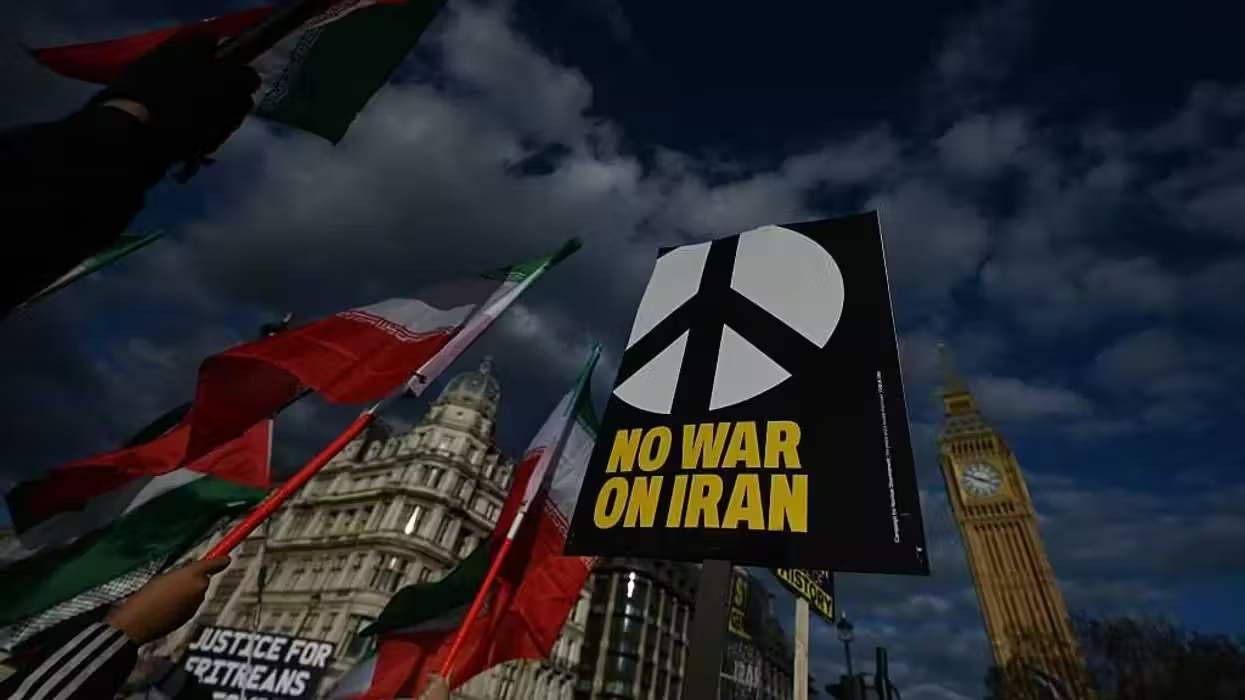
In parts of Western Europe, the rise of leftist and Islamist coalitions is undeniable. In the U.K. and elsewhere, such demographic realities are almost certainly why the ayatollah’s death is being mourned instead of being celebrated. Last weekend, after news of Khamenei’s death broke, former Labour Party leader Jeremy Corbyn joined hundreds of pro-Iran protesters in London carrying banners of the ayatollah.
Europe’s decision to throw open its doors to mass migration in 2015 signaled more than a policy preference. It revealed a self-conception: Europe increasingly sees itself as an economic zone, not a civilization with borders and obligations. In that worldview, spirited self-preservation becomes morally suspect. A continent that won’t defend itself can’t credibly lecture America about saving others — or help America do it.
Americans shouldn’t expect allies to endorse every U.S. action without question. Friendship doesn’t require cheerleading. It does require moral seriousness. Europe’s leaders shouldn’t treat righteous indignation at injustice as “extremism,” and they shouldn’t confuse decisive action with warmongering or reckless escalation.
A civilization that suppresses thymos will not endure. Much of Europe is already governed by technocratic managers, and the spirited element of the people is being shoved to the margins. That arrangement can’t last.
RELATED: ‘Boots on the ground’ would turn Iran into Iraq on steroids
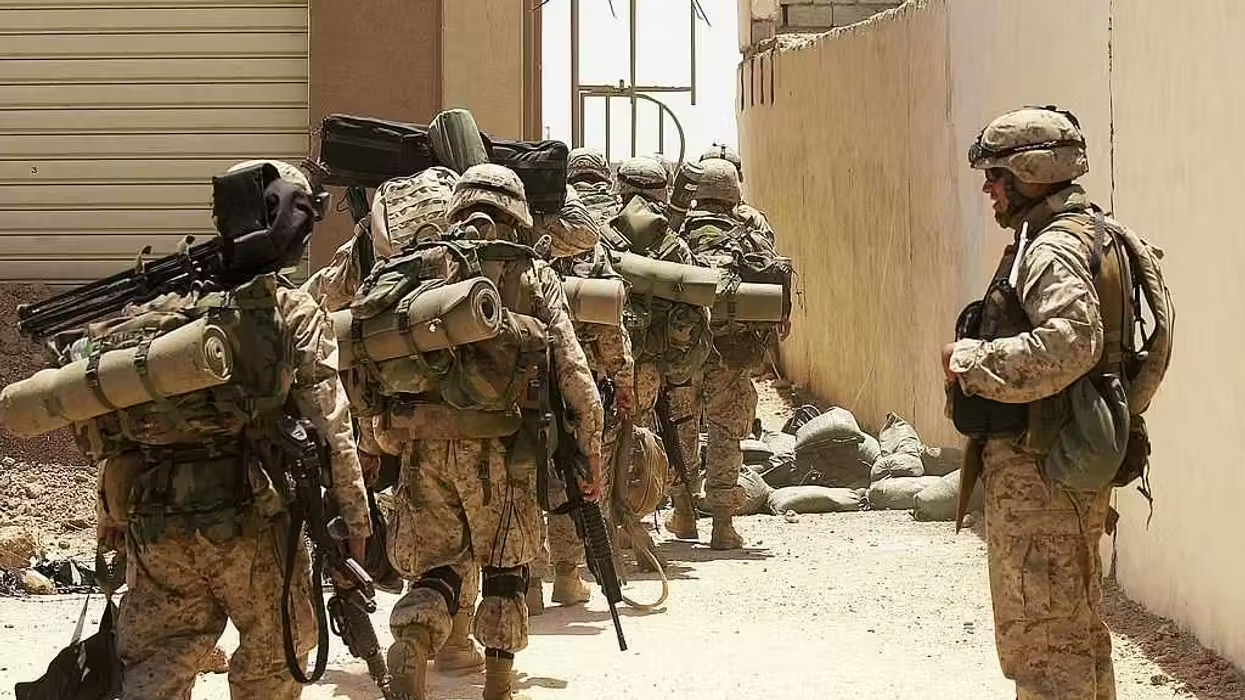 Photo by Scott Peterson/Getty Images
Under President Trump, the United States retains, however imperfectly, a measure of civilizational confidence. We still believe that sovereignty, national defense, and the protection of citizens are legitimate goods. Europe’s thymos has been effectively sedated by procedure and managed decline, but President Trump may be on his way to reviving it.
NATO Secretary General Mark Rutte voiced support for the strikes on Iran, declaring that key allies stand “all for one, one for all” amid our adversary’s widening missile retaliation. Such language hints at a remembered instinct — an older European reflex of solidarity not as bureaucratic coordination but as shared resolve and the will to act. There are also glimmers of hope in last Sunday’s E3 statement, in which Britain, France, and Germany said they were ready to take steps to defend their interests in the region.
Operation Epic Fury will be debated for years to come in the language of strategy and geopolitics. But beneath those arguments lies a more enduring question about the character of civilizations: Do they still believe that evil should be confronted? Do they still possess the spirited confidence that is required when words have failed?
Europe’s history is not one of defaulting to procedure. It is a civilizational resolve formed through centuries of trial. The same continent that produced parliaments and cathedrals also produced men willing to stand at Vienna’s gates and refuse surrender. Its Christianity did not preach passivity before tyranny. It taught that love may demand resistance.
Praising Athens’ war against Sparta, Pericles famously said:
For we are lovers of the beautiful in our tastes and our strength lies, in our opinion, not in deliberation and discussion, but that knowledge which is gained by discussion preparatory to action. For we have a peculiar power of thinking before we act, and of acting, too, whereas other men are courageous from ignorance but hesitate upon reflection. And they are surely to be esteemed the bravest spirits who, having the clearest sense both of the pains and pleasures of life, do not on that account shrink from danger.
Europe must choose whether it will regain its strength or allow the civilization it built to disappear forever.
Editor’s note: A version of this article appeared originally at the American Mind.