Warner Brothers/Getty Images
Americans are breathing a sigh of relief at the apparent end of woke lectures masquerading as movies. The last few that slipped through have been sent to the box office graveyard.
But another problem remains.
What gives a human life ultimate meaning? That is a question woke ideology cannot answer. It is also the question every civilization, and every soul, must face.
As John Wick taught us, bad choices lead to consequences. And after 15-plus years of woke education and pop culture, one consequence may be that American audiences can no longer handle a movie that wrestles seriously with the deepest questions of human life.
Permit me to explain why this trouble looms on the horizon like Kafka’s “Metamorphosis.”
The woke agenda, with its oppression-studies degrees and DEI catechisms, has trained generations of students and audiences to think superficially. They are told suffering comes from “whiteness” and “heteronormativity,” and that if they elect enough democratic socialists, these problems will vanish and free stuff will rain down from heaven.
Spend enough time on a modern university campus, and you will see how often life’s deepest questions are flattened into identity categories.
Why do people suffer? Systems of oppression.
Why does life feel empty? Unjust structures prevent economic flourishing.
The standard DEI professor solves the problems of evil and meaning by reassuring one group of students that their hardships are caused by another group of students, and that each group can be identified by skin color and sexual preference.
The solution is always the same: Become an activist. Advocate for the marginalized. Restructure society. Stop whiteness.
Think of the Ralph Wiggum meme: “I’m helping.”
Movie after movie has thrown these inane answers at American audiences. Marvel has done more than most. It had a chance to get serious when Ultron sought a solution to the problem of evil. Instead, it simply got violent.
What was the franchise’s answer to evil? Some saccharine claim about the innate goodness of human beings when they are “free” under a nanny state of superheroes.
But those supposedly good humans are the same people who committed all the evil Ultron saw when he studied world history.
The Avengers are an existential nightmare, making one wonder whether each member of the team was meant to be a hero of the absurd after all.
RELATED: Give He-Man credit for mocking the unmockable
 Screen Archives/Getty Images
These reflections made me wonder whether today’s audiences, ruined by DEI, could watch a movie like “Cool Hand Luke.”
The film would almost certainly never be made today. But even if it were, would anyone make it to the end? Better yet, would anyone understand what the movie asks us to confront?
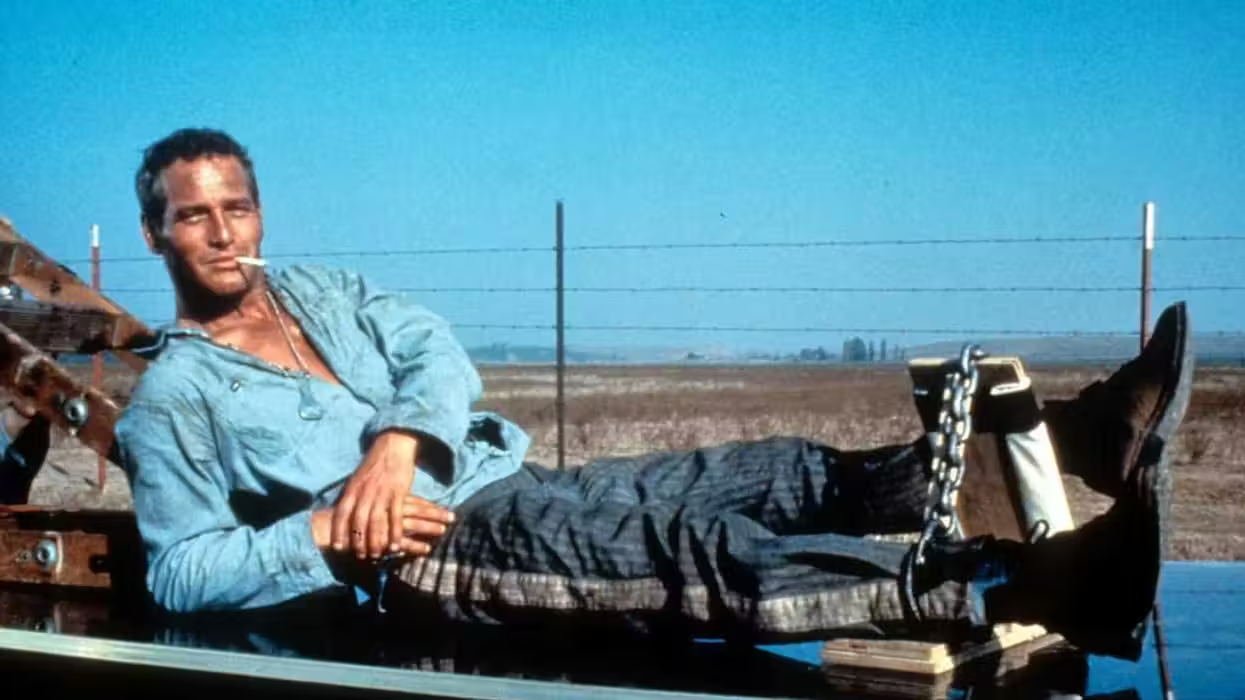
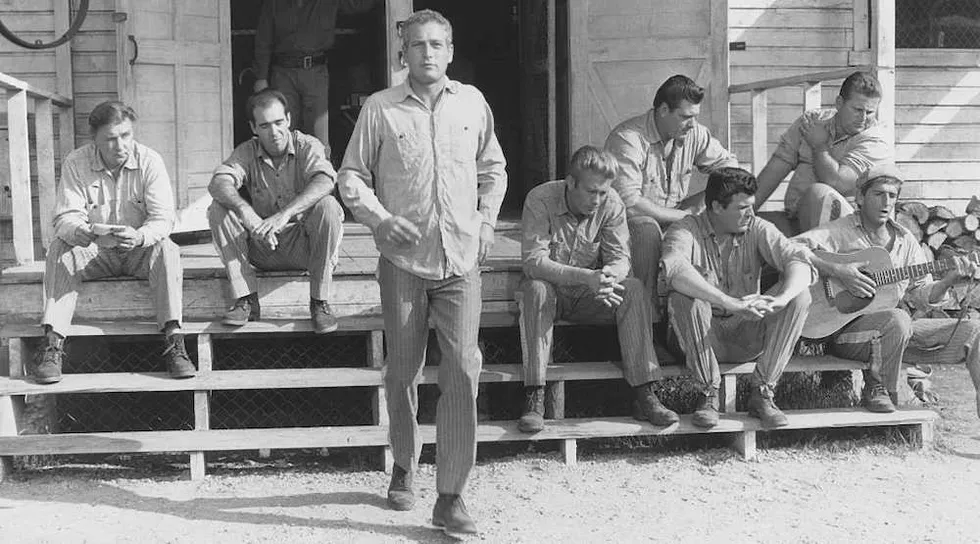
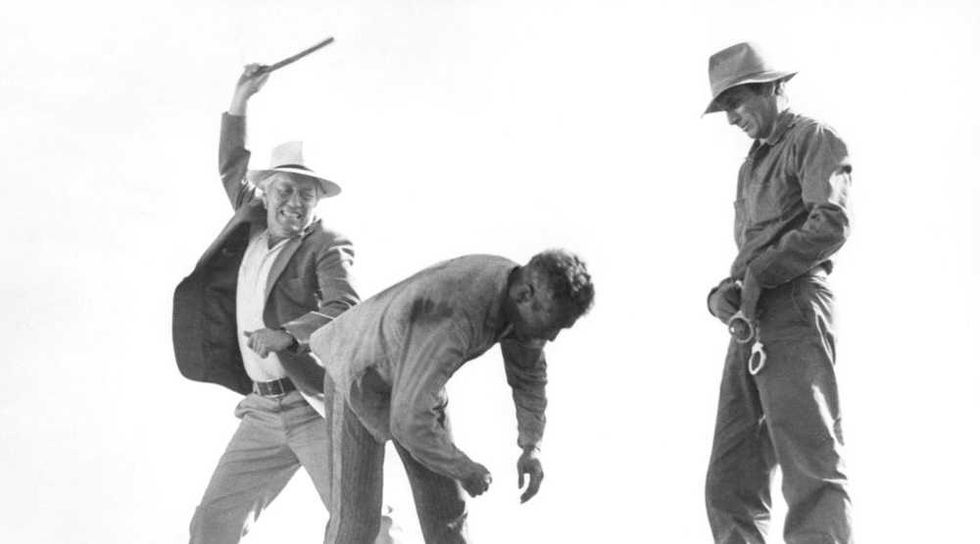
Luke, played by Paul Newman, returns home from World War II to a life with no obvious purpose. In a drunken act of vandalism, he cuts the heads off parking meters and is sentenced to a southern prison camp.
The crime is almost beside the point. The movie is not really about criminal justice. It is asking an older question: What does a man do when he cannot find meaning?
Luke’s struggle is existential. He first fights the toughest prisoner, and his refusal to stay down becomes a declaration that he will not surrender his humanity. Later, when Luke wins at poker, the men call him “Cool Hand Luke.”
His coolness is defiance against a universe that appears silent. If nothing matters, why get upset?
The prison itself becomes a metaphor for human existence. The laws appear arbitrary. Luke tells another prisoner, “All I see is a lot of guys laying down a lot of rules and regulations.”
Then, Luke’s mother visits one last time as she is dying.
Their final conversation is painfully cold. He calls her “Arletta” rather than “Mother.” Neither expresses love. As she leaves, he simply says, “So long, Arletta. Take care.”
Harry Dean Stanton sings “Just a Closer Walk with Thee” as Luke walks back into the prison. The inability of sentimentalized religion to give Luke meaning becomes the movie’s second theme, after the helplessness of law.
Soon afterward, Luke receives word of his mother’s death. He sings a mocking song about the empty superstition of popular religion:
Get yourself a sweet Madonna
Dressed in rhinestones, sitting on
A pedestal of abalone shell.
Going 90, it ain’t scary,
’Cause I got the Virgin Mary
Assurin’ me that I won’t go to hell.
Popular religion pours opium over the suffering of this life with empty sentimentality and promises of a better afterlife.
Neither law nor sentimental religion can quiet Luke’s soul. So he runs.
Captured once, he hears the famous line from the captain: “What we’ve got here is failure to communicate.”
After another escape attempt, the guards force him into a grotesque cycle of digging and filling the same hole.
“Luke, what’s your dirt doing in the boss’ hole?”
After Luke digs a grave-sized hole, another boss asks, “Luke, what’s your dirt doing on my yard? Put it back in that hole.”
This continues until his spirit finally breaks. He begs them to stop. He promises never to escape or back-sass again.
Yet he escapes once more.
RELATED: The left’s icons keep face-planting in public
 Silver Screen Collection/Getty Images
His final refuge is an empty church. There, Luke finally speaks honestly. He addresses God simply as, “Hey, Old Man.” He admits that he began strong but has grown tired. He wants answers. He wants someone to respond.
Silence.
“I guess you’re a pretty hard case too,” Luke concludes.
A fellow prisoner is sent in to persuade him to come out peacefully. Luke yells out the window, “What we’ve got here is failure to communicate,” but he is shot and killed before he can finish.
The movie refuses every easy answer. The audience is meant to leave and wrestle with the problem of meaning.
Luke cannot be right about final emptiness. But where can we find meaning if neither law nor superficial popular religion can provide it?
That is precisely the sort of question our culture increasingly avoids.
The last 15 years have been a parade of DEI sermons and ideological mush. The worry is that Americans raised in this, educated in woke K-12 schools, and graduated into oppression-studies assumptions would not know how to contemplate existential meaning in a movie like “Cool Hand Luke.”
They would reduce the story to demographic categories. White prisoner. White guards. Southern prison. Oppression explained. Luke deserves what he got.
As a philosophy professor, I hope Americans have not lost the ability to appreciate stories that force us to confront the deepest questions. I hope they are not merely rejecting the stupidity of DEI but also rejecting superficial answers and longing for something deeper.
What gives a human life ultimate meaning? That is a question woke ideology cannot answer.
It is also the question every civilization, and every soul, must face.