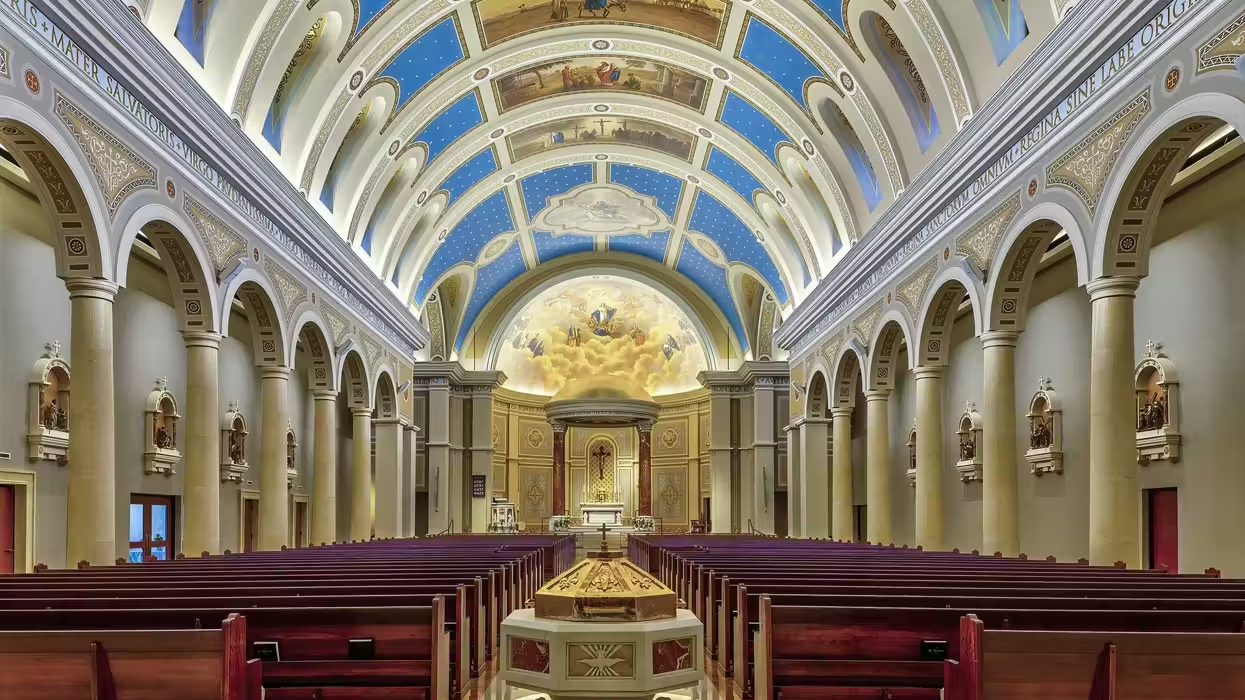
Photos courtesy of Conrad Schmitt Studios
“You get the full effect,” a woman whispered to me as I entered the church, “when you enter from the main doors over there.” She smiled from her post at the side entrance.
I didn’t know. It was my first time visiting St. Ann’s Catholic Parish in Coppell, Texas. Its church, one of the largest in the Dallas-Fort Worth area, had just undergone major renovations by Conrad Schmitt Studios, a renowned architectural arts studio intent on reviving the beauty of the liturgy in Catholic churches across the country.
Though in retrospect I wish I had listened to the woman holding the door, I was late for mass. Technically, I was on time, but the church pews were already brimming with excited parishioners entering their church for the first time since the project began last November. Effortlessly, unconsciously, eyes were pulled heavenward and jaws fell earthward as we took in the full scale of the renovation.
“That’s a feather in your cap when your project becomes a basilica.”
It was the noon mass on the Tuesday of Holy Week, the most important week of the Catholic liturgical calendar, and the priest pulled out all the stops—including a remarkable amount of incense—for the occasion.
“I love how everyone’s eyes are naturally drawn upward when they enter the church,” Father Edwin, the pastor at St. Ann’s, said at the beginning of his homily. Standing in front of the altar, he took a moment to admire the brand-new paintings on the inside of the dome directly above him and the beautifully detailed mural behind him in the apse.
Father Edwin could hardly contain his excitement at the completion of the massive overhaul, which, he hoped, would draw in still more parishioners and new faces now that the project was drawing to a close.
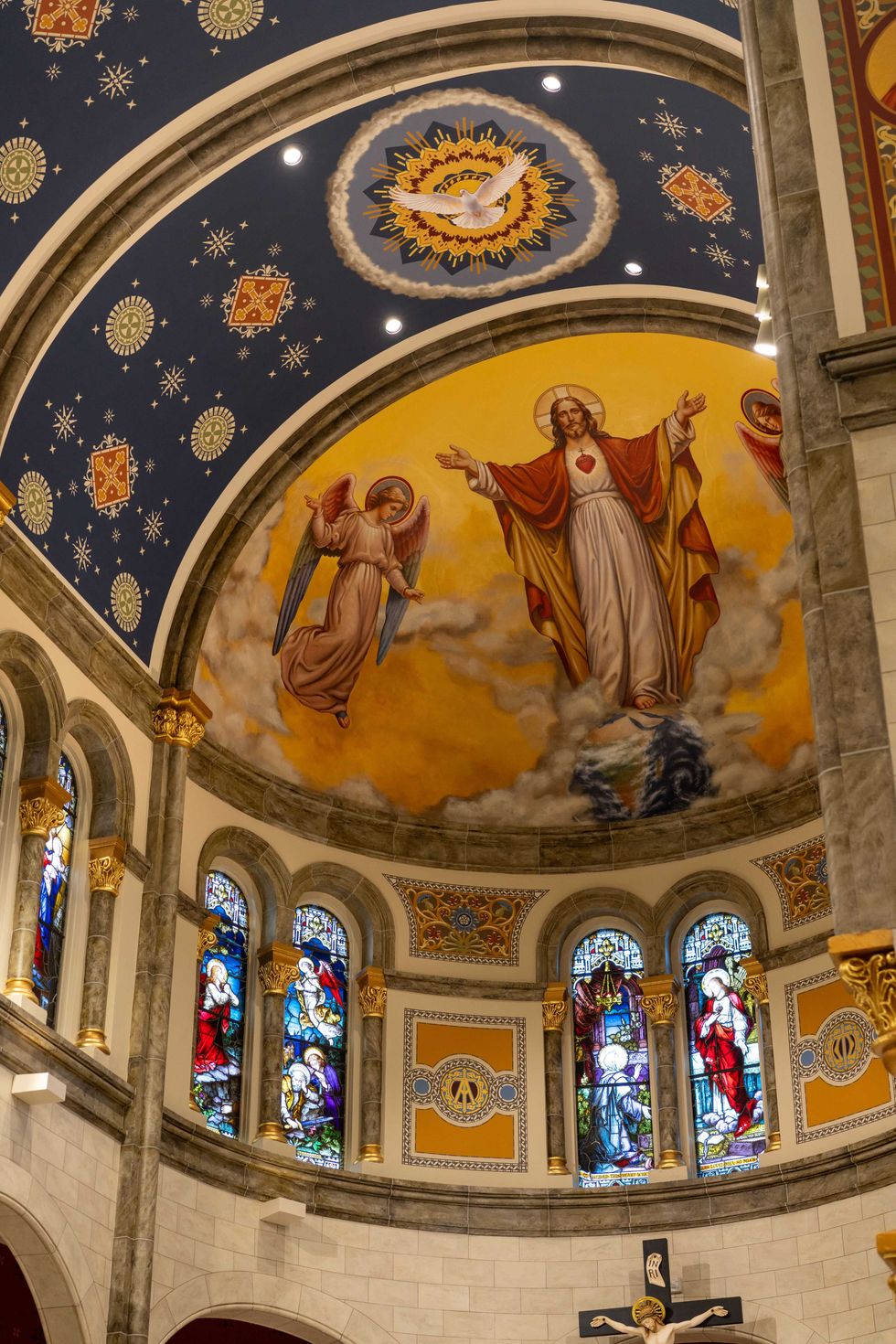
The project transformed the plain, white-walled interior into an enormous, cohesive artwork. Starting from the back of the church, the walls, arches, and columns, now covered in beautifully detailed stencil designs, draw the eye toward the altar and the freshly-designed tabernacle at its center. The apse beyond—the semicircular termination at the “top” of churches shaped like a cross—now features a dazzling rendering of the Transfiguration.
“Father wanted the murals to be devotional, so that people would look at them and be able to get into prayer by looking at them,” Gunar Gruenke, one of the owners of Conrad Schmitt Studios, told me after I had seen St. Ann’s in person. “So they were to be that beautiful, that they draw upon your emotions.”
St. Ann’s didn’t merely strike a chord with the parishioners, though that is one of the goals for every project Conrad Schmitt Studios works on.
“Our newest favorite church is probably St. Ann’s,” Gunar tells me. “I haven’t seen anything like what has been done there on the interior in the United States since probably the 1930s. It’s new, it’s decorative, it’s liturgically correct, and it goes beyond what anyone is doing right now.”
The truth is, many churches in America retreated from anything that could be perceived as ostentatious (read: classically beautiful)—styles like Gothic, Romanesque, neoclassical, and especially Baroque—in the latter half of the 20th century. As Gunar’s grandfather Bernard had explained to him, Americans visiting Germany after World War II saw the plaster-white interiors of the rebuilt churches and, unfortunately, decided to adopt this “style” for stateside churches. Charitably praised, perhaps, for their “noble simplicity,” these plain churches became the dominant trend for decades.
Far more important on a formal, liturgical level, of course, was the widespread trend after the Second Vatican Council (though not mandated by the Council itself) of removing not only much of the traditional imagery but also the tabernacle from the center of the sanctuary, not so-subtly shifting the focus away from the Blessed Sacrament and, arguably, toward the priest instead.
Conrad Schmitt Studios has a very long institutional memory, and has seen whole styles fade in and out—and back again— over its lifetime.
Since the studio’s beginning in 1889, the highest standards of beauty and liturgical correctness have been at the core of everything they do, however dramatically styles have changed.
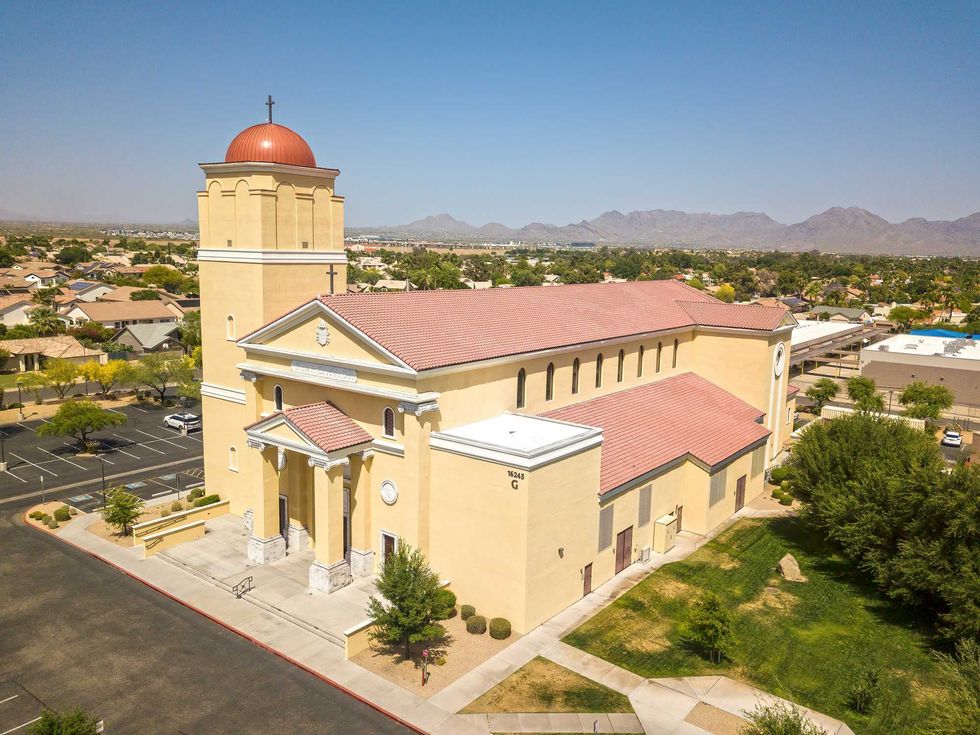 St Bernadette's in Scottsdale, Arizona, housing an award-winning interior after the recent renovations by Conrad Schmitt. Conrad Schmitt Studios
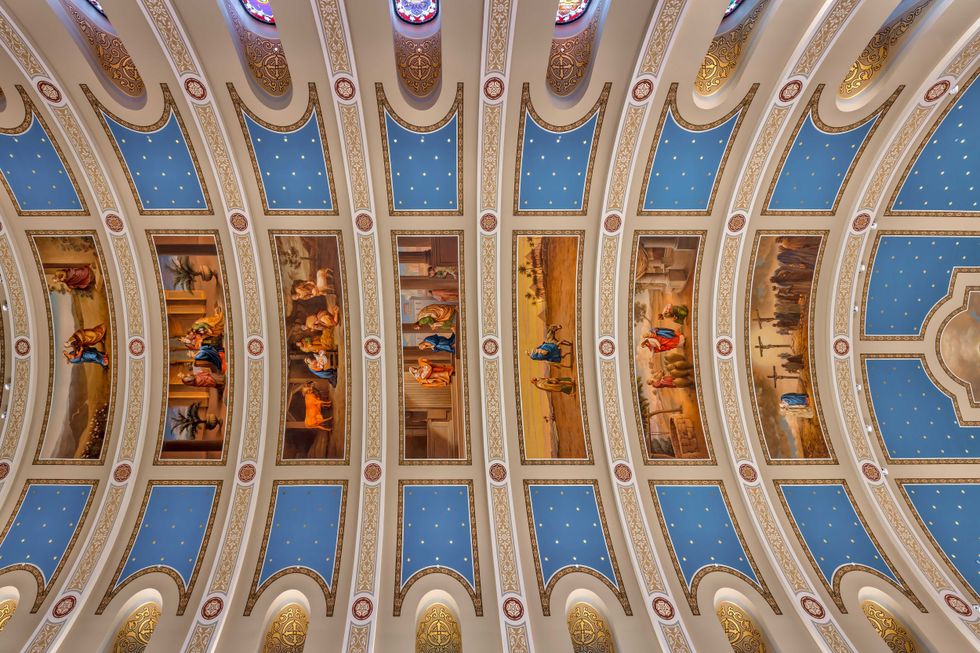 Conrad Schmitt Studios
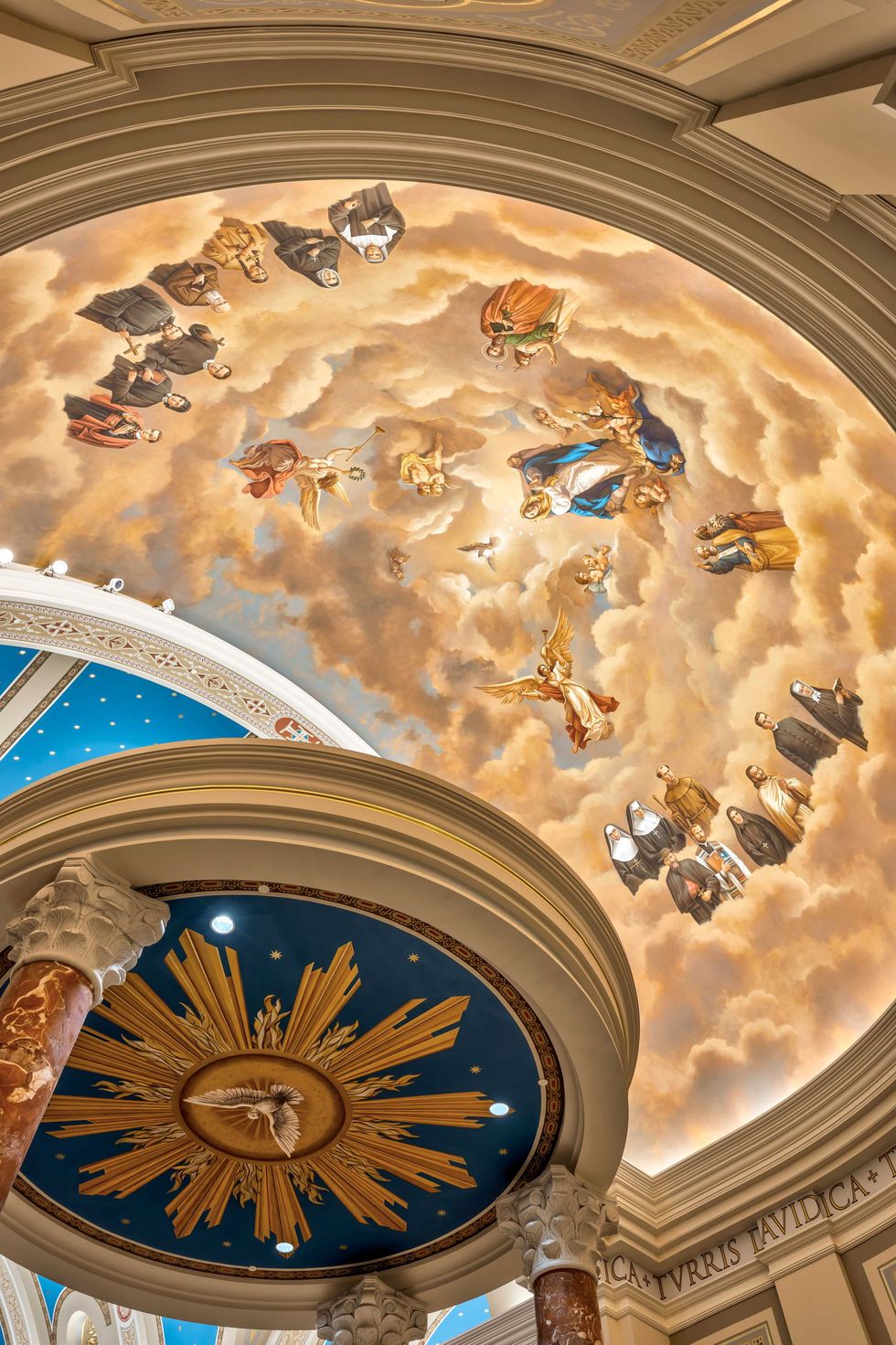 Conrad Schmitt Studios
Bernard Otto Gruenke was a living testament to burning artistic passion and unstoppable work ethic. In the 1930s, then in business school, he realized his longing to be an artist and approached studio founder and owner Conrad Schmitt for a job. Schmitt told Bernard he didn’t have any work for him.
The next day, however, Gruenke showed up again—and told Schmitt he would work for free.
“Young man, you have said the right thing,” Conrad Schmitt told him.
Years later, Gruenke became a partner and, in the early 1950s, purchased the company, which has remained under the care of the Gruenkes up to the present day.
“For me, it was family,” Abi Gruenke, Gunar’s daughter and a project manager at the company, explains when I ask her about her entry into the business. “Since I was the fourth generation of the Gruenke family, I grew up in the business,” though she added that she freely chose to continue the legacy because of “how special the work is.”
Abi told me about several projects she has personally worked on, including the “unique” restoration of the beer caves at the Miller Brewery in Milwaukee, Wisconsin, near their headquarters. The caves were once used to store their beer, but are now part of the museum tour. Abi managed the restoration of the murals that told the brewery’s story.
While Conrad Schmitt Studios has a large portfolio of work in public spaces such as state capitals and courthouses, their real focus is “growing the Catholic Church” through the beautification of sacred spaces.
The trends of creating churches of “noble simplicity” and of removing the tabernacle from the center of the sanctuary, however, have begun to reverse course in recent years as Catholics lean into more traditional practices and appreciate what was lost more than what replaced it. And this phenomenon, of course, would not be possible without the people—the architects, designers, and artists—who enable the physical restoration of these sacred spaces.
“We want to have all of the artwork be ‘the poor man’s Bible,’ but the most important thing is to offer a glimpse of Heaven, a hope for salvation, and a desire to meet our Lord in Heaven,” Gunar says.
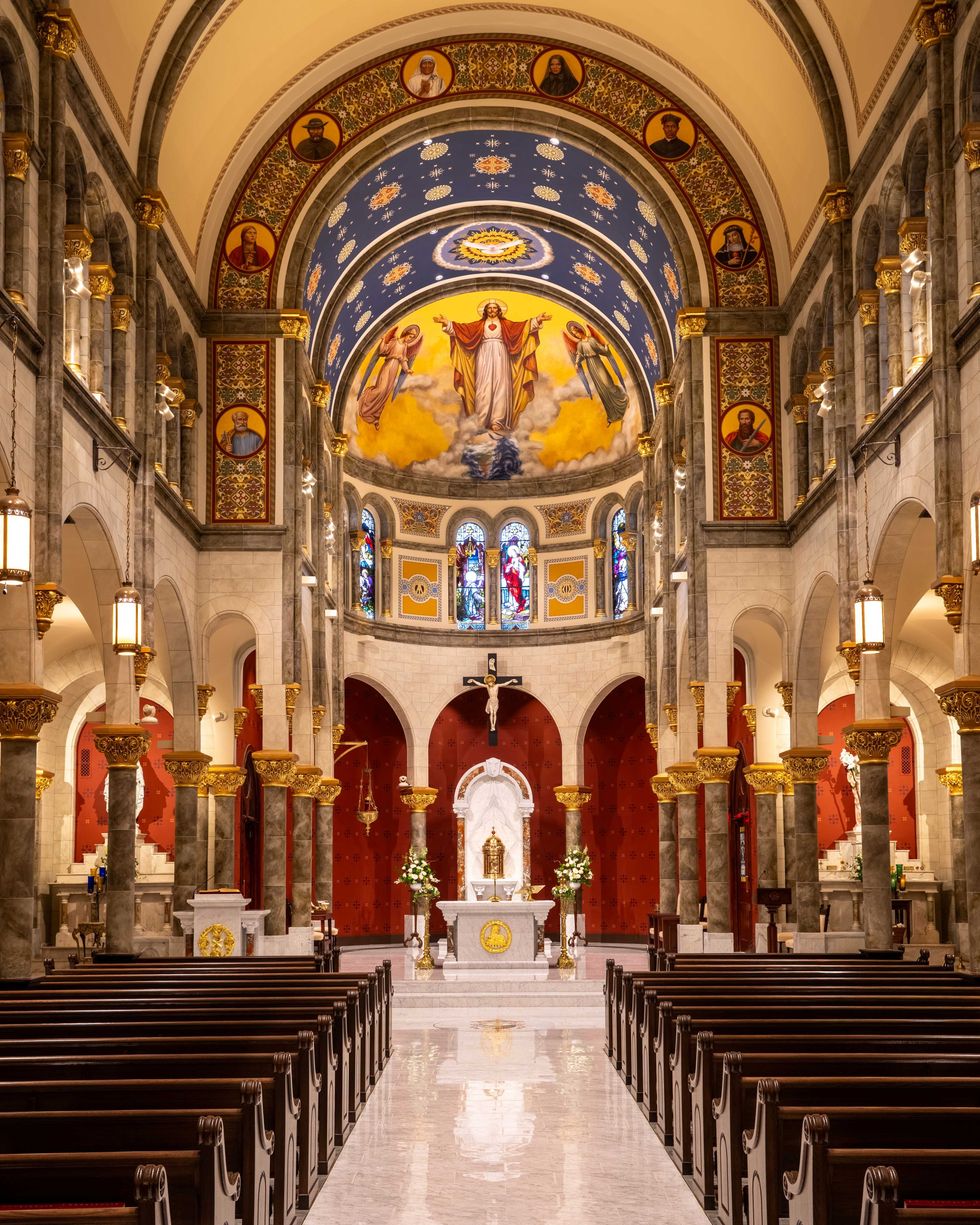 The Sacred Heart Basilica in Atlanta, Georgia, filled with inexhaustible detail, both in the masterful painting and the stained glass.Conrad Schmitt Studios
 Conrad Schmitt Studios
I remember the first time a church had that sublime effect on me. I was in Vienna, Austria, visiting St. Stephen’s Cathedral, an enormous Romanesque church with Gothic elements originally founded in 1137 and expanded in the ensuing decades and centuries. As I entered (after several minutes admiring the exterior—seriously, search for photos of this church), the view and direction of the columns, spires, and stained glass stopped me in my tracks at the door. They almost forced my eyes to look to Heaven, toward God. It’s not simply that these churches are enormous; their scale merely enhances the beauty of a church that directs and encourages man to seek to know God.
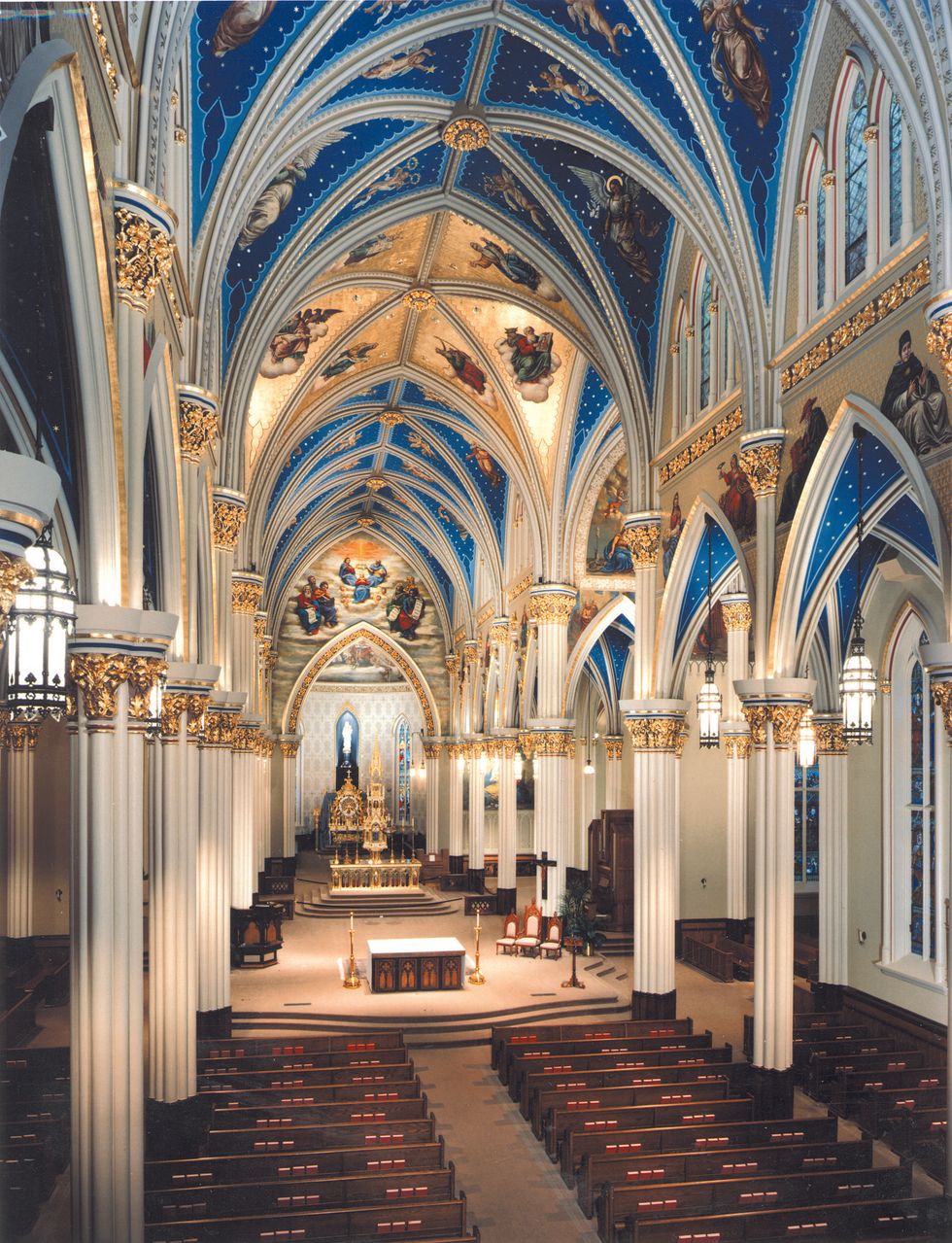
To name just a few of their major projects, many of which at least echo that inexplicable effect that St. Stephen’s had on me, Conrad Schmitt Studios has worked on the Sacred Heart Basilica in Atlanta, Georgia; St. Bernadette in Scottsdale, Arizona; the Sacred Heart Basilica on the Notre Dame campus in Indiana; St. Mary’s in Natchez, Mississippi; Sts. Peter and Paul in Chattanooga, Tennessee, and, of course, the Cathedral Basilica of St. John the Baptist in Savannah, Georgia—one of the most visited churches in the United States.
They noted that many of these churches, after completing their renovations, became basilicas, a special designation granted by the Vatican to certain churches worldwide in recognition of their history, art, and importance to the diocese.
“That’s a feather in your cap when your project becomes a basilica,” Gunar says.
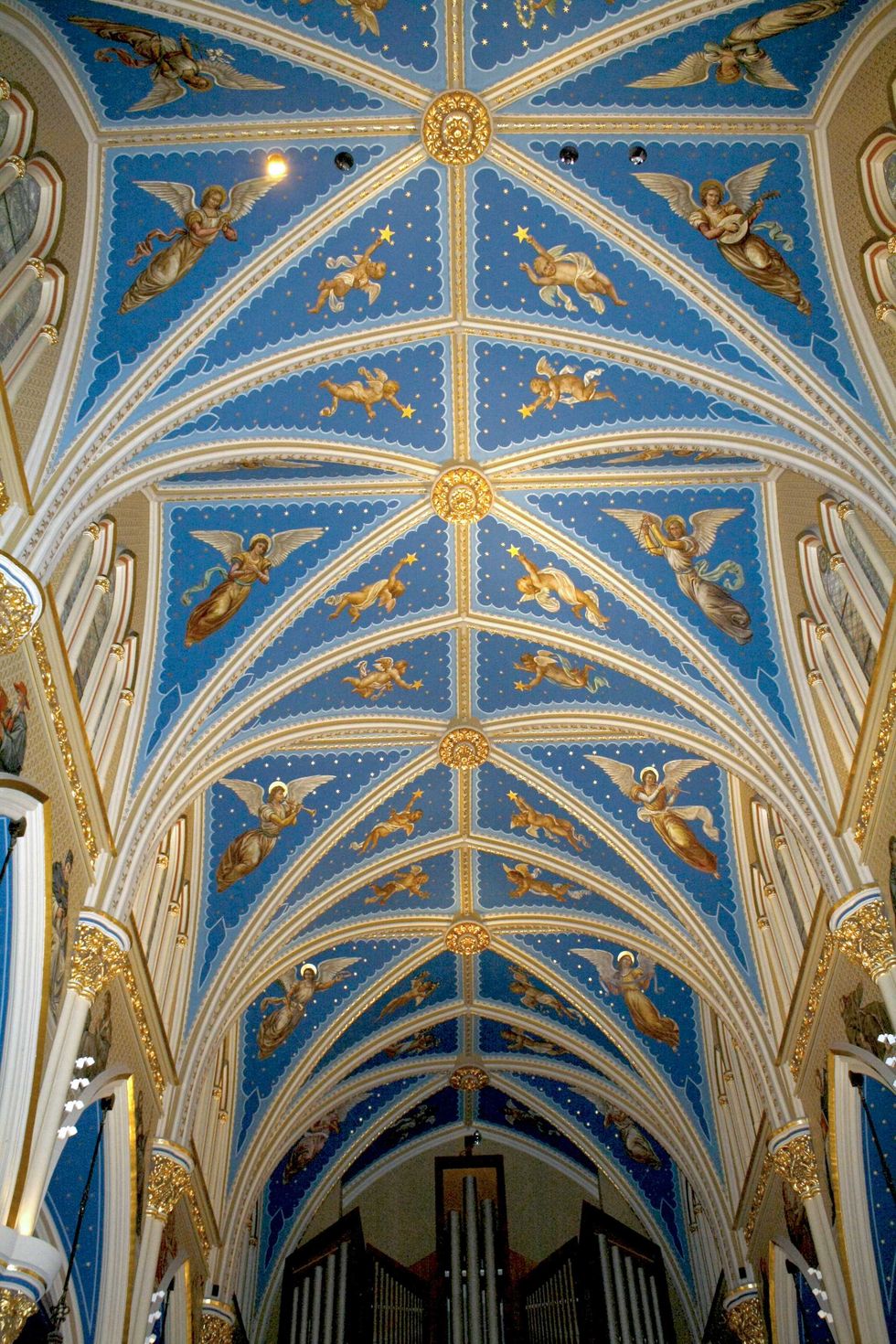
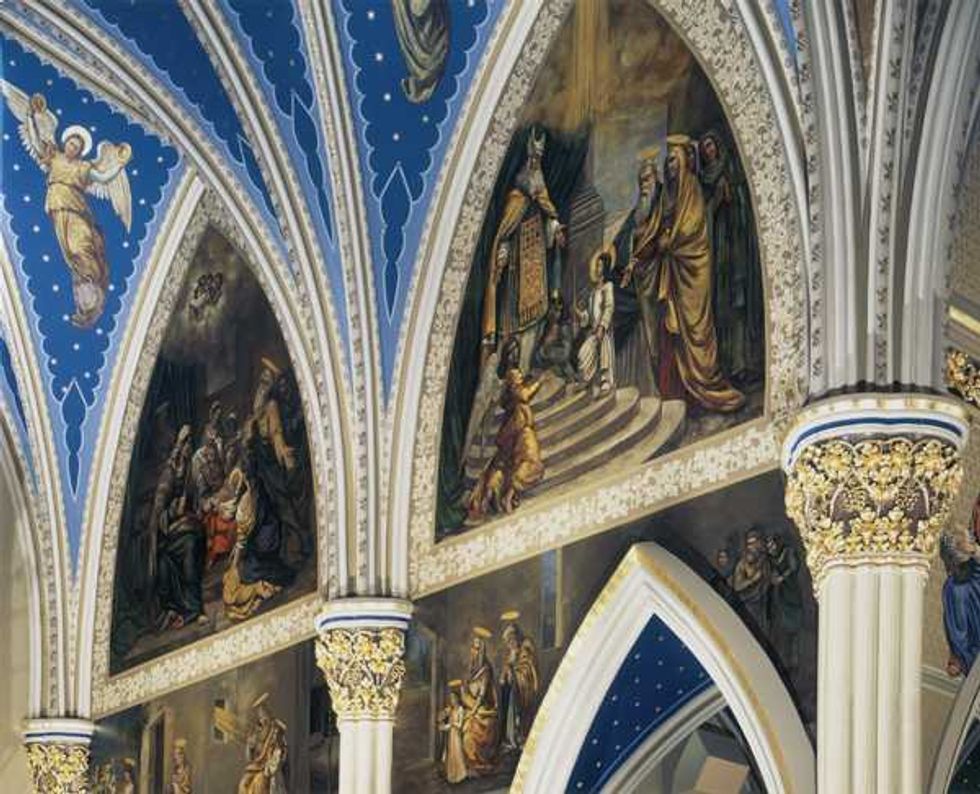 Conrad Schmitt’s renovations of Notre Dame’s Neo-Gothic basilica accentuate its detail and grandiosity.Conrad Schmitt Studios
 Conrad Schmitt Studios
 Conrad Schmitt Studios
But for every grandiose project they mentioned during our conversation, Gunar and Abi can just as easily describe in detail much smaller projects, which clearly have just as much significance to them as any of the better-known churches.
Gunar tells me the amazing story of Holy Hill Basilica and National Shrine of Mary Help of Christians, where healings at the shrine have supposedly taken place in great numbers: “If you go there, there are just 60 or 70 pairs of crutches and some wheelchairs laying there, because people just drop them off. They don’t need them; they’re cured.”
True to their goals, he gladly talks about St. Francis’ Seminary in Milwaukee, which they are painting and decorating this year, and how their work will be there for a sky rocketing number of seminarians to be raised in the faith.
Abi tells me that one of her sisters, who is also a project manager at the company, worked on a project for a tiny parish in Kansas with only a few dozen parishioners: “Not a lot of people are going to see that, but it means so much to the 50 parishioners that they have.”
Tinier still, Abi recalls, is a project in a Milwaukee church with a statue of an angel whose finger had fallen off. She took pride in having a team that could restore this tiny detail, which “meant the world” to the church’s parishioners.
Go to one of Conrad Schmitt Studios’ 10,000 projects, and you will never fail to find their hallmark close attention to detail, both in the artwork and in the design of the church according to canon law and tradition.
Whenever I visit one of the churches they have worked on, I will be paying close attention to the symbols in the stained glass, looking for their signature “church mouse” hidden in the murals, and examining the faces of the cherubs, who were once modeled off of Abi and her sister, though they will now be modeled off the newborn next generation of the Gruenke family, who, her grandfather hopes, will carry on the legacy of Conrad Schmitt Studios for years to come.