Photos by Matt Weinberger and Abigail Ford
A small, giddy voice interrupts my thoughts. "I just walked my first fashion show!" I turn to see a tall, thin girl next to me at the bar at the Elena Velez afterparty. "Congrats," I smile at the model. She leans in and grabs my arm. "But I'm freaking out. I had no idea those people were going to be in the show. Like, Clavicular? He's such a bad man. What's everyone gonna think of me?"
Clavicular is a streamer and something of a Nietzschean Last Man, a 20-year-old guy who decided that the purpose of his life is to look as good as he possibly can. He calls this “looksmaxxing,” and by way of looksmaxxing, he has given up all other aspects of his humanity. This sort of hedonic view of the human person—and of life itself—logically goes hand in hand with other, less palatable opinions, those that the young model I spoke to was concerned about. She did not want to be perceived as associated with him. Outside the fashion industry, this may be merely to your social advantage, but within the industry, controlling your associations is the means by which you ingratiate yourself with the market.
“They want to be good people so badly that in their reactions and critiques they distance themselves from any potential affiliation by pronouncing their own interpretation as the safe interpretation,” says a former Yeezy employee, someone who worked at the brand when Kanye West pioneered the last notable innovation in the way everyday people dress with his neutral, tattered, clinging clothes and his large rubber shoes. It seems that since those first Yeezy collections, and certainly since his banishment from the public sphere, American fashion is stuck. Even though this breed of puritanism is mocked in some fashion circles—those that have the best chance of surprising us yet—the institutions and industry itself are consumed by a schizophrenic form of iconoclasm that inhibits the creation of anything that truly distills our time.
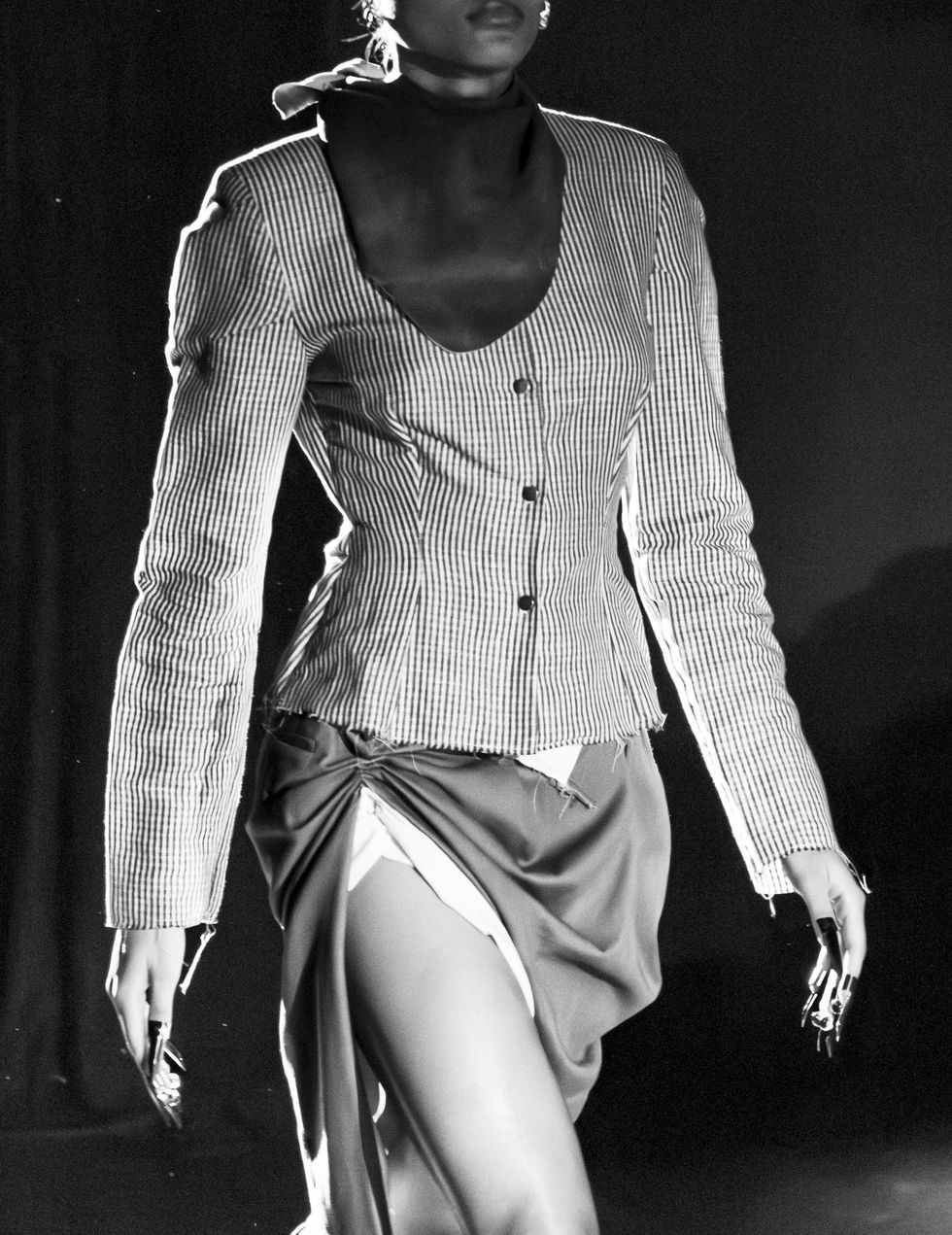
The New York Fashion Week interpretation police fawn exclusively over designers who have been marked as “safe” thanks to their commercial viability and unwillingness to provoke. Their concept of provocation is to present their brand alongside safe political disclaimers and to hand-hold their audience. Their game is to reduce design to a marketable moral proposition. In response to fashion designer Elena Velez’s casting of Clavicular, a crime of “implied endorsement,” Vogue contributor Laird Borelli-Pearson goes so far as to ask, “Why even do a runway show on the commercial calendar?” While she intends to denounce Velez’s participation in New York Fashion Week, what Borelli-Pearson really does is expose why Velez is seen as a risk to the industry: she’s bad for business. The freedom of artistic expression is paramount to Velez, which is why she dares to say ‘Public Relations and Capital be damned!’ and cast someone that the industry despises.
 Strike a pose.
To dismiss the importance of Capital is a sin against the progressive left, who control it—along with production, public relations, and criticism. The entire New York City fashion leviathan operates within their worldview. Because of this monopoly, they are not required to provide economic justification for any action. On the contrary, their monopoly on American fashion has allowed them to form a moral framework that justifies the entire industry, from design concept to third-world production.
In a sense, they are correct to moralize and politicize these things. Fashion actually matters, and people desire moral justification for things that matter. However, in this case, the market is the ethic. In a market-based culture like our own, moralizing is merely what is good for industry. There is no moral high ground in an industry that demands you increase your capital by a framework that is fundamentally anti-human. Progressivism with a Wokeness credential remains the industry’s chosen moral framework wherein industry people are kept zealous by the bogeyman of the right. The right—totally absent from the fashion industry—obsesses over its potential of cultural power, but is excluded and relegated to other backwaters. Their own version of dehumanization, dubbed “Elite Human Capital”—a sort of meritocratic, eugenic vision of a high-IQ elite—is merely an inversion of the woke hierarchy. But since the fashion industry is a monopoly of the left, Velez has to risk being perceived as the right–wing bogeyman if it allows her to maintain the integrity of her creativity. The outrage of both sides proved that the choice to cast Clavicular made Velez the hand holding the mirror. The man looking into the mirror might be Looksmaxxed Elite Human Capital, but the reflection is the fashion industry itself. Either way, human creativity is immolated on the altar of the market.
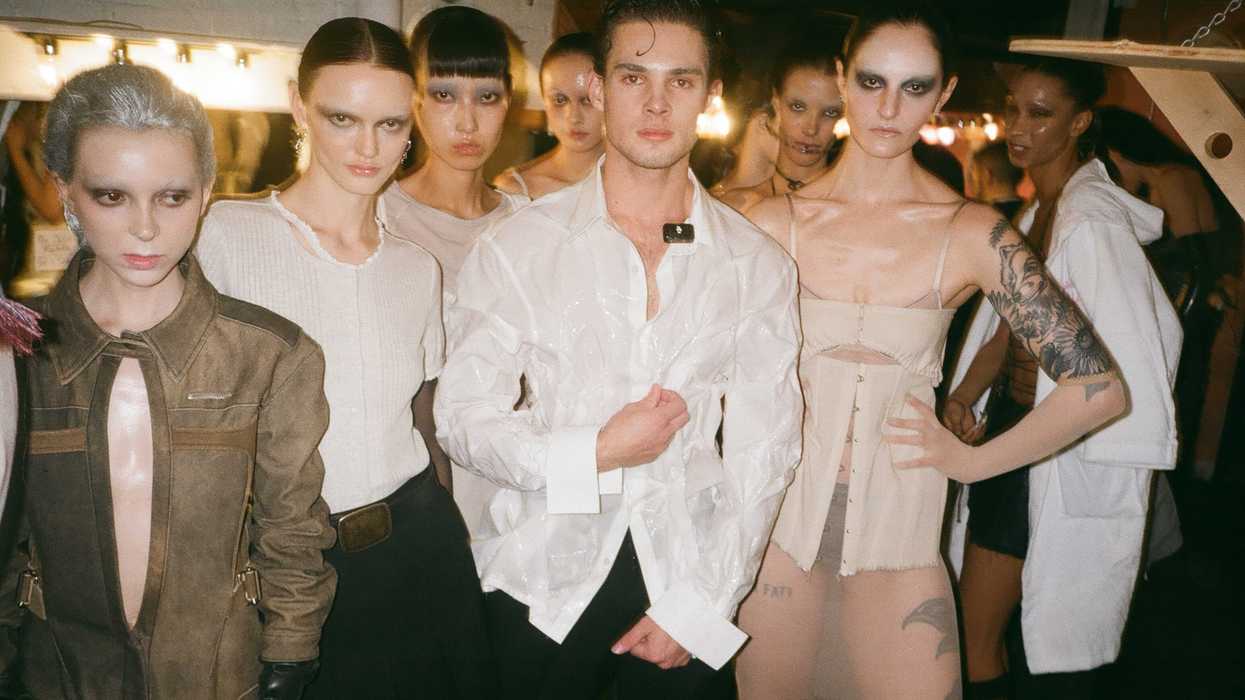
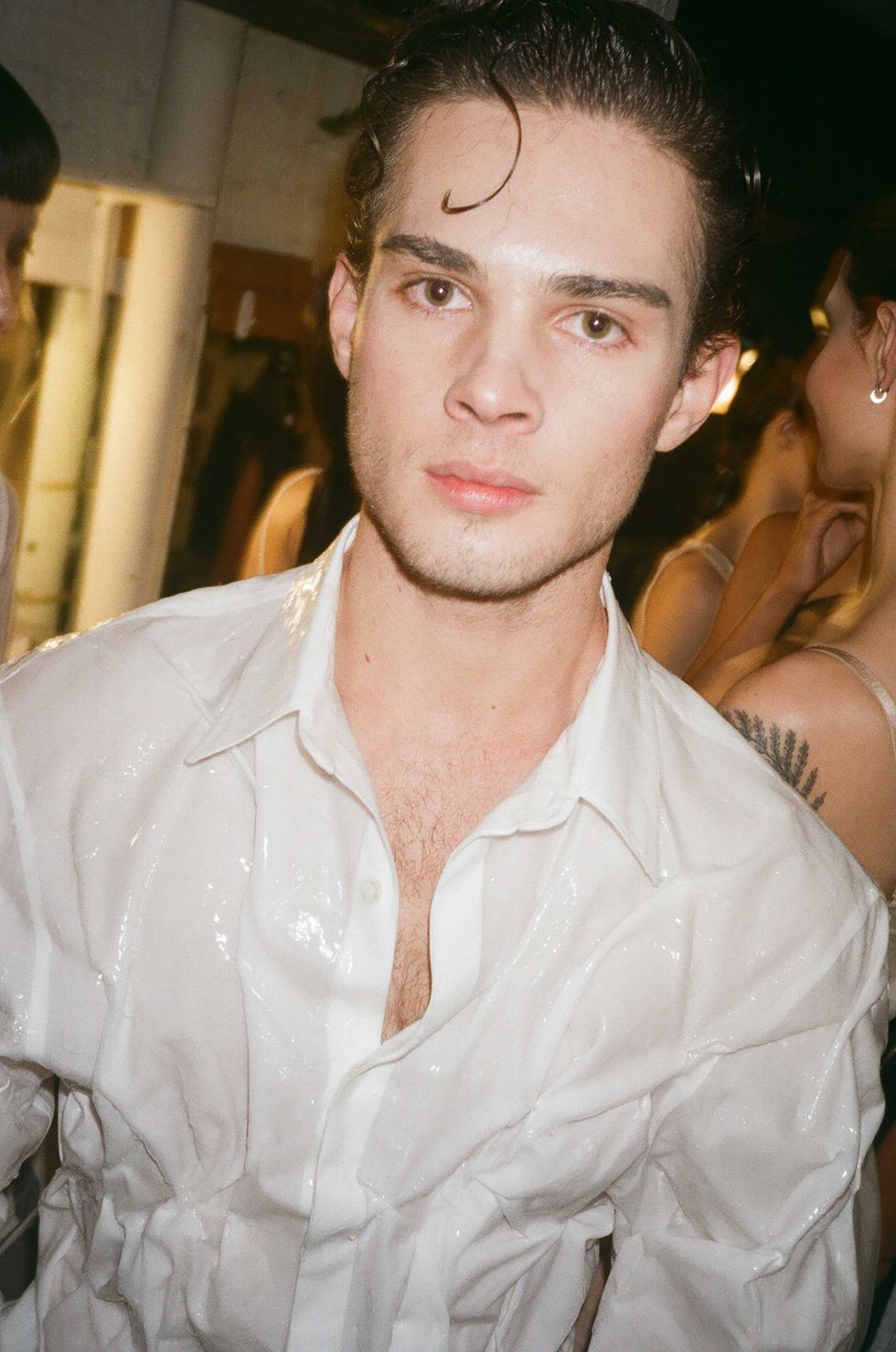 Clavicular and the other models ready for their closeup.
The Vogue editor rightly laments that, “Sadly, perception is often conflated with truth,” but she takes this to mean that it is the responsibility of an artist to present their work alongside an explainer of exactly how the viewer ought to receive it. The “fashion people” whose livelihoods and relationships depend upon the flourishing of the art form are inhibited by their own scrupulosity. Their thoughts and desires are determined by the system in which they work, by the economic structure that creates and maintains their livelihoods. The desperation to be good prevents them from feeling any genuine response of the spirit to the very art they live and die for. Like Clavicular, they have reduced the purpose of life to a single principle. This is why designers like Elena Velez are seen as a threat. They function outside of the fashion leviathan.
As with any system, hypocrisy is a function of the fashion leviathan. Why do the plethora of other brands with a stated interest in folk art, Americana, and Western heritage get milquetoast approval from institutional publications, when in other cases these inspirations would be seen as red flags? Thanks to their associations, of course, or lack thereof. This is exactly why Ralph Lauren can present a collection that he described as inspired by the “Ameri can renegade spirit,” and receive nothing but applause. His presentation of an ideal America, though almost exclusively inspired by the frontier, is not seen as a right-wing dog whistle.

Ralph Lauren is accompanied by a few other designers who, while they are happy to pay their dues to the industry, make genuinely beautiful clothes, present coherent collections, and have a distinctly American outlook. Joseph Altuzarra is another one, along with Tory Burch. They have managed to remain commercial without undermining their point of view. Even alternative industry darling Eckhaus Latta, though undeniably beholden to the logic of the market, creates clothes that integrate the product-nature while maintaining a novel artistic approach. However, they absolve themselves of running afoul of the industry by maintaining an ironic distance from their own creativity and the cultural objects they produce. This distance is facilitated by their compliance with the market and their commercial success.

But for the first time in a long time, there are designers with reasonable followings and impressive portfolios who resist the mainstream. Elena Velez is perhaps the most prominent in the press, but I also think of Zoe Gustavia Anna Whalen, CD1974, Mel Usine, Colleen Allen, and Emily Dawn Long. Each in their own way resists the transformation of clothing into PR and capital. Some risk associations are meant to hold a mirror to our culture but remain uncancelable. Some refuse to expand or offshore their production and persist in making one-of-one pieces. Some produce their clothing exclusively by sustainable practices or recycled textiles. They are seen by the industry as risks or nuisances to varying degrees, some merely because they resist the fate of becoming a money-making corporation. They persist in taking both fashion design and life with open hands. They have also succeeded in resisting the commodification of rebellion that has been the fate of any American countercultural movement since the 1960s.
Those who, out of moral indignation, seek to prevent certain artists from going mainstream are unwittingly creating the conditions by which the very meaning of mainstream and the decades-long power of commerciality will finally crumble. The fashion industry works in the same way that looksmaxxing does: it dehumanizes while at the same time redefining what it means to be human. Like a slowly disintegrating family, memories fade; stories are no longer told; what is lost is never made conscious because it can't be; the people aren't there to pass along their experiences. No industry can create ex nihilo.
Since Yeezy fell from grace, the industry has relied almost exclusively on nostalgia as its guiding design principle. This inability to form new cultural memories is part of what Capitalist Realism author Mark Fisher called “depressive hedonia.” He described it as an emotional impotence and melancholia brought on by an inability to do anything but pursue pleasure. In other words, it is a contagious mental illness brought on by decadence and abundance. It functions by convincing the population that participating as consumers with the right corporations and buying the right things will fix our culture. This creates a feedback loop in which the fulfillment of any satisfactory cultural change is constantly postponed by the work of finding and buying the right product. Thus, the American people are rendered culturally and politically impotent by “the freedom of choice and need-satisfaction.” In depressive hedonia, any creativity is trapped by the inverse principles of nostalgia and shock, familiarity and virality. Another way of viewing this phenomenon is “time-space compression,” a term coined by David Harvey, the author of The Condition of Postmodernity, to describe the effect of market-based ethics on human creativity. This describes nearly all of our popular culture understanding of fashion at the moment—a flash moment in one collection, quickly forgotten, or a rehash of some past decade that had what we don’t: clothes that marked the sign of the times.
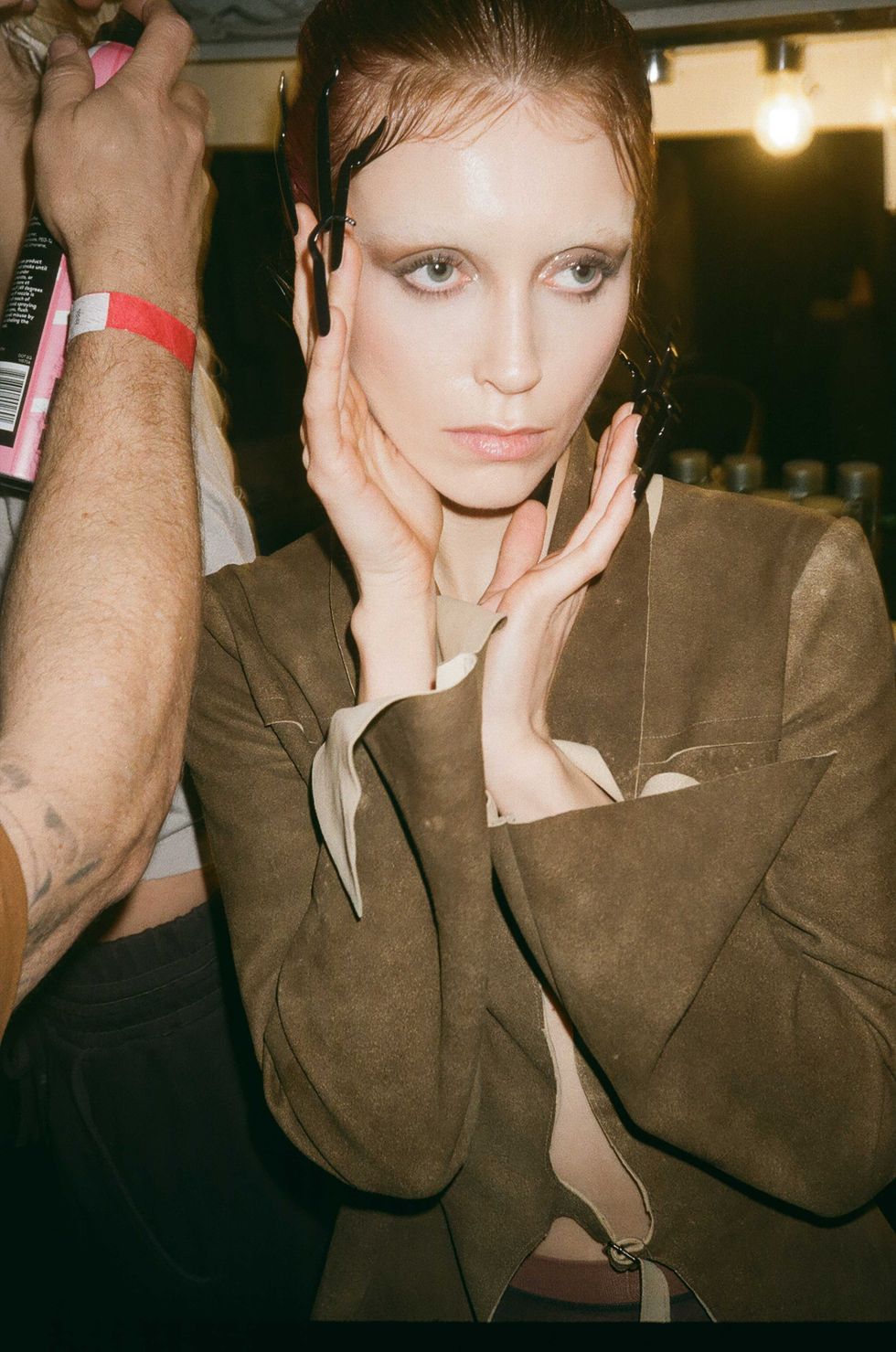
 Dasha Nekrasova stuns in a leather jacket.
While the fashion industry complains of a nostalgia loop and the absence of anything new, the critics—themselves employees within the industry and therefore dependent on the market's success—refuse to recognize that the existence of a “fashion industry” is fatalistic. The purpose of the industry is not to fashion clothing; it is to profit from fashioning clothes. While profit is not inherently disordered, it is disordered to demand that human creativity must conform to the homogenizing nature of industry. It is especially disordered when moralizing is used as a bludgeon to increase profit. As Fisher puts it, they say, "Buy our clothes, associate with our brand, and you (too) will be on the right side of history." And yet the industry complains about the nostalgia-shock loop just as they are doomed to perpetuate it.
 George Santos dressed to impress.
It is no wonder that, within this cultural labyrinth, we have turned to our own reflections for inspiration and even for consumption. One presentation I attended— that of fashion designer Kate Barton—is a particularly salient example. Upon walking in and looking around in confusion for models or even mannequins, I noticed that, amid the flashing lights of the editorial video projected onto the walls, iPads were staged throughout the space. A pretty intern waved at me. “Have you tried the simulation?” She smiled, gesturing to the iPad screen. I walked slowly in view of the camera and saw my own image captured and processed into an avatar wearing one of Barton’s designs. “You’ve been styled,” said the girl. I hurried out, past other attendees swiping themselves through various iterations of the fall/winter collection.
How strange, I thought, that this young designer would want her collection presented as an AI gimmick. I’m sympathetic to the fact that she was trying to do something new. She understood that the only thing that holds our attention within the constant stream of content is our own reflection. We are cannibals now, remade by AI as consumers—not of products, but of our own image.
As the ultimate passive consumer of himself, Clavicular embodies the fashion industry's consciousness. His life has been molded to the logic of the market ethic. He is Human Capital. Likewise, the fashion industry has taken a craft that once defined people's daily lives and stories and turned it into preening self-consumption. As long as the fashion leviathan is trapped in the struggle over economic progress masquerading as a culture war, it can have no other fate but to consume itself. It can never reinstitute the old icons; its only icon is its own reflection.