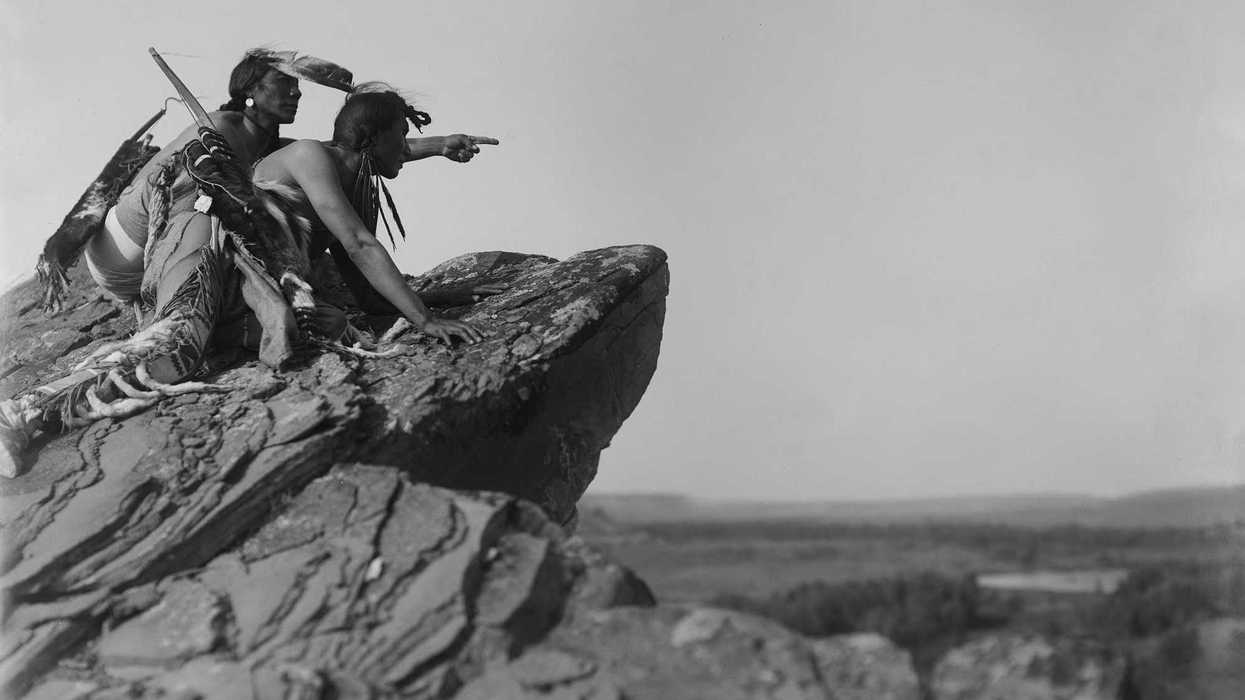
Roland Reed | Watching the Herd | Blackfoot | Montana | c. 1912
The story of the rediscovery of a lost American master photographer, Roland Reed, begins in a basement.
Not in a museum archive, nor the back room of a university collection, but in a basement in Minneapolis, where a nearly-forgotten body of work sat waiting for someone with enough imagination to recognize what was in front of him.
For years, the photographs had drifted dangerously near to the edge of obscurity. Roland Reed (1864-1934), one of the great photographers of the American West, had spent his life documenting Native American life with a patience that now seems impossible. He traveled with heavy cameras and fragile glass plates, on a mission to record. He wanted to preserve a world he knew was vanishing; he died nearly broke and practically forgotten. His work passed from hand to hand, from relative to collector to gallery, and finally to storage. For long stretches, it all but disappeared.
Then Jace Romick found it.
Romick, a photographer and gallery owner in Steamboat Springs, Colorado, first encountered Reed’s work in the 1990s when he was running an interior design and furniture showroom. A representative of the Kramer Gallery, which then owned the collection, had dropped off one of Reed’s photographs. Romick walked in and stopped cold.
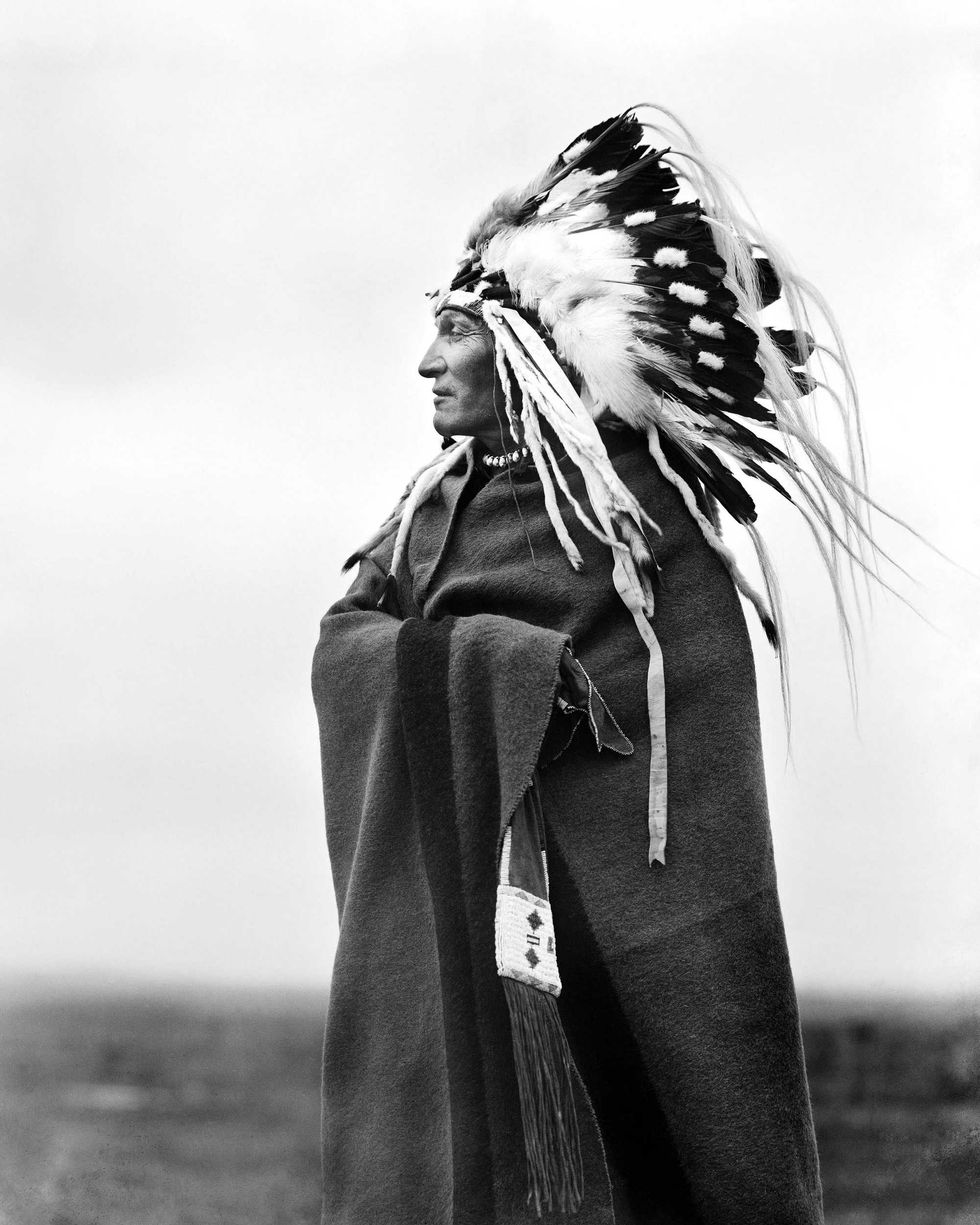 Chief Lazy Boy. Every Reed photograph began as a fragile wager against time, weather, breakage, and oblivion.Roland Reed
“I walked in, and I went, ‘Oh, my God, that is the most incredible photograph I’ve ever seen in my life,’ you know? So I immediately fell in love with Roland Reed at that point,” he said.
That first encounter he couldn’t shake. Years later, when Romick opened a fine art photography gallery in 2021, Reed was one of the first names that came back to him. He wanted to represent the collection. He tracked down the Kramer family and learned that they had retired, closed their Minneapolis gallery, and stored the Reed photographs away. What Romick thought might be a small group of pictures turned out to be something else entirely.
“We’ve been using his photographs to teach our children for years.”
He flew to Minneapolis and went downstairs.
“Arriving there and going down into this basement and starting to go through the files and so forth, realizing there were almost 150 photographs, and the quality of them, I was just, basically taken aback,” Romick said. “I was like, ‘Wow, this is a piece of American history.’”
Romick had come as a dealer. He left, in effect, as a would-be custodian. The mission had shifted from commerce to stewardship.
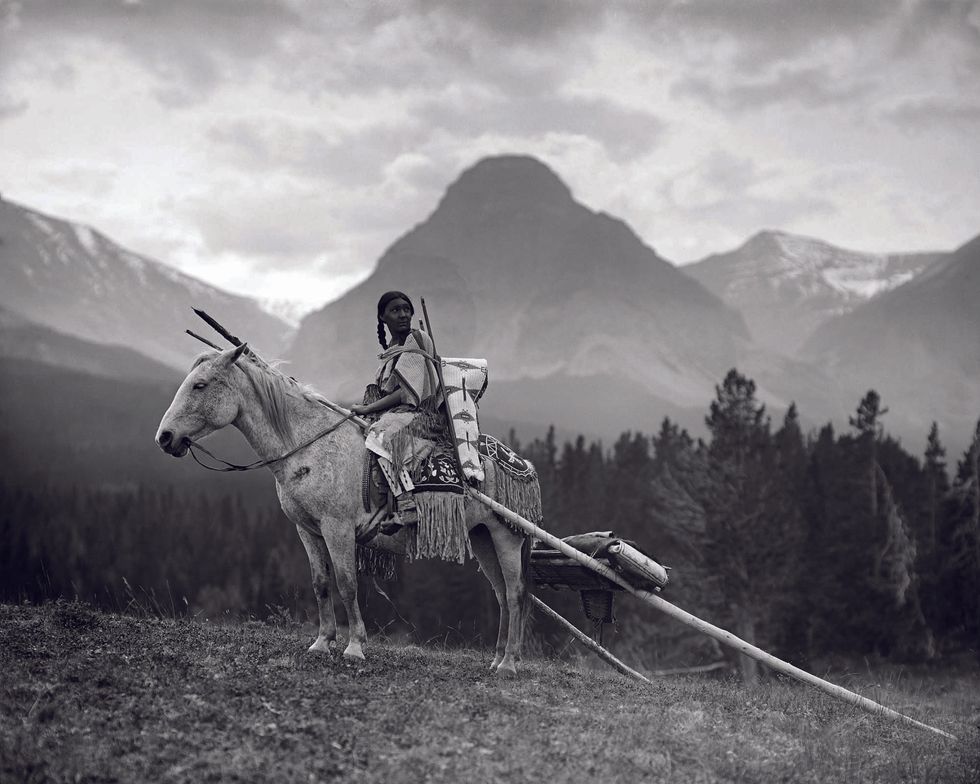 Woman with Travois (Variation) | Blackfoot | Montana | c. 1912 Roland Reed
“Instead of thinking, ‘Wow, I want to represent this collection,’ I sort of was thinking, ‘How can I purchase this collection? How can I take this collection in a direction that I would like to see it go?’”
The Kramers cared about one thing above all: that the collection remain intact. They did not want Reed’s images scattered, trivialized, or printed on souvenirs. Romick understood this when he bought the collection and hauled it from Minneapolis to Steamboat Springs, where it began its second life.
Wisconsin was the backdrop for the beginning of Roland Reed’s first life. He was raised in close proximity to Native American communities, specifically around the Red Lake region, and he had a profound childhood fascination with their way of life. Long before picking up a camera, Reed aspired to be an artist. Carrying paints and pastels, he journeyed into the American West, driven by a desire to visually document the fast-disappearing world of the Native Americans.
Then, in Havre, Montana, he fell in love with photography. According to Romick, Reed met a photographer named Dan Dutro and began to apprentice with him. The camera offered Reed something painting could not. It was testimony of a lost way of life.
Reed’s heavy wooden camera journeyed with him across Blackfeet, Navajo, and Hopi territories, capturing indelible images of canyons and remote villages.
As Romick put it, Reed came to believe that “If I can master photography, it’s not my interpretation of what the natives look like, or where they live by painting them, but it’s an actual interpretation that the camera captures.”
Reed was not merely making Western pictures. He understood, with a kind of melancholic urgency, that Native customs, dress, ceremonies, homes, and ways of life were changing fast under pressure from the modern United States. Reservation life had already altered much of what he wanted to record. Many photographs of Native Americans from this period were staged, including Reed’s. But staging, in his case, did not necessarily mean falsification. It meant reconstruction, arrangement, and preservation.
“He was meticulous at trying to capture them as authentically as he possibly could,” Romick said.
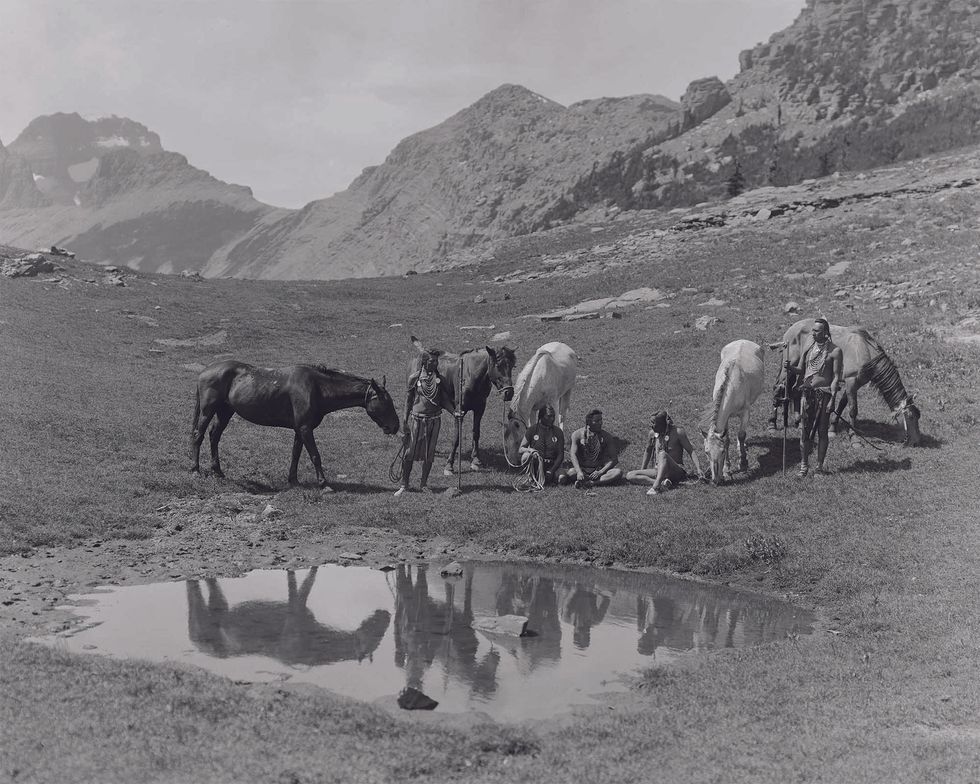 The Watering Hole | Blackfoot | Montana | c. 1912. Reed’s portraits of the Blackfeet carry the stillness of formal composition and the force of personal encounter. Roland Reed
Reed was working in an era when photography was slow, cumbersome, and physically demanding. He used dry glass plates and large view cameras, carrying fragile negatives into deserts, mountains, and canyons. It’s hard for modern photographers to imagine the difficulty involved in using that equipment. One toppled pack horse, one storm, one accident, and a week’s labor could vanish into splintered glass.
Romick, who shoots modern wildlife and landscape photography, marvels at the technical achievement. “I’m just blown away by, you know, when I go out and I realize I can take, you know, a thousand photos in one day if I really want to. And I have a titanium waterproof camera, and he’s out there with a wooden camera the size of an apple box with leather billows on it spending two weeks setting up a shot,” he said.
Reed’s heavy wooden camera journeyed with him across Blackfeet, Navajo, and Hopi territories, capturing indelible images of canyons and remote villages in Arizona. These pictures now feel profoundly historic. He documented the Blackfeet near what is now Glacier National Park, Canyon de Chelly National Monument, and Walpi, the Hopi village in Arizona where photography is still restricted. When Romick showed a Walpi photo to village officials, they were stunned—they’d never seen it before. In that moment, the past truly came back, captured in silver and shadow.
The Blackfeet images form much of Reed’s surviving collection. When Romick traveled to Browning, Montana, to the Blackfeet reservation he wondered how Reed’s work would be received. Would the descendants of Reed’s subjects see him as a sympathetic witness, or as another out sider with a camera? At the Cuts Wood School, which teaches children in the traditional Blackfeet language, Romick met Darrell Kipp, Native American educator, documentary filmmaker, and historian, and asked him if they were aware of the images. Kipp’s answer startled him.
“Of course we are,” Kipp told him. “We’ve been using his photographs to teach our children for years.” That may be the most moving vindication Reed could receive. His photographs had not merely survived—they had gone home. They were being used to show children how beadwork should look, how lodges were made, what a travois was, and how their own ancestors carried themselves.
Roland Reed called himself a picture maker. It’s almost too mundane for what he accomplished. But he made those pictures to keep the cultures he admired from disappearing.
One photo, the portrait of Chief Lazy Boy, became a photographic link between Reed’s time and ours. Romick told Kipp it was his favorite in the collection. Kipp shot back with the kind of line that makes history feel real: “How would you feel if I told you Lazy Boy’s great-great-grandson is in the classroom next door to us? They’re learning how to speak Blackfeet.”
Romick later photographed Lazy Boy’s great-great-grandson looking at Reed’s portrait of his ancestor. The image of the boy looking at the image of the chief contains almost everything this story is about: inheritance, loss, recovery, and the stubborn desire of the dead to be remembered rightly.
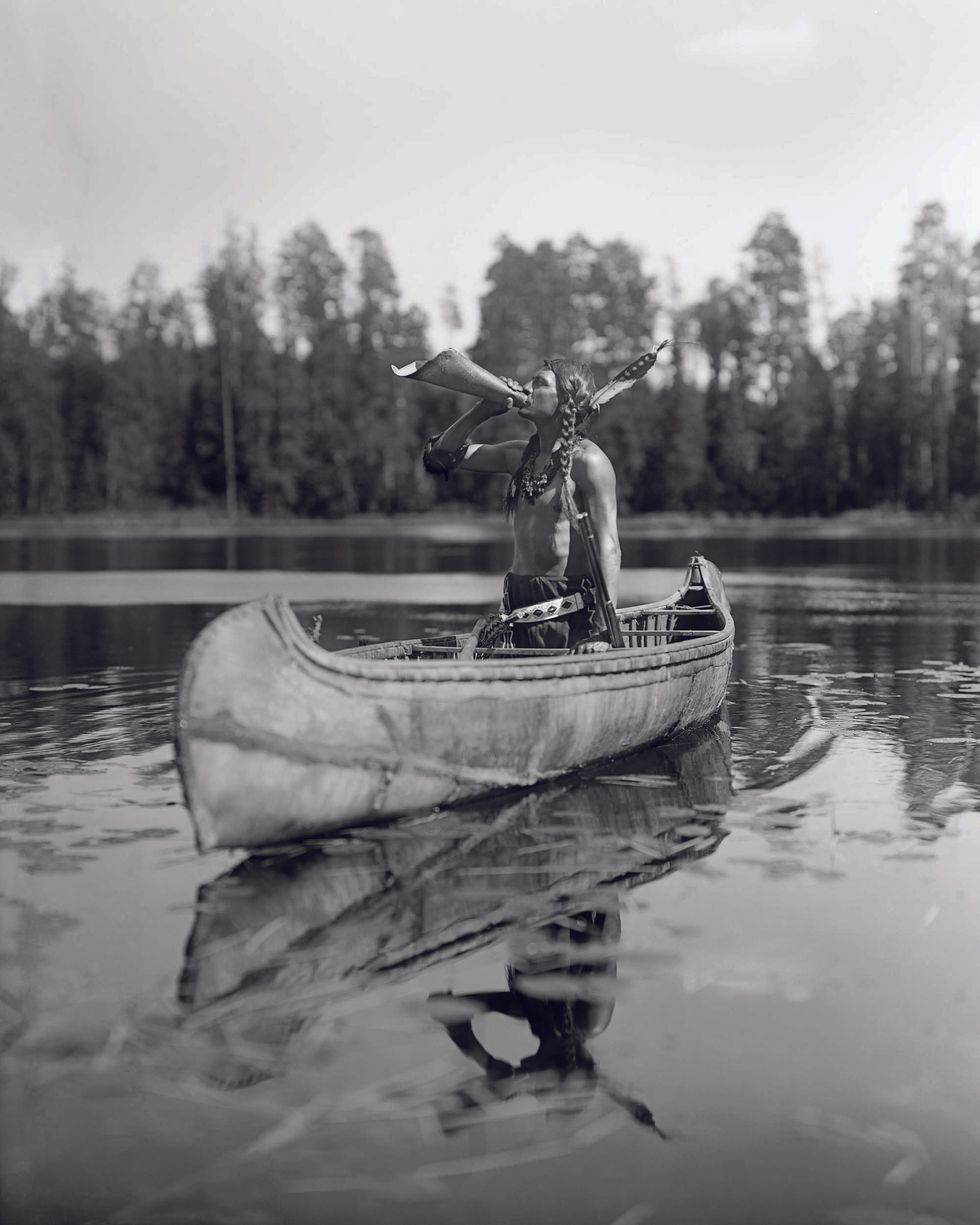 Moose Call | Ojibwe | Minnesota | c. 1908. Roland Reed spent his life chasing a vanishing world with a wooden camera, glass plates, and a stubborn belief that the American Indian should be seen with dignityRoland Reed
Romick believes that Lazy Boy himself understood something of what was happening when Reed made the portrait. “Lazy Boy is sitting there getting this photo taken. I’m standing here looking at it life-size, and you think about it, he’s sitting there thinking, ‘Wow, I want several hundred years from now or whatever, 100 years from now, for people to see me in the proud way that I am,’” Romick said.
Reed’s integrity appears throughout the surviving story. Romick says Reed was once offered a large sum for his photographs, money that would have meant a fortune to a struggling man. He refused because he did not want the work commercialized. He had spent everything to make the images and died with little to show for it. His death itself has the grim absurdity of an old newspaper item. In Manitou Springs, Colorado, he slipped, broke his hip, contracted pneumonia, and died. The death certificate, Romick says, listed the cause as slipping on a banana peel. For years, Reed lay in an unmarked grave.
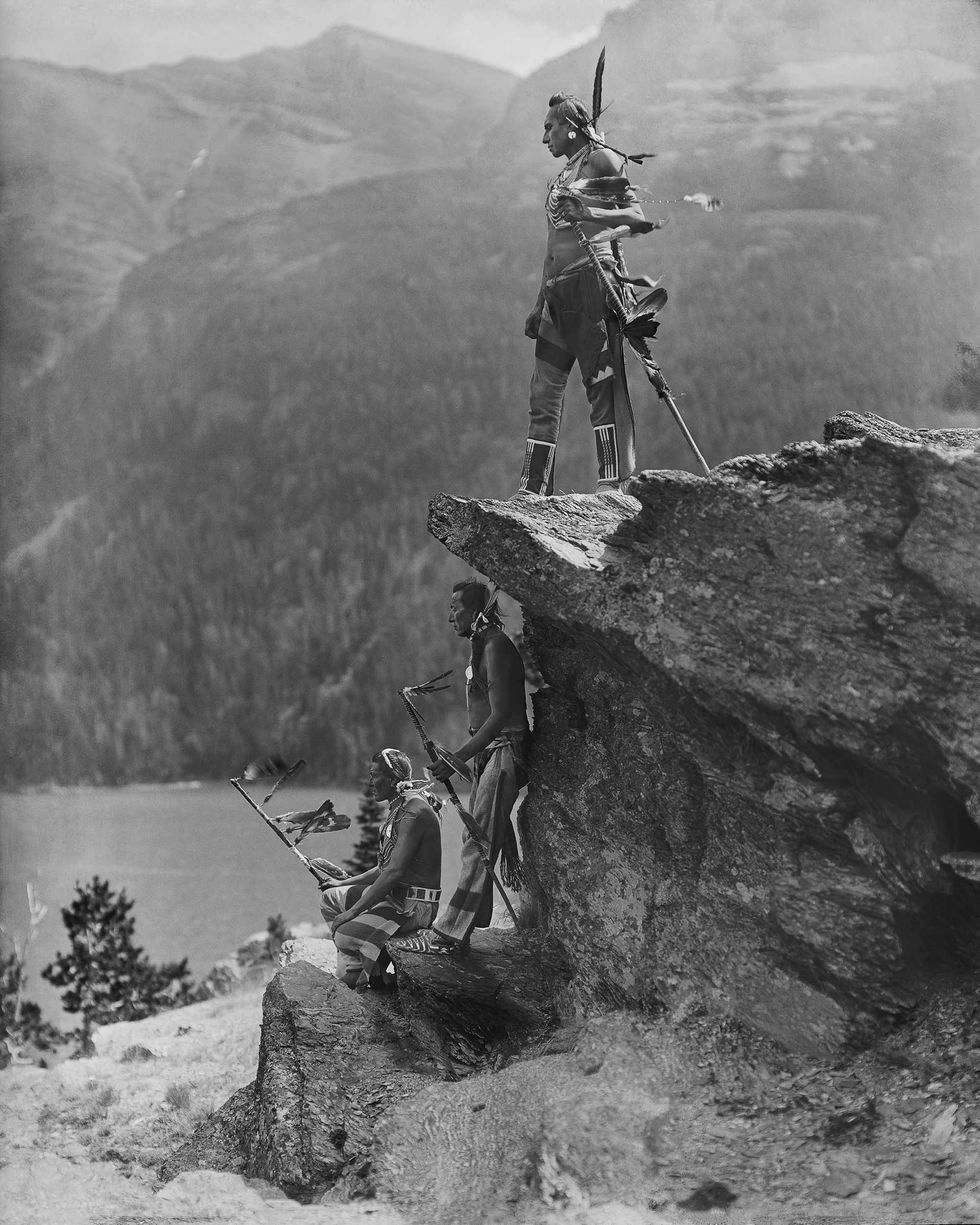 The Eagle | Blackfoot | Montana | c. 1912Roland Reed
His work persisted, mostly because the people who held it wouldn’t let it be picked clean. His cousin, Roy Williams, spent years hauling those images around for thousands of talks. Then the Kramers stumbled onto the pile by pure luck, and eventually, Romick did too. Every time it changed hands, it was the same call: keep the collection whole lest the vultures descend.
Roland Reed called himself a picture maker. It’s almost too mundane for what he accomplished. But he made those pictures to keep the cultures he admired from disappearing into rumor and obscurity. He hauled ancient equipment, but he had a mastery of light and composition all our modern gear hasn’t come close to improving. He could have licensed his photos for cheap souvenirs and made a small fortune, but he refused.
“The guy basically died broke and spent every dime he had trying to capture these photos,” Romick said. “Any time that anybody sees him, I think it’s incredible, you know, and it’s part of his legacy.”
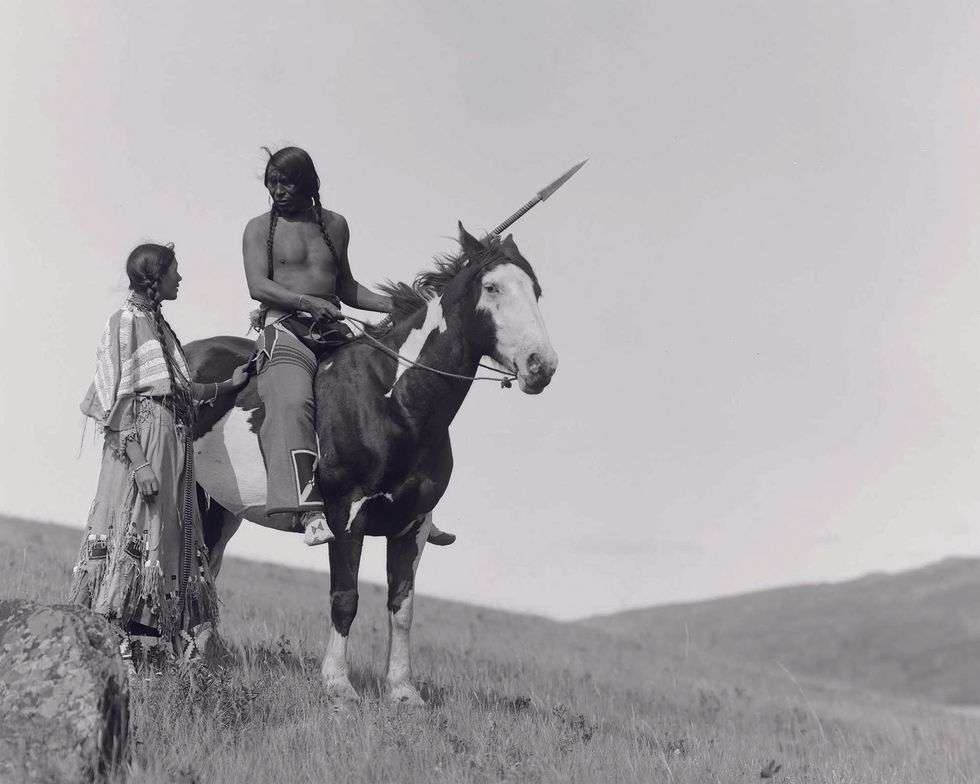 The Message | Blackfoot | Montana | c. 1912Roland Reed
Jace Romick is a humble man, and he would probably scoff at the praise. But by rediscovering and championing this extraordinary work, he’s become an integral part of the story—a custodian of history and our Western heritage. Roland Reed and the Native Americans whom he chronicled and admired will live on.
Editor’s Note: If you would like to learn more about Roland Reed’s extraordinary work, you can visit the Roland Reed Gallery in Steamboat Springs, Colorado, or visit their website, www.rolandreedgallery.com. There is a book of Roland Reed’s photos being released this summer.