John McDermott
Drug-addled, mentally unstable homeless haunt the streets like zombies. The ones on fentanyl are the slow-moving flesh-eaters, lumbering with their postures stuck at odd, uncomfortable angles. The ones geeked out on high-potency meth are the fast-twitch zombies, rabid and unpredictable; screaming and raging at innocent passersby. Their tents and literal shit litter the sidewalks in front of abandoned storefronts. Every few blocks a frustrated police officer stands helpless, watching the criminality play out in front of him, unable to make an arrest because the progressives who run the city believe it’s more compassionate to let the homeless slowly kill themselves in public view than to force them into involuntary confinement.
Downtown Los Angeles is a hollowed-out ruin; a vestige of a once-great city.
But amid all the decay and squalor—the open-air drug use, the human feces, the shuttered storefronts—an architectural marvel rises like some desert hallucination: Union Station.
The long-anticipated battle between human and machine seems nigh, and I’m contemplating joining the enemy so my future family can have a modicum of comfort in an increasingly unaffordable America.
From the exterior, Union Station looks like a Spanish mission: white stucco walls, arcades, and red tile roofs.
Union Station is a cathedral of a different time, one harkening back to a bygone America and way of life. Flanking the entry vestibule to the left is the ticketing con course, no longer in use but, thanks to the California Preservation Foundation, still in the same condition as when the station was built in 1939. Just ahead, the entryway opens up to the cavernous waiting room; a vaulted 62-foot high ceiling adorned with exposed timber frames and 10-foot wide Art Deco chandeliers. Oversized arch windows bathe the room in Southern California sunshine and give view to the courtyard garden to the room’s south. Neat rows of overstuffed leather chairs line the waiting room for passengers waiting for their train to come in.
There are certainly more efficient ways to travel the country than by long-distance train, but few are more enjoyable. Unlike LAX, with its Kafkaesque security checkpoints and palpable sense of anxiety from throngs of nervous flyers, Los Angeles Union Station—this grandiose mix of Native American, Colonial Revival, and Streamline Moderne design—is imbued with a sense of adventure and possibility. Somewhere on the other end of that train line is a bustling city or quaint, small town with a history, people, and culture all its own, a unique thread in the great American tapestry.
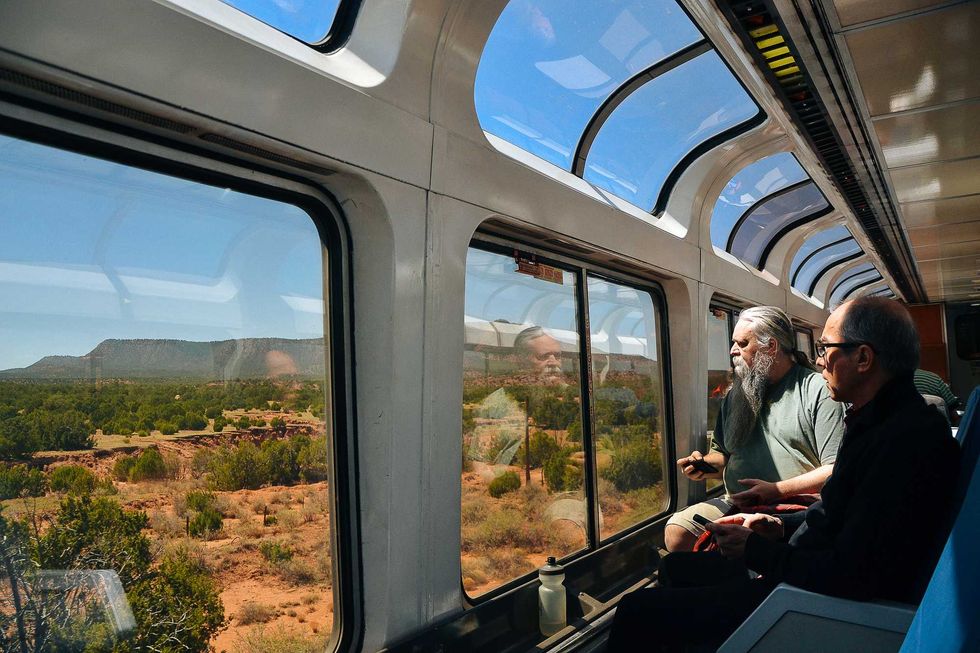 Traveling by train remains one of the most beautiful ways to see America.John McDermott
For the next week and a half, I will travel on Amtrak from Los Angeles to Chicago, with four stops along the way, and speak to locals to try to see what kind of country still exists between the coasts. America seems so uncertain and precarious. Life is increasingly unaffordable. AI threatens to permanently decimate the job market and the past 10 years of technological advancement and political discourse have left us bitter and lonely and depressed, leaving an enormous fissure in the populace, each side seething with resentment toward the other.
I hope to find a nation weary of the political polarization of the past 10 years and working to heal itself—to somehow rediscover a shared sense of unity of purpose. What I will find is a country far less ideological and politically engaged than the internet would have you believe. The American people are exasperated by the noise of politics and are instead trying, stubbornly, to carve out decent lives and communities to shield themselves from it.
“I’d love to take every train that’s ever been created,” a goateed retiree from Florida tells me as our train pulls out of Los Angeles. His wife nods approvingly.
They’re on a cross-country train expedition that makes mine look modest by comparison. They went from Florida to Washington, D.C., for the cherry blossom bloom and the No Kings protest against President Trump. Then to Chicago, Denver, Oakland, San Francisco, Los Angeles, back to Chicago, then east to Philly. He’s heard about the bullet train in Europe that whisks passengers from Paris to Bordeaux to Amsterdam, and he wants to take the train that spans the width of Canada.
This kind of enthusiasm for train travel is seen these days as a sign of autism, but more people should share this gentleman’s appreciation for locomotives, as the U.S. rail system is arguably the most significant infrastructure project in our nation’s history. The completion of the First Transcontinental Railroad in 1869 connected regional economies, creating a national market for manufacturing and agriculture, and allowing the interstate transportation of steel, iron, and timber. The rail industry was so influential that it literally rewrote time—in 1883, rail tycoons came together to establish four standardized time zones across the country, a measure the U.S. government adopted in the Standard Time Act of 1918.
By the Roaring Twenties, the U.S. rail network included more than 250,000 miles of track, the largest rail network in the world. The system carried 1.2 billion passengers a year at its peak in 1920, and train travel was both populist and aspirational. Americans of every class rode the rails. Hobos hitched rides in freight cars, rural and middle-class families rode coach, and the upper crust luxuriated in sleeper cars with fold-down beds and ate on fine China in dedicated diner cars.
And then we became a car culture. We built the interstate highway system, and hitting the open road became a staple of American culture. The road trip epitomized the American individualist ideal—there was no fixed route, the possibilities are endless, and you could go it alone. The ideal was cemented in the American consciousness by Jack Kerouac’s seminal Beat novel On the Road. All you needed to have the adventure of a lifetime was a full tank of gas. The train, meanwhile, was rigid and communal. Its route was fixed in place by wood and steel, its destination and arrival times tightly monitored, and the trip shared with others.
Us Englisch are laboring to be on our phones less, while even the Amish are having phones foisted upon them.
Train travel fell so out of style that the government created Amtrak in 1970 to consolidate failing passenger rail systems into a quasi-public corporation. The system we have now is rarely on time, its trips often cost more than a flight despite taking three times as long, and there is usually someone taking a FaceTime call on speaker or watching a YouTube video, sound up, no headphones in.
Why, then, would anyone travel cross-country by train anymore?
“When you go through places a car can’t . . . the views are beautiful,” the Florida man tells me, a claim that will prove itself true many times over this trip.
For now, though, the view is pitch black. We’re rumbling through the Mojave at night, and the desert is barren and devoid of human life—a world engulfed in darkness. I want to disappear into its void and sleep.
After six hours of travel, I, like Waylon, made it out to Needles, California, a fading Old West town off Route 66, at the jagged nexus of California, Nevada, and Arizona.
For the first time in years, I feel unsafe. A rural train station is nothing like an airport. No fluorescent crowds. No taxis waiting outside. No illusion that help is nearby. The train drops me off at the Needles station near midnight on a Sunday, and there isn’t any sign of life. My hotel is 40 minutes away, but the train arrived an hour and a half late so no rideshares are operating anymore. I stand alone on the empty main road refreshing Uber to no avail. The only sound breaking the eerie silence is the occasional screeching of steel train wheels on steel tracks. A couple of cars slow down as they pass by me, and I suddenly regret filling my wallet with cash before my trip.
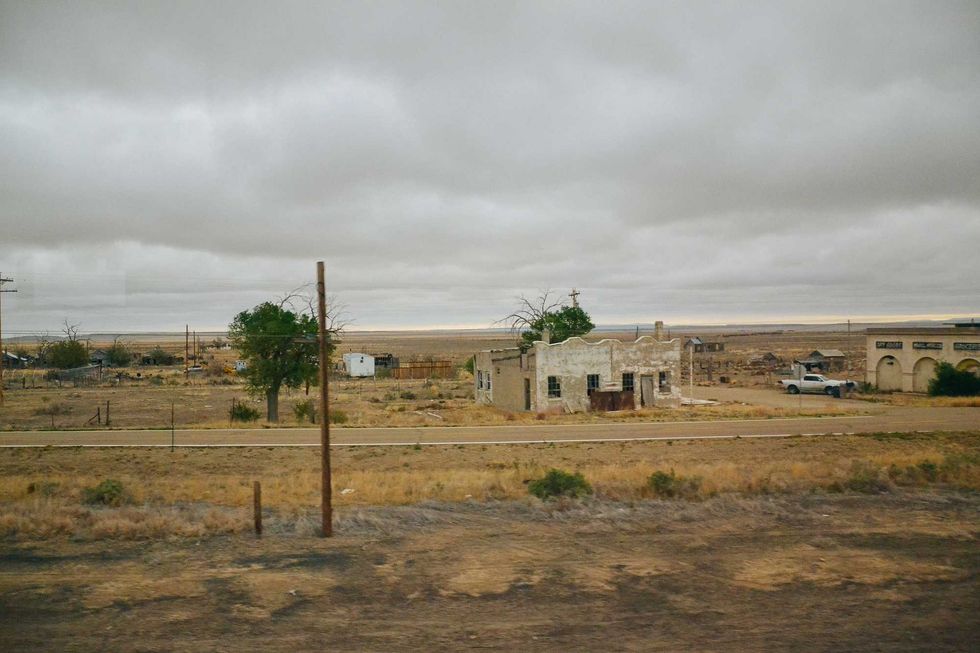 The views speed by as the vistas drown out the noise.John McDermott
I see a man with a beard, black hoodie, and camo pants emerge from behind the closed liquor store across the street. He gives a small nod before disappearing into the dark.
The only hotel on the main drag has no one in the lobby. I call the number displayed in the window and the person who picks up tells me the place is closed for the night.
Eventually I find a Days Inn off Interstate 10, nearly a mile uphill, and drag my suitcase there through the warm desert night. Somewhere along the walk, I begin convincing myself that this is all part of the romance of train travel.
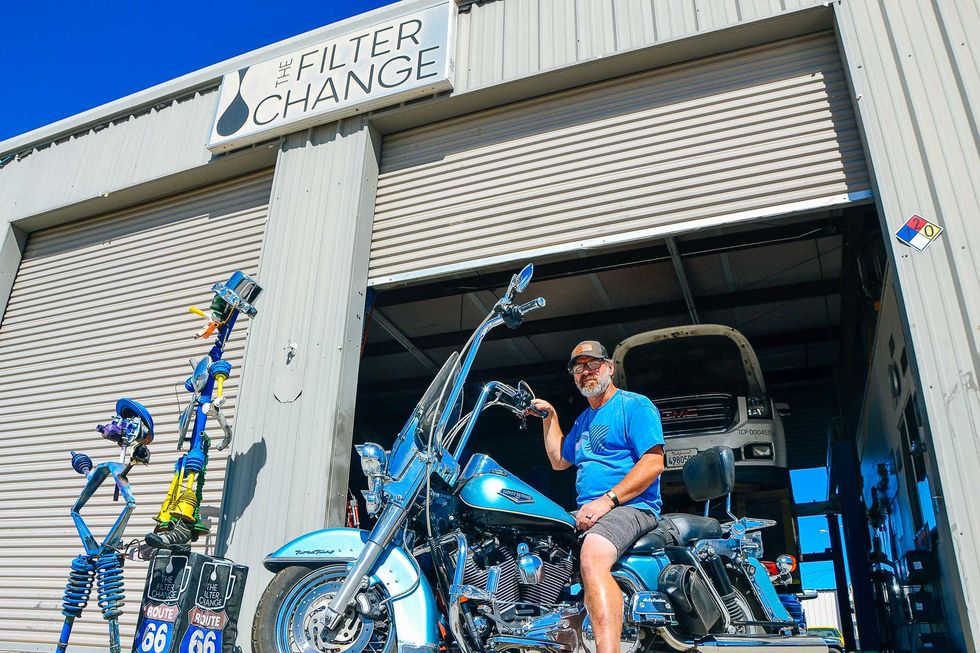
“If you like to do a lot of stuff, it’s not a great place to live,” a woman tells me inside The Filter Change, a hybrid auto repair/coffee shop in Needles.
She’s not lying. Needles (pop. 4,931) is deserted save for this shop where customers can sip a latte while getting their tires rotated. We like to romanticize hobo life, but the truth is that a lot of it is killing time in small towns until the next train arrives.
Whatever the town lacks in cosmopolitan activity, it makes up for in small town charm, says Greg Yeager, the 51-year-old owner of The Filter Change. Prior to opening the auto and coffee shop, he worked for 20 years at the freight rail company BNSF. One of his gigs was transporting the animals for the Ringling Bros. Circus. The train would leave at night, he says, to avoid the animal rights protestors.
Yeager has lived in Needles for 28 years, long enough to see the city lose its sense of community. The entire town used to come out for the city’s annual Memorial Day parade. In recent years, the crowds have thinned out. Needles was once the kind of town where neighbors looked after each other’s kids. “Now you don’t see anyone just out in their yard,” he tells me.
Politics have gotten so contentious that Yeager doesn’t put the news on the television in the shop’s waiting room. “The world has changed a lot,” he says. “It’s an angry world now.”
I wander to the banks of the Colorado River, the source for all life and recreation in this town, and find a man wading waist deep, T-shirt on, drinking a beer while Metallica blares from his portable speaker on the shore.
Every state in the American Southwest, a region home to more than 40 million Americans, relies on this river and its source, the Rocky Mountain snowpack, for its water supply. But the river is in crisis. Overdevelopment in the Southwest and years of drought have left the Colorado River at less than half its total capacity. Some of the lakes fed by the river are at a third or even a quarter of their typical water levels and continue to trend down. Record low snowfall this past winter has resulted in a Rocky Mountain snowpack at 17% of its median levels.
Proof of this drought hangs over the land as my train rolls through Arizona and New Mexico. Colorado River tributaries that have been reduced to mere trickles leaving dried out, leafless ashen-gray trees.
The Southwest is dying of thirst.
My train ride out of Needles to Albuquerque is my first time in a sleeping car on a train, a surprisingly comfortable experience considering the roomette is barely big enough for my 6’2”, 230-pound frame, and that the bed is folded out on train chairs. The gentle rocking of the train is like being rocked in the womb.
I wake to redstone mesas floating past my window as my train approaches my next stop, Albuquerque, a surprising jewel of a city filled with art and the kinds of weirdos the West always attracts. In the coffee shop Daily Rituals, two older women are talking about past lives, while another deals herself tarot cards. A mother plays with her young child in the makeshift play area in the corner.
“When people talk about community, the elders get shaved off, and the young people get shaved off,” Adriana Artiaga tells me. “But in a true community, everyone has a place.”
Artiaga, 43, owns the coffee shop and the crystal store next door, where she hosts men’s and women’s gatherings centered on meditation and conversation. “A lot of the retreats I do are all women. I see what happens when people have the safe space to communicate openly and freely, but I can’t do that with men,” she says. “I realized the men need their own space.”
In normal times, one would expect a woo-woo crystal seller to have far-left feminist politics, but Artiaga’s aims transcend reductive partisan politics. “Try to focus on unity,” she says. “Politics gives you division and people feel you have to choose a side. ‘I’m a liberal. I’m a conservative.’ It’s just another label for the ego to attach to.”
Artiaga is even a patriot. She volunteered in India earlier this year and it made her appreciate all the freedoms we enjoy in the U.S. “I felt the restrictions of being a woman over there,” she says. “The U.S., as hard as it is, is still the best option. I have a lot of hope for this country and its people.”
 Adriana Artiaga sits in her shop and eschews political labels.John McDermott
In downtown Albuquerque, I stumble into Willard & Byrd, a men’s vintage clothing shop. The owner, 39-year-old Kevin Blosser, used to work in film as a set designer in Austin. He had a knack for procuring vintage Americana, and when the film industry contracted, he turned his picking habit into a business. I ask what it’s like selling classic American wear when there’s so much angst about the country.
“People get too caught up in that shit,” he says. “Any common goal has gotten lost. I’m just trying to get by selling a dead man’s clothes.” That night I overhear a pair of college-aged women at a pizza shop complaining about Central New Mexico Community College erecting a new building to grow its film studies program. “I’m gonna fight it,” the stocky, short-haired woman tells her cuter friend.
I can’t help myself and ask the woman why she opposes the extension. “They should have engaged the community,” she says.
“About what?” I ask.
The stocky girl looks at me confused before turning to her friend for support. She turns back and repeats herself, “They should have engaged the community.”
“What about the project would you like done differently?” I ask.
“We want a community benefits agreement.”
“What’s a community benefits agreement?”
The pretty friend chimes in, “Literally it’s a community benefits agreement,” in a condescending tone, as if I don’t understand the meaning of those individual words. I consider accusing her of resorting to a tautology, but I doubt she knows what that means.
“Sure. But what’s in the agreement?” I ask.
They look at each other for a beat and the friend turns to me. “This conversation is a lot longer than we were hoping for.”
I leave the ladies to their pizza. I can’t fault those women and their poorly-held beliefs, though. Like all of us, they just want to feel like they’re doing something.
The train ride from Albuquerque into Colorado is the most aesthetic of the trip. One hundred fifty years ago, train workers blasted holes through the Sangre de Cristo mountains so they could charge ranchers to ship cattle up to slaughterhouses in Chicago, and because of their efforts, I am treated to stunning buenas vistas as my train car burrows in and out of mountain tunnels.
When I arrive at my next destination, I’m treated to my best meal of the trip.
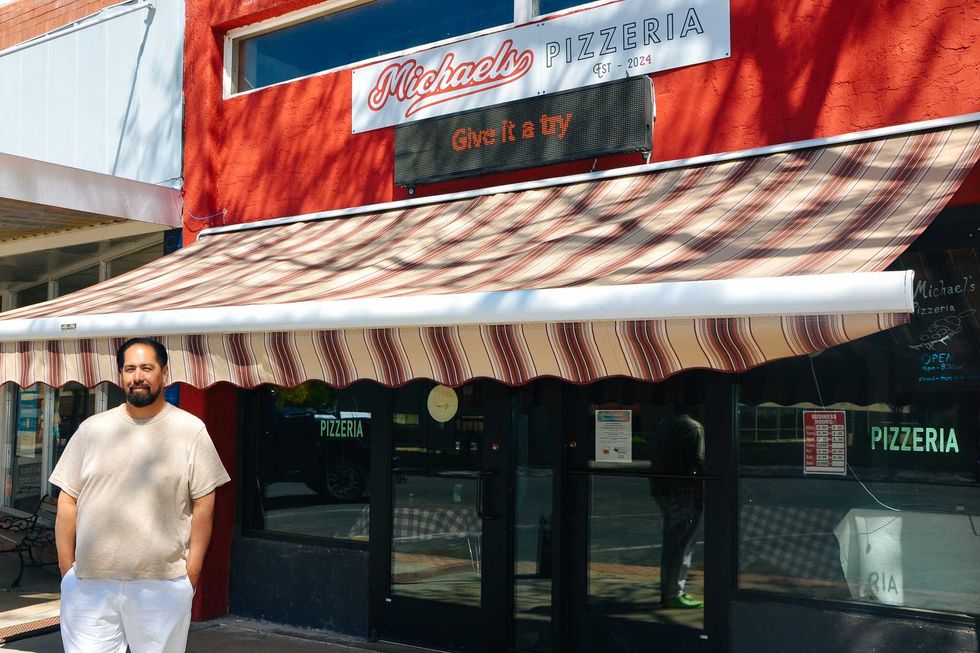
I was not expecting to sit down to some of the most delicious pizza I’ve ever eaten in a dimly-lit ex-opera house in La Junta, Colorado (pop. 6,864), but as I sink my teeth into a slice of Michael’s Pizzeria’s Meat Lover’s pie, I am astounded. I assumed the high Google and Yelp reviews reflected small-town generosity rather than culinary excellence, but I was wrong. The crust is crispy on the outside and airy and chewy within. A thin layer of sauce with a subtle tang to it, and a perfect ratio of cheese to toppings. After eating nothing but candy bars on the train all day, I am in food bliss.
I ask the kind, older woman working the register, in the politest way possible, how a restaurant in a tiny town in southeast Colorado can make New York City-worthy pizza, and she introduces me to her son, the head chef and proprietor, Michael Garcia.
In 2008, Garcia got “obsessed” with making pizza. He’d trawl online pizza-making forums for discussions of different flour mixtures, hydration points, baking temperatures, and cook times. He traveled to Brooklyn and New Haven to visit the country’s most heralded pizza spots, pestering their cooks for tips. He opened Michael’s Pizzeria in March 2024 and, he claims, made $20,000 in profit his first month of operation, a stupefying amount given the town’s size.
I finish eating and again find myself unable to make it to my hotel due to the dearth of rideshare options. The streets are so quiet that I can hear the hum of an electric vehicle three blocks away. So Garcia closes his pizza shop early to give me a ride.
I ask Garcia about his politics, and he tells me that as a Jehovah’s Witness, he abstains from politics. Jehovah’s Witnesses believe aligning oneself with any political candidate or movement is a sin. They don’t vote, run for office, or participate in the military.
“The politicians, they prey on people’s emotions and manipulate them,” Garcia says. “They just get used. You’re better off just doing what you can control. Just love your neighbor, love your family, love yourself.”
 John McDermott
Garcia, a Ventura, California, native, was actually raised Catholic. He grew tired of the surfer crew he grew up with, with their drugging and lusting, and decided to become “a person of character.” And he is most certainly that—whether it’s throwing pizza dough or lending charity to weary, lonesome travelers, Garcia’s integrity is unshakable.
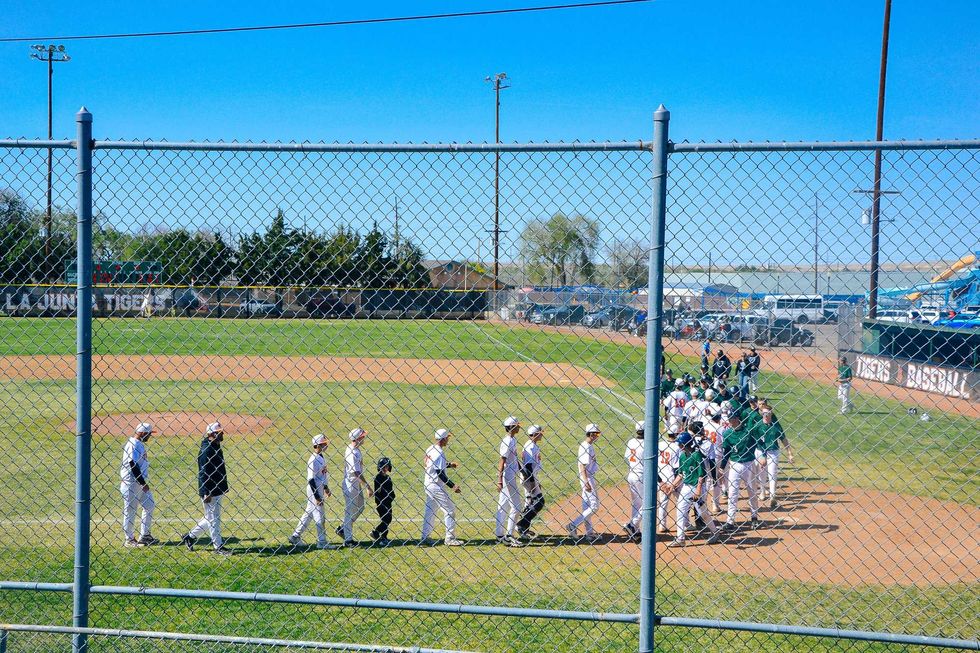
The next day, I come across a baseball game. The Tigers of La Junta Jr/Sr High School are in the fifth inning of the second game of a doubleheader against the previously undefeated Woodland Park Panthers.
La Junta handed Woodland Park their first loss in the first leg of the doubleheader, and are now up 14-6 and three outs away from taking the second game, too.
A parent in the stands says, “Prom pictures at 4.” And the final out is recorded shortly after.
I think about the seniors on the team, how, for many of them, this season will be the last time they will ever play organized baseball. They just won two games against their conference rival. They will go home, shower up, and change into their rented tuxes. They will slip corsages on their girlfriends’ wrists, their girlfriends will pin boutonnières onto their jacket lapels in return, and then they’ll pose for awkward photos that mean more to their girlfriends and parents than to them. At the dance, the boys and girls will retreat to their respective huddles. The baseball players will fist bump and recap the glory of their twin victories. Gradually, the opposite sexes will find each other on the dance floor. I hear the kids don’t drink much these days, but maybe someone will try to sneak in some booze. Or they’ll hit an afterparty. Maybe they’ll even get laid. Today is the greatest day of their lives, and their lives have hardly begun.
Train travel is, quite literally, an outdated mode of travel. Amtrak cars haven’t been updated since the 1970s, though there are efforts to modernize the U.S. train system. Shortly after I booked this trip, Amtrak announced it will replace its 50-year-old train cars. The new fleet looks amazing—sleek, Art Deco-inspired interiors, with automated push-button controls for tray tables and seat reclining, softer lighting, and comfier chairs.
Which is all fine and good, but the updates are mostly cosmetic. The real problem is that the U.S., once the leading power in train infrastructure, can’t build high-speed transit like the rest of the world.
The California high-speed rail project, for instance, is probably the single worst public works project in the history of our country. Started in 2008, California’s high speed rail system was intended to connect the state’s coastal cities. The first phase was slated to cost $33 billion and be completed by 2020.
We are now six years past the deadline and there isn’t a single consecutive mile of high-speed track laid in California, and the new projected cost for the L.A. to San Francisco line has soared to $231 billion, seven times the initial estimate.
Today is the greatest day of their lives, and their lives have hardly begun.
California’s high-speed rail project has been so terribly mismanaged that French national railway firm SNCF, which has built a network of high-speed rail in France, pulled out of its contract with the state of California, citing untenable “political dysfunction.” It’s never a good sign when the French are criticizing your byzantine bureaucracy.
For the Amish, however, riding Amtrak is a technological wonder. If you ever ride Amtrak, you will almost certainly see Amish people riding, as I did on every single leg of my trip. The Amish are constantly evaluating whether adopting a specific modern technology would strengthen their communities or be an affront to their humble way of living. Apparently flying in a plane would violate the Amish’s rejection of modern technology, but train travel is permissible.
 John McDermott
I learn this on the overnight train to Kansas City, over dinner with Mary and John, a married Amish couple from Arcola, Illinois. They’re coming back from Vegas, where John attended a conference for garage door installers, his chosen trade.
“Ninety-nine percent of what people go to Vegas for, we can’t participate in,” John tells me. “We were done with the place in a hurry.” He did delight in several of the steakhouses on the Vegas strip, the highlight of which was splitting a 52-ounce tomahawk ribeye with his brother.
I ask John what it’s like trying to maintain the Amish way of life amid an increasingly technologically driven world, and I’m crushed to learn that not even the Amish can completely avoid smartphones creeping into their lives. John’s employer requires him to have one so he can answer emails. Us Englisch are laboring to be on our phones less, while even the Amish are having phones foisted upon them.
My train pulls into Kansas City’s stunning Beaux-Arts designed Union Station. The 95-foot ceilings make L.A.’s depot look quaint by comparison.
I’m staying in Hotel Savoy, which, according to a plaque in the hotel’s restaurant, was frequented by President Harry Truman. Playing silently on the bar TV is Metropolis (1927), the visionary and dystopian German sci-fi film. Chillingly, it’s set in the year 2026, and the elites live in colossal skyscrapers while the working class lives underground, toiling endlessly to keep the city’s machinery running. The proletariat are plotting a rebellion, so the ruling class hires a mad scientist to create a robot and replace their labor.
The film feels all too prescient, especially for me, as I have a job interview tomorrow for an artificial intelligence company. After eight years as a freelance writer living the starving artist life, I’m contemplating going corporate. There’s a girl I want to marry and have a family with and a writer’s salary won’t cut it—certainly not in Los Angeles, not in this economy.
The long-anticipated battle between human and machine seems nigh, and I’m contemplating joining the enemy so my future family can have a modicum of comfort in an increasingly unaffordable America. I know I shouldn’t blame myself for the woeful state of the economy or the slow-motion collapse of my chosen industry, but I can’t escape the shameful feeling that time and money have eroded my spirit, and I’m not sure if the dream is worth pursuing anymore. I’m crawling out of the hole and joining the industrialists in the city above.
A month after the interview, I receive the kindest, most flattering job rejection I’ve ever experienced. The president of the AI company informs me that, while she finds me impressive, her technical co-founder would like someone with more experience in the technology industry. But she wants me to contribute to the company in some way in the future. “I want someone with a soul,” she tells me, “and you have a soul.”
The machines haven’t gotten to me just yet.
The last portion of my trip is to Chicago, my hometown and a city that owes its existence to the railroad. Timber and iron boated into Chicago from the East Coast, through the Erie Canal and Great Lakes, shipped out to the rest of the country from Chicago’s massive rail yards.
In the sightseeing car, two women discuss astrology and how it relates to one woman’s recent breakup, while a retirement-aged man schools a young woman on the shadowy cabal secretly running our government. “J.F.K. tried to warn us,” he tells her.
Strangers on a train, from all over the country, attempting to connect with each other in ways loony and practical, doing the best they can to find a sliver of kinship, even if only for a moment.
 Despite what the news or X might tell you, the spirit of the country is far from defeated. John McDermott
All throughout my trip, I encountered reminders of the maniacal, beleaguered state of the American people, looking for answers in tarot cards and conspiracy theories, opposing school expansion projects to make themselves feel important, anything to distract from the grim reality. Yet, occasionally an underlying hope glimmers: shopkeepers trying to cultivate a sense of belonging and higher consciousness, an Amish tradesman resisting the machinations of modern living the best he can.
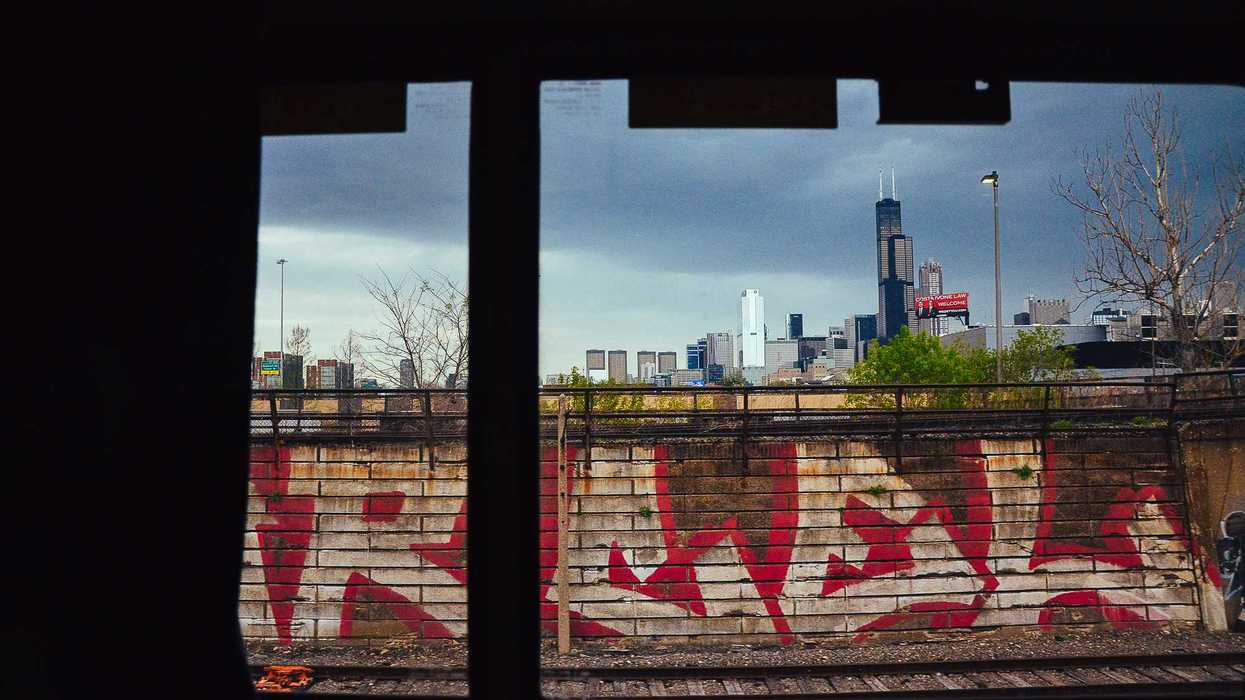
The terrain gets gradually more civilized as the train approaches Chicago. Corn and soybeans as far as the eye can see in Iowa and central Illinois, the occasional farmhouse the only sign of humanity. Then some small towns, each centered around its train station, before reaching the sprawl of suburban Chicago. The buildings get taller, from bungalows to two- and three-story homes, foothills leading up to the mountainous Big Shoulder skyline.
After a few days visiting with my family in Chicago, I fly back to Los Angeles. My flight will be quicker, cheaper, and more efficient than my train travels. I will speak to no one during my flight, the window will be closed, and the trip will be instantly forgettable.