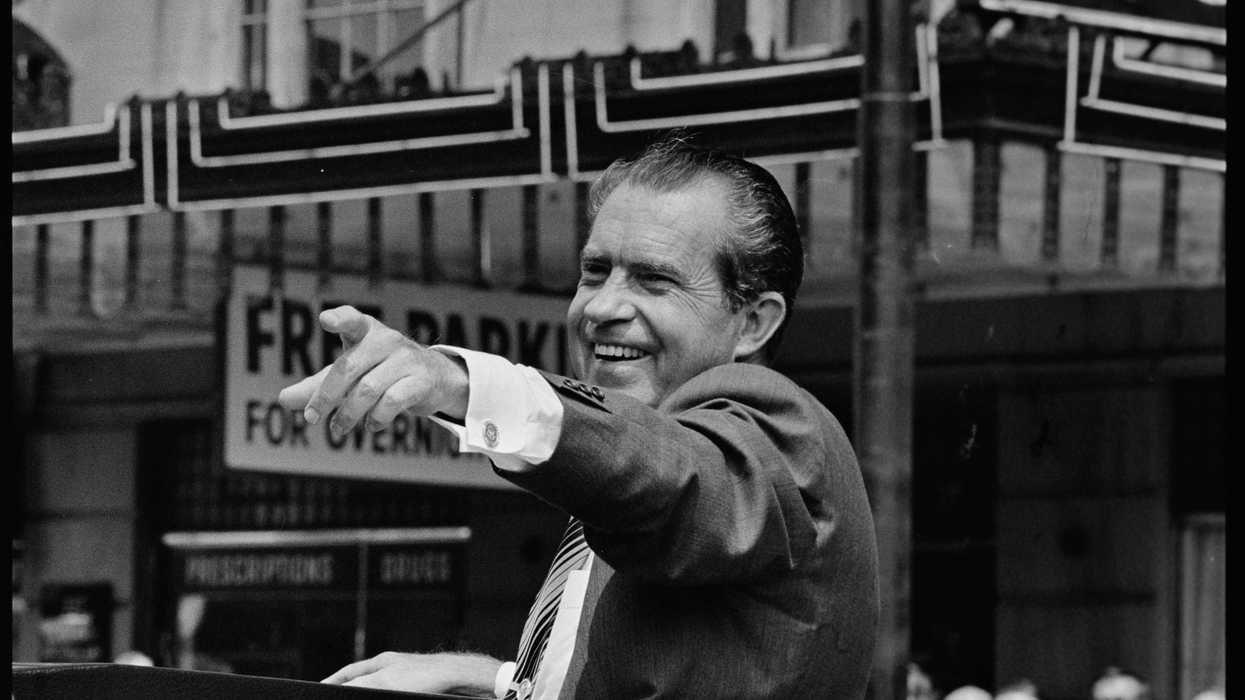
Photos courtesy of the Richard Nixon Foundation
The Watergate hotel is old. Its cement is faded, and the only retail in sight is an old gas station on an awkward corner. The mid-century modernism, once thought glamorous, feels as aged and isolated as the neighborhood itself. Pull into the small circle in front of the luxury hotel, however, and a valet will rush to your door, asking if you’re checking in or just stopping by.
In June 1972, the neighborhood was newly revitalized and prestigious. The Kennedy Center next door had held its first performance just nine months earlier, and the hotel was a hangout for artists, politicians, and celebrities.
In June 2016, after sitting vacant for nearly a decade, the hotel reopened and was finally restored to the glory it held in its eponymous era. Now, the furniture is high-fashion mid-century, the staff wear uniforms created by the costume designer for Mad Men, you can stay in the “Scandal Suite” for a night, and the $22 martini, served “just the way you like it,” is called “The Agent’s Choice.”
You’d have to order yours with gin, only soaking the olives in vermouth, to achieve the dryness of President Richard Nixon’s personal recipe, but as his most famous supporter, Elvis Presley, croons “Suspicious Minds” softly in the background, you can’t help but feel like the “the Old Man” himself is still just a mile down the road.
Nixon is back. And not as a cartoon villain, or some other crude caricature; rather, Nixon the Brilliant Statesman, Nixon the Strategic Architect, Nixon the Wronged, Nixon the Smeared, Nixon the Prophet, and even Nixon the Cool has made his triumphant return to America’s popular imagination.
For half a century in television, cartoons, and movies, wherever President Richard Nixon went, his scowl went with him. Nixon the Crook held such cultural dominance for so long that you’d be forgiven for not knowing he was re-elected in 1972 with nearly 18 million more votes than his opponent—a number not topped before or since. In the final tally, Nixon earned 162% of his rival’s votes—and won every single state save Massachusetts, even taking the Democratic nominee’s home state by nearly nine points. The Electoral College final count was 520 to 17.
Upon reaching the Lincoln Memorial, he talked both eloquently and personally for nearly two hours with the surprised hippy protesters.
Just 21 months later, he was gone, undone by investigative reporter Carl Bernstein and Bob Woodward, a novice reporter who was under the guidance of the second-in-command of the FBI, whom Woodward knew from his days on the staff of Admiral Thomas Moorer, the chief of Naval Operations.
Twenty-one months to subvert the will of the American electorate, using an office break-in that the president had nothing to do with. Nixon was finished and buried beneath the floor of the Church of Watergate, its rose window proclaiming the gospel of the saints who built it over him.
But there are cracks in the cathedral. Log on to Instagram or TikTok and you might see energetically stylized, rapid-fire videos of Nixon smiling, waving, laughing, and joking while dispensing still-poignant thoughts on subjects ranging from Iran and Israel to the liberal media and the Chinese military. Reels put out by the Millennial who runs the Nixon Foundation’s social media accounts garner tens to hundreds of thousands of views.
One edit opens with the iconic Don Draper explaining why he sees himself in the self-made Californian, before rapper Drake’s “National Treasures” plays over clips of the 37th president at his zenith. It’s approaching two million views.
A video posted the very morning I finished this article had drawn 42,000 views, a thousand likes, and over 100 retweets. This one wasn’t flashy. Captioned “Nixon’s critique of the CIA,” it’s simply a close-up of the former president speaking eloquently on the subject.
YouTube shorts of the president’s wisdom have blown up, with subjects as varied as the unchecked power of “the elitist media” (4.9 million views), the impending threat of “new despotism” (4.4 million), what the world might look like if the Russians and Chinese reconnected (3.9 million), Nixon’s first meeting with President Bill Clinton (3.2 million), and the deep unhappiness of a life of leisure (3 million).
While some of the thousands of comments are negative, others write messages like, “There is some Zoomer absolutely cooking at his internship with the Nixon Foundation rn” and “Babe, cancel my appointments. The official Nixon sigma edit just dropped.” Over the past three years, Nixon Foundation social media accounts have amassed 250 million views. The phrase “Nixon Maxxing” has bounced around the internet enough times that his presidential library started selling hats emblazoned with it. Both the original and the restock sold out within hours. At one point, the foundation’s online store even ran out of busts.
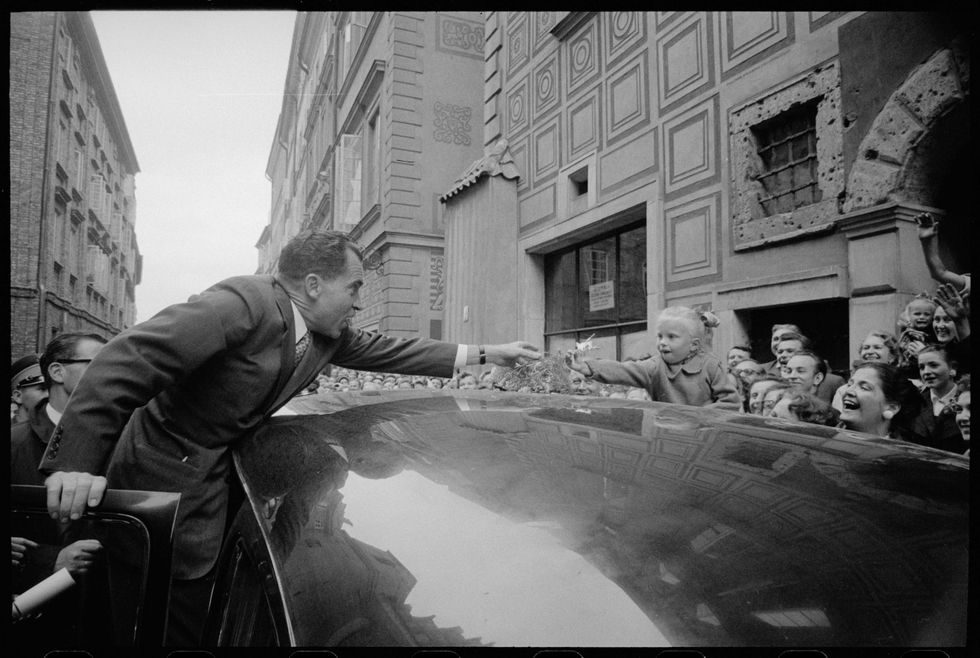 Richard Nixon greets supporters during a European visit, displaying the gift that often escaped his critics: an instinctive ease with ordinary people. Richard Nixon Foundation
“One thing you should know is the most popular president in U.S. history was Richard Nixon,” then-Fox News host Tucker Carlson said at the opening of a January 2023 primetime show:
Yet somehow, without a single vote being cast by a single American voter, Richard Nixon was kicked out of office and replaced by the only unelected president in American history. So we went from the most popular president to a president nobody voted for. ‘Wait a minute,’ you may ask, ‘Why didn’t I know that? Wasn’t Richard Nixon a criminal? Wasn’t he despised by all decent people?’ No! He wasn’t. In fact, if any president could claim to be the people’s choice, it was Richard Nixon.
Nixon’s back, and the reasons are many but include advances in serious scholarship, newly declassified materials, changes in our media landscape, and the demise of the Watergate-keepers; the echoes of deep-state Washington coups come alive—and finally, the durability of the man’s wisdom and his predictions.
“How old are you?” former Nixon White House lawyer Geoff Shepard asks me when I reach him at his home in Pennsylvania. “Almost 40,” I say, confirming his suspicion that I’d been born more than a decade after Watergate.
“Everything you’ve heard,” he responds, “is false.”
Nearly 10 years ago, I was on the train from Washington’s Union Station, sitting across a table from a handsome, older couple. I waited until we were pulling into New York’s Penn Station to introduce myself. The man was William Baribault, president of the Richard Nixon Foundation. He was excited to tell me about the overhaul and modernization he was leading at the library in the hopes of teaching the whole story to a younger generation. He invited me to visit the next time I was in Orange County.
I took Baribault up on that rare invitation a few years later, meeting him and Frank Gannon for lunch at the museum. Gannon, a historian and former special assistant to the president, had been a leader in the museum’s overdue overhaul. They’d finished their renovations by then and believed the time was right for President Richard Nixon’s redemption in history.
They’d already met with a prominent conservative writer and historian, hoping he might be the man to begin telling that story. The writer told them he believed they were right, but it was too soon for the project to succeed. So long as the keepers of the sacred myths of Watergate held sway, the true history would have to wait.
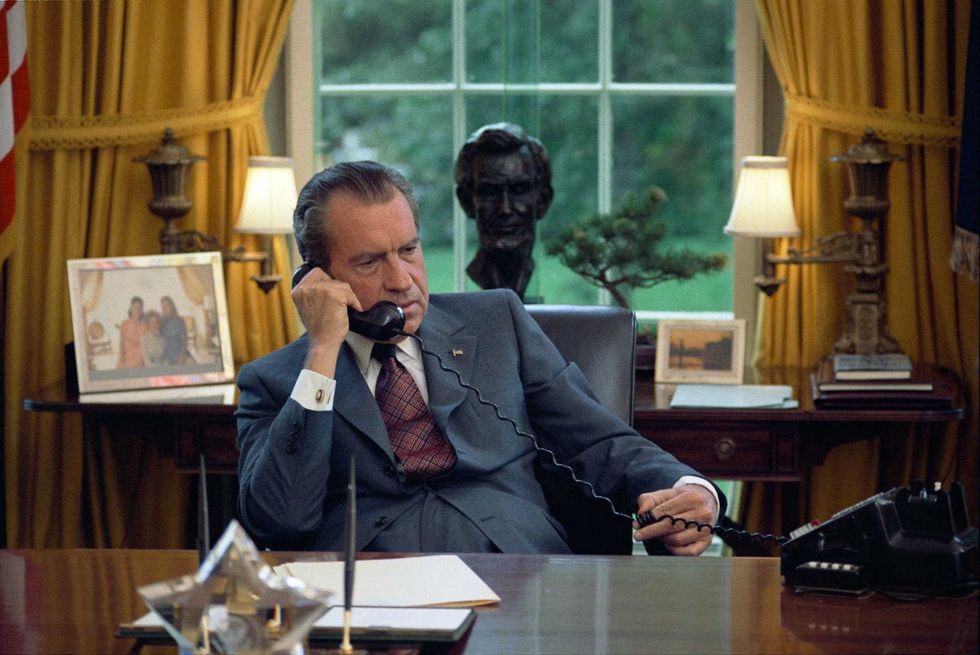 The presidency is often remembered through its scandals. It is lived through its phone calls.Richard Nixon Foundation
The exhibits were beautifully crafted. They didn’t shy from the scandal that brought the immensely popular president down, but they told a fuller story of a man who defined his era in domestic and foreign policy, and continues to inform presidents and thinkers to this day.
After the tour, you can stroll through the manicured gardens around a peaceful, shallow pool on the way to the final resting place of President Nixon and his wife, Pat. They lie under dignified stone markers just a few feet from the humble home he was born in. His father built it from a kit in 1913, planting the pepper tree that still stands beside it. On the other side of the home is a tree Pat grew from a seed of President Andrew Jackson’s White House magnolia. It was a long journey from that California ranch to the capital and back.
“Nixon is from nothing,” Draper declared in the now-viral Mad Men clip. “A self-made man. The Abe Lincoln of California, who was vice president of the United States six years after getting out of the Navy. Kennedy? I see a silver spoon. Nixon? I see myself.”
Walk beyond the little home, and you’ll see the helicopter that famously whisked him away from the city that had cast him out of the office the American people had resoundingly sent him to. You can walk up the ramp and take your picture with hands up in his famous “V for Victory” farewell.
On July 20, 1990, Richard and Pat Nixon stood in that garden courtyard before 50,000 cheering supporters under a warm, sunny sky. Trumpeters in red suits greeted them, as well as the Fords, the Reagans, and President George H.W. Bush and his wife. Thousands of red, white, and blue balloons were let loose, and the Los Angeles Times reports three brass bands played away.
It had been 16 years since the Nixons left Washington, and this day they had joined the largest group of American presidents yet gathered to dedicate the library that would trace his life from humble start to restful finish.
“I believe in the American Dream because I have seen it come true in my own life,” Nixon told the crowd. “You will suffer disappointments in your life and sometimes you will be discouraged. It is sad to lose. But the greatest sadness is to travel through life without knowing either victory or defeat.”
Inside those library walls, he said, “You will see a personal life: the influence of a strong family, of inspirational ministers, of great teachers. You will see a political life, running for Congress, running for Senate, running for president—three times. And you will see also the life of a nation, 77 years of it.”
“Nothing we have ever seen,” he told the thousands, his voice swelling with emotion, “matches this moment—to be welcomed home again so warmly.”
I toured that library in the winter of 2019. Nixon had been gone a quarter century, but he would have recognized much of what was to come. By the following spring, the world would be under lockdown. By summer, the country would be inflamed with violent racial conflict. By the fall, the president would be ousted in an election rife with irregularities and suspicions. The world was entering a storm from which we’ve not yet emerged, and more Americans were willing to look back at a man who’d faced trials and troubles not unlike our own. And they began to question the narrative we’ve all been told.
“There are four terms that we bandy about today we didn’t have then,” Shepard tells me over the phone. “Deep state, fake news, false narrative, and most of all, lawfare.”
“I think that the current time in the affairs of men are to the point where these stories are now out, they should be fully explored,” John Mitchell, Nixon’s attorney general and ‘68 and ‘72 campaign manager testified the year before his boss and friend resigned from office. “I think, however, that great care should be taken to ascertain who was involved and how they were involved, instead of just lumping it into a catchphrase of 'Watergate' or 'cover-up' or things like that. I think it is time that the individual activities be properly parceled out."
It’s been 53 years since he said that. It was true then, but it took a few good men toiling for decades to prove it. Men like Shepard have set about the task with great rigor. His time in the thick of Watergate, and his subsequent years uncovering documents and studying the archives have uncovered, among other things, prosecutors hiding exculpatory evidence and holding secret meetings to install and collaborate with Nixon's trial judge.
Shepard’s review of the tapes, the documents that give them context, and the written recollections of Nixon’s own betrayer, John Dean, blast holes in the so-called “smoking gun” tape, which famously collapsed the president’s support in Congress. In the tape, recorded six days after the arrest of the Watergate burglars, Chief of Staff H.R. Haldeman is heard recommending the CIA ask the FBI to limit its investigation, given the White House’s correct-but-understated understanding that a number of the burglars were tied to the agency.
Two years later, Nixon’s Watergate counsel, Fred Buzhardt Jr., was the second person after the president to listen to the tape. He had not been a member of the White House team when the recording was made, and lacked crucial context for the conversation. His deputy, Shepard himself, was the third to hear it and, playing off his boss’s reaction, was the first to characterize its contents as the “smoking gun.”
The problem was Nixon himself didn’t remember, and Buzhardt was dead wrong. The truth is, Haldeman was relaying a recommendation to the president to protect prominent Democratic donors. In his 2014 book, The Nixon Defense: What He Knew And When He Knew It, Dean admitted that the “smoking gun was shooting blanks.”
“When the conversation was revealed, . . . [Nixon] had long forgotten what was actually involved; they assumed it had the same meaning as everyone else,” he wrote.
In reality, it was only an effort by Haldeman to stop the FBI from investigating an anonymous campaign contribution from Mexico that the Justice Department prosecutors had already agreed was outside the scope of the Watergate investigation. In fact, this conversation did not put the lie to Nixon’s [previous] statements, and had Nixon known that he might have survived its disclosure to fight another day.
That means this conclusion is shared by both the deputy counsel and Dean, who, in an effort to conceal his own corruption, provided the sensational testimony crucial to bringing down his boss. It also means Dean sat on that information for decades without saying a thing.
“It’s very common late in life to get on the right side of history, to anticipate where it might be going,” Dr. Luke Nichter, the James H. Cavanaugh endowed chair in presidential studies at Chapman University and a Griffin Fellow at the Hoover Institution at Stanford University, reflects on Dean’s late in-life change of heart. “These are people very aware of the state of current declassification, and they also have a sense of what’s coming; they were the authors.”
The day he heard the tape, Buzhardt didn’t know any of this. He did, however, know that, in his current understanding, the tape would mean the collapse of support among Southern Democrats, and he conceded he could no longer defend the president. Three days later, Nixon resigned.
“The head lawyers misinterpreted what they thought was the smoking gun,” Shepard explains, “but nobody wants to listen to the tapes! I’ve recovered documents and primary sources that open-and-shut refute the conventional wisdom, but they don't take it into account. They don't say, ‘Oh there's this new stuff.’”
The wilderness can be a place where dissidents’ voices are easily ignored by the high priests, but as the similarly maligned British statesman Enoch Powell once observed, “Voices in the wilderness reverberate more than those in crowded spaces.” And in all mediums—traditional and new media alike—those fighting to correct Nixon’s record have found a large and receptive audience.
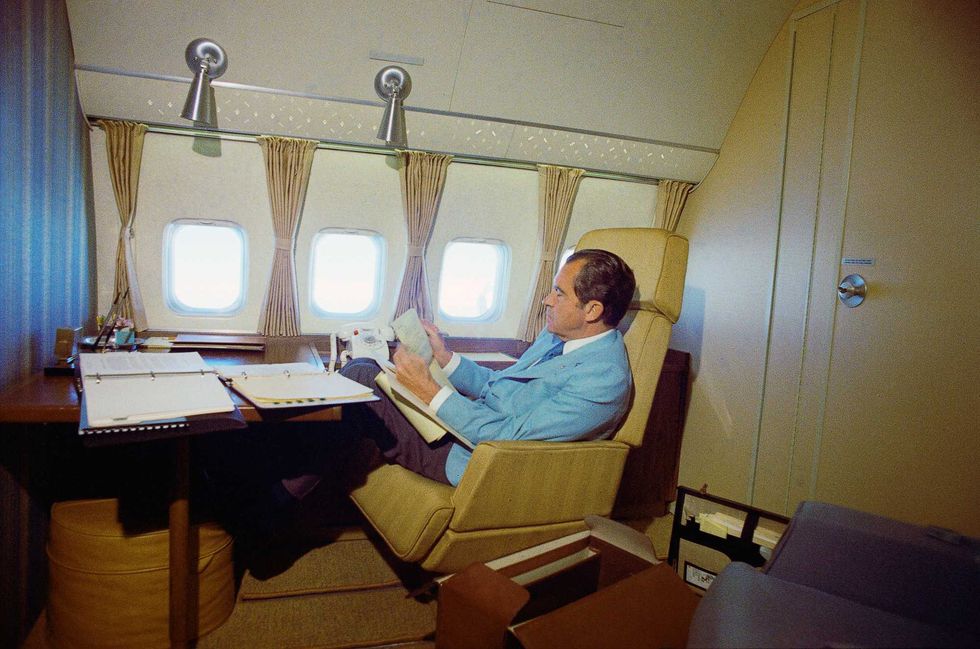 While others saw the glamour of the presidency, Nixon saw the paperwork.Richard Nixon Foundation
The effort “is not just a revisionism, but a justifiable correction of the record,” former Nixon strategist, speech writer, and confidant Ken Khachigian explains on a call from California. “That's not just speculation; it's by documentation, which has been very, very, very important.”
“There are increasingly some people out there taking a fresh look,” he continues, “thanks to Geoff Shepard. He's discovered so much evidence of malfeasance and unethical behavior, not just by the Watergate special prosecutor, but the House Impeachment Committee, and by the Senate Watergate Committee. He's uncovered, extremely substantially, how unfairly many of the investigations were conducted: how one-sided, politically directed, and unethically.”
The administration veterans aren’t alone in their efforts. “Nixon’s presidency was long before I was born, yet we are always learning all kinds of new things,” Nichter tells me. “So I have to keep my mind open— and I encourage others to do the same.”
His research and petitions to the court have added to the trove of new information, including the unsealing of U.S. v. G. Gordon Liddy, the case involving the lead Water gate burglar, which sheds more light on the prosecution's withholding of evidence from the defense as well as the incredibly inappropriate relationship the trial judge had with the prosecutors.
Misdeeds by Judge John Sirica include arranging secret meetings between the judge and the prosecutors to ensure he could appoint himself to the case, discussing trial strategy plans and alternative legal moves, and gaming out how to release grand jury information to House investigators without challenge from the defense.
“What we’re seeing is some of the key people who accused Nixon of impropriety of various kinds were themselves engaged in impropriety in their effort to get Nixon and his people,” Nichter explains.
“Most history books,” he said, “tell the same story over and over again, and if you track down the footnotes, they vanish. Most historians don’t do the work.”
It’s not just the historians, but the media that has changed. Had it not, the buttresses of Watergate would remain unassailed even while cannonballs flew back and forth between the National Archives and Ivory Towers.
“President Nixon used to sit in the Oval Office,” journalist and longtime Nixon researcher James Rosen tells me in a call from his post in the White House press corps, “. . . and pound the desk in the company of his chief of staff, H.R. Haldeman, and say things like, ‘We must build our own establishment, our own business roundtable, our own academia, our own media.’”
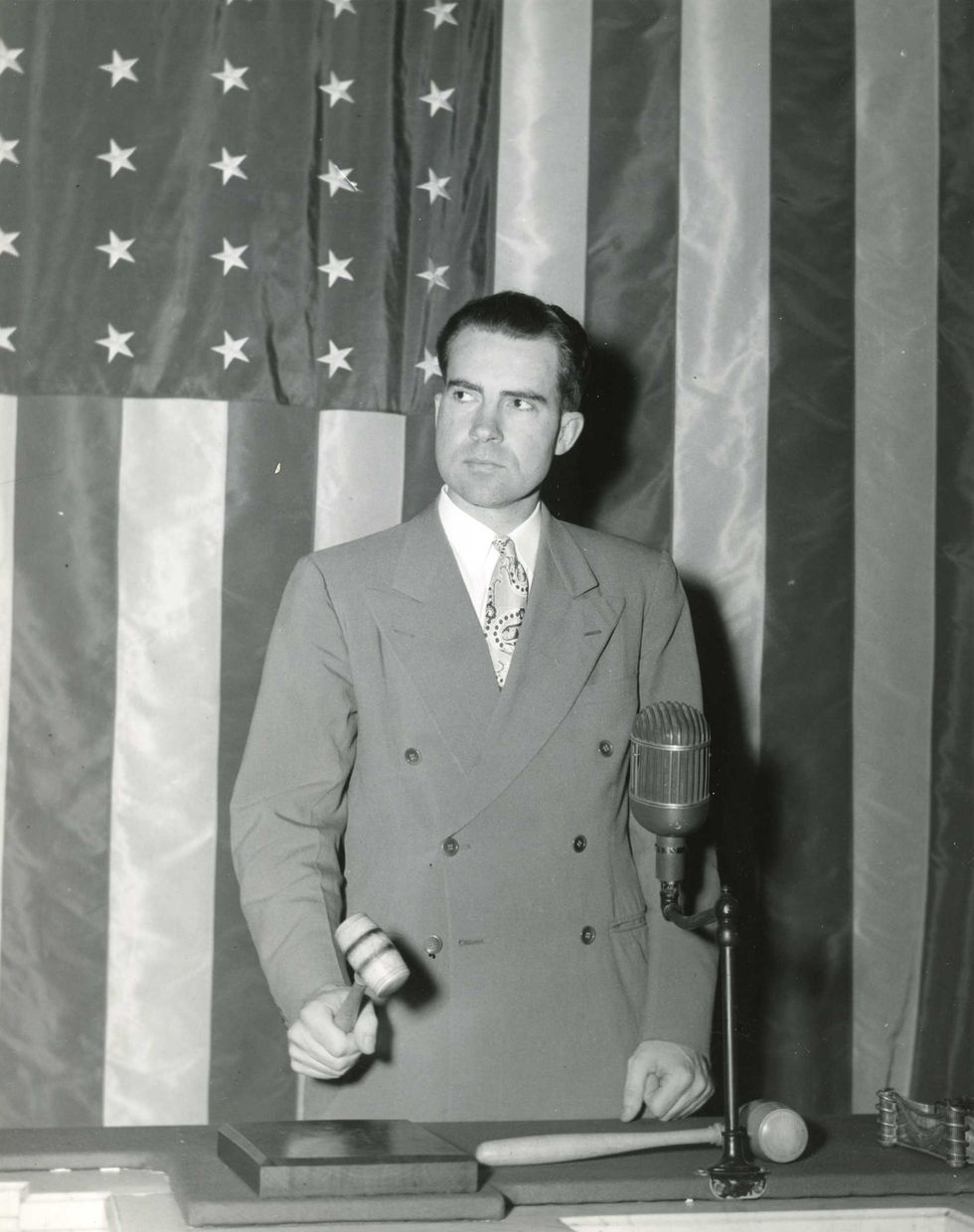 A young Richard Nixon takes the podium.Richard Nixon Foundation
Indeed, President Nixon’s image consultant got the idea for an alternative media channel during his years fighting a deeply anti-Nixon press. His name was Roger Ailes.
“The media system has evolved continuously since the early 1990s when I started publishing on Watergate and President Nixon,” Rosen, a Fox News veteran, tells me, “and there is a direct line from the mistreatment of Richard Nixon in the 1960s through the Watergate scandal to the start of Fox News and the alternative ecosystem.”
The press never expected Nixon to stick around. When he conceded the California governor’s race two years after losing the presidency to his great nemesis, John F. Kennedy, in 1960, he famously promised the gathered reporters, "You won't have Nixon to kick around anymore, because, gentlemen, this is my last press conference."
The American left and their fellow travelers in elite Washington didn’t shed any tears. Nixon was the man who’d exposed their beloved Alger Hiss as the Soviet spy he was. When the man from Whittier first came to Washington, it was by beating Democratic Rep. Jerry Voorhis, who the year prior had been voted as the Washington press corps’ favorite member. Four years later he won a seat in the United States Senate by defeating Helen Gahagan Douglas, a glamorous actress so liberal the Kennedys reportedly worried about her communist influence. Then, from 1953-61, he was the public face of Republican President Dwight Eisenhower’s domestic political operation.
“In its own way, the press hated Nixon for the same reason they hated [President Donald] Trump,” Shepard says. “Nixon said these things, they didn't believe him. He believed in the working man, and he kept winning elections. And he exposed and destroyed Alger Hiss. They never forgave him for that. Hiss was the darling of the liberal establishment.”
“Jack Kennedy derided him and said he was classless and didn't have the sophistication,” Shepard recalls. “But it wasn’t just the Kennedys, it was [ The Washington Post Executive Editor] Ben Bradlee and all the press. They thought Nixon shouldn't even be on the stage with Jack Kennedy. ‘He just lacked class!’”
None of them expected Nixon to last more than a single term. Sen. Ted Kennedy would take the White House back in ‘72, and nature would heal. Then came Chappaquiddick. Then came ‘72. Then finally, mercifully, came Watergate—and they never let go.
Today, Watergate is the creation myth of the Baby Boomer Cathedral. Journalists Bob Woodward and Carl Bernstein wrote the canon, and CBS, NBC, ABC, The New York Times, and The Washington Post defend the faith. Robert Redford and Dustin Hoffman starred in the movie. But those who were there have become aged men who have shown their partisan sides. Their sloppy work, distortions, lies, and embellishments have been painstakingly exposed, and they no longer command the respect they once had.
Those willing to question the tenets of this false religion abound, and their platforms are growing, in part because those things that once seemed so far out—U.S. intelligence and a permanent bureaucracy collaborating with America’s elites and press corps to topple a president—make a lot more sense in 2026.
“Nixon was not a man of the Republican Party,” Center for Renewing America senior fellow, Dr. Nathan Pinkoski, explains over lunch at Butterworth’s, D.C. conservatives’ favorite gathering place.
The claim is difficult to square with a man who was a congressman, senator, vice president, and the party’s presidential nominee three times, but there’s truth in it. Nixon wasn’t part of the Northeast liberal gang, nor was he one of the Western conservatives. His power was more institutionally Republican. When institutional support finally collapsed with the defection of the conservative Southern Democrats, he resigned.
“He didn't have a power base within the Republican Party that was neatly his,” Pinkoski continues, “because he wasn't a [liberal] Rockefeller Republican and he wasn't an [arch-conservative] Goldwater Republican. So his talent was he mobilized support for himself by appeal to the party base, the middle American, the Invisible Man. But that meant in Congress he didn't have a clear basis of support.”
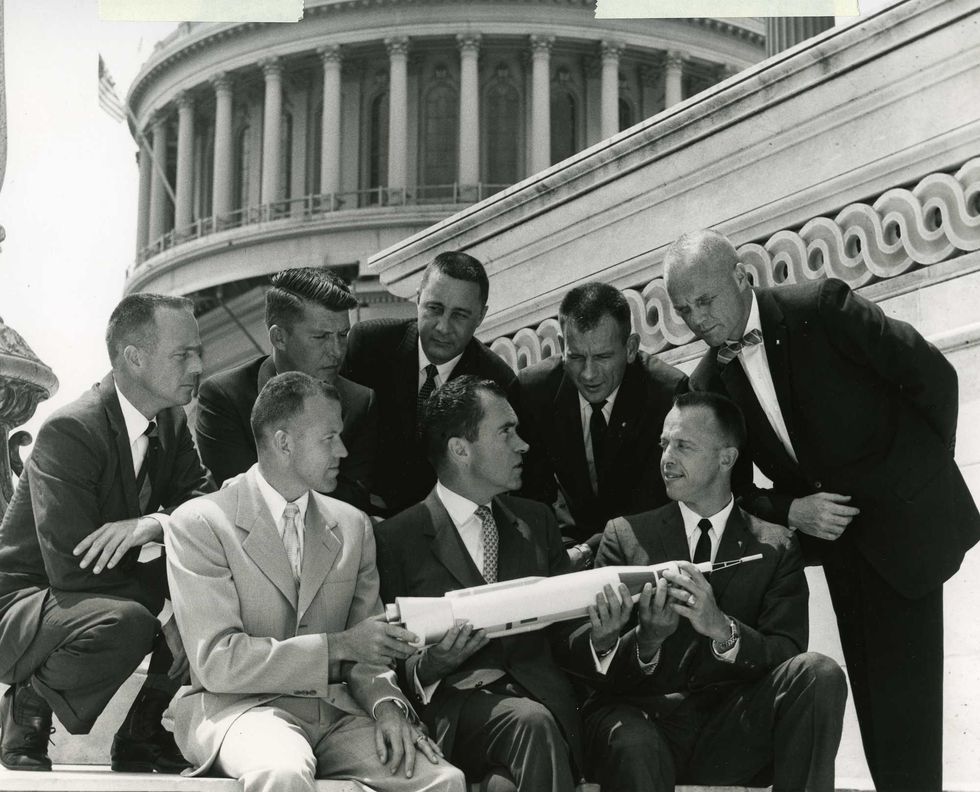 Richard Nixon meets with the astronauts of the Apollo era, when American ambition was measured in Saturn V rockets rather than committee reports.Richard Nixon Foundation
Trump has also been the nominee three times, but despite high-profile Republican defections, he survived impeachment, prosecution, and exile. The difference is a base that is highly engaged, networked, mobilized, and represented. Were it up to the institutional powers of the Grand Old Party, there is little doubt the 45th president would have gone down much the same as the 37th, but by 2020, these powers were either captured or husks of their former selves—and Trump returned triumphant, the 47th president of the United States.
“Nixon’s situation was worse than Trump’s,” Pinkoski explains, “because at least Trump had, from 2017 on, varying degrees of support . . . in a block of congressional representatives who were willing to defend him.”
Nixon’s base support existed, but its power simply “wasn't mobilized in the same way.” When you combine this with elite control of a much smaller media apparatus, the total lack of opposition press, the shared, news-informed experience of the American people, the powers arrayed against President Nixon, and the modern introduction of weaponized legal warfare, it brewed a deadly poison. Or, as Dean termed the coverup he’d created by his own hand, “a cancer on the presidency.”
“Lawfare,” Shepard explains, “is the misuse of law to destroy your political opponent. And that’s Watergate. And people are now willing to consider how maybe Nixon got railroaded, and how Trump is getting railroaded too. Trump is battling back, but Nixon had no money and no backing and nobody on his side to battle back.”
“But the same types of people that are after Trump,” he continues, “were after Nixon, and they are willing to lie, cheat, and steal to prosecute him. And what’s so interesting is they left a paper trail. And all of my work these past 20 years has focused on that paper trail.”
Rosen is among those whose work has shone light on Watergate, including the murky, “entrenched, controlling, and malign” involvement of the Nixon-hating Central Intelligence Agency. On February 8, he published 6,100 words in Sunday’s New York Times, digging into seven pages of the former president’s grand jury testimony, kept sealed for half a century to protect the truth Nixon knew: The military itself had spied on and worked against his presidency. The Times’ publication was a sign of seriously changing times.
“History means the endless rethinking—and reviewing and revisiting—of the past,” reads a quote from historian John Lukacs at the opening of Rosen’s book, The Strong Man: John Mitchell and the Secrets of Watergate. “History, in the broad sense of the word, is revisionist. History involves multiple jeopardy that the law eschews: people and events are retried and retried again."
And over 50 years later, under the gaze of a history shuffling off the mortal coil of partisanship, Nixon’s genius shines from a past age of strife not too unlike our own.
He was a thinking man’s president and surrounded himself with giants. His top three policy advisors were the liberal Harvard professor Daniel Patrick Moynihan, Columbia University President Arthur Burns, who was to Nixon’s right, and the Nelson-Rockefeller-aligned Henry Kissinger.
Clips and cuts bouncing across the internet feature the former president weighing in on foreign trade, military alliances, America’s place in the world, and the chaos of the future. In a clip that went viral just last May, he’s seen on camera, visibly emotional as he remembers the tragedies his mother endured to raise her family. “She will have no books written about her,” he conceded, choking back a tear, “and yet she was a saint."
“He's become a counter cultural figure,” Pinkoski says. “It's a tragic story that resonates well with our time.”
“There's the era; the social and cultural turbulence, the lack of faith and trust that so many Americans have in the institutions,” Nichter posits. “When you're in the eye of the storm, you reach for things that are stable, that are consistent. Serious politicians considered Nixon to be a serious politician. He was a guide through a turbulent era when we ourselves are looking for a guide.”
Shepherd recalls David Gergen, the speechwriter who served under Nixon, Gerald Ford, Ronald Reagan, and Clinton, describing Nixon as the only president he’d worked for who talked in terms of decades. “Most presidents deal with the crisis of the day,” Shepard contends, “Nixon was a student of history, and knew what happened 25 years ago and was thinking about 25 years from now.”
“They see him, they think about him,” Khachigian muses. “Even younger people think of him now as a giant, overarching figure of history.”
How could they not? He was the self-made man and the hated outsider, the strategic mind and the enemy of liberal institutions. He wasn’t glamorous like Kennedy, the son of a billionaire. He was the battle-hardened son of a worker. He saw through the elite pieties—and he paid for it.
He’s a man who resonates deeply with a youth who came of age in the chaos of impeachments, school closures, weekly race riots, and deans and professors telling them to feel ashamed for their patriotism, their sexuality, their skin color, their religion, and their heritage. Nixon, they know, was right about all those people.
In a May 1971 Oval Office tape you can even hear him complain to his aides about the exclusive and elite Bohemian Grove Club as if he is an anonymous poster on Reddit, calling it ”the most faggy god damned thing you could ever imagine.”
“It's just terrible,” he went on. “I mean, I don't even want to shake hands with anybody from San Francisco.”
It’s true, Nixon didn’t tell jokes and stories like Reagan, but those close to both say he was more comfortable in a crowd than his fellow Californian. For example, Nixon once walked onto the National Mall at four in the morning, unable to sleep under the stress of the shootings at Kent State and the bombing campaign in Cambodia. Upon reaching the Lincoln Memorial, he talked both eloquently and personally for nearly two hours with the surprised hippy protesters.
“Nixon always said the worst thing a politician can be is dull,” Khachigian tells me, “and people always saw him as interesting, as fascinating. Even if they didn't like him, they were curious about him.”
They're starting to look past some of the foibles of Watergate, [and see] this is a person who really stood astride a lot of the big issues of the Cold War, the opening of China, the end of the Vietnam War, and determining a lot of the big domestic issues of the day. And if you ask someone if they'd want to have dinner and listen to somebody talk about international politics, who would you want to listen to, Barack Obama or Richard Nixon? It would be like, ‘Do you want to listen to Winston Churchill or Gavin Newsom?’
“Look at what we lost,” Shepard, his old aide, laments. “Look at all these good things he was doing, and we ran him out of office.”
When Nixon left Washington, Khachigian followed him back home to California, where he continued an active life writing books, meeting with world leaders, giving interviews, and serving as an international statesman for the country he once led. “It was hard to be angry at him anymore,” he tells me, “and anyway, he was advising Bill Clinton.
“Even in the worst times he was always looking forward. He said, ‘We'll get past this.’ He didn't live to see what's taking place now, but he did live to see a lot of change . . . I hope it works out. The Old Man deserves a shot in the arm.”
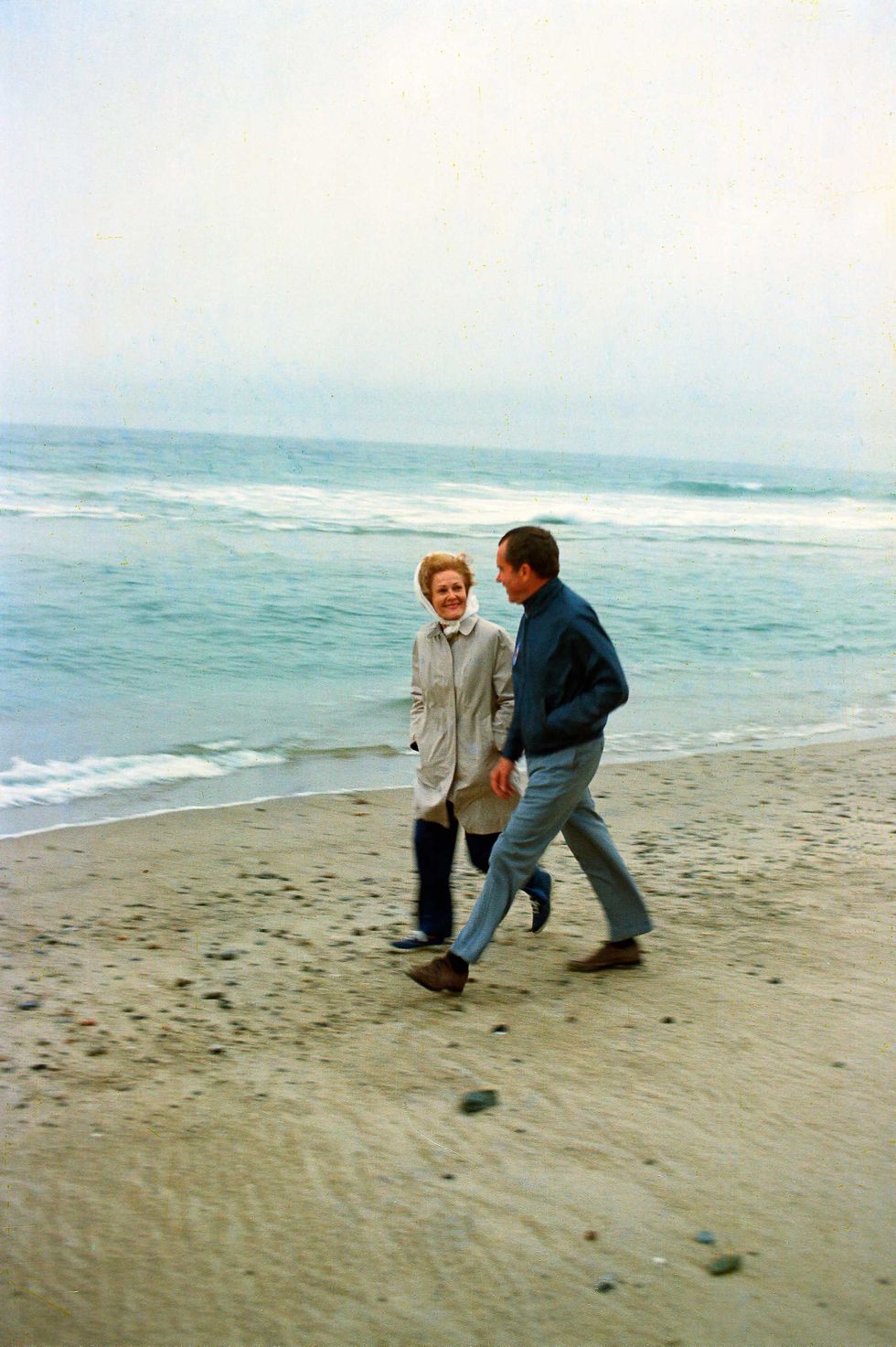 Richard and Pat Nixon walk the California coast, far from the stress of Washington DC.Richard Nixon Foundation
“Subjects pass from politics to history,” Nichter muses. “We have fewer living people who remember the events, so it’s no longer visceral, it's no longer divisive, it's no longer partisan.”
Nixon is back because 50 years on, America has finally become capable of understanding suspicions it once dismissed. The case has been reopened, the young people are at the door, and the stained glass is shaking in the dusty walls. The old legend can’t disperse the crowd. The old story no longer works.
Yes, the Honorable Richard Nixon is back. And whether he is merely retried or finally redeemed, his return tells us as much about our institutions now as it does about his fall those many years ago.