Mike Marshall
Somebody asked me where I learned to write. I had to tell him that I never did learn how to write.
I know how to type, and I’d like to think I know how to tell a story. So I put those two things together and . . . suddenly I’m a writer.
But I don’t like being called a writer.
Why?
I don’t know. I honestly can’t say.
It probably has something to do with my self-critical nature. There’s that voice in my head saying, “It’s not good enough” and “you’re not good enough.”
Sometimes I ignore the voice. But usually not.
Sometimes the voice stops being a voice—and it’s just me. It consumes me.
But other times—when I get touched by the Muse—I can’t help but write.
I get struck by a compulsion to create. And that compulsion drowns everything else out.
So I type. And I tell stories.
I can’t pinpoint when I first noticed it— maybe it was around 2017. It was the era of #MeToo, and the panic around the election of Donald Trump. But I noticed that something was wrong, something was missing.
All great journeys start with this realization. And maybe this was the start of mine.
We all shared the same bad dream of the Woke Era, and we were trying to wake up as a group, wipe the sleep from our eyes, see the world clearly, discuss what had happened and what to do next.
What I noticed—what I missed—was that there was a force in the world dedicated to the obfuscation of truth and the destruction of beauty.
At first, I thought I was crazy. Because no such thing could possibly exist! Right?
(Right?)
But as time went on, it became clear that I wasn’t crazy—that I wasn’t imagining this. I couldn’t just write this off as changing tastes, or my own loss of enchantment with the world as I moved into middle age.
No, something was wrong.
I saw many examples of this destruction of beauty. Here’s one from my professional life.
I’ve been working in the film industry for over 25 years now. At the time of #MeToo, I was a producer. I worked as a line producer (that’s a mid-senior project manager) and sometimes as a creative producer. But often my work straddled both roles.
By 2016, we’d been doing the diversity thing for a while. There was no affirmative action at that time, but the crews were a fairly diverse bunch—it just happened naturally. But for many years, there’d been a mandate for diverse casting. These weren’t strict mandates, but we aimed for casts of something like 30% POCs (people of color), which at the time was about the same ethnic breakdown of the U.S.
The diversity mandate wasn’t hard to meet—because there were plenty of talented and attractive POCs in Hollywood.
The attractiveness was important—or at least I thought it was important—because we weren’t just capturing reality. No, we were creating something. We were giving the audience a “hyper-reality” where things are realer than real.
Think Disneyland or Vegas. Like that. Where everything is perfect and where everyone is attractive. And even the unattractive people are attractive.
Maybe the best analogy is a dream. That’s what we were aiming for. That’s what we were making.
And no, not all dreams are happy. Not all dreams are good—or enjoyable.
Dreams give you something. They give you a vision of what could be—what might be. They give you something to aim for—or something to avoid.
There are stories in dreams. Sometimes they don’t make sense—at least not after the fact. But when you’re in the dream, everything makes sense. Things are perfectly logical. Because dreams have their own logic—and their own language.
It’s a language that’s not too different from cinematic language. But to make cinema work—to make it make sense like a dream makes sense—it helps to have attractive people.
But suddenly we weren’t allowed to cast attractive actors, no matter their skin color.
It wasn’t like a memo went out telling us to cast fat, ugly people. But the tastes of the higher-ups changed. And beautiful people were suddenly not welcome.
It wasn’t just the people, either. The locations, lighting, and cinematography had to be “realistic” and “authentic.”
Now, I want to avoid a long digression into the nature of “reality,” but when we (the directors, writers, and producers) get creative notes from the higher-ups telling us the product needs to be more “real,” it’s the most absurd thing someone could possibly tell us.
Because when it comes to visual media, nothing is real. It’s all fake. It’s all a “work.”
And yes, in a film, there are real actors and real sets and real locations and real props.
But we’re not capturing reality—we’re sculpting it. And we’re creating something else.
René Magritte nailed it in his painting, The Treachery of Images. It’s not a pipe; it’s a painting of a pipe.
And when you’re in a theater watching a Ryan Gosling movie, you’re not watching Ryan Gosling. You’re watching light generated by a digital projector from data off a digital drive, which was assembled by hundreds to thousands of people over the course of several years.
There’s nothing real about it.
But if it’s a good movie—that is, if it’s crafted well enough that you can suspend your disbelief and imagine you really are on a spaceship with Ryan Gosling—then it will feel real.
The movie will feel real, just like your dreams feel real. We call that Movie Magic.
So when a non-creative executive gives a note that something needs to be more “real,” what they’re really saying is it needs to be less polished, and less beautiful, and less aspirational, and less true.
But they didn’t come up with this on their own. These people aren’t that imaginative. These aren’t Big Thinkers.
No, something else was going on. There was a force at play—a force dedicated to the obfuscation of truth and the destruction of beauty.
Talent is rare.
Why can’t every movie be a great movie? Because talent is rare.
There are only so many talented directors. And that talented director needs to be surrounded by talent at all levels—above and below, from the investors who see the genius of the story down to the caterers and the Teamsters. Everybody needs to be good. Everyone needs to be talented enough to support the director’s talent.
The things I create—the things I make—I make as a man.
A funny thing about talented directors: the vast majority are men.
And yeah, there are a few talented female directors—some really great ones, actually. But despite a concerted push to get more women into the director’s chair, there are only a handful with exceptional talent.
But since, say, 2016ish, the talented male directors were pushed out. Partly because their talent wasn’t valued. But mostly because their masculinity wasn’t valued.
Being a man became a detriment.
So men left the industry. In general, they left all creative fields.
The audience noticed. They wanted to watch a movie and escape.
It takes a rare talent who can bounce light off a screen in such a way that you’re hypnotized and mesmerized and absorbed in the story to the point that you forget about your cares and your worries.
But for the past decade, those rare talents haven’t been welcome.
John Ford was one of those rare talents. And he was a man’s man. He was just about as manly as they come.
He started working in Hollywood in 1914. Among other things, he played a klansman in D.W. Griffith’s Birth of a Nation. In 1917, he directed his first short film.
In the 1930s, Ford joined the U.S. Navy Reserve and formed a film unit to create propaganda and training films.
He was called to active service at the start of WWII. By this time, he was in his mid-40s. He took shrapnel to the arm during the Battle of Midway, then he landed in Normandy on D-Day. Among other things, Ford was known for his foul mouth and blunt directing style.
If you want to get a sense of Ford, watch the interview he did with the BBC in 1968. This is not a man who would sit through a sensitivity training seminar—and there’s no way he could succeed as a director in Our Current Year.
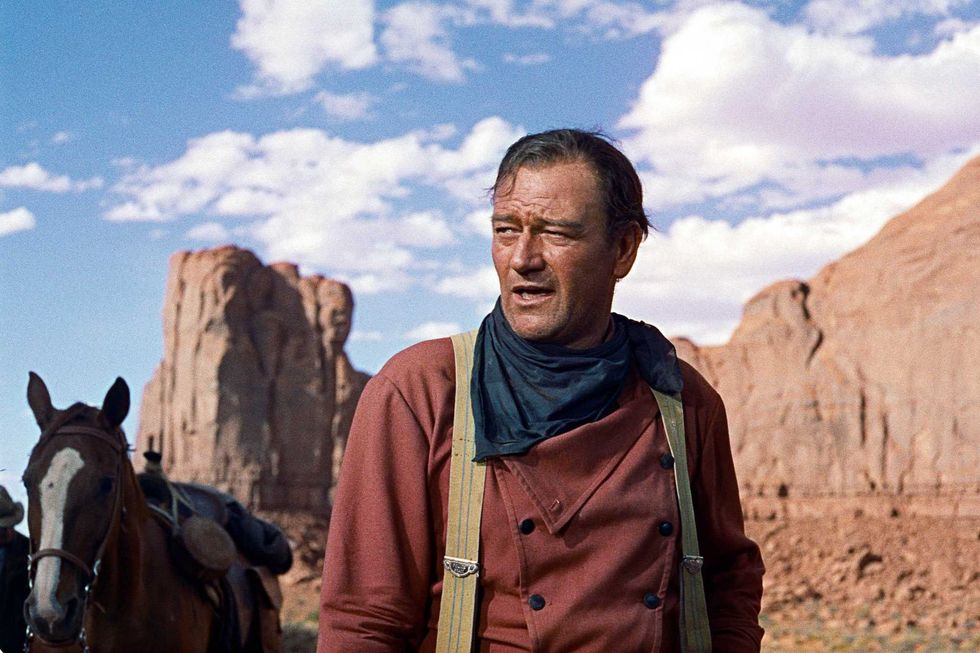 The masculine ideal of art. The Searchers
He’s too brash, too blunt, too discourteous.
Not that he was a bad man, or a bully, or a sex pest. He was just a man—a man who made movies the way he wanted to make them because it was his work, his profession.
Ford says in the BBC interview that, aside from earning a living, he’s not interested in film, which is certainly something I recognize. After a long day at work, the last thing I want to think about is the language of cinema.
Spending my free time watching a movie is a busman’s holiday. I’d rather do something productive with my time—something enjoyable, something I’m actually passion ate about. Like fly fishing.
By the time of his death in 1974, he’d directed over 150 films—and many of them were forgettable. And indeed, a lot of them have been lost to time.
The old cellulose nitrate film stocks— the film Ford would have used early in his career—were notorious for this. Modern film stocks are a bit more stable, but they degrade without proper care. Even with digitized movies, there’s always a risk that the data will be corrupted, accidentally deleted, or maybe (yes, these things happen) someone will lose the hard drive.
It’s a reminder that nothing is permanent—nothing is forever. Men are fragile creatures, and our work—the works of men—the fruits of our labors—the result of our toil—won’t survive. Just like we won’t survive.
Because we’re mortal, and we’re inferior. Our works are inferior to the works of God.
And just as our work will eventually crumble, and no matter our accomplishments and accolades, eventually we’ll be forgotten too.
Ford understood this.
He was a humble man.
I know this because there’s a measure of humility about him. I see it in the interview.
For example, I see it in the way he uses his hand to shield his eyes from the bright interview lights. He knows that will put his face in shadow—he understands lighting and blocking.
But he didn’t care.
Because he was not a vain man.
And I see it when he answers a question about courage. Ford admits that he’s a coward. He tells us his heroism in the war was a result of hiding his cowardice.
This humility is present in his (arguably) greatest work, The Searchers. Set among the towering landscape of Monument Valley, whose rock spires—the timeless works of God—tower above the story about the petty cares of the people below.
Ford didn’t see himself as some sort of luminary. To my knowledge, he never referred to himself as an “artist.”
He didn’t only make good movies. Some of them were terrible.
He knew this.
He was aware of this.
Because men have limitations.
He was just a guy with a job to do. He liked the job—in the interview, he says it’s easy—but it was still a job. In other words, he was a professional.
But underneath the professionalism, I suspect there was a compulsion.
There was that compulsion to create. That an idea would enter his mind, and he couldn’t rest until he made it into something real—something he could share with the world.
He’d go to any length to do it. And he wouldn’t stop until it was done.
This compulsion is a masculine impulse. That’s not to say it’s limited to men. But the impulse, the compulsion, the obsession— that comes from the masculine.
For the most part, the compulsion to create lives in the domain of talented men.
We still make that type of man. But that type of man isn’t allowed to make movies.
Then again, that type of man isn’t allowed to make much of anything these days.
Resentment is the tell.
So many men—so many creative guys— they’re bitter. They seethe with vehemence and quiet rage.
They’re still mad about what happened. And sometimes rightfully so. They were kept out—or pushed out—or sometimes straight up canceled.
They can’t get past it—they can’t get over it—and that’s what holds them back.
Most of these guys aren’t good enough. They don’t have the talent (because talent is rare).
But some of them are good enough. They have the talent. And they have that com pulsion to create. They have things inside them. Things they need to get out. Things they need to make real and to share.
But they can’t do it themselves.
They need support.
They need patrons.
But sadly, they’re not going to get them. A lot of these guys (myself included) congregated around something called the online right, a collection of social media posters and commentators on X and Substack.
Are there artists with right-wing/ conservative political views? Yes, of course there are. It’s true now just as it’s been true historically. But the good ones—the ones with talent—don’t create political art. They communicate truth, even when their beliefs and experience inform it.
I was attracted by the ideas—new, bold ideas. I thought I’d found solutions to the problems of this upside down, fucked up world. It was a way to fix things. To make things work again.
We all shared the same bad dream of the Woke Era, and we were trying to wake up as a group, wipe the sleep from our eyes, see the world clearly, discuss what had happened and what to do next.
The online right was also a vehicle for free expression. You could say anything and everything.
And I did just that. I would write. Just typing, really. Typing and telling stories—about my past and my life and my work.
I guess people liked what I wrote because I gained a following. And then a book deal. And then a larger following. And now I’m being asked to write for magazines.
There’s an idea floating around in this space. The gist of it is that the right can somehow create its own right wing art as a counterweight to the cultural dominance of the left.
But the idea of right wing art is absurd.
There’s art, and there’s political propaganda. Sometimes propaganda can become art—but only by accident.
Yes, you can infuse film, music, books, art, or anything you want with politics. But it won’t be accepted by the public. It will be accepted just as well as the feminized, woke culture of the past decade has been accepted.
Are there artists with right-wing/conservative political views? Yes, of course there are. It’s true now just as it’s been true historically. But the good ones—the ones with talent—don’t create political art. They communicate truth, even when their beliefs and experience inform it.
The biggest problem I see with right wing art is this: it can only exist in opposition to wokeism and leftism. As such, it will never transcend. And it will never be great art.
Anything created in opposition invariably carries a tinge of resentment.
Resentment is poison.
It corrupts the soul.
And it kills everything it touches.
That resentful undertone is repulsive to most people. They intuitively want nothing to do with it. And they’ll stay away from your resentful art—your “reality”. That’s not what they want in their life. That’s not what they need. They need transcendence, but disgruntled people get stuck in resentment.
So, because of the animus and opposition, the right can’t make art that elevates and exalts and surpasses and transcends. It can only make mere propaganda.
Potential patrons see this. There’s no way they’ll fund anything like it. And nothing—at least nothing at a large scale, like a movie—gets made without patrons.
Frankly, the right wing art discussion is silly. One, because nobody talks about this in the real world—it’s a discussion limited to online spaces. But also because in our hyper-politicized media—especially in social media—“the right” is conflated with masculinity.
Maybe they don’t want Right Wing Art. Perhaps they just want masculine art.
And we know how to make masculine art. Most art throughout the ages was masculine art.
Because men have always created, that’s what men do.
Women give birth to the world, but men build it. They always have, and they always will.
So if you want to change culture, put your hatred and resentment aside and embrace the masculine.
Create. Build. Listen to the Muse, become inspired, and surrender to the compulsion.
Even when it’s uncomfortable. Even when you don’t like it. Even when that critical voice tells you to stop.
Just embrace it.
The things I create—the things I make—I make as a man.
Because that’s who I am.
Because that’s the only way I know how to travel through this world.
And that’s the only way I know how to express myself.
So that’s why I type and tell stories.
Because I have to.