Photos: Anna Moneymaker/Getty Images (left); Alex Wong/Getty Images (right)
The U.S. Supreme Court issued a hugely consequential 6-3 ruling in Louisiana v. Callais last week, striking down the Bayou State's controversial 2024 congressional map as an unconstitutional racial gerrymander and providing some much-needed clarity on "whether compliance with the Voting Rights Act can indeed provide a compelling reason for race-based districting."
Democrats and other liberals — including Justice Elena Kagan — condemned the ruling, construing it as a gutting of the Voting Rights Act of 1965 and a setback for racial minority representation in American politics.
Less than a week after its monumental ruling, the high court gave critics another reason to rend their garments.
'The dissent's rhetoric ... lacks restraint.'
While it customarily waits 32 days after a ruling to issue its judgment, the Supreme Court on Monday granted Louisiana Republicans' request to fast-track the process and immediately finalize its opinion in the case, thereby enabling the Bayou State to draw a new congressional map favoring the GOP in time for the 2026 midterm elections.
The court noted in its unsigned order that the usual 32-day delay ordinarily affords the "losing party time to file a petition for rehearing"; however, in this case, the defenders of the unconstitutional gerrymander "have not expressed any intent to ask this Court to reconsider its judgment."
RELATED: Obama, Mamdani, other Democrats throw ugly tantrums after SCOTUS strikes racial gerrymander
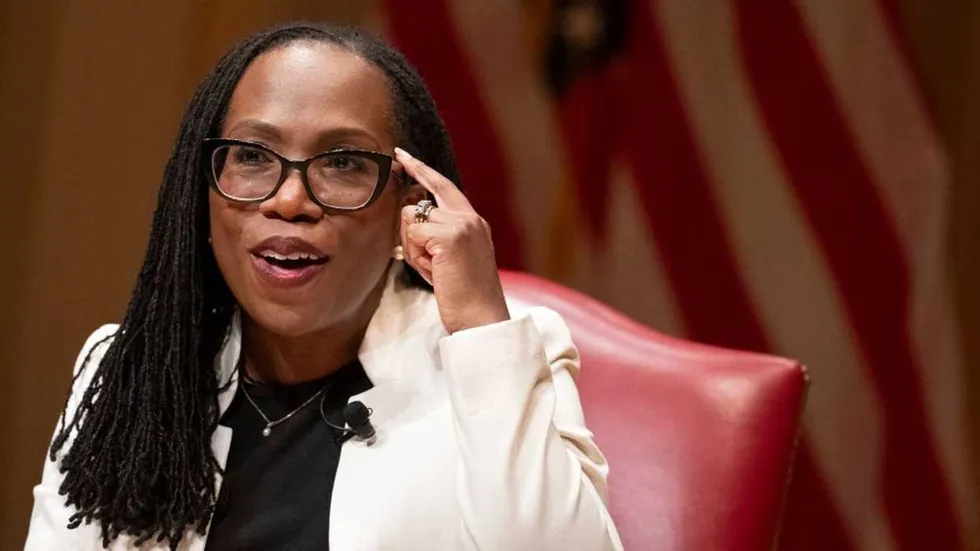 U.S. Supreme Court Justice Ketanji Brown Jackson. JACQUELYN MARTIN/POOL/AFP/Getty Images
Absent that expression of intent or any opposition from Louisiana, the court allowed its ruling to go into effect immediately, prompting Justice Ketanji Brown Jackson to lash out at her colleagues in an unhinged four-page dissent.
"The Court's decision in these cases has spawned chaos in the State of Louisiana," Jackson said in her opening salvo.
After criticizing Louisiana's eagerness to ditch its unlawful congressional map in the wake of the Callais ruling, Jackson said that "to avoid the appearance of partiality here, we could, as per usual, opt to stay on the sidelines and take no position by applying our default procedures. But, today, the Court chooses the opposite."
Jackson said further that the court's expedited certification of the ruling "is tantamount to an approval of Louisiana's rush to pause the ongoing election in order to pass a new map" and represents an abandonment of constraints and principles that is "unwarranted and unwise."
Evidently it was Justice Samuel Alito's turn to dunk on Jackson over the latest in her series of trademark screeds.
Alito underscored in an opinion joined by Justices Clarence Thomas and Neil Gorsuch that the charges leveled in Jackson's dissent "cannot go unanswered."
The conservative justice pointed out that if Jackson had her way, the 2026 congressional elections in Louisiana would be "held under a map that has been held to be unconstitutional" and that the Biden-nominated justice had failed to make the case for why it is somehow now too late for Louisiana to adopt a new, constitutionally compliant map and "not feasible for the elections to be held under such a map."
In response to the two reasons Jackson did provide for dooming Louisiana to use an unconstitutional map in the midterm elections — first, that the court should observe the customary 32-day delay, and second, that the court should do so to avoid the appearance of bias — Alito wrote that "one is trivial at best, and the other is baseless and insulting."
Turning on its head the assertion by Jackson that an expedited ruling-certification process screams bias, Alito noted that the Biden-nominated justice failed to explain why "unthinking compliance" with the custom "does not create the appearance of partiality (by running out the clock) on behalf of those who may find it politically advantageous to have the election occur under the unconstitutional map."
Alito called Jackson's claim that the decision represents an unprincipled use of power "a groundless and utterly irresponsible charge."
The conservative justice concluded, "The dissent accuses the Court of 'unshackl[ing]' itself from 'constraints.' It is the dissent's rhetoric that lacks restraint."
Like Blaze News? Bypass the censors, sign up for our newsletters, and get stories like this direct to your inbox. Sign up here!