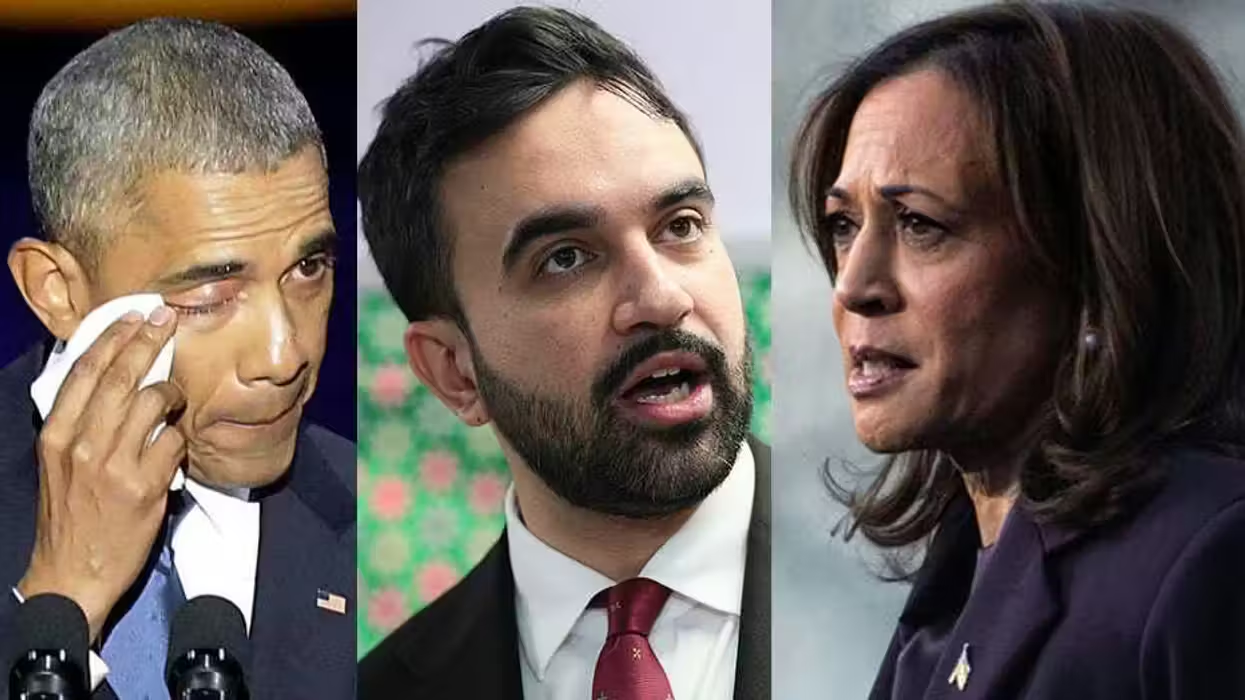
L-R: JOSHUA LOTT/AFP/Getty Images; Michael M. Santiago/Getty Images; Tom Williams/CQ-Roll Call Inc./Getty Images
Former President Barack Obama is among the many liberals who had conniptions Wednesday over the U.S. Supreme Court's rejection of an unconstitutional racial gerrymander in Louisiana.
While such critics have largely spun the ruling as a setback for racial minority representation in American politics, it appears they are chiefly concerned with how the ruling might affect Democrats politically in the the midterm elections and beyond.
Louisiana adopted a new congressional map in the wake of the 2020 consensus, which then-House Speaker Pro Tempore Tanner Magee (R) claimed honored "traditional boundaries."
'This is one of the most consequential and devastating rulings issued by the Supreme Court in the 21st century.'
Dissatisfied that only one of the Bayou State's six congressional districts had a black majority, a group of black voters sued the state, alleging that the new 2022 congressional map diluted black voting strength in violation of the Voting Rights Act of 1965.
A federal judge appointed by Democrat former President Barack Obama ruled that the map likely violated the VRA and ordered the Louisiana legislature to add a second majority-black district.
Pursuant to this ruling, which was upheld by the U.S. Court of Appeals for the Fifth Circuit, Louisiana created a map with a second majority-black district — this time prompting a legal challenge by "non-African American" voters who recognized the new map both as a racial gerrymander and a violation of the Equal Protection Clause of the 14th Amendment.
Their case, Louisiana v. Callais, ultimately made its way to the U.S. Supreme Court, which ruled on Wednesday that "because the Voting Rights Act did not require Louisiana to create an additional majority-minority district, no compelling interest justified the State's use of race in creating SB8, and that map is an unconstitutional racial gerrymander."
RELATED: 'Trump is racist' arguments seem to fall on deaf ears at SCOTUS TPS hearing about Haiti and Syria
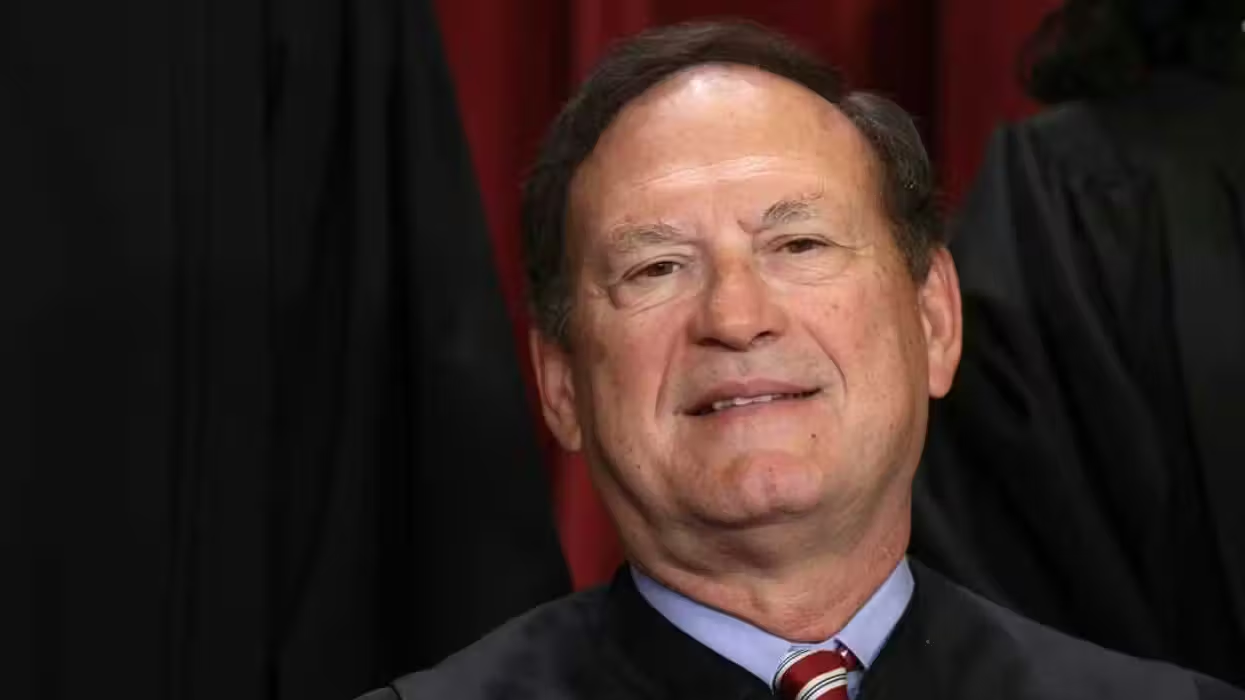 Alex Wong/Getty Images
Beyond striking down the racial gerrymander in its 6-3 decision, the court provided some much-needed clarity on "whether compliance with the Voting Rights Act can indeed provide a compelling reason for race-based districting."
Justice Samuel Alito noted in the opinion for the court, for example, that "interpreting §2 of the Voting Rights Act to outlaw a map solely because it fails to provide a sufficient number of majority-minority districts would create a right that the Amendment does not protect. And such an interpretation would run headlong into the Act’s express disclaimer against racial proportionality."
Alito noted further that "§2 imposes liability only when the evidence supports a strong inference that the State intentionally drew its districts to afford minority voters less opportunity because of their race."
Although the court's clarifications appear aimed at providing states with guidance on how to comply with Section 2 of the VRA without unduly discriminating on the basis of race and violating the U.S. Constitution, Justice Elena Kagan alerted fellow travelers in her dissent — which was joined by Justices Sonia Sotomayor and Ketanji Brown Jackson — that the ruling will supposedly impact "racial equality in electoral opportunity."
"The consequences are likely to be far-reaching and grave. Today’s decision renders Section 2 all but a dead letter," wrote Kagan.
"If other States follow Louisiana’s lead, the minority citizens residing there will no longer have an equal opportunity to elect candidates of their choice. And minority representation in government institutions will sharply decline."
Alito found Kagan's dissent to be "unabashedly at war with key precedents."
Obama, a champion of Virginia's recent legally dubious gerrymander whose appointee's decision in 2022 unwittingly set the stage for the SCOTUS ruling, complained on social media, "Today's Supreme Court decision effectively guts a key pillar of the Voting Rights Act, freeing state legislatures to gerrymander legislative districts to systematically dilute and weaken the voting power of racial minorities — so long as they do it under the guise of 'partisanship' rather than explicit 'racial bias.'"
Obama accused the Supreme Court's conservative majority of "abandoning its vital role in ensuring equal participation in our democracy and protecting the rights of minority groups against majority overreach" and hinted that the decision could affect the upcoming midterms.
He added that "such setbacks can be overcome" but only if "citizens across the country who cherish our democratic ideals continue to mobilize and vote in record numbers."
Twice-failed Democrat presidential candidate Kamala Harris similarly bemoaned the Supreme Court's ruling, calling it "an outrage" that "turns back the clock on the foundational promise of equality and fairness in our election systems" and that is "part of an agenda that conservatives set in place decades ago to steal power from everyday people."
'This will embolden lawmakers in former slave-holding states.'
Like Obama, Harris expressed concern about the midterm elections and the possibility that red states will "rush to redraw districts" before voting begins.
Democratic socialist Mayor Zohran Mamdani of New York City also threw a fit online, calling the decision a "direct assault on the promise of the Voting Rights Act" that threatens to disenfranchise "millions of Americans along racial lines."
Rep. Yvette Clarke of New York, a Democrat who said in 2021 that her district needs to bring in migrants to increase the population in time for redistricting, claimed in a joint statement with other members of the Congressional Black Caucus that "with the stroke of a pen, this rogue, unaccountable Court has effectively signed the death certificate of the Voting Rights Act, undoing decades of Black progress."
"Not since Jim Crow have we seen this level of systematic disenfranchisement of Black voters," said the joint statement.
Failed Democrat gubernatorial candidate Stacey Abrams — the founder of a voter turnout group slapped last year with what the Georgia State Ethics commission said was the largest fine it has ever imposed — said in an alarmist op-ed for MS NOW that the ruling was a "direct hit" to the "fragile promise that every American's vote should carry equal weight."
"This is one of the most consequential and devastating rulings issued by the Supreme Court in the 21st century," whined NAACP general counsel Kristen Clarke.
"This will embolden lawmakers in former slave-holding states to target and eradicate districts that have provided Black Americans a fair opportunity to elect candidates of choice, and they will do so with the blessing of this Court."
Alanah Odoms, executive director of the ACLU of Louisiana, characterized the 6-3 decision as "cruel" and a "significant setback for our multiracial democracy."
Rep. Cleo Fields, a Louisiana Democrat who benefited from the Bayou State's racially gerrymandered map struck down by the Supreme Court, condemned the ruling and suggested that while Louisiana now has the authority to adopt a new map, "redrawing maps at this stage would not be prudent."
Like Blaze News? Bypass the censors, sign up for our newsletters, and get stories like this direct to your inbox. Sign up here!