Courtesy of Twinkle Don't Blink
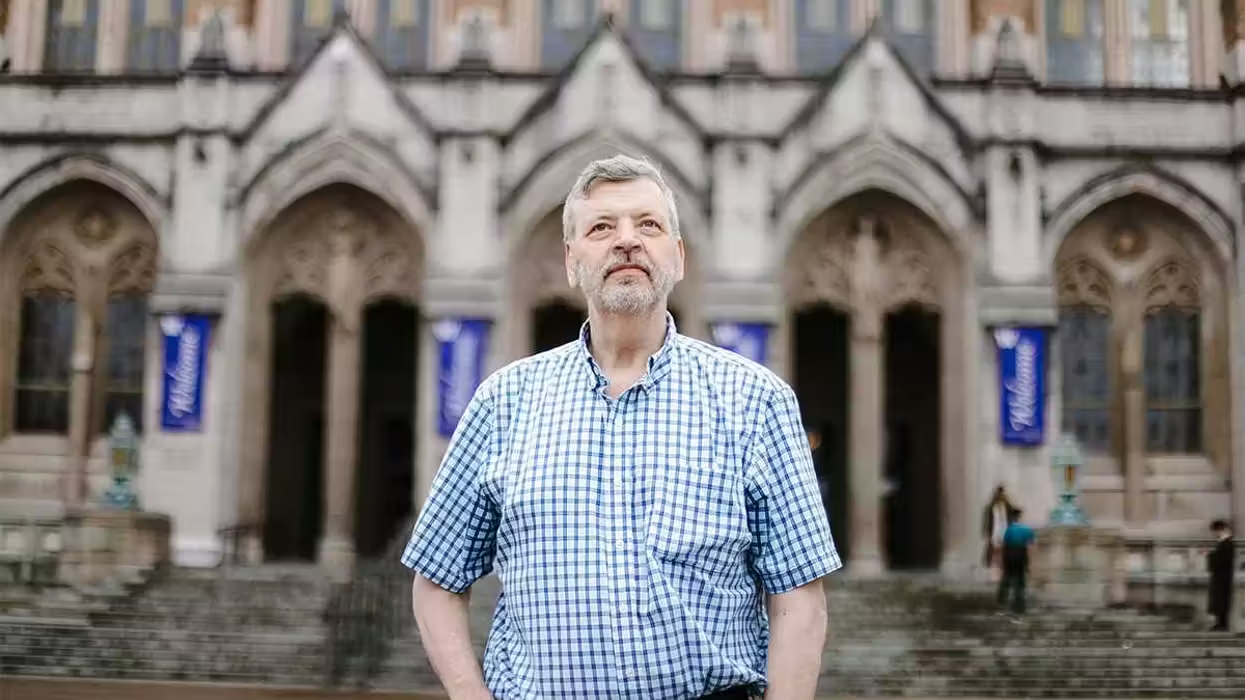
A professor at the University of Washington was punished for having the audacity to poke fun at the school's moral exhibitionism. Stuart Reges, a professor at UW's Paul G. Allen School of Computer Science and Engineering, fought back and, on Friday, secured a decisive victory.
Reges ruffled feathers at the university where he has worked for decades by including a parodic land acknowledgment in his 2022 course syllabus.
'The Coast Salish people can claim historical ownership of almost none of the land.'
According to the Foundation for Individual Rights and Expression, the outfit that represented Reges, the university recommended in its "best practices" guide that instructors incorporate an "Indigenous Land Acknowledgment" in their course syllabi, providing the following as an example statement: "The University of Washington acknowledges the Coast Salish peoples of this land, the land which touches the shared waters of all tribes and bands within the Suquamish, Tulalip, and Muckleshoot nations."
In a December 2021 faculty email thread, one of Reges' colleagues referred to an article that characterized land acknowledgments as "moral onanism." Reges said in response that he was uncertain about the value of making such statements and noted that he might include a mock statement in his syllabus.
Sure enough, the professor included the following land acknowledgment on the syllabus of his winter 2022 computer science course: "I acknowledge that by the labor theory of property the Coast Salish people can claim historical ownership of almost none of the land currently occupied by the University of Washington."
Administrators at UW's Paul G. Allen School of Computer Science and Engineering punished Stuart Reges over his failure to conform, which they claimed had caused a "disruption to instruction" but had in reality enraged only ideologically delicate members of the faculty and the school's DEI student committee.
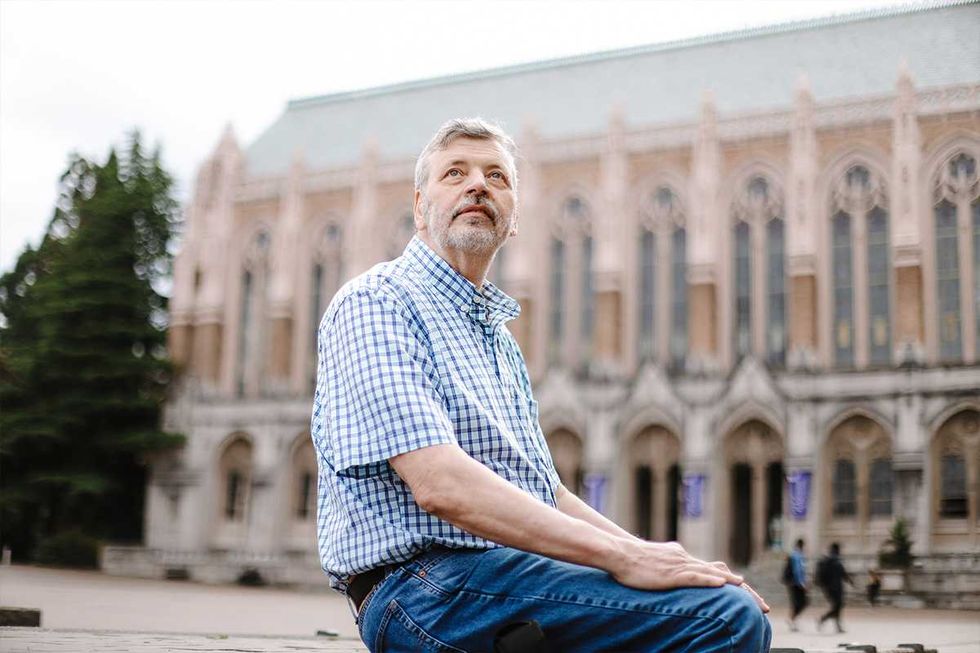 Stuart Reges. Courtesy of Twinkle Don't Blink
The director of UW's computer science department, Magdalena Balazinska, ordered Reges to remove the statement because it was supposedly "offensive" and generated a "toxic environment."
According to court documents, when Reges refused to remove his dissenting statement, Balazinska unilaterally removed it, then apologized to Reges' students, detailing ways that they could file complaints against their professor.
'Land acknowledgments are performative acts of conformity that should be resisted.'
In addition to inviting students to switch out of Reges' computer programming course and into a "shadow" class section taught by a different professor, university administrators launched a years-long disciplinary investigation into Reges.
In July 2022, Reges sued Balazinska, then-UW President Ana Mari Cauce, and other school officials, accusing them of violating his First Amendment rights.
"University administrators turned me into a pariah on campus because I included a land acknowledgment that wasn’t sufficiently progressive for them," Reges said at the time. "Land acknowledgments are performative acts of conformity that should be resisted, even if it lands you in court."
U.S. District Court Judge John Chun, an appointee of former President Joe Biden, dismissed Reges' lawsuit last year, claiming that "the disruption caused by Plaintiff's speech rendered it unprotected."
Reges appealed and found a court that viewed his case differently.
In a 2-1 decision on Friday, a Ninth Circuit Court of Appeals panel disagreed with and reversed the Biden judge's ruling, remanding the case for further proceedings.
Circuit Judge Daniel Bress, writing for the majority, noted, "Debate and disagreement are hallmarks of higher education. Student discomfort with a professor's views can prompt discussion and disapproval. But this discomfort is not grounds for the university retaliating against the professor. We hold that the university's actions toward the professor violated his First Amendment rights."
Bress, an appointee of President Donald Trump, highlighted the long-standing debate over the value, factual basis, and political nature of land acknowledgments as well as Reges' sense that they are part of "an agenda of 'diversity, equity, and inclusion' that treats some groups of students as more deserving of recognition and welcome than others on account of their race or other immutable characteristic."
While acknowledging the right of members of the UW community to speak out against Reges and his views, Bress stressed that "Reges has rights too. And here, we conclude that UW violated the First Amendment in taking adverse action against Reges based on his views on a matter of public concern."
Will Creeley, the legal director of FIRE, said that the ruling "recognizes that sometimes, 'exposure to views that distress and offend is a form of education unto itself.'"
"If you graduate from college without once being offended, you should ask for your money back," added Creeley.
Like Blaze News? Bypass the censors, sign up for our newsletters, and get stories like this direct to your inbox. Sign up here!