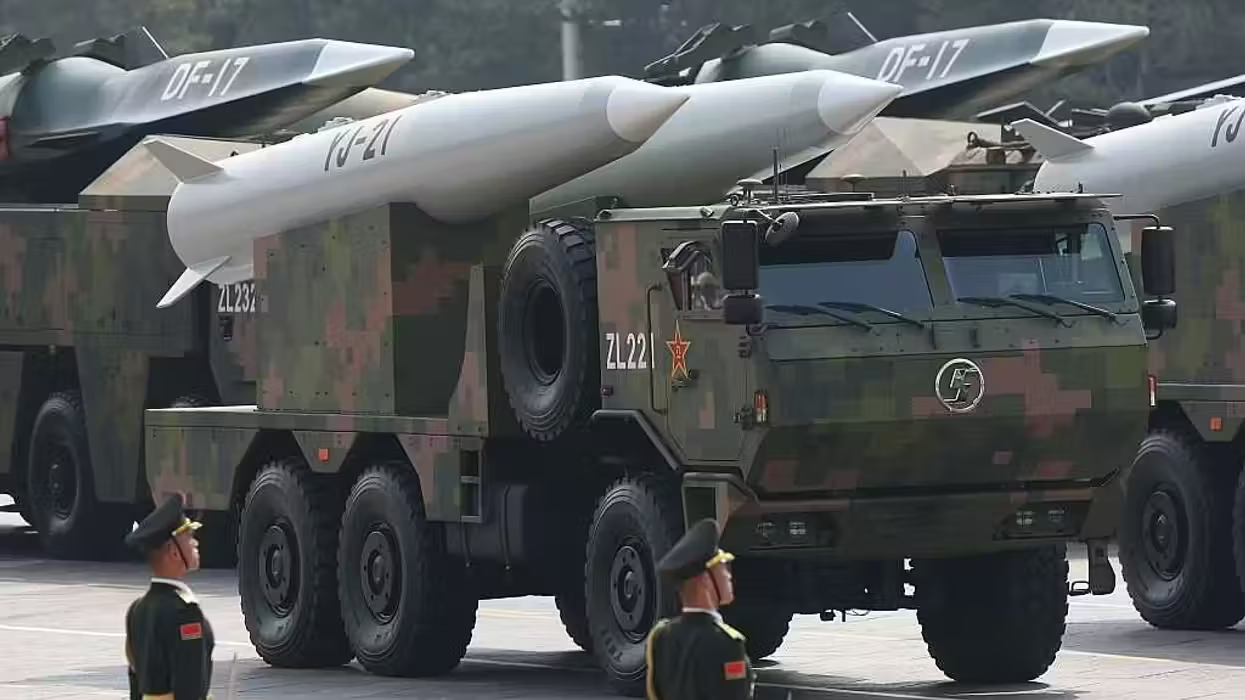
Photo by Pan Yulong/Xinhua via Getty Images
Castelion, a California-based defense manufacturing startup, has been tapped by the Pentagon to produce hypersonic missiles, and the company is promising lightning-fast delivery at costs much reduced from what Americans have grown to expect. The Blackbeard missile, which is said to far exceed enemy capabilities, will be scaled and brought to market using streamlined techniques borrowed from SpaceX methodology.
The company’s chief executive, operations, and financial officers are all former SpaceX employees now working to fill the market for a missile system to cover gaps in the current European geopolitical defense situation.
Elon's manufacturing innovations are set to fast-track the next epoch of tech war.
Insiders are calling this the post-Oreshnik era, referring to Moscow's recently showcased, devastatingly new and improved hypersonic missile. The Russian missile tech instantly changed the coercion/deterrence calculus. European options are dwindling. NATO is at odds with the Trump administration.
Going forward, we’re in a era when, once again, as in the Cold War years, military technological advancement on the part of the major geopolitical oppositional players (Russia, China, and friends) necessitates bold reallocation of funds and brainpower. It’s the same race with new technologies.
Missiles are much faster. Cheap mass production of highly effective, small suicide-style drones reshapes every battle space. Bioweapons — illegal, insane, and otherwise — continue to haunt the future. Meanwhile, the whole of the defense contractor sector is being rejiggered. War Secretary Pete Hegseth just last week ordered a revamp of SBA 8(a) contracts; commonly associated with old DEI practices, they're said to be rife with fraud, waste, and abuse.
We’ve lived through many iterations of this “great game”-style military tech race. While the urgency around AI in military applications continues to burn through government budgets, good old-fashioned kinetic munitions are in no way being left in the dust.
Castelion, in addition to its SpaceX vet C-suite cadre, also boasts a number of manufacturing specialists also brought over from Elon’s rocket company. A recent analysis from writer R.C. Maxwell sums it up well:
The company vertically integrates key technologies like rocket motors and guidance systems while conducting high-tempo flight testing, with more than 25 developmental tests completed in under 18 months. Castelion designs for manufacturability, compressing development cycles from years to months and potentially cutting costs by 10x compared to traditional weapons. This approach enables industrial-scale production of Blackbeard at commercial prices, positioning it as the first U.S. hypersonic system built for mass production.
Perhaps we may surmise from this that a good bit of Elon’s applied manufacturing innovations, coupled with AI's precise technical analysis and the urgency of a geopolitical reset, are set to fast-track the next epoch of tech war.
In a press release, Castelion CEO Bryon Hargis said the announced Pentagon contracts "validate that affordability and speed are critical to modern deterrence.” This is consistent with Secretary Hegseth’s stated position regarding an attitudinal shift within the contracts and acquisitions sector of his department.
RELATED: Rubio reportedly reveals Trump's plan to acquire Greenland to bolster US defense
 Photo by Alex Wong/Getty Images
Meanwhile, Hesgeth affirmed, in what is now referred to as the “Arsenal of Freedom” speech, that "innovation is stifled not by ill intent but by institutional inertia. Just as we must transform American’s military capability to meet changing threats, we must transform the way the department works and what it works on.”
Asked for comment on how scalable the new missile tech might be, global risk analyst Ronald Dodson, CEO of Dallas North Capital Partners, compared the situation to a new Wild West, faster and more lethal than ever. “In the Old West, where the presence of the overarching magistrate was only an occasional luxury, everyone carried a gun — and usually two," he said. "The primitive version of MAD wasn’t perfect, but it provided for a much higher bar for a disagreement to break containment. The chase for ever-greater missile tech is the equivalent of practicing an ever-quicker draw.”