Jemal Countess/Getty Images for MoveOn
“You’re a traitor to your race!”
Hearing this insult made me realize I was not truly a moderate, but a conservative who needed to be more vocal.
When I was a 1L at Rutgers-Camden in my constitutional law class, we discussed issues such as affirmative action and disparate impact theory. I expressed the opinion that the law should be colorblind and merit-based, and that Asians were often harmed by these policies.
The left only celebrates minority success when it serves progressive grievance.
We also covered the Japanese internment camps. As a member of the Asian Pacific American Law Student Association, I reminded the class that the Japanese people at the time followed their political leadership with near-religious devotion and that it could be reasonably argued the camps were necessary at the time. I noted that while the internment camps were wrong, they did not rise anywhere near the level of the German death camps.
I was used to seeing dismay from students and professors when a minority student expressed conservative beliefs. But during this conversation, I first heard someone question my relationship with my mother’s heritage solely because of my political views.
To the best of my recollection, this statement came from a white law student who once bragged about working on Senator Ted Kennedy’s campaign on Martha’s Vineyard. I was a mixed-race student who had worked as a bartender while attending Penn State and as a roofer during summers just to make ends meet.
Identity politics has produced more division than unity. It becomes discriminatory by enforcing ideological litmus tests within racial groups. Those who prioritize colorblind merit, individual responsibility, and limited government are labeled traitors or inauthentic.
The liberal media and Democratic rhetoric claim to champion minorities while viciously attacking prominent minority conservatives personally — often without engaging their arguments on policy or evidence.
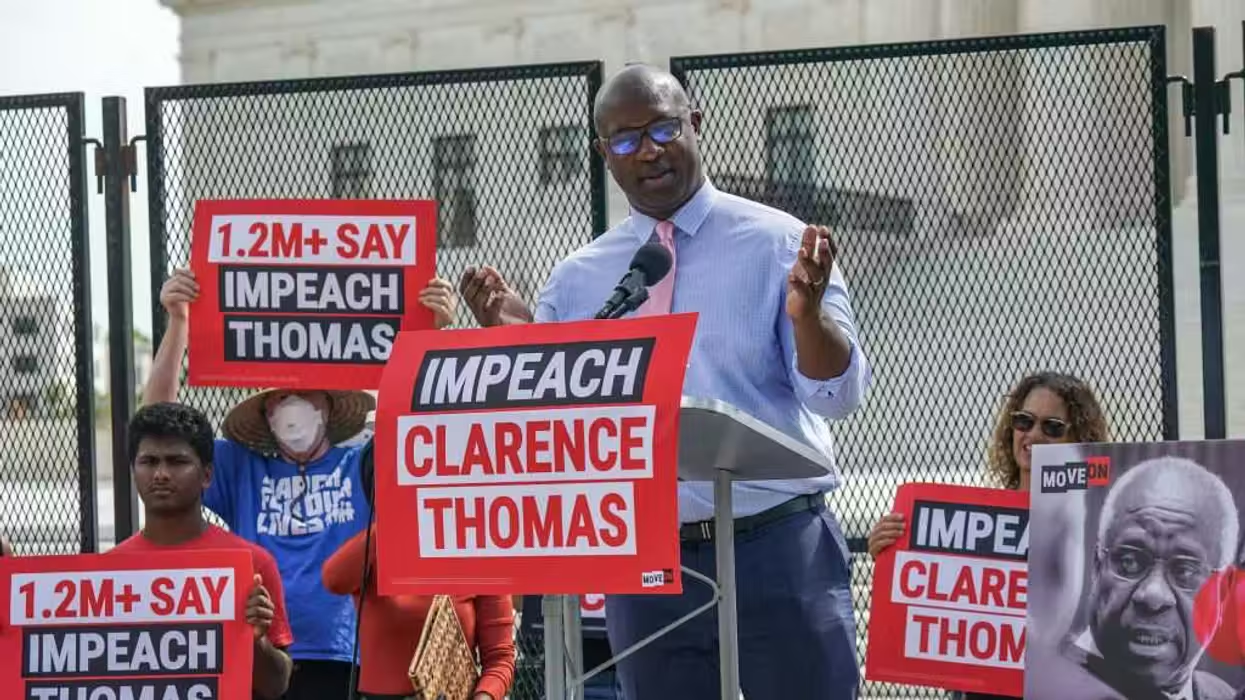
Supreme Court Justice Clarence Thomas, a black conservative who rose from poverty in the segregated South, embodies the self-made success story that identity politics struggles to accommodate. Rather than debate his skepticism of race-based policies, critics frequently resort to personal attacks and racial slurs. More recently, Charlamagne tha God called Justice Clarence Thomas a “coon” on “The Daily Show.”
U.S. Secretary of State Marco Rubio, who has been one of Trump’s most popular cabinet members, recently gave a passionate defense of the American dream. It’s a dream he has long believed in, but Rubio has long been labeled a traitor to his own culture primarily because of his policy positions on immigration and economics.
Kash Patel is an Indian-American FBI director. He has been a victim of personal attacks and racist death threats, yet little has been offered to criticize his results on crime and national security. Identity politics won’t allow it.
Even prominent black voices in sports and entertainment take risks when they deviate. Stephen A. Smith has faced fierce backlash for simply suggesting black voters consider voting Republican or for criticizing certain Democratic policies.
Economist Thomas Sowell, one of the most influential black thinkers of our time, has been repeatedly smeared with terrible racist attacks for documenting how culture, incentives, and policy explain disparities better than systemic racism narratives. Refusal to conform comes at a personal cost.
RELATED: Democrats love free speech — until conservatives get some
 Nathan Posner/Anadolu/Getty Images
A glaring example of this selective outrage appears among prominent Asian-American Democratic politicians. Senator Andy Kim (D-N.J.), the first Korean-American U.S. Senator, frequently highlights his identity as the son of Korean immigrants and advocates greater Asian-American representation in politics.
Yet when the Supreme Court ruled in Students for Fair Admissions v. Harvard (2023) that race-based admissions policies violated the Equal Protection Clause — policies that data showed penalized Asian applicants with higher academic standards — Kim expressed dismay and pivoted to criticizing legacy admissions rather than the clear anti-Asian discrimination.
In contrast, retired Navy Captain Hung Cao, a Vietnamese refugee and decorated veteran recently appointed acting secretary of the Navy, was immediately mocked by the Democratic Party’s official X account. (The post has since been deleted.)
These examples reveal identity politics’ discriminatory core: The left only celebrates minority success when it serves progressive grievance. When Asians or other minorities succeed through merit, service, and conservative principles, that success becomes a problem.
These Democrat lawmakers embrace group-based advocacy when it aligns with progressive causes — pushing for representation and condemning hate when politically convenient, and supporting affirmative action frameworks that benefit some minority groups. Yet when high-achieving Asians suffer from the very racial preferences identity politics demands, the commitment to fighting discrimination evaporates.
Identity politics demands loyalty to the liberal ideologies above consistent principle or the specific interest of their communities.
True equality comes from judging individuals by character and content, not enforcing racial political blocs.