© 2026 Blaze Media LLC. All rights reserved.
The story of an unfashionable drink, a vanished military world, and a man who never changed his order.
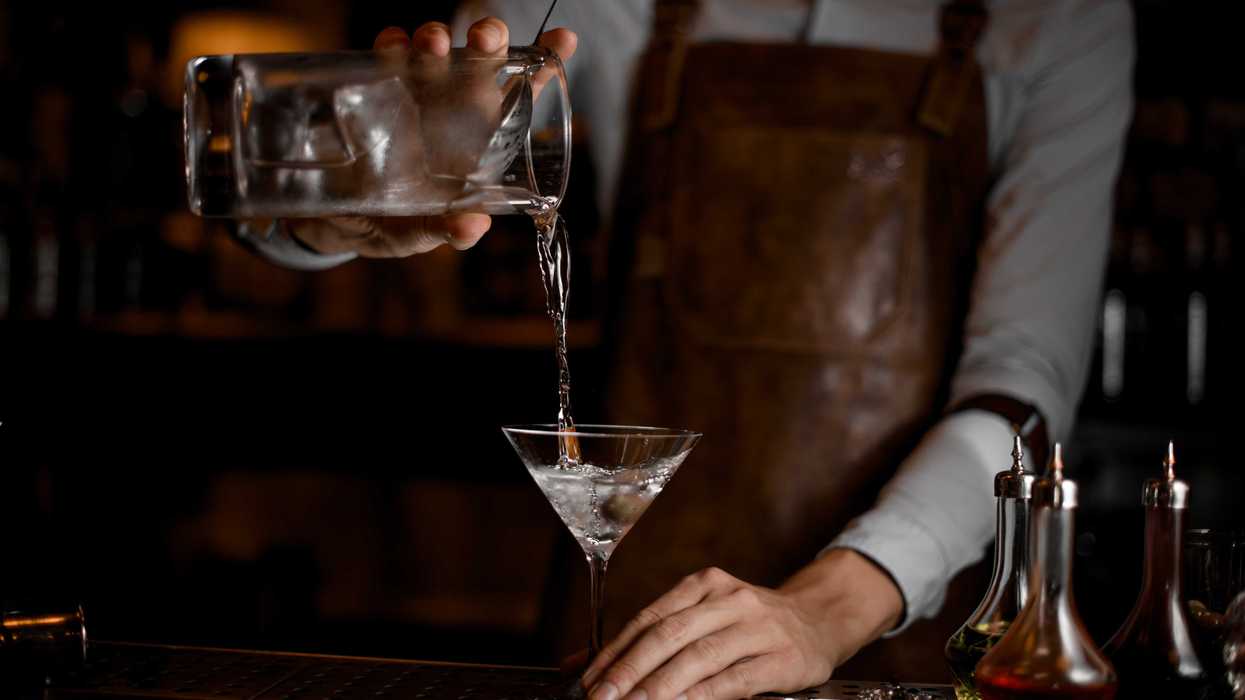
Everyone knows what a Martini is supposed to look like, even if nobody can agree anymore on exactly how it should taste: crystal clear, served in that familiar V-shaped glass, with an olive or a lemon twist. And cold. Very cold.
It is “the iconic cocktail,” according to The Oxford Companion to Spirits and Cocktails. H. L. Mencken called it “the only American invention as perfect as a sonnet.” Historian and critic Bernard DeVoto went further, calling the Martini “the supreme American gift to world culture.” Classicist Lowell Edmunds, who devoted an entire scholarly study to the drink, declared it “a permanent fixture of American life, of the American imagination, of America’s image in the rest of the world.”
People have strong feelings about Martinis.
My father’s Martini looked nothing, and tasted little, like the ideal.
He learned to drink it in the 1950s at Herzo Base, a former Luftwaffe airfield outside Herzogenaurach, West Germany. First constructed in the 1930s, the base was taken over by the Americans after World War II and became a major signals-intelligence listening post during the Cold War.
That is quite the burden for a few ice cubes to bear.
That’s why my father was there.
Dad never talked much about the actual work he did in the Army. Most of it sounded pretty boring, punctuated by occasional hijinks from Americans riding high in the postwar glow of the 1950s, when everything seemed possible and nuclear annihilation was always somewhere in the background. He and his pals would drink beer and go down to the dump to shoot rats with their M1 carbines. Occasionally, they would cut down trees with .50 caliber machine guns.
Only once did he discuss his job as second-in-command of his unit. “I transported the company payroll and the papers,” he told me—meaning by the “papers” classified material produced by the listening operation.
“If you wanted to rob me of the payroll, I would have gladly handed it over to you. But if you wanted to take the papers,” he said, with a steely glare, “I would have shot you right between the eyes.”
Dad was a drinker, but not a fussy sophisticate. He loved a Cutty Sark on the rocks—“Make me a short one”—or, when we went out to dinner, a Martini.
But his was a peculiar version.
I asked him once where it came from. By his telling, a two- or three-star general was making an important visit to the base, and the junior officers were keen to impress him. At the officers’ club on the evening of the general’s arrival, all eyes and ears were on his cocktail order.
What would it be? Scotch? Bourbon neat?
No.
“Martini, on the rocks, with one olive.” And from then on, Dad said, that became the unofficial cocktail of the officers at Herzo Base.
The funny thing is the general wasn’t being eccentric.
Turns out, Martini on the rocks was very much a ’50s thing. In 1953, syndicated columnist Bert Bacharach reported that the “most popular cocktail” seemed to be a Martini on the rocks. Big booze companies like Seagram’s advertised them. Bartending books printed recipes for them. By the late 1950s and early 1960s, a Martini over ice was ordinary enough that nobody needed to explain what he meant.
Not everyone approved.
In the preface to his classic study of the Martini, The Silver Bullet, Edmunds denounced the Martini on the rocks as “an abomination”—a word that turns up surprisingly often in cocktail literature—and ranked it among “fast foods, rock and roll, snowmobiles, acid rain, polyester fabrics, supermarket tomatoes, and books printed on toilet paper as a symptom of anomie.”
That is quite the burden for a few ice cubes to bear.
For Edmunds and other “Martini elitists”—to borrow a term from the late, great Werner Dannhauser—the drink allowed for certain rules. One of them was non-negotiable: A Martini was served straight up. Ice belonged in the shaker or mixing glass, not in the final drink.
Yet the rocks version of the Martini flourished, perhaps because it suited the postwar American moment. Serving it over ice made the Martini less ceremonial and more durable. No precarious stem. No race against the drink’s mortal enemy, warmth. Just gin, vermouth, ice, and garnish in a low glass, gradually diluting as a man worked his way through it.
Maybe the general liked that. Maybe he had picked it up from another general. Dad never said and probably never knew.
The Cold War ended. The United States entered a temporary period of retrenchment and downsizing. Herzo Base eventually closed, and the property returned to the newly reunified German government in 1992.
Times change. People change. Drinks change.
Dad, a creature of habit almost to the very end, did not change much at all.
By the time I was old enough to care about Martinis myself, ordering one on the rocks already sounded like something an old man did. Dad’s version had evolved only slightly from the general’s order.
His was a Beefeater Martini, extra dry—which, for all practical purposes, meant no vermouth at all—on the rocks, with an olive and an onion.
An onion?
Technically, the onion belongs in a Gibson. Dad apparently saw no reason to choose. Olive and onion both went in.
It isn’t my Martini.
I follow Bernard DeVoto’s somewhat stern guidance. “There is a point at which the marriage of gin and vermouth is consummated,” he wrote in The Hour seven decades ago. “It varies a little with the constituents, but for gin of 94.4 proof and a harmonious vermouth it may be generalized at about 3.7 to one.”
My gin is Boodles. I’ve stayed true to DeVoto’s formulation for 25 years.
Almost everything else DeVoto had to say about cocktails is arrant nonsense. Is the Manhattan “an offense against piety” and an “abomination”? Please.
As for men like Dad who put an onion in a Martini, DeVoto thought “strangulation seems best.” That seems a bit harsh.
I like my father’s version because it was his.
A product of mid-century postwar military conformity? Sure. A young officer saw a general order a drink and adopted it as his own. That is not exactly mysterious behavior.
But over time imitation became habit, and habit became identity. The rocks stayed. The Beefeater stayed. The olive stayed. Somewhere along the way, the onion joined them.
And nobody was quite like my father: a man of the Silent Generation, an engineer, the smartest man in the room, sometimes wrong but never in doubt.
My father died in 2017. So, once or twice a year, usually on my birthday in July or his on October 23, I set aside my long-held prejudices and pay homage to the man.
Beefeater Martini. Extra dry. On the rocks. Two olives and an onion.
Call it an abomination if you like. For a few moments, there he is.
Want to leave a tip?
We answer to you. Help keep our content free of advertisers and big tech censorship by leaving a tip today.
Editor, Opinion & Analysis
Ben Boychuk is the opinion and analysis editor for Blaze News.
NiceThingsBen

Ben Boychuk
Editor, Opinion & Analysis
Ben Boychuk is the opinion and analysis editor for Blaze News.
@NiceThingsBen →more stories


© 2026 Blaze Media LLC. All rights reserved.
Get the stories that matter most delivered directly to your inbox.
By signing up, you agree to our Privacy Policy and Terms of Use, and agree to receive content that may sometimes include advertisements. You may opt out at any time.