Mark Sullivan/ullstein bild/Getty Images
From Kirk Cameron’s impossible promise to William Lane Craig’s cosmology overreach, these losses offer a useful lesson in how not to defend the faith.
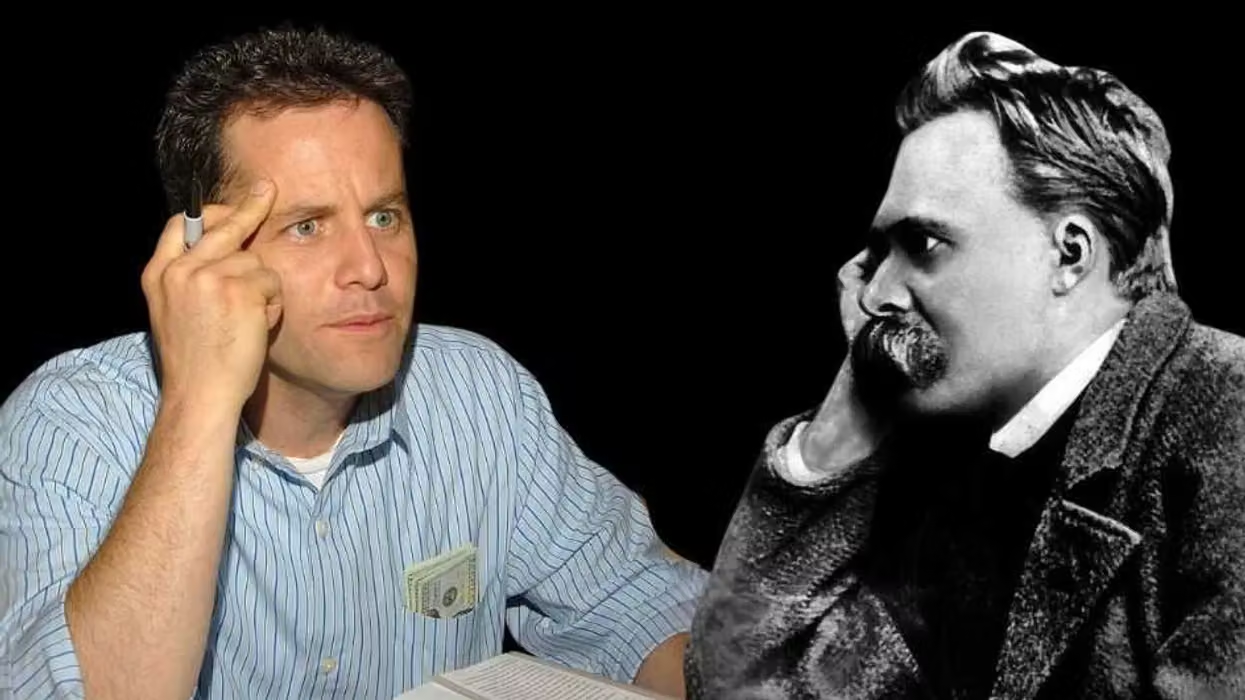
In May 2007, Kirk Cameron went on national television to do something 2,000 years of Christian theology had somehow failed to do: prove the existence of God "100%, absolutely, without the use of faith."
Cameron, long removed from "Growing Pains" and working as an evangelical apologist, was appearing with evangelist Ray Comfort on ABC's "Nightline." Facing them were Brian Sapient and a woman identified as Kelly from the Rational Response Squad, an atheist group best known for encouraging people to post videos denying the Holy Spirit.
An easier opponent might accept the task of defending moral relativism. Kagan didn't; he simply denied that atheism required him to do any such thing.
"Proving the existence of God is actually a lot easier than you think," Cameron announced, with the confidence of someone about to produce the Holy Grail from his carry-on luggage.
Christians have been arguing with unbelievers since Paul encountered the Epicureans and Stoics in Athens. And ever since Paul's preaching made a guy doze off and fall three stories from a window, the results have been mixed.
That doesn't make atheism true. It doesn't even necessarily mean the atheist had the better argument. A Christian can be defending something true and still lose badly — by promising too much, preparing for the wrong opponent, losing his temper, putting words in the other man's mouth, or asking evidence to prove more than it can.
Here are five examples worth studying.
At least nobody could accuse Kirk Cameron and Ray Comfort of hiding their lamps under a bushel — even if they could have used a little more oil.
After seeing an ABC report on the Rational Response Squad, Comfort contacted "Nightline" and proposed a public debate. "We cannot only prove that God exists," he wrote, "but we can prove that the atheist doesn't."
By the time Cameron delivered his opening statement, the undertaking had become even more ambitious. "We'd like to show you that the existence of God can be proven, 100%, absolutely, without the use of faith."
Cameron then promised to expose evolution as a "fairy tale for grownups."
Even if Cameron and Comfort had somehow demolished Darwinian evolution that night, God would not automatically follow. And even a successful argument for a creator still leaves some distance between "something caused the universe" and "Jesus Christ rose from the dead."
Comfort proceeded with arguments familiar to anyone who has encountered his evangelistic ministry: A painting implies a painter; a building implies a builder; creation implies a Creator.
Those arguments can be debated. What Comfort could not plausibly do in 90 minutes was deliver what Cameron had promised: absolute scientific proof of God without faith. Unless adding "100%, absolutely" to your assertions counts as science.
Christian reaction afterward was not uniformly charitable. Contemporary Christian reporting quoted believers who thought Cameron and Comfort had arrived badly underprepared. Pastor Marty Duren's verdict was especially concise: The duo had gotten "completely shellacked."
At least they didn't bring a banana.
By the time Dinesh D'Souza faced New Testament scholar Bart Ehrman at the University of North Carolina in 2009, he had developed a solid playbook for sparring with "New Atheists" like Christopher Hitchens.
And that was the problem. Ehrman wasn't Hitchens or Richard Dawkins. He wasn't even, strictly speaking, an atheist. He was an agnostic who had once been an evangelical Christian and gradually lost his faith. The problem of suffering played an especially important role in that journey.
Jason Staples, a Christian biblical scholar who attended the debate, described what followed as a "beatdown."
D'Souza, Staples wrote immediately afterward, seemed to be working from material meant for "an atheist such as Hitchens" and appeared "entirely unfamiliar with the perspective Ehrman would present." "After an adequate opening," Staples said, D'Souza struggled badly during the questions, while Ehrman remained comfortably within the case he had come to make.
The mismatch produced awkward moments. D'Souza attacked atheistic explanations of morality and treated Ehrman as though he were asserting that God did not exist.
"You keep referring to atheists, which I would consider myself to be an agnostic," Ehrman reminded him, as D'Souza's canned responses failed to engage with Ehrman's case about the sheer amount of apparently pointless suffering in the world.
William Lane Craig is no Kirk Cameron. The philosopher and Christian apologist has spent decades debating prominent atheists and is widely regarded — including by many opponents — as exceptionally good at it.
Which makes his 2009 encounter with Yale philosopher Shelly Kagan all the more interesting.
The subject was whether God is necessary for morality. Craig's argument begins with a proposition many Christians find intuitively powerful: If God does not exist, what makes moral values and duties objectively true? Why is torturing a child actually wrong rather than merely something human beings strongly dislike?
An easier opponent might accept the task of defending moral relativism. Kagan didn't; he simply denied that atheism required him to do any such thing. Maybe objective morality existed and could be understood in terms of principles perfectly rational agents would agree upon, Kagan suggested. Whatever the ultimate account, he wasn't willing to concede that removing God from the equation removed objective morality with him.
Craig could no longer spend much time showing that relativism produced unacceptable consequences.
Kagan also pressed Craig on another argument: that without God, our actions ultimately come to nothing. Humanity disappears; the universe dies; none of it lasts. Kagan's rebuttal was wonderfully ordinary. His relationship with his wife doesn't become meaningless because both of them will someday be dead. A thing needn't last forever to matter.
Even Catholic apologist Trent Horn has singled Kagan out as an unusually formidable opponent, praising how thoroughly he had prepared and how effectively he was able to pin Craig down.
Craig later qualified his loss by explaining that Veritas Forum organizers had specifically asked for a friendly dialogue rather than a "knock-down debate," and he continued to reject Kagan's proposed foundations for morality.
Fair enough. But he still let Kagan expose a flaw common to many practiced debaters: becoming so good at defeating familiar positions that you stop noticing when the person across the table doesn't hold them.
Christian apologist Jonathan McLatchie debated prominent atheist Matt Dillahunty in 2020 over the evidence for the resurrection of Jesus. Unfortunately, he couldn't quite summon the Christ-like patience necessary to resist Dillahunty's Philistine-level baiting.
Dillahunty is an aggressive interlocutor who interrupts, challenges premises, and is not especially concerned with making his opponent comfortable. McLatchie became increasingly frustrated as Dillahunty rejected evidence McLatchie thought deserved serious consideration.
Finally, McLatchie had enough. "If you're just going to keep dismissing the evidence, then we're done," he said. Then he disappeared from the call.
Dillahunty looked momentarily surprised. "Oh, did he just leave?"
McLatchie eventually returned and apologized, explaining that he had become frustrated by Dillahunty's interruptions. Catholic apologist Trent Horn later replayed the incident as an object lesson for Christians considering public debate: With very few exceptions, quitting because you're angry makes you look bad.
What's interesting is that McLatchie didn't necessarily need rescuing on the substance. Christian writer James Bishop, reviewing the exchange from McLatchie's side, thought Dillahunty had behaved badly and believed McLatchie had the stronger arguments.
Once McLatchie walked out, none of that mattered very much.
Craig's 2014 debate with Sean Carroll was a much more formidable affair.
The subject was "The Existence of God in Light of Contemporary Cosmology." Carroll wasn't a professional atheist who happened to have read some popular physics. He was a theoretical physicist and cosmologist at Caltech.
Craig knew this, of course. And unlike Cameron and Comfort, he was hardly wandering into unfamiliar intellectual territory. Craig had long appealed to evidence from modern physics in defense of the Kalam cosmological argument: Whatever begins to exist has a cause; the universe began to exist; therefore, the universe has a cause.
Among the evidence Craig invoked was the Borde-Guth-Vilenkin theorem, which concerns the past incompleteness of certain expanding space-time models.
Carroll objected that Craig was making it carry too much weight. Where Craig treated BGV as important evidence that the universe had a beginning, Carroll emphasized that the theorem operates under particular assumptions and describes the limits of certain classical space-time models. It does not by itself establish that all physical reality came into existence at a first moment.
You don't have to take Carroll's word for it. Physicist Aron Wall later examined the debate in detail. Wall is a Christian, and Craig had invoked Wall's own work during the exchange. On BGV, however, Wall agreed with Carroll's crucial point.
The theorem's assumptions need not hold in every cosmological model, he wrote. There are models that contract and then expand. His conclusion was unusually clear: BGV "is not by itself particularly strong evidence for a beginning."
Craig didn't lose because Christians have no business discussing cosmology. The problem was simpler. A theorem can be correct and still establish less than the person citing it wants.
Christians believe truth is not merely useful but sacred. We therefore have less excuse than anyone for stretching an argument until it points in a direction we happen to like.
The atheist who catches us doing this hasn't disproved God — but he has done us a favor.