Paramount Pictures | JB Lacroix/Getty Images
David Ayer opens up about grief, spiritual endurance, and why Hollywood may be ready for a return to traditional storytelling.
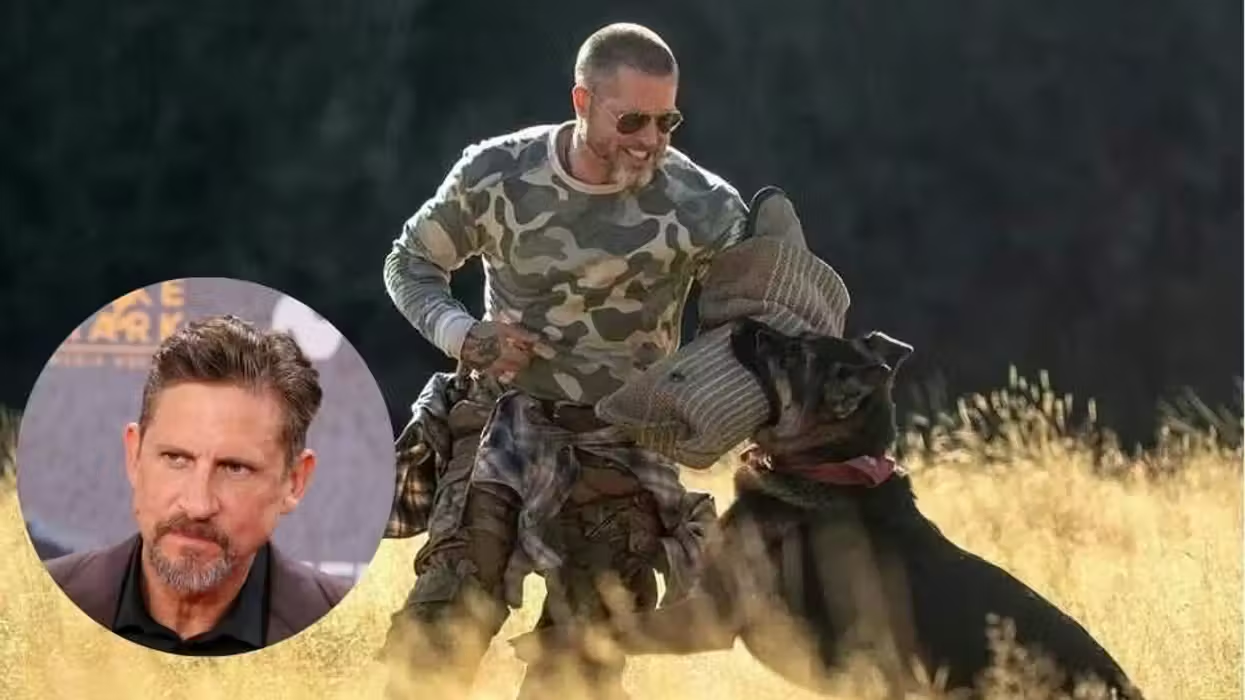
David Ayer took a Zen-like approach to his canine lead actor.
The veteran director behind “Fury,” “End of Watch,” and “The Beekeeper” worked extensively with Uber, a German Shepherd at the heart of his new film.
'I feel like traditional storytelling is going to have its place more than ever now, in values and ways of living that bring hope. I think audiences really respond to that.'
Uber plays a wounded combat dog named Odin fighting for survival alongside fellow veteran Brad Pitt in “Heart of the Beast,” which hits theaters today. And making sure Uber hit his marks took the patience of Job.
“The dog’s wonderful and capable and trained and really in his own way a character actor ... but not necessarily the most cooperative,” Ayer tells Blaze News. “You learn to accept the dog as a dog is ... it’s a real lesson in patience and also acceptance and surrender to the situation.”
Pitt’s character, seeking solace after years in combat, crashes his small plane in the Alaskan forests. That leaves him and his faithful companion struggling to survive in inhospitable terrain.
“I’ve always been inspired by Jack London and tales of wilderness and survival,” he says of his initial reaction to the script. “This had something deeper, the connection with the dog ... these parental relationships. This idea is that no matter what, I’m going to protect you and keep you safe."
The story struck something within Ayer.
“I lost my father at a young age. Something in the script brought up that grief, allowed me to look at it in a different way. ... It really broke my heart open in a way it hadn’t been before,” he says.
“Heart of the Beast” isn’t a faith-based movie, but the director sees the story in deeply spiritual terms.
“These things we carry in our hearts, the damage that life and the world that it is can do to us ... it’s important to have hope, important to have faith, something outside of yourself. If you sit in your pain, it can overwhelm us,” he says, adding the film is a “simple portrait of spiritual endurance.”
To get there, Pitt met with military veterans to prepare to play his character, a soldier adjusting to civilian life on his own terms.
“He sat there with a notebook, hearing their stories ... what they felt and what they carried, the successes and the loss and the wisdom, the life wisdom they gained from these experiences,” Ayer says. His star, who he previously collaborated with on “Fury,” didn’t put on any A-list airs.
“There’s movie stars who are movie stars. Brad’s an actor first ... he was throwing himself down on the ground again and again [for select scenes] ... shivering on set, refusing to warm up so he could stay in it. He became a leader for us,” the director recalls.
Ayer’s work reflects a complicated bond with law enforcement (“Dark Blue,” “End of Watch”), but it’s also impressively diverse. Think vigilante romps (“The Beekeeper,” “A Working Man”), Superhero fare (“Suicide Squad”), and sci-fi adventures (“Bright”).
He sees his film choices as an evolution, showing people who are “broken in the world and how we fix that in ourselves.”
“In order to heal, we have to move heart first,” he says. “One of the most important things to have in our hearts is faith, that becomes the mechanism through which we can really endure everything.”
Ayer is one of Hollywood’s busiest directors, and he suspects he’ll soon have company in the filmmaking space.
“As technology evolves, it’s going to give more people access to tell more stories,” he says, a change that could bring mid-level movies back in vogue. The industry currently binges on big-budget IP films and micro-indies, but he envisions a return to the “amazing middle ground” of movies like “Pretty Woman” and “Jerry Maguire” that once captivated audiences.
That, in turn, could spark another positive trend.
“You look at the success of Hollywood, and for 100 years, we were really a great cultural ambassador to the world and showing an aspirational lifestyle, an aspirational way of being in the world,” he says. “If you look at the current slates ... not everything has been in that more traditional vein. I feel like traditional storytelling is going to have its place more than ever now, in values and ways of living that bring hope. I think audiences really respond to that.”

Christian Toto