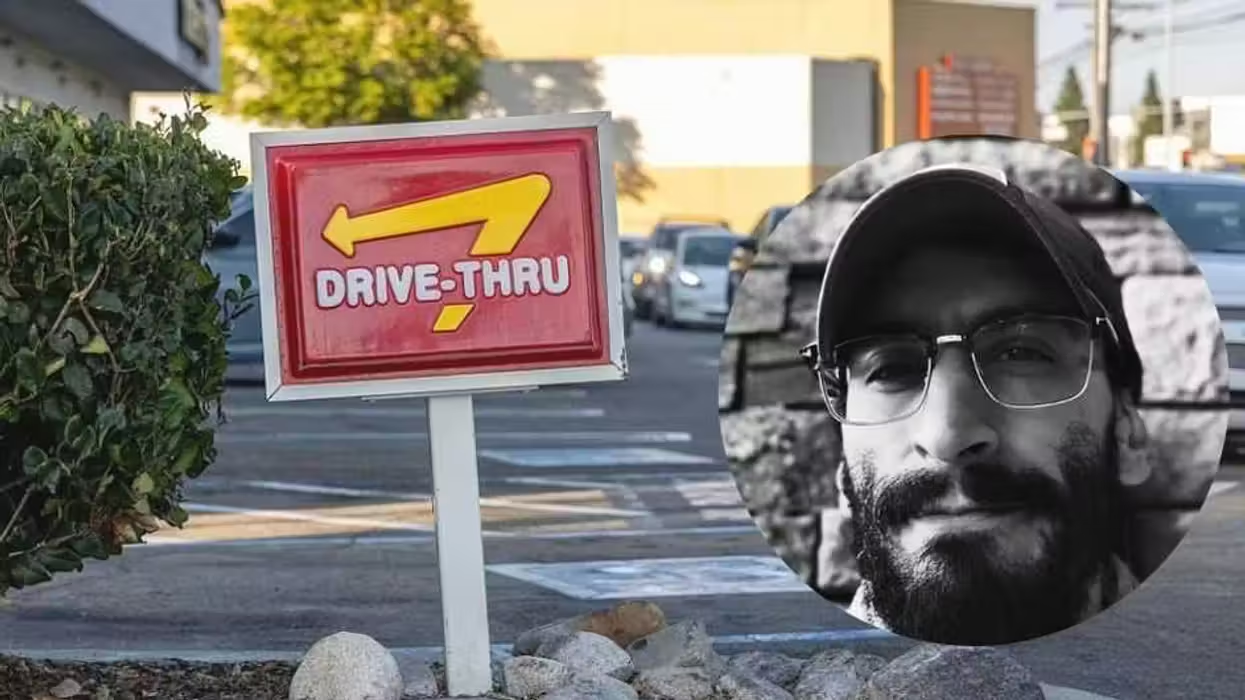
Jason Armond/Getty Images; Facebook/JordanSalinas
Jordan Salinas had already seen one mass shooting.
In October 2021, he was at the Boise Towne Square mall when a gunman opened fire, killing two people and wounding several others. Salinas remembers thinking about his brother, who uses a wheelchair, and what would happen if the two of them ever found themselves trapped in such a situation.
Fire extinguishers can be used incorrectly too. That's not an argument for limiting their use to professional firefighters.
So he did something about it. He began training.
Last Saturday afternoon, almost five years later, Salinas and his girlfriend pulled into the parking lot of the newly opened In-N-Out Burger in Twin Falls, Idaho. People were streaming out of the restaurant. At first, Salinas figured there had been some kind of kitchen fire.
Then he heard gunshots.
What happened next is worth lingering over, if only because we've been told so many times that it doesn't really happen.
Salinas drew the semiautomatic pistol he was carrying and moved toward the shooting.
The gunman, identified by police as 24-year-old Chad Williams, had already killed three people and wounded seven. Salinas fired at him. So did an off-duty Idaho state trooper who happened to be nearby.
Neither man delivered the movie-ending kill shot. Williams eventually died from a self-inflicted gunshot wound.
But Twin Falls Police Chief Matthew Hicks says their intervention mattered. "We believe their actions drove the suspect from the scene, preventing further casualties," he said.
In other words, not one, but two good guys with a gun showed up. And things could have been a lot worse if they hadn't.
If the phrase "good guy with a gun" sounds corny, blame former NRA chief Wayne LaPierre, who turned it into a slogan after the 2012 Sandy Hook massacre.
"The only thing that stops a bad guy with a gun is a good guy with a gun," LaPierre famously said.
Ever since, journalists and gun-control advocates have devoted considerable energy to informing us that this seemingly self-evident proposition is, in fact, a "fantasy."
Salon was still at it in 2024, publishing a story headlined "'Manipulation of fear': New analysis blows hole in 'good guy with a gun' myth."
The article, originally published by Common Dreams, described armed self-defense as an "enduring myth" propagated by "right-wing politicians and the powerful gun lobby." The Center for American Progress report on which it was based went further, calling the good-guy-with-a-gun idea one of the gun lobby's "most personal and insidious" myths.
"The Bulwark" wasn't troubled by ambiguity either. In a 2024 podcast episode titled "Debunking the 'Good Guy with a Gun' Myth," it brought on gun-control activist Fred Guttenberg, whose 14-year-old daughter, Jaime, was murdered in the 2018 Parkland school shooting.
There's a grim irony here. Guttenberg is now among the Parkland family members suing the Broward Sheriff's Office over what they say was its negligent response to the massacre. Eight years later, the case is finally headed toward trial.
In other words, one of the men enlisted to debunk the usefulness of an armed "good guy" lost his daughter in a massacre in part because the armed good guys who were supposed to protect her failed to act.
On the rare occasion that the "myth" debunkers provide a real-world example, it doesn't always make the case they think it does.
Consider the Trace. The nonprofit newsroom devoted to gun violence returned to the familiar theme last December with a story headlined "There Was No 'Good Guy With a Gun' in Salt Lake City."
This time, at least, there was a good reason for the skepticism. An armed member of a volunteer safety team at a Salt Lake City No Kings protest opened fire on a man carrying a rifle and accidentally shot and killed an innocent demonstrator.
A tragic mistake? Absolutely. Evidence that an armed bystander can make a chaotic situation even worse? Certainly. That's one reason carrying a firearm entails considerably more responsibility than carrying a reusable shopping bag.
Evidence that the "good guy with a gun" is a myth? That's harder to see.
Especially considering how gun control advocates treat cases in which a bystander with a gun acted safely and responsibly.
I've written about this curious phenomenon before.
In July 2022, 20-year-old Jonathan Sapirman entered the Greenwood Park Mall outside Indianapolis carrying a rifle, a pistol, and more than 100 rounds of ammunition. He killed three people in just 15 seconds.
Then 22-year-old Elisjsha Dicken shot him.
Dicken was shopping with his girlfriend. He had no military or law-enforcement background. He was legally carrying a Glock pistol and, from roughly 40 yards away, hit Sapirman repeatedly, then moved closer while directing fleeing shoppers toward an exit.
Greenwood Police Chief James Ison called Dicken's actions "nothing short of heroic."
CNN agreed — sort of.
"Making Dicken's heroism perhaps even more remarkable," the network explained, "is the fact cases of an armed bystander attacking an active shooter are rare."
Thanks, CNN.
And so the usual cycle plays out: Armed civilian stops a shooter; media reports it, when the story is too conspicuous to ignore; then somebody rushes in to remind readers that what they just watched happen never happens.
RELATED: Aim true: Anna Thomasson sets her sights on empowering women through firearms training
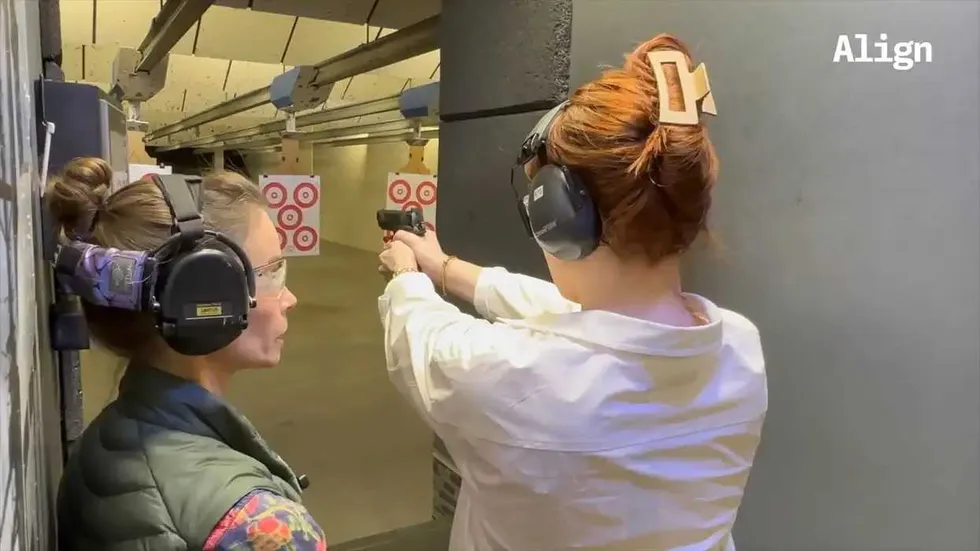 Matt Himes
But are people like Elisjsha Dicken really that rare?
Last August, two gunmen opened fire on a house party in Harvey, Illinois, hitting five people, including a 4-year-old child. A concealed-carry license holder returned fire, killing one alleged shooter and wounding the other, who was taken into custody.
Last year in Rapid City, South Dakota, police say a man attempting to steal merchandise from a convenience store pulled a knife when confronted by an employee. A customer drew a pistol and held him there until police arrived.
In the latter case, nobody got shot or stabbed. Funny how these stories sometimes end before there's much of a story to report.
In Chicago in October 2024, a 23-year-old man driving by saw another man fighting with a woman and stopped to help. Police say the other man pulled a gun. The bystander — a licensed concealed carrier — pulled his own and shot him.
That same month, also in Chicago, a group of men allegedly attempted to carjack a 47-year-old driver, spraying him with some kind of chemical agent. The driver, another concealed-carry license holder, opened fire, hitting one of the alleged attackers. He survived.
You can argue about any one of these cases. You can argue about gun laws, concealed carry, training requirements, crime rates, suicide, accidents, domestic shootings, or any of the other considerations that make gun policy more complicated than an NRA bumper sticker.
What you can't plausibly argue is that armed citizens never use guns successfully to defend themselves or other people.
Yet somehow we've moved from "How often does this happen?" to "It never happens."
According to the FBI's active shooter reports, armed citizens stopped just 14 of 350 active shooters between 2014 and 2023 — a measly 4%.
If that number sounds familiar, it should. It's the kind of statistic regularly trotted out to debunk the "good guy with a gun."
Economist John Lott's Crime Prevention Research Center says there's a big problem with that calculation: The FBI is missing a lot of active shooter incidents.
Applying what it says is the FBI's own definition of an active shooter, CPRC found 515 incidents over the same period — 165 additional shootings that never made it into the FBI dataset in the first place.
That's important because many of the missing incidents ended with an armed citizen stopping the shooter. If those shootings aren't classified as active shooter incidents, the good guys who stopped them don't get counted either.
CPRC also identified five cases the FBI did count but, it argues, mischaracterized the armed civilian's role. In two, armed civilians caused shooters to flee but weren't credited with stopping them because police later made the arrests. In two others, armed civilians were classified as security personnel.
Put it all together, and the difference is enormous: The FBI's reports credit armed citizens with stopping 14 of 350 active shooters, or 4%. CPRC says the actual number is 180 of 515, or 35%.
Sometimes the guy with the gun isn't a good guy. Sometimes he's frightened, reckless, drunk, or stupid. Sometimes he mistakes the victim for the attacker. Sometimes the presence of another gun makes a chaotic situation even worse.
Fire extinguishers can be used incorrectly too. That's not an argument for limiting their use to professional firefighters.
And here's the strange thing about this whole debate: The "good guy with a gun" isn't even the principal argument for the right to own a gun.
The Second Amendment doesn't guarantee Americans the right to keep and bear arms on the condition that a sufficient number of them eventually stop mass shootings. Nor does anyone need to prove that armed civilians routinely save the day in order to justify owning a firearm for self-defense.
The occasional good guy who happens to be in the right place when a bad guy starts shooting is simply one of the benefits of living in a country where ordinary citizens can be armed.
Jordan Salinas acted heroically. If there's a general "lesson" to be derived from his actions, it's one that is modest and hard to dispute: When a murderous man starts shooting innocent people, having another responsible, trained, and courageous person nearby who can shoot back can make a difference.
That appears to be precisely what happened in Twin Falls. How often does it have to happen before we can stop pretending it doesn't?