Erin Schaff-Pool/Getty Images
The U.S. Supreme Court delivered a big defeat on Monday to conservatives seeking to prevent Election Day from becoming little more than an "abstraction."
The high court ruled 5-4 that the "federal election-day statutes do not prevent Mississippi from counting absentee ballots postmarked by Election Day but received up to five days thereafter," adding that "nothing in the federal election-day statutes requires ballots received by election day."
'Today’s decision compounds these vulnerabilities.'
The case in question, Watson v. Republican National Committee, was the result of a years-long battle over a COVID-era Mississippi law passed by the Magnolia State's Republican trifecta that permits the counting of mail-in absentee ballots postmarked by the date of the election but received up to five business days after Election Day.
Republicans were wary, in part, because mail-in voting is starkly polarized by party and "the late-arriving mail-in ballots that are counted for five additional days disproportionately break for Democrats."
While it has narrowed since 2020, the partisan divide in mail-in voting remained substantial in the 2024 election — which helps explain why so many Democrat-aligned groups have defended the practice and the Mississippi law.
In 2024, the RNC, the Mississippi GOP, and several individuals sued Mississippi's secretary of state and other state election officials, arguing that federal law bars Mississippi from counting absentee ballots received after Election Day.
 Chip Somodevilla/Getty Images
In October 2024, the Fifth Circuit Court of Appeals ruled in the plaintiffs' favor. Last year, however, the state asked SCOTUS to get involved and reinstate its post-Election Day grace period.
Mississippi maintained that late counts are acceptable as "federal election-day statutes require only that the voters cast their ballots by election day" — that "an election requires ballot casting — not ballot receipt."
Justice Amy Coney Barrett, who delivered the majority opinion, wrote that "this is not a case about the Constitution. We do not consider the scope of Congress' authority to regulate federal elections. The sole question before us is whether counting ballots postmarked by election day, but received up to five days later, violates the federal election-day statutes."
Barrett answered that the existing statutes "do not preempt Mississippi's law."
"As we have said before, the federal election-day statutes 'simply regulate the time of the election,'" wrote Barrett.
While the relevant federal statutes determine when the electorate must make its choice, Barrett noted that "choice is made when voting is complete, not when ballots are received."
"The framers recognized the difficulty of crafting election laws 'applicable to every probable change in the situation of the country,'" Barrett wrote in her conclusion, citing the Federalist No. 59. "So instead of constitutionalizing election law, they decided that 'a discretionary power over elections' needed to be lodged 'somewhere.' ... Suffice it to say, that power was not lodged in this court. The election-day statutes say nothing about ballot receipt, and we cannot add to the words Congress chose."
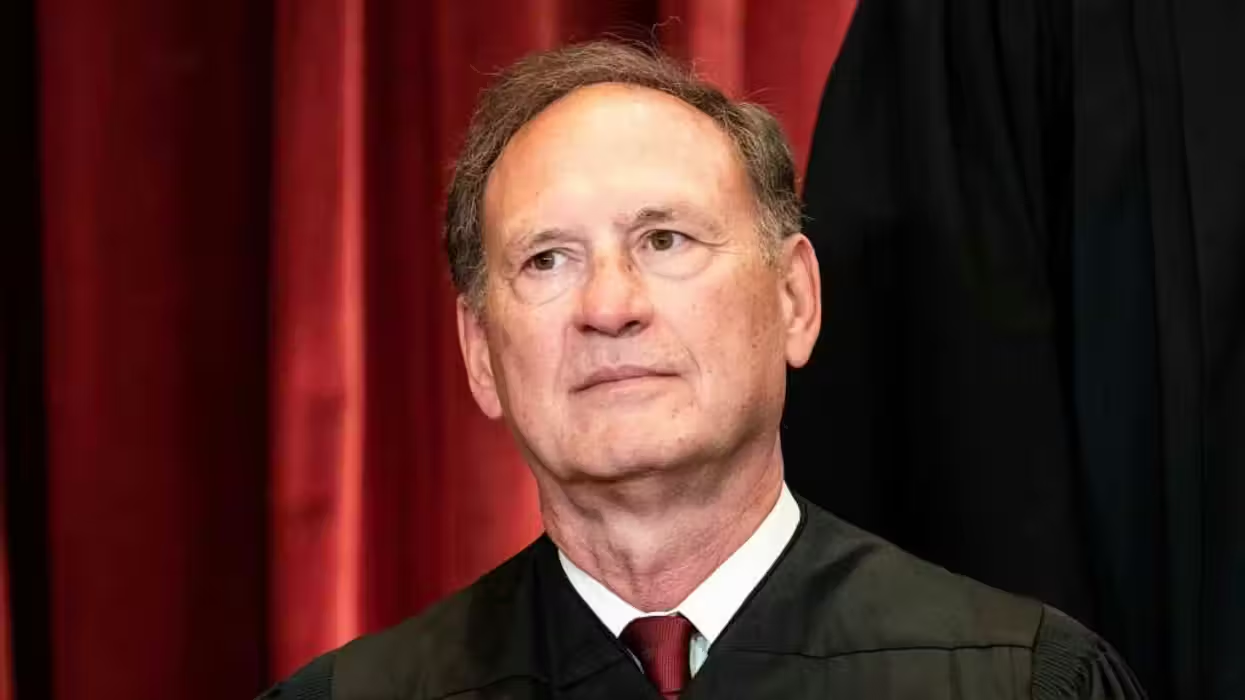
Justice Samuel Alito — who dissented along with Justices Clarence Thomas, Neil Gorsuch, and Brett Kavanaugh — torched his liberal and nominally conservative colleagues' arguments in a lengthy takedown, emphasizing at the outset that "if ballots received after election day are added to the set of ballots that dictate the election’s outcome, the electorate’s choice does not occur on election day, and the federal election-day statutes are violated."
"The acceptance of these late-arriving ballots effectively postpones the date on which the electorate's choice is made, and federal law precludes that postponement," added Alito.
He further emphasized that for most of America's history, the expectation was that votes were received and American elections were decided on Election Day.
"Two centuries of historical practice reinforce the proposition that holding an 'election' on a particular day means that poll workers had to receive the ballots by that date," wrote the conservative justice. "From this country’s founding until the late 20th century, election-day ballot collection was the near-uniform practice, with only a few, late-arriving exceptions."
Alito noted this was the case "even when the Civil War took soldiers hundreds of miles from their usual polling places."
In his scathing critique of the majority's opinion, Alito also accused his colleagues of attempting "to fend off two centuries of American election practice" and noted that "when Congress enacted the three election-day statutes, having the 'election' on a particular date meant that ballots would be collected by that date."
Alito stressed that the ruling not only "threatens to produce lamentable consequences" and a "slurry of troubling election-law questions," but "leaves open opportunities for voter fraud that may further undermine Americans’ faith in the integrity of this country’s elections."
"When someone votes by mail, it is harder for officials to verify the identity of the person requesting and completing the ballot. Mail voting also presents a greater opportunity for voter manipulation, a more vulnerable chain of ballot custody, and a diminished ability to detect improprieties in real time," wrote Alito. "Today’s decision compounds these vulnerabilities. Allowing absentee ballots to pour in over the days and weeks after election day, by which point preliminary election returns are being publicly reported, creates greater opportunity for fraud and risks further undermining the public’s confidence in election integrity."
Like Blaze News? Bypass the censors, sign up for our newsletters, and get stories like this direct to your inbox. Sign up here!